Python regiusBall Python, Royal Python

Geographic Range
Ball pythons (Python regius), also known as royal pythons, are found in the grasslands and open forests of West and Central Africa. They are native to the Sudanese subprovince west of the Nile, in southern Sudan, the Bahrel Ghazal and Nuba Mountains Region, from Senegal to Sierra Leone in West Africa, and in the Ivory Coast and some parts of Central Africa. (De Vosjoli, et al., 1995; Sillman, et al., 1999)
Habitat
Ball pythons spend most of their time on or under the ground in burrows. They are most active at dawn and dusk. They inhabit savanna grasslands or open forests and are found in areas that have been cleared for farming. (De Vosjoli, et al., 1995)
- Habitat Regions
- tropical
- terrestrial
- Terrestrial Biomes
- savanna or grassland
Physical Description
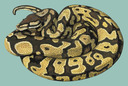
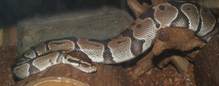
At birth, ball pythons range from 25 to 43 centimeters in length and grow to 1 to 1.5 meters as adults. There are some reports of ball pythons found in the wild at 1.83 meters in length. Their heads are larger than their relatively slender necks and they are considered heavy-bodied. The typical ball python has large brown markings with lighter medium-brown spots interspersed between the darker spots. They may also have yellow stripes from the nostrils through the eyes. The belly is generally ivory white. Adult female ball pythons are larger than adult males. This sexual dimorphism is not present in neonates, but is apparent in adults. Adult females also have longer jaws than their male counterparts. The resultant increase in swallowing capacity may improve their hunting ability. (Aubret, et al., 2005; Barker and Barker, 2006; De Vosjoli, et al., 1995)
- Other Physical Features
- heterothermic
- polymorphic
- Sexual Dimorphism
- female larger
-
- Range length
- 1 to 1.83 m
- 3.28 to 6.00 ft
Development
Ball python hatchlings range from 25 to 43 centimeters; adults from 0.9 to 1.5 meters. The gestation period is about 44 to 54 days. Most ball pythons lay their eggs during the second half of the dry season, from mid-February to the beginning of April. Eggs are then hatched from mid-April to mid June. Approximately 3 weeks after ovulation, a female ball python begins to shed its skin. Eggs are laid about 4 weeks later. (De Vosjoli, et al., 1995)
Reproduction
After laying their clutch of eggs, female ball pythons coil around their clutches until hatched (after approximately 2 months). Hatchlings are immediately independent, but remain in the vicinity for months after. (Aubret, et al., 2002)
- Mating System
- polygynandrous (promiscuous)
Ball pythons have long reproductive lives that last from about 27 months to 30 years. The breeding season is primarily from mid-September through mid-November, correlating with the minor rainy season. A clutch is from 1 to 11 eggs. The eggs typically adhere to each other. A few days before hatching they lose their adhesion. After the eggs are no longer attached and are ready to hatch, baby ball pythons slit the shells with their egg tooth and work their way out. Weight at birth is 65 to 103 grams, with an average of 86 grams. Female ball pythons reach reproductive maturity from 27 to 31 months. Males reach reproductive maturity at 16 to 18 months. Both male and female ball pythons have large cloacal spurs.
Humans can determine python sex by placing a probe through the cloacal spur and into the inverted hemipenis. The probe will travel deeper into the base of the tail for male ball pythons, spanning 8 to 10 subcaudal scales in contrast to females in which the probe may be only inserted a distance of 2 to 4 subcaudal scales. (De Vosjoli, et al., 1995)
- Key Reproductive Features
- iteroparous
- seasonal breeding
- sexual
- oviparous
-
- Breeding interval
- Breeding occurs yearly.
-
- Breeding season
- Breeding is from mid-September through mid-November, correlating with the minor rainy season.
-
- Range number of offspring
- 1 to 11
-
- Average number of offspring
- 7
- AnAge
-
- Range gestation period
- 44 to 54 days
-
- Average time to independence
- 1 minutes
-
- Range age at sexual or reproductive maturity (female)
- 27 to 31 months
-
- Range age at sexual or reproductive maturity (male)
- 16 to 18 months
Once female ball pythons lay their eggs, they consistently ball around the eggs for protection. Ball pythons also stay in close proximity to eggs to protect them from predators. (Ellis and Chappell, 1986)
- Parental Investment
- female parental care
-
pre-fertilization
- provisioning
-
protecting
- female
-
pre-hatching/birth
-
protecting
- female
-
protecting
Lifespan/Longevity
The average lifespan of ball pythons in captivity is 20 years. Reports document the maximum lifespan in captivity ranges from 28 years (at the Oakland Zoo) up to 50 years (reported by the Philadelphia Zoo). Average life span in the wild is reported to be 10 years. (Gorzula, et al., 1997; Bartlett and Bartlett, 2000; Bartlett, et al., 2001; Gorzula, et al., 1997)
-
- Range lifespan
Status: captivity - 48 (high) years
- Range lifespan
-
- Average lifespan
Status: captivity - 20 years
- Average lifespan
-
- Average lifespan
Status: wild - 10 years
- Average lifespan
-
- Average lifespan
Status: captivity - 20 years
- Average lifespan
-
- Average lifespan
Sex: male
Status: captivity - 30.5 years
- Max Planck Institute for Demographic Research
- Average lifespan
-
- Average lifespan
Status: captivity - 8.7 years
- Max Planck Institute for Demographic Research
- Average lifespan
Behavior
Ball pythons move by way of rectilinear locomotion, whereby bilateral symmetrical contractions propel them forward as they push against the surface. Ball pythons are known for the protective mechanism of “balling,” where they form a tight ball with the head at the center in response to threats, earning them their common name, "ball python." (Bustard, 1969; De Vosjoli, et al., 1995; Greene, 1997; McDonald, 1996; Sillman, et al., 1999)
Communication and Perception
Vision plays an important role in a ball python’s ability to secure prey. Research on the way these snakes behaved under bright light determined that ultraviolet activity may be a factor in capturing prey. Other research suggests that ball pythons may follow the scent trails of their mammalian prey because those trails reflect ultraviolet light. (McDonald, 1996; Sillman, et al., 1999)
- Perception Channels
- visual
- infrared/heat
- tactile
- vibrations
- chemical
Food Habits
Ball pythons are carnivorous and have mobile lower and upper jaws. They use chemical and visual cues to hunt for their prey. Ball pythons sit and wait to ambush prey. As heavy-bodied snakes, they are less active and instead choose good ambush sites. The feeding strategy is to retract the head and neck and strike rapidly. After the rapid strike, they swallow prey alive or immobilize by constriction. They feed almost exclusively on rodents and eat infrequently. Infrequent feeders have adapted by having the capacity to widely regulate gastrointestinal functioning with feeding and fasting. Ball pythons prey on rodents and are vital to controlling these pests, especially in rural communities. Rodent prey includes African giant rats (Cricetomys gambianus), black rats (Rattus rattus), rufous-nosed rats (Oenomys species), shaggy rats (Dasymys species), and grass mice (Lemniscomys species). (Greene, 1997; Ott and Secor, 2007)
- Primary Diet
-
carnivore
- eats terrestrial vertebrates
- Animal Foods
- mammals
Predation
Ball pythons attempt to avoid detection by predators and to seek cover. Defenses include camouflage, escape attempts, bluffing displays, and biting. Ball pythons are best known for “balling,” in which they form a tight ball with the head at the center. There are few known predators of adults, although the trappers of Ghana have reported that black cobras (Naja nigricollis) prey on small and medium pythons. Some known predators, especially of young pythons, include humans (Homo sapiens), carnivorous mammals, and birds of prey. (Greene, 1997)
- Anti-predator Adaptations
- cryptic
-
- Known Predators
-
- humans (Homo sapiens)
- carnivores (Carnivora)
- large birds of prey (Falconiformes)
- black cobras (Naja nigricollis)
Ecosystem Roles
Ball pythons are found in western to central Africa, just north of the equator. They are found in grasslands and open forests, and in areas with some cover. They are typically found near open water so they can cool themselves during hot weather. They spend most of their time on or in burrows under the ground, although they are able to climb. They are primarily nocturnal and active during the wet season. Bush fires can also affect ball pythons. In addition, farmers may kill ball pythons out of fear.
Ticks are primary parasites, with a slightly higher tick burden in males than females. This may be due to the prolonged periods of immobility in females during the two months of brooding their clutch. Male movement to capitalize on encounters with females may increase their risk of exposure to ticks. There are also internal parasites found in ball pythons including, Trypanosoma varani, Helpatozoon (Apicomplexa: Adelorina), and Spinicauda regiensis. (Aubret, et al., 2005; De Vosjoli, et al., 1995; Gorzula, et al., 1997; Mukhtar, et al., 2009; Platt and Bush, 1979; Sloboda, et al., 2007)
- Trypanosoma varani
- ticks (Acari)
- Helpatozoon (Apicomplexa: Adelorina)
- Spinicauda regiensis
Economic Importance for Humans: Positive
The economic importance of ball pythons to rural communities of central and western Afria is the control of rodents. The magnitude of this benefit is in the millions of dollars per year. Even though ball pythons are exported, there is little direct economic benefit to rural communities except the economic impact of providing lodging and food for trappers. There are some areas where ball pythons are considered sacred and are fully protected. In these areas there seems to be an awareness of the benefits of these pythons. Although ball pythons can be bred in captivity, most are imported from Africa. Approximately 30,000 to 50,000 ball pythons are exported annually to America, mostly as hatchlings from wild pythons. Ball pythons are easily handled snakes, which is what makes them good pets. Trappers of ball pythons tend to be economically vulnerable, which drives them towards trapping these snakes for export. Ball pythons are also occasionally eaten. (Aubret, et al., 2005; Bartlett and Bartlett, 2000; De Vosjoli, et al., 1995; Gorzula, et al., 1997)
- Positive Impacts
- pet trade
- controls pest population
Economic Importance for Humans: Negative
There are few negative effects of ball pythons on humans, as these snakes do not tend to be aggressive. (De Vosjoli, et al., 1995; Gorzula, et al., 1997)
- Negative Impacts
- household pest
Conservation Status
Because of their large range and high, stable population numbers, ball pythons are not considered threatened currently. A change to highly mechanized farming and substantial use of agrochemicals may change survival rates of ball pythons, affecting populations. (Gorzula, et al., 1997)
-
- IUCN Red List
-
Least Concern
More information
-
- IUCN Red List
-
Least Concern
More information
-
- US Federal List
- No special status
-
- CITES
- No special status
Contributors
Alex Graf (author), Radford University, Karen Powers (editor), Radford University, Tanya Dewey (editor), University of Michigan-Ann Arbor.
Glossary
- Ethiopian
-
living in sub-Saharan Africa (south of 30 degrees north) and Madagascar.

- carnivore
-
an animal that mainly eats meat
- chemical
-
uses smells or other chemicals to communicate
- cryptic
-
having markings, coloration, shapes, or other features that cause an animal to be camouflaged in its natural environment; being difficult to see or otherwise detect.
- female parental care
-
parental care is carried out by females
- heterothermic
-
having a body temperature that fluctuates with that of the immediate environment; having no mechanism or a poorly developed mechanism for regulating internal body temperature.
- infrared/heat
-
(as keyword in perception channel section) This animal has a special ability to detect heat from other organisms in its environment.
- iteroparous
-
offspring are produced in more than one group (litters, clutches, etc.) and across multiple seasons (or other periods hospitable to reproduction). Iteroparous animals must, by definition, survive over multiple seasons (or periodic condition changes).
- native range
-
the area in which the animal is naturally found, the region in which it is endemic.
- nocturnal
-
active during the night
- oviparous
-
reproduction in which eggs are released by the female; development of offspring occurs outside the mother's body.
- pet trade
-
the business of buying and selling animals for people to keep in their homes as pets.
- polygynandrous
-
the kind of polygamy in which a female pairs with several males, each of which also pairs with several different females.
- polymorphic
-
"many forms." A species is polymorphic if its individuals can be divided into two or more easily recognized groups, based on structure, color, or other similar characteristics. The term only applies when the distinct groups can be found in the same area; graded or clinal variation throughout the range of a species (e.g. a north-to-south decrease in size) is not polymorphism. Polymorphic characteristics may be inherited because the differences have a genetic basis, or they may be the result of environmental influences. We do not consider sexual differences (i.e. sexual dimorphism), seasonal changes (e.g. change in fur color), or age-related changes to be polymorphic. Polymorphism in a local population can be an adaptation to prevent density-dependent predation, where predators preferentially prey on the most common morph.
- seasonal breeding
-
breeding is confined to a particular season
- sedentary
-
remains in the same area
- sexual
-
reproduction that includes combining the genetic contribution of two individuals, a male and a female
- solitary
-
lives alone
- tactile
-
uses touch to communicate
- terrestrial
-
Living on the ground.
- tropical
-
the region of the earth that surrounds the equator, from 23.5 degrees north to 23.5 degrees south.
- tropical savanna and grassland
-
A terrestrial biome. Savannas are grasslands with scattered individual trees that do not form a closed canopy. Extensive savannas are found in parts of subtropical and tropical Africa and South America, and in Australia.
- savanna
-
A grassland with scattered trees or scattered clumps of trees, a type of community intermediate between grassland and forest. See also Tropical savanna and grassland biome.
- temperate grassland
-
A terrestrial biome found in temperate latitudes (>23.5° N or S latitude). Vegetation is made up mostly of grasses, the height and species diversity of which depend largely on the amount of moisture available. Fire and grazing are important in the long-term maintenance of grasslands.
- vibrations
-
movements of a hard surface that are produced by animals as signals to others
- visual
-
uses sight to communicate
References
Aubret, F., X. Bonnet, M. Harris, S. Maumelat. 2005. Sex Differences in Body Size and Ectoparasite Load in the Ball Python, Python regius.. Journal of Herpetology, 39/2: 312-215.
Aubret, F., X. Bonnter, R. Shine, S. Maumelat. 2002. Clutch size manipulation, hatching success and offspring phenotype in the ball python ( Python regius ). Biological Journal of the Linnean Society, 78: 263–272.
Barker, D., T. Barker. 2006. "The Ball Python Care Sheet" (On-line). Accessed February 18, 2010 at http://www.vpi.com/publications/the_ball_python_care_sheet.
Bartlett, P., E. Wagner. 1997. Pythons: everything about selection, care, nutrition, diseases, breeding. Hauppauge, New York: Barrons Educational series.
Bartlett, P., B. Griswold, R. Bartlett. 2001. Reptiles, amphibians, and invertebrates: an identification and care guide. Hauppauge, New York: Barrons Educational series.
Bartlett, R., P. Bartlett. 2000. Ball Pythons. Hauppauge, New York: Barrons Educational series.
Bustard, H. 1969. Defensive Behavior and Locomotion of the Pacific Boa, Candoia aspera, with a Brief Review of Head Concealment in Snakes. Herpetologica, 25/3: 164-170.
De Vosjoli, P., R. Klingenberg, T. Barker, D. Barker. 1995. Ball Python Manual. Santee, California: Advanced Vivarium Systems.
Doeden, M. 2005. Pythons. Mankato, Minnesota: Capstone Press.
Ellis, T., M. Chappell. 1986. Metabolism, temperature relations, maternal behavior, and reproductive energetics in the ball python (Pythonregius). Journal of Comparative Physiology B, 157/3: 393-403.
Gorzula, S., W. Nsiah, W. Oduro. 1997. "Survey of the Status and Management of the Royal Python (Python regius) in Ghana" (On-line pdf). Accessed April 23, 2010 at ec.europa.eu/environment/cites/pdf/studies/royal_python_ghana.pdf.
Greene, H. 1997. Snakes: The Evolution of Mystery and Nature. Berkeley, California: Berkley University of California Press.
Luiselli, L., F. Angelici. 1998. Sexual size dimorphism and natural history traits are correlated with intersexual dietary divergence in royal pythons (Python regius) from the rainforests of southeastern Nigeria. Italian Journal of Zoology, 65/2: 183-185.
Luiselli, L. 2006. Why do males and females of Python regius differ in ectoparasite load?. Amphibia-Reptilia, 27/3: 469-471.
Mary Ann, M. 1996. Pythons. Minneapolis, MN: Capstone Press.
Mattison, C. 1986. Snakes of the World. New York, New York: Fact on File Publications.
McDonald, M. 1996. Pythons. Minneapolis: Capston Press.
Mukhtar, M., Y. Une, H. Kawabata, A. Takano, H. Sato, H. Watanabe. 2009. Trypanosoma cf. varani in an Imported Ball Python (Python reginus) From Ghana. The Journal of Parasitology, 95/4: 1029-1033.
O'Shea, M. 2007. Boas and Pythons of the World. London: New Holland Publishers.
Ott, B., S. Secor. 2007. Adaptive regulation of digestive performance in the genus Python. Journal of Experimental Biology, 210: 340-356.
Parker, H. 1963. Snakes of the World. New York: Dover Publications.
Platt, T., A. Bush. 1979. Spinicauda regiensis n. sp. (Nematoda: Heterakoidea), a parasite of the ball python ( Python regius).. Journal of Helminthology, 53/3: 257-260.
Seigel, R., J. Collins, S. Novak. 1987. Snakes-- ecology and evolutionary biology. New York, New York: Macmillan Publishing Co..
Sillman, A., J. Carver, E. Loew. 1999. The photoreceptors and visual pigments in the retina of a boid snake, the ball python (Python regius). Journal of Experimental Biology, 202/14: 1931-1938.
Sloboda, M., M. Kamler, J. Bulantova, J. Votypka, D. Modry. 2007. A New Species of Hepatozoon (Apicomplexa: Adeleorina) from Python regius (Serpentes: Pythonidae) and Its Experimental Transmission by a Mosquito Vector. The Journal of Parasitology, 93/5: 1189-1198.
Starck, J., P. Moser, R. Werner, P. Linke. 2004. Pythons metabolize prey to fuel the response to feeding. The Royal Society, 271/1542: 903-908.
Wright, A., A. Wright. 1957. Handbook of Snakes. Ithaca, New York: Comstock Publishing Associates.