Pygoderma bilabiatumIpanema bat
Geographic Range
Ipanema bats (Pygoderma bilabiatum) are a neotropical species found in central South America including the Oriental Paraguayan region, southeastern Brazil (Atlantic forest), northern Argentina, and south Bolivia. There have been accounts of P. bilabiatum in Suriname, although there are disagreements about its presence in that region. The state of Parana, in eastern Brazil, has a population of P. bilabiatum that only occur during the cold winter months. (Esberard, et al., 2011; Myers, 1981; Owen and Webster, 1983)
- Biogeographic Regions
- neotropical
Habitat
Ipanema bats live in the rainforests of Parana and the Amazon, assuming this species is indeed found in Suriname. Ipanema bats are found more frequently at medium and high elevations within their range, at altitudes above 250 m. Males are more commonly captured at low elevations, while female P. bilabiatum are more commonly captured at medium to high elevations. Ipanema bats have also been captured in the canopy of forests around small bodies of water. This species prefers temperatures between 16 and 23 degrees Celsius. (Esberard, et al., 2011; Myers, 1981)
- Habitat Regions
- tropical
- Terrestrial Biomes
- rainforest
-
- Range elevation
- 1 to 1430 m
- 3.28 to 4691.60 ft
Physical Description
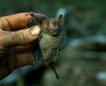
Ipanema bats are small tailless bats with brown tricolor fur, a shortened nose, white shoulder patches and a semicircular uropatagium that is totally furred. They have a deep cubical rostrum that is half the length of their cranium. They have a characteristic well developed nose leaf, with a small calcar. Ipanema bats are sexually dimorphic, females are larger than males. Although both males and females have pre-orbital glands, female glands are smaller, whereas males have more pronounced glandular tissues, including swollen glandular structures on their forelimb, sac-like glandular structures dorsal to their forearm and a glandular mass below their mandible. Furthermore, P. bilabiatum possess five to six vibrissae in each mandible. Ipanema bats are sub-divided into two sub-species P. bilabiatum bilabiatum (Paraguayan and Eastern Brazil populations) and P. bilabiatum magma (Bolivian population). The sub-species differ in the size and extension of the male's forearm glandular tissue, P. bilabiatum magma possesses more elongated forearm glandular tissue, extending to the forearm, plapiopatagium, and fifth digit. Pygoderma bilabiatum bilabiatum possess distinct coma shaped glandular tissue, restricted to the lateral and distal part of their forearms. Ipanema bats have a deep cuboid skull with dilambdodont molars; their basisphenoid pits are well developed and deep. The upper molars have reduced cusp and the crowns of their lower molars are also reduced. Their molars are long and stout. Females have more teeth than males, in some cases they have a third molar either in their mandibles, or in rare cases in their maxilla, the third molar is absent in males. The upper incisors are unequal in size, with their inner pair larger in size. Their dental formula is: I 2/2, C 1/1, PM 2/2, M 2/2-3, total = 28 to 30. The basal metabolic rate of this species has not been documented; however, members of Family Phyllostomidae usually have high BMRs. (Dick, 2002; Lopez Gonzalez, 1998; McNabb, 2003; Myers, 1981; Oprea, et al., 2007; Ordones Rego, et al., 2012; Smith and Elsam, 2006; Tavares and Tejedor, 2009; Webster and Owen, 1984)
- Other Physical Features
- endothermic
- bilateral symmetry
- Sexual Dimorphism
- female larger
-
- Range mass
- 17.5 to 18 g
- 0.62 to 0.63 oz
-
- Range wingspan
- 140 (male) to 150 (female) mm
- to in
Reproduction
The mating system of this species has not been studied; however, females of this species are larger than males, suggesting that sexual selection is not intense in this species. Although, the extensive glandular tissue found on their forelimbs, pre-orbital and sub-mandibular regions of males, but not females, may be a consequence of sexual selection. (Faria, 1997; Myers, 1981; Taddei, 1976; Tavares and Tejedor, 2009)
The reproductive cycles of P. bilabiatum appears to coincide with the peak abundance of food. No gestation period has been recorded in this species but young are thought to be born in the late dry season (April to September), and weaned at the beginnings of the wet season (October to March). One study found females with lactating young only once a year, while another study found lactating females twice in a year. Lactating females have been caught in November, suggesting a bimodal reproductive pattern. Females give birth to one cub. (Dick, 2002; Esberard, et al., 2011; Faria, 1997; Myers, 1981; Taddei, 1976; Tavares and Tejedor, 2009; Webster and Owen, 1984)
- Key Reproductive Features
- seasonal breeding
- gonochoric/gonochoristic/dioecious (sexes separate)
- sexual
-
- Breeding interval
- This species breeds once or twice a year.
-
- Range number of offspring
- 1 to 1
There is not much known about the parental investment of this species. Females will carry young during lactation. Females have been caught with young in the lactating phase during the months of November and December, suggesting lactation lasts for at least two months. There is no evidence of male parental care. (Esberard, et al., 2011; Faria, 1997; Taddei, 1976)
- Parental Investment
- female parental care
-
pre-hatching/birth
-
provisioning
- female
-
protecting
- female
-
provisioning
-
pre-weaning/fledging
-
protecting
- female
-
protecting
Lifespan/Longevity
There is very little data on the longevity of tropical bats. It is expected that Neotropical bats in the wild have a long lifespan, similar to their counterparts in temperate regions. (Herreid, 1964)
Behavior
Very little is known of the life history and behavior of P. bilabiatum. This species undergoes vertical (altitudinal) migration between the dry and rainy seasons, possibly to find locations with more favorable temperatures and greater food availability. (Esberard, et al., 2011)
Home Range
The home range of this species has not been studied; however, elevation segregation has been observed. Males are more likely to be found at altitudes lower than 250 meters and females are usually found at higher elevations. Ipanema bats of Brazilian and Paraguayan populations undergo altitudinal (vertical) migrations as part of their foraging behaviour. (Esberard, et al., 2011)
Communication and Perception
Similar to other members of Family Phyllostomidae, this bat is capable of echolocation. However, nothing is known about the range or frequency of the ultrasound produced, or if they use this medium for communicating inter or intra-specifically.
- Communication Channels
- acoustic
- Other Communication Modes
- vibrations
- Perception Channels
- tactile
- ultrasound
- echolocation
- chemical
Food Habits
This species, like all the members of sub-family Sternodermatinae, are frugivorous. Ipanema bats feed on the fruits of Pouteria caimito, Miconia brasiliensis, Maclura tinctonia, Ficus hispida, Ficus enormis, Solano sanctae-catharinae, and Solanum granulosum-leprosum. Examination of their digestive tract has found only plant pulp, but no seeds or fiber, suggesting they consume overripe and pulpy fruits that are easily digested. Furthermore, there is a record of P. bilabiatum visiting Cipocereus lanifloris flowers; likewise, the pollen of this plant has been found on their fur, suggesting they are a potential pollinator of this plant. (Esberard, et al., 2011; Faria, 1997; Myers, 1981; Ordones Rego, et al., 2012)
- Plant Foods
- fruit
- pollen
Predation
Predators specific to P. bilabiatum have not been recorded, although barn owls (Tyto alba) prey on Neotropical bats. Opportunistic predation by forest foxes (Cerdocyon thous) has also been recorded in southeastern Brazil. (Brasil, et al., 2010; Novaes, et al., 2011)
-
- Known Predators
-
- barn owls (Tyto alba)
- forest foxes (Cerdocyon thous)
Ecosystem Roles
Frugivorous bats, such as Ipanema bats, are very important in the spread of plant seeds, which helps maintain the forest ecosystem. This species also visits flowers during the dry season and may act as a pollen disperser. Ipanema bats are hosts of parasitic flies, a common ectoparasite of bats. (Graciolli and Barros de Carvalho, 2001; Ordones Rego, et al., 2012)
- Ecosystem Impact
- disperses seeds
- bat flies (Paratrichobius longicrus) (class Insecta; phylum Arthropoda)
Economic Importance for Humans: Positive
Frugivorous bats, like P. bilabiatum, are important seed disperser, which helps trees and other plant species reproduce. Furthermore, P. bilabiatum can be used as a model for research on migration among bats species. Likewise, research on their dietary habits can give a better understanding of food trophic levels in the tropical forest. (Esberard, et al., 2011; Faria, 1997)
- Positive Impacts
- research and education
Economic Importance for Humans: Negative
There are no known negative effects of P. bilabiatum for human populations.
Conservation Status
Population trends are unknown, as stated by the IUCN Red List.
-
- IUCN Red List
- Least Concern
-
- US Federal List
- No special status
-
- CITES
- No special status
-
- State of Michigan List
- No special status
Other Comments
There are two recognized sub-species of Pygoderma bilabiatum: P. bilabiatum bilabiatum and P. bilabiatum magma. Pygoderma bilabiatum bilabiatum is small and found in the Paraguayan population, Suriname (if the accounts of this population are accurate), as well as northeast Argentina, and southern Brazil. Pygoderma bilabiatum magma is bigger and found in northwestern Argentina and south of Bolivia. Pygoderma bilabiatum bilabiatum has a few synonyms: Phyllostoma bilabiatum, Arctibeus leucomus, and Stenoderma microdon. Ipanema bats are understudied organisms; clearly more research should be conducted to gain more understanding of their biology. (Webster and Owen, 1984)
Contributors
lilian maria wiens (author), University of Manitoba, Jane Waterman (editor), University of Manitoba, Leila Siciliano Martina (editor), Animal Diversity Web Staff.
Glossary
- Neotropical
-
living in the southern part of the New World. In other words, Central and South America.

- acoustic
-
uses sound to communicate
- bilateral symmetry
-
having body symmetry such that the animal can be divided in one plane into two mirror-image halves. Animals with bilateral symmetry have dorsal and ventral sides, as well as anterior and posterior ends. Synapomorphy of the Bilateria.
- chemical
-
uses smells or other chemicals to communicate
- echolocation
-
The process by which an animal locates itself with respect to other animals and objects by emitting sound waves and sensing the pattern of the reflected sound waves.
- endothermic
-
animals that use metabolically generated heat to regulate body temperature independently of ambient temperature. Endothermy is a synapomorphy of the Mammalia, although it may have arisen in a (now extinct) synapsid ancestor; the fossil record does not distinguish these possibilities. Convergent in birds.
- female parental care
-
parental care is carried out by females
- frugivore
-
an animal that mainly eats fruit
- herbivore
-
An animal that eats mainly plants or parts of plants.
- migratory
-
makes seasonal movements between breeding and wintering grounds
- motile
-
having the capacity to move from one place to another.
- native range
-
the area in which the animal is naturally found, the region in which it is endemic.
- nocturnal
-
active during the night
- rainforest
-
rainforests, both temperate and tropical, are dominated by trees often forming a closed canopy with little light reaching the ground. Epiphytes and climbing plants are also abundant. Precipitation is typically not limiting, but may be somewhat seasonal.
- seasonal breeding
-
breeding is confined to a particular season
- sexual
-
reproduction that includes combining the genetic contribution of two individuals, a male and a female
- tactile
-
uses touch to communicate
- tropical
-
the region of the earth that surrounds the equator, from 23.5 degrees north to 23.5 degrees south.
- ultrasound
-
uses sound above the range of human hearing for either navigation or communication or both
- vibrations
-
movements of a hard surface that are produced by animals as signals to others
References
Brasil, A., S. Ribeiro, G. Niederauer, G. Daiane, S. Pacheco. 2010. Quirópteros encontrados na dieta de Tyto alba (Strigiformes, Tytonidae) no Centro de Porto Alegre, RS, Brasil. Chroptera Neotropical, 16: 35-36.
Dick, C. 2002. Variation in the Dental Formula of the Ipanema Bat, Pygoderma bilabiatum. Southwestern Association of Naturalists, 47: 505-508.
Esberard, C., I. de Lima, P. Nobre, S. Althoff, T. Jordao Nogueira, D. Dias, F. Carvalho, M. Fabian, M. Seklama, A. Stanke Sobrinho. 2011. Evidence of Vertical Migration in the Ipanema Bat Pygoderma bilabiatum (Chiroptera: Phyllostomidae: Sternodermatinae). Zoologia, 28: 717-724.
Faria, D. 1997. Reports on the Diet and Reproduction of the Ipanema Fruit Bat, Pygoderma bilabiatum in a Brazilian Forest Fragment. Chiroptera Neotropical, 3: 65-66.
Graciolli, G., C. Barros de Carvalho. 2001. Moscas ectoparasitas (Diptera, Hippoboscoidea) de morcegos (Mammalia, Chiroptera) do Estado do Paraná. 11. Streblidae. Chave pictórica para gêneros e espécies. Revista Brasileira de Zoologia, 18: 907-960.
Herreid, C. 1964. Bat Longevity and Metabolic Rate. Experimental Gerontology, 1: 1-9.
Lopez Gonzalez, C. 1998. Systematics and Biogeography of the Bats of Paraguay, A Dissertation in Biology. Texas: Texas Tech University.
McNabb, B. 2003. Standard Energetics of Phyllostomid Bats: the Inadequecies of Phylogenetic Contrast Analises. Comparative Biochemistry and Physiology Part A, 135: 357-368.
Myers, P. 1981. Observations on Pygoderma bilabiatum. Zeitschrift fuer Saeugetierkunde, 46: 146-151.
Novaes, R., C. Sant Anna, L. Menezes, A. Facanha, M. Louro, T. Cardoso, S. Felix, R. Silvares, A. Siqueira, R. Souza, L. Dias-de-Oliveira. 2011. Opportunistic Predation of Bats by Crab Eating Fox in Atlantic Forest, South-Eastern Brazil. Canid News, 14.1: 1-4. Accessed November 09, 2012 at http://www.canids.org/canidnews/14/Bat predation by crab-eating fox.pdf.
Oprea, M., P. Mendes, T. Vieira, V. Pimenta, D. Brito, A. Ditchfield. 2007. Mammalia, Chiroptera, Phyllostomidae, Phyllostomus hastatus and Pygoderma bilabiatum: First occurrence in the Brazilian coastal shrubland ecosystem. Check List, 3: 175-179. Accessed November 29, 2012 at http://www.checklist.org.br/getpdf?NGD009-07.
Ordones Rego, J., E. Villaron Franceschinelli, D. Zappi. 2012. Reproductive Biology of a Highly Endemeic Species: Cipocereus laniflorus N. P. Taylor & Zappa (Cactaceae). Acta Botanica Brasilica, 26: 243-250.
Owen, R., W. Webster. 1983. Morphological Variation in the Ipanema Bat, Pygoderma bilabiatum, with Description of a New Subspecies. Journal of Mammalogy, 64: 146-149.
Passos, F., W. Silva, W. Pedro, M. BonIn. 2003. Frugivoria en Morcegos (Mammalia; Chiroptera) no Parque Estadual Intervales, sudeste do Brasil. Revista Brasileira de Zoologia, 20: 511-517.
Pedro, W., F. Passos. 1995. Ocurrence and Food Habits of Some Bat Species from the Linhares Forest Reserve, Espiritu Santo, Brazil. Bat Research News, 36: 1-2.
Presley, S. 2005. Ectoparasitic Assemblages of Paraguayan Bats: Ecological and Evolutionary Perspectives. Mastozoologia Neotropical, 12: 103-105.
San Martin Mouriz Savani, E., M. Fernandes de Almeida, M. Gibrail de Oliveira Camargo, S. Nicoletti D'Auria, M. Martos Sodre Silva, M. de Oliveira, D. Sacramento. 2009. Detection of Leishmania (Leishmania) amazonensis and Leishmania (Leishmaia) infantum chagasi in Brazilian Bats. Veterinary Parasitology, 168: 5-10.
Santana, S., I. Grosse, E. Dumont. 2012. Dietary hardness, loading behavior, and the evolution of skull form in bats. Evolution, 66: 2587-2598.
Smith, P., R. Elsam. 2006. "Fauna Paraguay" (On-line). Accessed February 08, 2013 at http://www.faunaparaguay.com/phyllostomidae.html.
Taddei, V. 1976. The Reproduction of Some Phyllostomidae (Chiroptera) from the North-Western region of the State of Sao Paulo. Boletim Zoologico, 1: 313-330.
Tavares, V., A. Tejedor. 2009. The Forelimbs swelling of Pygoderma bilabitum (Chiroptera: Phyllostomidae). Chiroptera Neotropical, 15: 411-416.
Webster, W., R. Owen. 1984. Pygoderma bilabiatum. Mammalian Species, 220: 1-3.
Willig, M. 1983. Composition, Microgeographic variation, and Sexual Dimorphism in the Caatingas and Cerrado Bat Communities from Northeast-Brazil. Bulleting of Carnegie Museum of Natural History, 23: 1-123.