Pulmonata

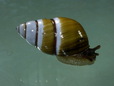
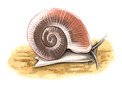
Pulmonates are the land snails and slugs (a few species are marine). A coiled shell is usually present, but it is lost in some important groups. Some detorsion has occurred in many species. The Subclass derives its name from the fact that the mantle cavity forms lungs; these are filled with air as a result of contractions of the mantle floor. One or two pairs of tentacles are found on the head, depending on whether the snail or slug is terrestrial (two pairs) or aquatic (one). The nervous system is highly concentrated. Pulmonates are dioecious and hermaphroditic as are prosobranchs, but pulmonates develop directly (there is no larval form).
Source:
Hickman, C.P. and L. S. Roberts. 1994. Animal Diversity. Wm. C. Brown, Dubuque, IA.
Brusca, R. C., and G. J. Brusca. Invertebrates. 1990. Sinauer Associates, Sunderland, MA.
Contributors
John B. Burch (author), Mollusk Division, Museum of Zoology, University of Michigan-Ann Arbor, Phil Myers (author), Museum of Zoology, University of Michigan-Ann Arbor.
Glossary
- bilateral symmetry
-
having body symmetry such that the animal can be divided in one plane into two mirror-image halves. Animals with bilateral symmetry have dorsal and ventral sides, as well as anterior and posterior ends. Synapomorphy of the Bilateria.
- ectothermic
-
animals which must use heat acquired from the environment and behavioral adaptations to regulate body temperature