Pteronotus parnelliiParnell's mustached bat

Geographic Range
Pteronotus parnellii is found from southern Mexico to northern Brazil (Herd 1983).
- Biogeographic Regions
- nearctic
- neotropical
Habitat
P. parnellii lives in edge habitats (Estrada 2001). These habitats range from humid to arid (Herd 1983). They also live in moist areas in forest (Gray 1843). They range in elevation from coastal lowland areas to 3000 m.
- Habitat Regions
- tropical
- terrestrial
- Terrestrial Biomes
- forest
- rainforest
- scrub forest
-
- Range elevation
- 0 to 3000 m
- 0.00 to 9842.52 ft
Physical Description
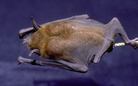
Pteronotus parnellii have tufts of hair sticking out of the sides of their muzzles, hence the name "Parnell's Mustached Bat". Members of this species have long and narrow wings, and their wing aspect ratio is greater than most bats. Both their ears and tragus are narrow and pointed, and they have a furless chin. Their dental formula is i2/2 c1/1 p2/3 m3/3. During their annual molt, which takes place from May to July, their coat turns from a dark brown/blackish color to a brilliant orange/fulvous. The male is usually slightly larger than the female (Estrada 2001).
- Other Physical Features
- endothermic
- bilateral symmetry
-
- Range mass
- 10 to 20 g
- 0.35 to 0.70 oz
-
- Range length
- 73 to 102 mm
- 2.87 to 4.02 in
Development
P. parnellii is born immobile with closed eyes and naked skin, but with good hearing (Herd 1983).
Reproduction
The females are monestrous. The timing of pregnancy varies from region to region, but pregnancies generally take place from January to July (Gray, 1843). Males and females roost together only around the time of mating (Gray, 1843; Herd, 1983).
- Key Reproductive Features
- gonochoric/gonochoristic/dioecious (sexes separate)
- sexual
- fertilization
- viviparous
-
- Average number of offspring
- 1
-
- Average weaning age
- 2-3 months
Behavior
They leave their roost shortly after sunset and remain in flight for about 5-7 hours (Herd 1983). They usually roost individually within large caves or similar chambers (Gray 1843). They usually fly near the ground, often following natural depressions.
Communication and Perception
Food Habits
P. parnellii eats moths, butterflies, and beetles (Herd 1983).
Economic Importance for Humans: Positive
This species feeds on insects that are sometimes injurious to humans. It has also served as a model in the study of echolocation.
- Positive Impacts
- research and education
- controls pest population
Economic Importance for Humans: Negative
P. parnellii may carry rabies, Histoplasma, Scopulariopsis, mites, or bat flies, which are hazardous to humans (Herd 1983).
Conservation Status
-
- IUCN Red List
-
Least Concern
More information
-
- IUCN Red List
-
Least Concern
More information
-
- US Federal List
- No special status
-
- CITES
- No special status
Other Comments
Their echolocation pulse is emitted from the mouth (Herd 1983).
Contributors
Gabriel Gam (author), University of Michigan-Ann Arbor, Ondrej Podlaha (editor), University of Michigan-Ann Arbor.
Glossary
- Nearctic
-
living in the Nearctic biogeographic province, the northern part of the New World. This includes Greenland, the Canadian Arctic islands, and all of the North American as far south as the highlands of central Mexico.

- Neotropical
-
living in the southern part of the New World. In other words, Central and South America.
- bilateral symmetry
-
having body symmetry such that the animal can be divided in one plane into two mirror-image halves. Animals with bilateral symmetry have dorsal and ventral sides, as well as anterior and posterior ends. Synapomorphy of the Bilateria.
- chemical
-
uses smells or other chemicals to communicate
- colonial
-
used loosely to describe any group of organisms living together or in close proximity to each other - for example nesting shorebirds that live in large colonies. More specifically refers to a group of organisms in which members act as specialized subunits (a continuous, modular society) - as in clonal organisms.
- endothermic
-
animals that use metabolically generated heat to regulate body temperature independently of ambient temperature. Endothermy is a synapomorphy of the Mammalia, although it may have arisen in a (now extinct) synapsid ancestor; the fossil record does not distinguish these possibilities. Convergent in birds.
- fertilization
-
union of egg and spermatozoan
- forest
-
forest biomes are dominated by trees, otherwise forest biomes can vary widely in amount of precipitation and seasonality.
- internal fertilization
-
fertilization takes place within the female's body
- motile
-
having the capacity to move from one place to another.
- native range
-
the area in which the animal is naturally found, the region in which it is endemic.
- nocturnal
-
active during the night
- rainforest
-
rainforests, both temperate and tropical, are dominated by trees often forming a closed canopy with little light reaching the ground. Epiphytes and climbing plants are also abundant. Precipitation is typically not limiting, but may be somewhat seasonal.
- scrub forest
-
scrub forests develop in areas that experience dry seasons.
- sexual
-
reproduction that includes combining the genetic contribution of two individuals, a male and a female
- tactile
-
uses touch to communicate
- terrestrial
-
Living on the ground.
- tropical
-
the region of the earth that surrounds the equator, from 23.5 degrees north to 23.5 degrees south.
- viviparous
-
reproduction in which fertilization and development take place within the female body and the developing embryo derives nourishment from the female.
References
Estrada, A., R. Coates-Estrada. 2001. "Bat species richness in live fences and in corridors of residual rain forest vegetation at Los Tuxtlas, Mexico" (On-line). Accessed October 9, 2001 at http://www.csa3.com/htbin/ids52/procskel.cgi.
Hall, E., K. Koopman, J. Smith. 1997. "Naked-backed Bats, Moustached Bats, or Leaf-lipped Bats" (On-line). Accessed October 10, 2001 at http://www.press.jhu.edu/books/walkers_mammals_of_the_world/chiroptera/chiroptera.mormoopidae.pteronotus.html.
Herd, R. 1983. Pteronotus parnellii. Mammalian Species, 209: 1-5.