Pteromys volansSiberian flying squirrel
Geographic Range
Pteromys volans occurs throughout Scandinavia, Russia, across northern Asia to Siberia and south along the Pacific coast of northern China. (Yanagawa et.al 1991)
- Biogeographic Regions
- palearctic
Habitat
Populations of Pteromys volans can be found in forests with aspen, birch, spruce, cedar, or pine trees. They prefer areas with a lot of old, hollow trees for building nests. (Ognev 1966)
Physical Description
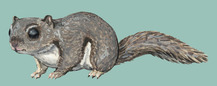
Pteromys volans have a membrane that extends between their fore- and hind limbs. Unlike some other species of flying squirrels, Pteromys volans do not have a membrane between their hind limbs and the base of their tail. Their limbs are relatively short and thick and their hind feet are significantly larger than their forefeet. The length of the head and body is 120-228 mm. Pteromys volans have distinct, large, black eyes. Old World flying squirrels have thick, long and soft fur. In the summer, the fur on the back is yellow-gray to blackish gray. In the winter, it becomes silvery gray. The belly remains white throughout the year. The margins of the gliding membrane are bordered with a distinct fringe of soft fur. The tail is flat and is covered with short hair.
(Nowak 1991, Ognev 1966)
- Other Physical Features
- endothermic
- bilateral symmetry
-
- Average mass
- 130 g
- 4.58 oz
- AnAge
Reproduction
The information on the reproduction of Pteromys volans is contradictory and incomplete. The reproduction patterns may differ among subspecies. Pteromys volans has one or two litters a year each consisting of anywhere from 1-6 young. The most recent evidence states that they have two litters, each consisting of 2-3 young, one in May and the other in late June or early July. Gestation lasts for four weeks. (Corbet 1966, Niethammer 1990, Nowak 1991, Ognev 1966)
- Key Reproductive Features
- gonochoric/gonochoristic/dioecious (sexes separate)
- sexual
Lifespan/Longevity
-
- Average lifespan
Status: wild - 3.8 years
- Max Planck Institute for Demographic Research
- Average lifespan
Behavior
Pteromys volans are nocturnal. In the summer, they are active from a half hour to an hour after sunset until dawn. Most of this time is spent searching for food. During the winter, this period of activity is shorter and P. volans consume less food. When active, P. volans spend little time on the ground. They glide from tree to tree collecting and consuming food. During flight, they extend their forelimbs laterally, but their hind limbs are kept close together along the tail. This creates an unsual triangle silhouette. Pteromys volans are a social species; many can be found together in a single tree. They build nests in vacant tree holes or in the junction of a branch and the trunk. Nests are often inhabited by pairs.
Information on mating behavior in nature is incomplete. However, captive males vocalize distinct chirping sounds and chase captive females.
(Ognev 1966, Yanagawa et. al. 1991)
- Key Behaviors
- motile
Communication and Perception
Food Habits
Pteromys volans are basically herbivores. In the summer, they feed on green plants, young branches, berries and seeds. During the winter months, P. volans consume nuts, catkins, pine cones, and pine needles. Local hunters claim the Old World flying squirrels also eat young birds and eggs from nests. However, there is no scientific evidence of this behavior. (Niethammer 1990, Ognev 1966)
Economic Importance for Humans: Positive
Pteromys volans are hunted for commercial use of their fur. (Nowak 1991)
Conservation Status
Populations of P. volans are declining in Europe because of habitat destruction due to lumbering. (Nowak 1991)
-
- IUCN Red List
-
Least Concern
More information
Other Comments
Pteromys volans are preyed upon by martens, owls, ermines, and cats. (Ognev 1966)
Contributors
Lauren Pascoe (author), University of Michigan-Ann Arbor.
Glossary
- Palearctic
-
living in the northern part of the Old World. In otherwords, Europe and Asia and northern Africa.

- bilateral symmetry
-
having body symmetry such that the animal can be divided in one plane into two mirror-image halves. Animals with bilateral symmetry have dorsal and ventral sides, as well as anterior and posterior ends. Synapomorphy of the Bilateria.
- chemical
-
uses smells or other chemicals to communicate
- endothermic
-
animals that use metabolically generated heat to regulate body temperature independently of ambient temperature. Endothermy is a synapomorphy of the Mammalia, although it may have arisen in a (now extinct) synapsid ancestor; the fossil record does not distinguish these possibilities. Convergent in birds.
- forest
-
forest biomes are dominated by trees, otherwise forest biomes can vary widely in amount of precipitation and seasonality.
- motile
-
having the capacity to move from one place to another.
- native range
-
the area in which the animal is naturally found, the region in which it is endemic.
- sexual
-
reproduction that includes combining the genetic contribution of two individuals, a male and a female
- tactile
-
uses touch to communicate
- taiga
-
Coniferous or boreal forest, located in a band across northern North America, Europe, and Asia. This terrestrial biome also occurs at high elevations. Long, cold winters and short, wet summers. Few species of trees are present; these are primarily conifers that grow in dense stands with little undergrowth. Some deciduous trees also may be present.
References
Corbet, G. 1966. The Terrestrial Mammals of Western Europe. Dufour Editions, Philadelphia.
Niethammer, J. 1990. Flying Squirrels. Grzimek's Encyclopedia of Mammals, Vol. 3. McGraw Hill Publishing Co., New York.
Nowak, R. 1991. Walker's Mammals of the World. Fifth Edition. John Hopkins University Press, Baltimore.
Ognev, S. 1966. Mammals of the U.S.S.R. and Adjacent Countries. Isreal Program for Scientific Translations Ltd., Jerusalem.
Yanagawa, H., M. Tanaka, T. Inoue and M. Taniguchi. 1991. Annual and daily activities of the flying squirrel, Pteromys volans orii in captivity. Honyurui Kagaku. Vol. 30(2).