Pseudocalyptomena graueriGrauer's broadbill
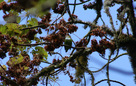

Geographic Range
African Green Broadbills are an endemic species located in a small region in far eastern Zaire and in western Uganda. This area consists of the Itombwe Mountains and the Impenetrable Forest of Uganda (Keith and al., 1992).
Habitat
African Green Broadbills mostly inhabit tropical primary forest, forest edges, and forests that are dominated by bamboo. They fly at all heights, but seem to prefer the upper branches of fairly tall trees (Lambert and Woodcock, 1996).
- Terrestrial Biomes
- forest
- rainforest
Physical Description
Pseudocalyptomena graueri are 13.6 to 15.6 centimeters in length. Male and female adults are both primarily green with small dark brown to black streaks on the forehead and crown with a white chin and throat. The young are slightly duller than the adults, and both adults and young have beaks that are very wide at the base. No geographical variation is known (Lambert and Woodcock, 1996).
- Other Physical Features
- endothermic
- bilateral symmetry
Reproduction
Pseudocalyptomena graueri are thought to have long breeding seasons. They have been found to nest 11 meters up in 20 meter tall trees in the outer most branches. They make their nests out of a Spanish-moss-like green lichen, and their nests are usually 20 to 25 centimeters in diameter with a 5 centimeter wide entrance. Besides this information, little else is known about the reproduction of P. graueri (Keith and al., 1992).
- Key Reproductive Features
- iteroparous
- gonochoric/gonochoristic/dioecious (sexes separate)
- sexual
- oviparous
Behavior
African Green Broadbills have been spotted alone or in small groups with up to ten members, and they sometimes join mixed-species flocks. In Uganda their flight is slow and they glide most of the time. Their call is described as tsi-tsi or cree-cree and is repeated 3 to 8 times at a fast rate, usually four notes to a second. During the breeding season they sometimes make a very high-pitched bell-like ringing noise (Lambert and Woodcock, 1996).
- Key Behaviors
- flies
- motile
Communication and Perception
Food Habits
African Green Broadbills are omnivores and feed on seeds, flowers, buds, fruits, beetles, larvae, and snails (Keith and al., 1992).
Economic Importance for Humans: Positive
African Green Broadbills have little economic importance to humans. While they are very pretty birds, they are usually hard to spot so they are not key figures in tourism (Keith and al., 1992).
Conservation Status
Although common in the Itombwe Mountains of Zaire, P. graueri are rare in the Impenetrable forest in Uganda and have been classified as both Rare and Vulnerable by different biologists. They are threatened by forest clearance near villages, commercial logging, and mining activities. Safe from these hazards is the population found in the mountains west of Lake Kivu, Zaire, which is thought to be protected because it resides in the Kahuzi-Biega National Park (Lambert and Woodcock, 1996).
-
- IUCN Red List
-
Vulnerable
More information
Other Comments
Little is known about P. graueri, they were thought to be a flycatcher species until well into the twentieth century. They had been previously classified with the flycatchers because of their behavior when catching insects, which consists of hawking insects on their wings (Lambert and Woodcock, 1996).
Contributors
Sara Dietsch (author), University of Michigan-Ann Arbor.
Glossary
- Ethiopian
-
living in sub-Saharan Africa (south of 30 degrees north) and Madagascar.

- acoustic
-
uses sound to communicate
- bilateral symmetry
-
having body symmetry such that the animal can be divided in one plane into two mirror-image halves. Animals with bilateral symmetry have dorsal and ventral sides, as well as anterior and posterior ends. Synapomorphy of the Bilateria.
- chemical
-
uses smells or other chemicals to communicate
- endothermic
-
animals that use metabolically generated heat to regulate body temperature independently of ambient temperature. Endothermy is a synapomorphy of the Mammalia, although it may have arisen in a (now extinct) synapsid ancestor; the fossil record does not distinguish these possibilities. Convergent in birds.
- forest
-
forest biomes are dominated by trees, otherwise forest biomes can vary widely in amount of precipitation and seasonality.
- iteroparous
-
offspring are produced in more than one group (litters, clutches, etc.) and across multiple seasons (or other periods hospitable to reproduction). Iteroparous animals must, by definition, survive over multiple seasons (or periodic condition changes).
- motile
-
having the capacity to move from one place to another.
- native range
-
the area in which the animal is naturally found, the region in which it is endemic.
- oviparous
-
reproduction in which eggs are released by the female; development of offspring occurs outside the mother's body.
- rainforest
-
rainforests, both temperate and tropical, are dominated by trees often forming a closed canopy with little light reaching the ground. Epiphytes and climbing plants are also abundant. Precipitation is typically not limiting, but may be somewhat seasonal.
- sexual
-
reproduction that includes combining the genetic contribution of two individuals, a male and a female
- tactile
-
uses touch to communicate
- visual
-
uses sight to communicate
References
Keith, S., E. K. Urban, and C. H. Fry. 1992. The Birds of Africa. Volume Four. Academic Press.
Lambert, F. and Woodcock, M. 1996. Pittas, Broadbills and Asities. Pica Press, Mountfield, Sussex, United Kingdom.