Pseudacris triseriataWestern Chorus Frog


Geographic Range
Midland chorus frogs (formerly known as striped or western chorus frogs) are now considered to be found solely east of the Mississippi River. The range extends from Michigan, southern Ontario, and western New York south through western Pennsylvania, Ohio, and Indiana to southern Illinois and north-central Tennessee. Midland chorus frog eastern distribution appears to be limited by the Appalachian Mountains (Lemmon et al. 2007; Green et al., 2013). (Green, et al., 2013; Lemmon, et al., 2007; Powell, et al., 2016)
Habitat
Midland chorus frogs live largely in open, damp areas including marshes, meadows, forest edges, fallow farm fields, bottomland swamps, floodplains and damp woodland areas (Powell, Conant, and Collins, 2016). They are rarely seen outside of the breeding season (early spring) but can sporadically be spotted under logs or boards, among dead vegetation, leaf litter, in cracks in the ground, or in crayfish burrows mostly in damp places (Harding and Holman, 1992; Green et al., 2013). Due to an ability to tolerate the partial freezing of body water, these frogs can overwinter buried shallowly in soil and leaf litter near breeding sites, typically temporary bodies of water such as vernal ponds, flooded fields, ditches, marsh edges and wooded swamps (Harding and Holman, 1992). (Green, et al., 2013; Harding and Holman, 1992; Powell, et al., 2016)
- Habitat Regions
- temperate
- terrestrial
- Terrestrial Biomes
- forest
- Aquatic Biomes
- temporary pools
- Other Habitat Features
- suburban
- agricultural
- riparian
Physical Description
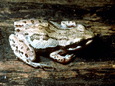
Midland chorus frogs range from 1.9 to 3.2 cm (.75 to 1.25 inches) in snout to vent length. Dorsal coloration can vary from light or dark brown to gray or greenish (or very rarely rust orange). They have a white line along the upper lip which can extend to the shoulder. There also may be a dark triangle or other figure between the eyes. A dark stripe runs from the snout through the eyes and eardrums and can continue along side of the groin. They have 3 dark brown or gray longitudinal stripes down their backs. These stripes are rarely broken into streaks or spots or absent. They have a whitish belly with dark stippling on the chest. Males have dark throats during the breeding season. The length of the tibia (lower hind limb) is approximately half the head-body length. Also, the ends of the toes slightly expand into small discs (Harding and Holman, 1992; Powell, Conant and Collins, 2016). They exhibit slight sexual dimorphism, as females tend to be a bit larger than males. (Encyclopedia of Life, 2016; Harding and Holman, 1992; Powell, et al., 2016)
- Other Physical Features
- ectothermic
- heterothermic
- bilateral symmetry
- Sexual Dimorphism
- female larger
-
- Range length
- 1.9 to 3.2 cm
- 0.75 to 1.26 in
Development
Midland chorus frogs breed in shallow waters in late winter or early spring. Males call to attract females. During amplexus (where the male grips the female from above with his front legs), the female lays from 500 to 1500 eggs in small gelatinous masses, while the male fertilizes them externally. As with most amphibians, the rate of development of eggs and larvae can depend on water temperature. Colder temperatures can increase development time. Once eggs are laid, tadpoles hatch in anywhere from 3 to 14 days and will metamorphose into small versions of their adult form in another 40 to 90 days (Harding and Holman, 1992). Maximum length of the tadpole before metamorphosis is about 3 cm. (Encyclopedia of Life, 2016; Harding and Holman, 1992)
- Development - Life Cycle
- metamorphosis
Reproduction
Midland chorus frogs breed, sometimes in small to large congresses, in shallow pools and temporary waters in or adjacent to marshes, swamps, and swales. During axillary amplexus, males externally fertilize the eggs as they are laid by the female in a pattern typical of most hylids (Halliday and Adler, 2002). Over most of the range, amplexus and egg laying takes place from late March to early April, but breeding occasionally extends into May in the north (Harding and Holman, 1992). (Halliday and Adler, 2002; Harding and Holman, 1992; Landreth and Ferguson, 1966)
- Mating System
- polygynandrous (promiscuous)
Midland chorus frogs are often the first frog species to call in the spring (Harding and Holman, 1992). In the north this is typically in mid to late-March, but further south it may be even earlier. Breeding is initiated by favorable temperatures and rainfall to create the required temporary bodies of water (Landreth and Furguson, 1966). Amplexus and egg laying takes place mostly in April but will occasionally continue into May. Females produce between 500 and 1500 eggs that are laid in small gelatinous masses of 20 to 100 or more eggs. Females attach the mass to grasses or twigs underwater. Eggs hatch in 3 to 14 days and metamorphose in 40 to 90 days (Harding and Holman, 1992). (Halliday and Adler, 2002; Harding and Holman, 1992; Landreth and Ferguson, 1966)
- Key Reproductive Features
- iteroparous
- seasonal breeding
- gonochoric/gonochoristic/dioecious (sexes separate)
- sexual
- fertilization
- oviparous
-
- Breeding interval
- Midland chorus frogs breed once yearly, during a narrow early spring season.
-
- Breeding season
- Egg laying occurs mostly in April, but can extend into May.
-
- Range number of offspring
- 500 to 1500
-
- Range time to hatching
- 3 to 14 days
-
- Average time to independence
- immediate minutes
-
- Range age at sexual or reproductive maturity (female)
- 1 to 2 years
-
- Average age at sexual or reproductive maturity (female)
- 1 years
-
- Range age at sexual or reproductive maturity (male)
- <1 to 1 years
There is no known parental involvement once the female has laid her eggs.
- Parental Investment
- no parental involvement
Lifespan/Longevity
Typical for frogs that lay a large number of eggs, most of the offspring will die before reaching adulthood, though the exact numbers are unknown. However, once these frogs reach maturity, they may live for 2 to 5 years. (Encyclopedia of Life, 2016)
-
- Range lifespan
Status: wild - ±5 (high) years
- Range lifespan
-
- Typical lifespan
Status: wild - 1 to 5 years
- Typical lifespan
Behavior
Despite being in the treefrog family (Hylidae), midland chorus frogs rarely climb. They are not often seen outside of the breeding season but are occasionally found in damp retreats (Harding and Holman, 1992). Additionally, they are largely solitary outside of breeding congresses (Kramer, 1974). They can tolerate partial freezing of body water in the winter and use glucose as an antifreeze mechanism to preserve important critical organs (Pough et al., 2004). Overwintering sites are typically near breeding sites and are in shallow soil and leaf litter. This allows these frogs to quickly emerge and start breeding as soon as breeding sites are thawed and flooded (Harding and Holman, 1992). Tadpoles are active feeders relative to other frogs that breed at the same time, allowing faster growth and shorter time to metamorphosis, and thus may be able to escape from the temporary pond before it dries up. However, predators may be attracted to this increased activity (Pough et al., 2004). (Harding and Holman, 1992; Kramer, 1974; Pough, et al., 2004)
- Key Behaviors
- terricolous
- natatorial
- crepuscular
- motile
- migratory
- sedentary
- hibernation
- aestivation
- solitary
-
- Average territory size
- 2116 m^2
Home Range
Midland chorus frog home ranges average 2116 square meters, including the breeding pond. They migrate long distances in order to breed (Kramer et al., 1974; Landreth and Ferguson, 1966) (Kramer, 1974; Landreth and Ferguson, 1966)
Communication and Perception
The call of midland chorus frogs is a short, rising, squeaky trill which sounds like “cree-ee-ee-ee-eek." It can be roughly imitated by strumming the teeth of a small, stiff pocket comb from middle to end with a thumbnail (Harding and Holman, 1992). Their calls are used mainly to attract females to breeding sites during their breeding season. They create a chorus of their calls during their breeding congresses. They also use visual and auditory cues for migration and breeding and rely on their keen vision for capturing prey. (Encyclopedia of Life, 2016; Harding and Holman, 1992; Pough, et al., 2004)
- Other Communication Modes
- choruses
Food Habits
Like most small frogs, the diet of midland chorus frogs includes a variety of small invertebrates, such as spiders, ants, flies, and moths. Younger, smaller frogs will feed on smaller prey: mites, midges and springtails. Tadpoles are herbivorous feeding mostly on algae (Harding and Holman, 1992). (Harding and Holman, 1992)
- Primary Diet
-
carnivore
- insectivore
- eats non-insect arthropods
-
herbivore
- algivore
- Animal Foods
- insects
- terrestrial worms
- Plant Foods
- algae
Predation
Typical predators on adult midland chorus frogs would include birds (herons, grackles, etc.), small mammals (raccoons, mink, skunks), snakes, and larger frogs. Young metamorphs and tadpoles are eaten by salamander larvae, crayfish, fish (if present), turtles, and aquatic insects such as water scorpions, diving beetles, and dragonfly larvae. (Encyclopedia of Life, 2016; Harding and Holman, 1992)
- Anti-predator Adaptations
- cryptic
-
- Known Predators
-
- herons (Ardeidae)
- grackles (Quiscalus)
- raccoons (Procyon lotor)
- mink (Neovison vison)
- skunks (Mephitis)
- snakes (Serpentes)
- larger frogs (Lithobates)
- salamander larvae (Ambystomatidae)
- crayfish (Cambaridae)
- fish (if present)
- turtles (Testudines)
- water scorpions (Nepidae)
- diving beetles (Dytiscidae)
- dragonfly larvae (Odonata)
Ecosystem Roles
Midland chorus frogs serve as a food source for their predators and help keep prey populations under control. Both adult and larval forms (tadpoles) have different but important ecological roles. In both environments these frogs and their larvae serve as predator and prey and do not compete with their parents or offspring. Water-breeding amphibians such as midland chorus frogs can channel nutrients from the aquatic to the terrestrial environment. (Encyclopedia of Life, 2016; Pough, et al., 2004)
Economic Importance for Humans: Positive
As with other amphibians, midland chorus frogs can act as a critical indicator of environmental health. Their permeable skin makes them susceptible to many contaminants, external stimuli and toxins that they are exposed to in both aquatic and terrestrial portions of their life cycle. Since their larval and adult forms occupy very different habitats, a decline in frog numbers or population health could signify problems in either environment or both. (Encyclopedia of Life, 2016; Harding and Holman, 1992; Pough, et al., 2004)
- Positive Impacts
- research and education
- controls pest population
Economic Importance for Humans: Negative
There are no known adverse effects of Pseudacris triseriata on humans.
Conservation Status
This species is considered to be mostly stable. Although listed as "vulnerable" in Quebec (Green et al.,2013), it has no special status in the United States. It is common in much of its large range. The IUCN indicates there has been a decline but the degree is uncertain. Like other frogs, they are very susceptible to agricultural chemicals and to baitfish and gamefish introduction into breeding wetlands. Their breeding habitat is also vulnerable to destruction due to urban and suburban development (Green et al., 2013). (Green, et al., 2013; Harding and Holman, 1992)
-
- IUCN Red List
-
Least Concern
More information
-
- IUCN Red List
-
Least Concern
More information
-
- US Federal List
- No special status
-
- CITES
- No special status
-
- State of Michigan List
- No special status
Other Comments
There has been much change in recent years in the taxonomy and species delimitation of chorus frogs (Pseudacris). Until recently, what is called the Pseudacris triseriata complex (including Upland, Cajun, New Jersey, Boreal and Midland chorus frogs) were considered a subspecies of northern chorus frogs (Powell, Conant, and Collins, 2016). Now, they have all been promoted to species status. Recent findings show mitochondrial DNA is similar to that of the boreal chorus frogs but the species status hold due to the differences in range and calls (Green et al., 2013).
The many names of this species can also be confusing. The common name "striped chorus frogs" comes from the characteristic 3 stripes down its back. Until recently, this species was called western chorus frogs. Due to the restricted range east of the Mississippi, though, the proper common name is now midland chorus frogs. (Green, et al., 2013; Powell, et al., 2016)
Contributors
Kelsey Landry (author), Michigan State University, James Harding (editor), Michigan State University, Tanya Dewey (editor), University of Michigan-Ann Arbor.
Glossary
- Nearctic
-
living in the Nearctic biogeographic province, the northern part of the New World. This includes Greenland, the Canadian Arctic islands, and all of the North American as far south as the highlands of central Mexico.

- acoustic
-
uses sound to communicate
- agricultural
-
living in landscapes dominated by human agriculture.
- bilateral symmetry
-
having body symmetry such that the animal can be divided in one plane into two mirror-image halves. Animals with bilateral symmetry have dorsal and ventral sides, as well as anterior and posterior ends. Synapomorphy of the Bilateria.
- bog
-
a wetland area rich in accumulated plant material and with acidic soils surrounding a body of open water. Bogs have a flora dominated by sedges, heaths, and sphagnum.
- carnivore
-
an animal that mainly eats meat
- choruses
-
to jointly display, usually with sounds, at the same time as two or more other individuals of the same or different species
- crepuscular
-
active at dawn and dusk
- cryptic
-
having markings, coloration, shapes, or other features that cause an animal to be camouflaged in its natural environment; being difficult to see or otherwise detect.
- ectothermic
-
animals which must use heat acquired from the environment and behavioral adaptations to regulate body temperature
- external fertilization
-
fertilization takes place outside the female's body
- fertilization
-
union of egg and spermatozoan
- forest
-
forest biomes are dominated by trees, otherwise forest biomes can vary widely in amount of precipitation and seasonality.
- herbivore
-
An animal that eats mainly plants or parts of plants.
- heterothermic
-
having a body temperature that fluctuates with that of the immediate environment; having no mechanism or a poorly developed mechanism for regulating internal body temperature.
- hibernation
-
the state that some animals enter during winter in which normal physiological processes are significantly reduced, thus lowering the animal's energy requirements. The act or condition of passing winter in a torpid or resting state, typically involving the abandonment of homoiothermy in mammals.
- insectivore
-
An animal that eats mainly insects or spiders.
- iteroparous
-
offspring are produced in more than one group (litters, clutches, etc.) and across multiple seasons (or other periods hospitable to reproduction). Iteroparous animals must, by definition, survive over multiple seasons (or periodic condition changes).
- marsh
-
marshes are wetland areas often dominated by grasses and reeds.
- metamorphosis
-
A large change in the shape or structure of an animal that happens as the animal grows. In insects, "incomplete metamorphosis" is when young animals are similar to adults and change gradually into the adult form, and "complete metamorphosis" is when there is a profound change between larval and adult forms. Butterflies have complete metamorphosis, grasshoppers have incomplete metamorphosis.
- migratory
-
makes seasonal movements between breeding and wintering grounds
- motile
-
having the capacity to move from one place to another.
- natatorial
-
specialized for swimming
- native range
-
the area in which the animal is naturally found, the region in which it is endemic.
- oviparous
-
reproduction in which eggs are released by the female; development of offspring occurs outside the mother's body.
- polygynandrous
-
the kind of polygamy in which a female pairs with several males, each of which also pairs with several different females.
- riparian
-
Referring to something living or located adjacent to a waterbody (usually, but not always, a river or stream).
- seasonal breeding
-
breeding is confined to a particular season
- sedentary
-
remains in the same area
- sexual
-
reproduction that includes combining the genetic contribution of two individuals, a male and a female
- solitary
-
lives alone
- suburban
-
living in residential areas on the outskirts of large cities or towns.
- swamp
-
a wetland area that may be permanently or intermittently covered in water, often dominated by woody vegetation.
- tactile
-
uses touch to communicate
- temperate
-
that region of the Earth between 23.5 degrees North and 60 degrees North (between the Tropic of Cancer and the Arctic Circle) and between 23.5 degrees South and 60 degrees South (between the Tropic of Capricorn and the Antarctic Circle).
- terrestrial
-
Living on the ground.
- visual
-
uses sight to communicate
References
Encyclopedia of Life, 2016. "Pseudacris triseriata, Striped Chorus Frog" (On-line). Encyclopedia of Life. Accessed November 10, 2017 at http://eol.org/pages/1048370/details.
Green, D., L. Weir, G. Casper, M. Lannoo. 2013. North American Amphibians Distribution and Diversity. Berkeley and Los Angeles, California: University of California Press.
Halliday, T., K. Adler. 2002. Firefly Encyclopedia of Reptiles and Amphibians. Toronto, Ontario; Buffalo, New York: Firefly Books Ltd.
Harding, J., J. Holman. 1992. Michigan Frogs, Toads, and Salamanders: A Field Guide and Pocket Reference. East Lansing, MI 28824: Michigan State University Museum.
Kramer, D. 1974. HOME RANGE OF THE WESTERN CHORUS FROG PSEUDACRIS-TRISERIATA-TRISERIATA. Journal of herpetology, 8/3: 245. Accessed November 08, 2017 at http://za2uf4ps7f.search.serialssolutions.com.proxy1.cl.msu.edu/?url_ver=Z39.88-2004&url_ctx_fmt=info:ofi/fmt:kev:mtx:ctx&rft_val_fmt=info:ofi/fmt:kev:mtx:journal&rft.atitle=HOME%20RANGE%20OF%20THE%20WESTERN%20CHORUS%20FROG%20PSEUDACRIS-TRISERIATA-TRISERIATA&rft.aufirst=D&rft.aulast=KRAMER&rft.date=1974&rft.epage=246&rft.genre=article&rft.issn=0022-1511&rft.issue=3&rft.jtitle=Journal%20of%20Herpetology&rft.pages=245-246&rft.spage=245&rft.volume=8&rfr_id=info:sid/www.isinet.com:WoK:UA&rft_id=info:doi/10%2E2307%2F1563171.
Landreth, H., D. Ferguson. 1966. Behavioral Adaptations in the Chorus Frog, Pseudacris Triseriata. Journal of the Mississippi Academy of Sciences, 12: 197-202.
Lemmon, E., A. Lemmon, J. Collins, J. Lee-Yaw, D. Cannatella. 2007. Phylogeny-based delimitation of species boundaries and contact zones in the trilling chorus frogs (Pseudacris). Molecular Phylogenetics and Evolution, 44: "1068-1082".
Pough, F., R. Andrews, J. Cadle, M. Crump, A. Savitzky, K. Wells. 2004. Herpetology Third Edition. New Jersey: Pearson Prentice Hall.
Powell, R., R. Conant, J. Collins. 2016. Peterson Field Guide to Reptiles and Amphibians of Eastern and Central North America Fourth Edition. Boston, New York: Houghton Mifflin Harcourt Publishing Company.
Stuart, S., G. Hammerson, D. Sharp, L. Hoblin. 2015. "Pseudacris triseriata" (On-line). IUCN Redlist. Accessed November 08, 2017 at http://www.iucnredlist.org/details/55899/0.