Prionace glaucaBlue Shark
Geographic Range
Blue sharks are one of the most wide ranging shark species and can be found in all major oceans (except the Arctic), as well as the Mediterranean Sea and in temperate and tropical pelagic waters. (Last and Stevens, 1994; Megalofonou, et al., 2009)
- Biogeographic Regions
- indian ocean
- atlantic ocean
- pacific ocean
- mediterranean sea
- Other Geographic Terms
- cosmopolitan
Habitat
Blue sharks inhabit the epipelagic and mesopelagic zones (from the surface to about 350 m in depth), in water temperatures ranging between 12 and 20°C. While they are mainly found in pelagic, open-ocean waters, they may sometimes be found closer to shore in the neritic zone, near the edge of continental shelves. (Last and Stevens, 1994)
- Habitat Regions
- temperate
- tropical
- saltwater or marine
- Aquatic Biomes
- pelagic
-
- Range depth
- 0 to 350 m
- 0.00 to 1148.29 ft
Physical Description
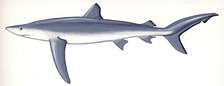
The striking coloration of blue sharks makes them one of the most distinctive species in the family Carcharhinidae (requiem or whaler sharks). The dorsum is a deep shade of indigo, while the flanks are a vibrant blue. The ventral surface fades to a light grey, exhibiting the typical pelagic countershaded coloration that deceives the eyes of bottom-dwelling prey or predators by blending in with light coming from the sun. The body is streamlined and thin, with an elongated heterocercal caudal (tail) fin, making it one of the fastest sharks in the ocean. The second dorsal fin is approximately half the size of the first, and the pectoral fins are proportionately longer than in most other shark species. The eyes are large, and the mouth is lined with several rows of triangular, serrated teeth; each tooth is usually replaced every 8 to 15 days. Blue sharks can reach 4 m in total length and weigh up to 240 kg. ("Blue Shark", 2012; "Database of IGFA angling records", 2012; Cervigón, et al., 1992; Last and Stevens, 1994; MarineBio.org, 2012; Stevens, 2012)
- Other Physical Features
- ectothermic
- heterothermic
- bilateral symmetry
- Sexual Dimorphism
- female larger
-
- Range mass
- 240 (high) kg
- 528.63 (high) lb
-
- Range length
- 4 (high) m
- 13.12 (high) ft
-
- Average length
- 3.35 m
- 10.99 ft
Development
After fertilization, embryos develop inside the female's uterus, nourished by a placenta-like yolk sac. Females give birth to fully-developed, live young. Blue sharks have one of the fastest growth rates of all sharks, growing up to 30 cm annually until maturity. Blue sharks are 35to 50 cm in length at birth, and will grow up to 400 cm (although the average length is 335 cm). Both sexes reach adulthood at about 220 cm in length. Juveniles usually stay in pupping areas of the sub-Arctic boundary (42°N North Pacific Ocean) until they reach maturity at 5 years of age. (Camhi, et al., 2008; Cervigón, et al., 1992)
- Development - Life Cycle
- indeterminate growth
Reproduction
Blue sharks congregate together on continental shelves during the summer. Mating begins when a male bites a female between her first and second dorsal fins. For this reason, the skin over most of a female's dorsum may be up to three times as thick as in males. Insemination occurs via insertion of one of the claspers into the female's urogenital opening. Pair bonding does not occur, and after mating, individuals separate. (Pratt Jr. and Carrier, 2001; Pratt Jr., 1979)
- Mating System
- polygynandrous (promiscuous)
Males reach sexual maturity at 187 cm in length, while females become mature at 220 cm. It is not definitively known if females breed every year and deposited sperm may be stored within the female's oviductal gland for several months after mating. Once pregnant, females migrate north to birthing and pupping grounds in the sub-Arctic boundary. Gestation lasts from 9 to 12 months, and up to 130 pups in a litter have been documented, but 25 to 50 pups are born on average. Pups average 39 cm at birth. Unlike bony fish, sharks utilize internal fertilization. The male bites down and insert a clasper inside the female to transfer sperm. Females have thick skin to protect them from injury when the males bite them during mating. Blue sharks are viviparous. (Camhi, et al., 2008; Pratt Jr. and Carrier, 2001; Pratt Jr., 1979; "Blue Shark (Prionace Glauca)", 1997)
- Key Reproductive Features
- iteroparous
- seasonal breeding
- gonochoric/gonochoristic/dioecious (sexes separate)
- sexual
- fertilization
- viviparous
- sperm-storing
- delayed fertilization
-
- Breeding interval
- It is unknown whether female blue sharks breed annually, or less frequently.
-
- Breeding season
- In the northern Pacific, most births occur from December to April.
-
- Range number of offspring
- 25 to 130
-
- Range gestation period
- 9 to 12 months
-
- Range age at sexual or reproductive maturity (female)
- 5 to 6 years
-
- Range age at sexual or reproductive maturity (male)
- 5 to 6 years
As in other viviparous species, female blue sharks provide nourishment and protection to their young as they develop. After birth, shark pups separate from their mother and have no further contact. (Pratt Jr. and Carrier, 2001; Pratt Jr., 1979)
- Parental Investment
- female parental care
-
pre-hatching/birth
-
provisioning
- female
-
protecting
- female
-
provisioning
Lifespan/Longevity
Blue sharks in the wild have an average lifespan of 15 to 16 years. Blue shark life expectancy decreases to an average of 8 years when held in captivity, likely due to their inability to engage in their pelagic and migratory lifestyle. (Skomal and Natanson, 2003)
-
- Range lifespan
Status: wild - 20 (high) years
- Range lifespan
-
- Range lifespan
Status: captivity - 8 (high) years
- Range lifespan
-
- Average lifespan
Status: wild - 15 years
- Average lifespan
-
- Typical lifespan
Status: captivity - 8 (high) years
- Typical lifespan
Behavior
In the Atlantic, blue sharks have a clockwise migration pattern that follows the Gulf Stream from the Caribbean, moving up the U.S. coast and east to Europe, south to Africa, and back to the Caribbean. Blue Sharks sometimes form gender-specific schools of similar-sized conspecifics. It is currently unknown what purpose these schools serve. (MarineBio.org, 2012)
Home Range
As a free-ranging, pelagic species, blue sharks maintain neither permanent home ranges nor territories. (MarineBio.org, 2012)
Communication and Perception
Most sharks are known to use body language to signal aggression, but there is little data available on whether sharks utilize other forms of communication between individuals. Like all sharks, blue sharks have highly developed senses of smell, sight, and touch. The lateral line is a sensory organ running down the length of their body that detects pressure waves from movements in the water, allowing the sharks to perceive movements of prey. They also possess electroreceptors called Ampullae of Lorenzini on the underside of the snout, which detect electrical fields generated by the muscle contractions of prey items. (Last and Stevens, 1994)
- Communication Channels
- visual
Food Habits
Blue sharks prey on up to 24 species of cephalopods and 16 species of fish. They primarily feed upon non-active, gelatinous, mesopelagic/bathypelagic cephalopods such as blanket octopus (genus Tremoctopus), bathyscaphoid squids (family Cranchiidae), and pelagic octopus (Ocythoe tuberculata). Prey also includes small schooling fishes, such as long-snouted lancetfish (Alepisaurus feroxe), snake mackerel (Gempylus serpens), and castor oil fish (Ruvettus pretiosus). During their reproductive migration cycles off of the coast of Brazil, blue sharks were found to have consumed seabirds, including great shearwaters (Puffinus gravis). (Ichii, et al., 2007; Vaske, 2012)
- Primary Diet
- carnivore
- Animal Foods
- birds
- fish
- mollusks
Predation
Aside from predation by humans for the lucrative shark fin trade, blue sharks are not frequently preyed upon. Occasional predators can include larger sharks such as shortfin makos Isurus oxyrinchus and great whites (Carcharodon carcharias), as well as killer whales Orcinus orca, while juveniles can also be taken by California sea lions (Zalophus californianus). (Cooper, 2012; "A report of Killer whales (Orcinus orca) feeding on a carcharhinid shark in Costa Rica", 1996)
Due to their pelagic lifestyle, blue sharks exhibit countershading. The lighter coloration on the ventral surface helps to camouflage the sharks against the background of lighter-colored water when viewed from below. In contrast, the darker shades of blue and silver on the dorsal side allows them to blend in with the depths below when viewed from above. This countershading, along with a streamlined body shape, allows blue sharks to maneuver both swiftly and unnoticed as both predator and prey. (Cooper, 2012)
- Anti-predator Adaptations
- cryptic
-
- Known Predators
-
- short fin mako sharks (Isurus oxyrinchus)
- great white sharks (Carcharodon carcharias)
- orcas (Orcinus orca)
- California sea lions (Zalophus californianus)
- humans (Homo sapiens)
Ecosystem Roles
Blue sharks are top-level predators that help to regulate prey populations in the marine pelagic environment. ("Blue Shark", 2012; Cooper, 2012)
Pilotfish (Naucrates ductor) have a mutualistic symbiosis with blue sharks. They clean the shark's teeth and gills and removes any parasitic species that have attached themselves to the shark's skin. In return, pilotfish gain protection from predators and a ready source of food. ("Blue Shark", 2012)
Many species of copepods are found on the gills and outer skin of blue sharks. Several tapeworm and one nematode species have been found in the stomach and spiral valve of blue sharks, resulting from consumption of infected fish that are the intermediate hosts of these parasites. (A.C. Henderson, et al., 2002; Rokicki and Bychawska, 1991)
- pilot fish (Naucrates ductor)
- Kroyeria carchariaeglauci (Subclass Copepoda, Subphylum Crustacea)
- Kroyeria lineata (Subclass Copepoda, Subphylum Crustacea)
- Pandarus floridanus (Subclass Copepoda, Subphylum Crustacea)
- Phyllothereus cornutus (Subclass Copepoda, Subphylum Crustacea)
- Echthrogaleus sp. (Subclass Copepoda, Subphylum Crustacea)
- Anisakis simplex (Family Anisakidae, Phylum Nematoda)
- Anthrobothrium laciniatum (Class Cestoda, Phylum Platyhelminthes)
- Pelichnibothrium speciosum (Class Cestoda, Phylum Platyhelminthes)
- Platybothrium auriculatum (Class Cestoda, Phylum Platyhelminthes)
- Prosobothrium armigerum (Class Cestoda, Phylum Platyhelminthes)
Economic Importance for Humans: Positive
Although mainly caught indirectly as bycatch on long lines and in gill nets, blue sharks, like many shark species, are valued commercially for their fins, squalene (liver oil), skin, cartilage, and their teeth and jaws. Their meat is less valued because of its high ammonia content. (Teutscher, 2012)
- Positive Impacts
- food
- body parts are source of valuable material
Economic Importance for Humans: Negative
Blue sharks are considered by commercial fishermen (particularly those of mackerel, pilchard, and salmon) to be a nuisance species, as they prey on target species and ruin nets by becoming entangled in them. ("Blue Shark", 2012; Cooper, 2012)
Due to their pelagic lifestyle, blue sharks are not often encountered by divers and swimmers. They are considered to be a dangerous species, however, with the International Shark Attack File recording a dozen confirmed, unprovoked attacks (4 fatal), and nearly two dozen additional, provoked attacks. ("ISAF Statistics on Attacking Species of Shark", 2012)
- Negative Impacts
-
injures humans
- bites or stings
Conservation Status
Although not usually a targeted species, blue sharks are caught as bycatch by longline and dragnet fishing fleets, and to a lesser extent by sport fishermen. International conservation projects have been implemented to decrease the harvest of pelagic sharks, including this species. In 1991, the Australian Government implemented legislation that banned Japanese longline fishing fleets from taking shark fins without their attendant carcasses. Canada issued a fishery management plan for shark species in 1995 that established catch limits of 250,000 kg for blue sharks, and implemented limitations on finning and gear use, licenses, areas and seasons, and bycatch limits. Management plans have been in place in the US since 1993. Proper licensing and commercial quota limits have been introduced, and finning has also been banned within the US Exclusive Economic Zone. However, exploitation by the shark finning industry has still decreased populations globally, and the IUCN lists this species as "Near Threatened". (Campana, et al., 2009; Stevens, 2009)
-
- IUCN Red List
-
Near Threatened
More information
-
- IUCN Red List
-
Near Threatened
More information
-
- US Federal List
- No special status
-
- CITES
- No special status
-
- State of Michigan List
- No special status
Contributors
Alexandra Axtell (author), San Diego Mesa College, Joseph Boucree (author), San Diego Mesa College, Paul Detwiler (editor), San Diego Mesa College, Jeremy Wright (editor), University of Michigan-Ann Arbor.
Glossary
- Atlantic Ocean
-
the body of water between Africa, Europe, the southern ocean (above 60 degrees south latitude), and the western hemisphere. It is the second largest ocean in the world after the Pacific Ocean.

- Pacific Ocean
-
body of water between the southern ocean (above 60 degrees south latitude), Australia, Asia, and the western hemisphere. This is the world's largest ocean, covering about 28% of the world's surface.
- acoustic
-
uses sound to communicate
- bilateral symmetry
-
having body symmetry such that the animal can be divided in one plane into two mirror-image halves. Animals with bilateral symmetry have dorsal and ventral sides, as well as anterior and posterior ends. Synapomorphy of the Bilateria.
- carnivore
-
an animal that mainly eats meat
- chemical
-
uses smells or other chemicals to communicate
- cosmopolitan
-
having a worldwide distribution. Found on all continents (except maybe Antarctica) and in all biogeographic provinces; or in all the major oceans (Atlantic, Indian, and Pacific.
- cryptic
-
having markings, coloration, shapes, or other features that cause an animal to be camouflaged in its natural environment; being difficult to see or otherwise detect.
- delayed fertilization
-
a substantial delay (longer than the minimum time required for sperm to travel to the egg) takes place between copulation and fertilization, used to describe female sperm storage.
- diurnal
-
- active during the day, 2. lasting for one day.
- ectothermic
-
animals which must use heat acquired from the environment and behavioral adaptations to regulate body temperature
- electric
-
uses electric signals to communicate
- female parental care
-
parental care is carried out by females
- fertilization
-
union of egg and spermatozoan
- food
-
A substance that provides both nutrients and energy to a living thing.
- heterothermic
-
having a body temperature that fluctuates with that of the immediate environment; having no mechanism or a poorly developed mechanism for regulating internal body temperature.
- indeterminate growth
-
Animals with indeterminate growth continue to grow throughout their lives.
- internal fertilization
-
fertilization takes place within the female's body
- iteroparous
-
offspring are produced in more than one group (litters, clutches, etc.) and across multiple seasons (or other periods hospitable to reproduction). Iteroparous animals must, by definition, survive over multiple seasons (or periodic condition changes).
- migratory
-
makes seasonal movements between breeding and wintering grounds
- molluscivore
-
eats mollusks, members of Phylum Mollusca
- motile
-
having the capacity to move from one place to another.
- natatorial
-
specialized for swimming
- native range
-
the area in which the animal is naturally found, the region in which it is endemic.
- nocturnal
-
active during the night
- pelagic
-
An aquatic biome consisting of the open ocean, far from land, does not include sea bottom (benthic zone).
- piscivore
-
an animal that mainly eats fish
- polygynandrous
-
the kind of polygamy in which a female pairs with several males, each of which also pairs with several different females.
- saltwater or marine
-
mainly lives in oceans, seas, or other bodies of salt water.
- seasonal breeding
-
breeding is confined to a particular season
- sexual
-
reproduction that includes combining the genetic contribution of two individuals, a male and a female
- solitary
-
lives alone
- sperm-storing
-
mature spermatozoa are stored by females following copulation. Male sperm storage also occurs, as sperm are retained in the male epididymes (in mammals) for a period that can, in some cases, extend over several weeks or more, but here we use the term to refer only to sperm storage by females.
- tactile
-
uses touch to communicate
- temperate
-
that region of the Earth between 23.5 degrees North and 60 degrees North (between the Tropic of Cancer and the Arctic Circle) and between 23.5 degrees South and 60 degrees South (between the Tropic of Capricorn and the Antarctic Circle).
- tropical
-
the region of the earth that surrounds the equator, from 23.5 degrees north to 23.5 degrees south.
- vibrations
-
movements of a hard surface that are produced by animals as signals to others
- visual
-
uses sight to communicate
- viviparous
-
reproduction in which fertilization and development take place within the female body and the developing embryo derives nourishment from the female.
References
Society for Marine Mammalogy. 1996. A report of Killer whales (Orcinus orca) feeding on a carcharhinid shark in Costa Rica. Marine Mammal Science, 12(4): 2. Accessed April 17, 2012 at http://www.ziphiusecoservices.com/pdfs/peer-reviewed/1996/orcinus-orca.PDF.
Shark Foundation/Hai-Stiftung. 1997. "Blue Shark (Prionace Glauca)" (On-line). Shark Foundation Hai-Stiftung. Accessed April 16, 2012 at http://www.shark.ch/Database/Search/species.html?sh_id=1032.
2012. "Blue Shark" (On-line). Canadian Shark Research Laboratory. Accessed March 05, 2012 at http://www.marinebiodiversity.ca/shark/english/blue.htm.
2012. "Database of IGFA angling records" (On-line). Accessed July 10, 2012 at http://www.igfa.org/Records/Fish-Records.aspx?LC=ATR&Fish=Shark, blue.
International Shark Attack File, Florida Museum of Natural History, University of Florida. 2012. "ISAF Statistics on Attacking Species of Shark" (On-line). International Shark Attack File. Accessed July 11, 2012 at http://www.flmnh.ufl.edu/fish/sharks/statistics/species2.htm.
A.C. Henderson, K., K. Flannery, J. Dunne. 2002. Parasites of the Blue shark (Prionace glauca) in the North East-Atlantic Ocean. Journal of Natural History, 36(16): 1995-2004.
Camhi, M., E. Pikitch, E. Babcock. 2008. Sharks of the Open Ocean: Biology, Fisheries, & Conservation. Singapore: Blackwell Publishing.
Campana, S., W. Joyce, M. Manning. 2009. Bycatch and discard mortality in commercially caught blue sharks Prionace glauca assessed using archival satellite pop-up tags. Marine Ecology Progress Series, 387: 241-253.
Cervigón, F., R. Cipriani, W. Fisher, L. Garibaldi, M. Hendrickx, A. Lemus, R. Márquez, J. Poutiers, G. Robaina, B. Rodriguez. 1992. Fichas FAO de identificación de especies para los fines de la pesca. Guía de campo de las especies comerciales marinas y de aquas salobres de la costa septentrional de Sur América. Rome, Italy: Food and Agriculture Organization of the United Nations.
Cooper, P. 2012. "Blue Shark Biological Profile" (On-line). Florida Museum of Natural History. Accessed April 17, 2012 at http://www.flmnh.ufl.edu/fish/gallery/descript/blueshark/blueshark.html.
Ichii, T., T. Kubodera, H. Watanabe. 2007. Feeding habits of the Blue shark, Prionace glauca, and Salmon shark, Lamna ditropis, in the transition region of the Western North Pacific. Reviews in Fish Biology and Fisheries, 17(2): 111-123.
Last, P., J. Stevens. 1994. Sharks and Rays of Australia. Melbourne, Australia: CSIRO PUBLISHING.
MarineBio.org, 2012. "Blue Sharks, Prionace glauca at MarineBio.org" (On-line). MarineBio. Accessed March 05, 2012 at http://marinebio.org/species.asp?id=35.
Megalofonou, P., D. Damalas, G. De Metrio. 2009. Biological characteristics of blue shark, Prionace glauca, in the Mediterranean Sea. Journal of the Marine Biological Association of the United Kingdom, 89/6: 1233-1242.
Pratt Jr., H., J. Carrier. 2001. A review of elasmobranch reproductive behavior with a case study on the nurse, Ginglymostoma cirratum. Environmental Biology of Fishes, 60: 157-188.
Pratt Jr., H. 1979. Reproduction of the Blue shark (Prionace glauca). Fishery Bulletin, 77: 445-470. Accessed May 25, 2012 at http://isurus.mote.org/research/trl/shark_mating/Pratt_1979.pdf.
Rokicki, J., D. Bychawska. 1991. Parasitic copepods of Carcharhinidae and Sphyridae (Elasmobranchia) from the Atlantic Ocean. Journal of Natural History, 25/6: 1439-1448.
Skomal, G., L. Natanson. 2003. Age and growth of the Blue shark, Prionace glauca in the North Atlantic Ocean. Fishery Bulletin, 101: 627-639. Accessed April 08, 2012 at http://www.flyingsharks.eu/literature/iccat/CV054041212%20-%20Age%20and%20growth%20of%20the%20Blue%20Shark.pdf.
Stevens, J. 2009. "Blue Shark" (On-line). IUCN Red List of Threatened Species. Accessed April 23, 2012 at http://www.iucnredlist.org/apps/redlist/details/39381/0.
Stevens, J. 2012. "Blue Shark (Prionace Glauca)" (On-line). ARKive Images of Life On Earth. Accessed March 05, 2012 at http://www.arkive.org/blue-shark/prionace-glauca/.
Teutscher, F. 2012. "Sharks (Chondrichthyes)" (On-line). FAO Corporate Document Repository. Accessed April 29, 2012 at http://www.fao.org/DOCREP/006/Y5261E/y5261e08.htm.
Vaske, L. 2012. Feeding habits of the Blue shark (Prionace glauca) off the coast of Brazil. Biota Neotropica, 9(3): 2. Accessed April 17, 2012 at http://www.biotaneotropica.org.br/v9n3/pt/fullpaper?bn00809032009+en.