Porphyrio porphyriopurple swamphen

Geographic Range
Purple swamphens are native to the tropical and sub-tropical regions of Europe, Africa, Asia, and Australasia. They have been introduced to Florida. In Europe, purple swamphens live in the Atlantic and Mediterranean basins where there are suitable lagoons, rivers, and other wetlands. There are 13 recognized subspecies of purple swamphen. (Balasubramaniam and Guay, 2008; Celdran, et al., 1994; Pacheco and McGregor, 2004; Sanchez-Lafuente, et al., 1992)
- Biogeographic Regions
- nearctic
- palearctic
- oriental
- ethiopian
- australian
- oceanic islands
Habitat
Purple swamphens live in freshwater and brackish wetlands containing plenty of emergent vegetation. The vegetation often includes reedmace (Typha), sedges (Carex), and reeds (Phragmites). They prefer marshes and swamps with consistent water levels. They can also be found in pastures and disturbed areas. They spend most of their lives on the ground and are not interested in forests. (Freifeld, et al., 2001; Jamieson, 1988; Jamieson, 1997; Pacheco and McGregor, 2004; Sanchez-Lafuente, et al., 1992)
- Habitat Regions
- temperate
- tropical
- terrestrial
- freshwater
- Aquatic Biomes
- lakes and ponds
- rivers and streams
- coastal
- brackish water
- Other Habitat Features
- agricultural
- riparian
- estuarine
Physical Description
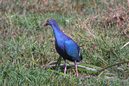
Purple swamphens are large members of the rail family (Rallidae). Males are larger than females, males average 1,050 g and females 850 g. They are chicken-sized birds with dark, shiny indigo or purple feathers and red bills and frontal shields. Although plumage color varies regionally, in general their backs and wings are dark green, brown or black with a green sheen and their breasts and heads are from pale blue to purple blue. Their tails are short, and they have bright white feathers on the undersides of their tails. Their legs are long, scaly, and orange-red. (Balasubramaniam and Guay, 2008; Olliver, 2008)
- Other Physical Features
- endothermic
- homoiothermic
- bilateral symmetry
- Sexual Dimorphism
- male larger
-
- Range mass
- 850 to 1050 g
- 29.96 to 37.00 oz
-
- Average length
- 51 cm
- 20.08 in
Reproduction
Purple swamphens use a variety of mating systems, ranging from monogamous mating to communal mating. In communal mating, two breeding females share one nest and are fertilized by several males. In addition to the parents, non-breeding helpers of both sexes help raise the young. These groups generally contain 6 to 9 birds and the helpers are usually close kin to the breeders. Dominance hierarchies in these groups exist and there is generally a dominant female that breeds the most. Some populations of purple swamphens are monogamous. The full range of mating systems can be found in other populations, including smaller social breeding arrangements consisting of 1 or 2 females, 1 or several males, and helpers at the nest or not. (Jamieson, 1997)
Courtship in New Zealand populations begins in late July and continues until early December. Males use an elaborate courtship display where they hold reeds in their bill, bow, and emit a chuckling vocalization. Preening is a common behavior, and it is often invited by one bird preening and bowing while another approaches. Courtship feeding occurs more often in communal settings than in pairs. Copulation could be initiated by a bird giving a humming call or by the male chasing her. Copulation within communal settings involves every type of pairing possible, including heterosexual, homosexual, and multiple participants. Group mating activity appears to have a function in synchronizing all the birds’ sexual cycles, thus allowing clutches to be laid and hatched simultaneously. Birds nesting in exclusive pairs copulate less than those in communal settings. (Craig, 1980)
Males become sexually mature when they are three years old. They mate with the two oldest and most dominant females in their group. Two to seven breeding males are possible in one communal breeding group. Young from previous seasons may be present to help with rearing the young. Both sexes of parents, but not sexually immature helpers, incubate the eggs. If a helper is old enough to breed but didn’t, it may help incubate near the end of the incubation period. Because of this system, yearling birds encounter their first hatchlings while under the supervision of more experienced birds. Non-breeders two or three years old have already had at least one year experience with young, and the parents themselves have had three or more years experience raising young. It appears raising chicks is partly a learned behavior, since non-breeders observe and learn how to provision the young. They build nests out of grass and tussock and sometimes both breeding females lay in the same nest. Neither female attempts to damage the other female’s eggs. The eggs hatch within four days of each other and the hatchlings are ready to leave the nest after about two days. They are brooded for a week and parents and helpers feed them until they are about ten weeks old. Breeding groups often attempt a second brood in a season, but these broods are not often successful. (Jamieson, 1988)
Males build several nests. The ones built early in the season appear to be practice nests, as they are poorly constructed and lack a well-shaped bowl. They use stems of Typha and Juncus and tussocks of Carex and Cyperus. Nests are protected by a canopy of plants and are accessible by a ramp. After hatching, males then construct new nests specifically for brooding. Nests made of Typha are preferred for this purpose. Brood nests are often abandoned in favor of ones built nearer feeding sites. (Craig, 1980)
Females usually lay their eggs around dawn. Females sharing a nest typically lay their eggs on the same days. Clutches are laid between mid August and mid February. Most breeders lay one or two clutches per season, but if a clutch is lost, extra clutches will be laid to make up for it. Each female will lay 3 to 6 eggs per clutch, with up to 12 eggs in a communal nest. Dominant females lay at least one egg more than submissive females when in communal settings. Incubation begins when half the clutch is laid, so individual eggs will end up hatching between 23 and 29 days after being laid. Hatching occurs over a two to three day interval. Only adults incubate, and females incubate more than males. In communal settings, the dominant female incubates the most. Interestingly, in group settings females will incubate most often during the day and allow males to concentrate on defense. Males are better at defense and incubate at night, when they aren’t needed for protection. In pair settings, this division of labor is difficult to implement and nest defense is not as effective. (Craig, 1980; Jamieson and Craig, 1987)
- Key Reproductive Features
- iteroparous
- seasonal breeding
- gonochoric/gonochoristic/dioecious (sexes separate)
- sexual
- oviparous
-
- Breeding interval
- Purple swamphens have one breeding season per year and produce 1 or 2 clutches at that time.
-
- Breeding season
- Breeding varies with region, coinciding with spring.
-
- Range eggs per season
- 3 to 6
-
- Range time to hatching
- 23 to 29 days
-
- Average time to independence
- 2 months
-
- Average age at sexual or reproductive maturity (male)
- 3 years
Purple swamphens generally have help when raising young. Monogamous pairs are often assisted by the young they’ve raised from earlier broods. Promiscuous mating groups all help each other. Also, both of the above groups may receive aid from non-breeders of either sex and different ages. When young hatch they are nidifugous and precocial. During the hatching period, one parent will sit on the nest and the hatched chick(s) while others bring food to feed the sitter or the young. Within three days new hatchlings are led away from the nest and fed elsewhere, sometimes on floating platforms of aquatic vegetation. Hatchlings begin to eat on their own after two days, but are still fed by adults until they are two months old. Hatchlings learn to stay close to cover and whenever a predator is spotted adults rush to protect the young. In pair territories, the young become independent earlier because their parents re-nest and hand over care to helpers. (Craig, 1980)
- Parental Investment
- precocial
-
pre-fertilization
- provisioning
-
protecting
- female
-
pre-hatching/birth
-
provisioning
- female
-
protecting
- male
- female
-
provisioning
-
pre-weaning/fledging
-
provisioning
- male
- female
-
protecting
- male
- female
-
provisioning
-
pre-independence
-
provisioning
- male
- female
-
protecting
- male
- female
-
provisioning
- post-independence association with parents
Lifespan/Longevity
There is little information on lifespan in purple swamphens in the literature. In New Zealand the oldest recorded pukeho was 9 years old. The related American species, Porphyrio martinica, has been recorded living up to 22 years in the wild.
Behavior
Breeding birds defend a home range to the exclusion of other purple swamphens. Resident birds have an equal sex ratio and all of them, juveniles included, assist with territorial defense. Groups usually have a stable membership, but some groups which are formed early in the breeding season and which have too many males may change membership. The members of the groups arrange themselves into a dominance hierarchy using sex and age as factors to determine each other’s place. When juveniles grow up in a communal breeding setting, they will remain in their natal territories after maturity. When juveniles have been raised by pairs, however, they leave their natal territory when nesting begins the next season. (Craig, 1980)
Purple swamphens prefer to run or swim but will attempt to fly if necessary. They are poor fliers, their take-offs are difficult and their long legs dangle awkwardly while they are airborne. Their landings are more controlled crashes, and they often try to cushion themselves by falling on a shrub. (Olliver, 2008)
- Key Behaviors
- cursorial
- terricolous
- flies
- diurnal
- motile
- sedentary
- territorial
- social
- dominance hierarchies
Home Range
Home range sizes are not reported for purple swamphens.
Communication and Perception
Purple swamphens communicate visually and with vocalizations. Their calls are varied, including their shrieking warning and attack calls and their hummed courtship calls. They also use a flash of their white rumps to tell predators they’ve been spotted. (Craig, 1980; Olliver, 2008)
Food Habits
Purple swamphens eat vegetable matter and small animal prey. They eat the bulbs of Scirpus plants and browse on the shoots of marsh grasses and reeds. Animal prey is usually arthropods and other invertebrates, such as snails, although they occasionally take vertebrate prey, including fish, birds, and lizards. When they eat birds, they generally eat eggs, nestlings, and juveniles. They have been recorded preying on passerines and waterfowl, including teal, swans, and ducks. They also swallow grit, like sand or other sediment, to help their gizzards grind up their food. They sometimes lift food to their mouths with their feet, rather than eating it on the ground. (Balasubramaniam and Guay, 2008; Gomez, et al., 2004)
- Primary Diet
- omnivore
- Animal Foods
- birds
- amphibians
- reptiles
- fish
- eggs
- insects
- terrestrial non-insect arthropods
- mollusks
- Plant Foods
- leaves
- roots and tubers
Predation
Purple swamphens are one of New Zealand’s most successful bird species because they have appropriate responses to terrestrial mammalian predators. New Zealand has no native terrestrial predators, so many native New Zealand birds are very vulnerable to predation by introduced mammalian predators. One of their responses to predators is to physically attack the predator. They also use wing flapping, calls, and flashing their white rump patches to alert conspecifics to the presence of a predator and disturb the predator itself. (Bunin and Jamieson, 1996)
Purple swamphens use a conspicuous rump patch to signal their awareness of a predator’s proximity. To call attention to the patch, they flick their tails up and down rapidly. Interestingly, it appears the signal is not meant to alarm other swamphens as much as it is meant to tell the predator it’s been spotted. If the prey communicates its awareness of the predator’s presence, the predator may be less likely to attempt a pursuit. Also, purple swamphens have been noted to signal their awareness less when they are closer to cover. This may be due to decreased vigilance or to the lower visibility of the signal when the swamphen is close to cover. (Alvarez, 1993)
Sometimes purple swamphens form groups to mob stoats and rats. The shrieking calls they emit during these hunts are called “blue murder” by overhearing humans. When not attacking, they will flee. (Olliver, 2008)
-
- Known Predators
-
- marsh harriers (Circus aeruginosus)
- Australasian harriers (Circus approximans)
- stoats (Mustela erminea)
- rats (Rattus species)
Ecosystem Roles
Purple swamphens are important predators of marsh invertebrates and impact marsh communities through their predation and browsing.
Economic Importance for Humans: Positive
Purple swamphens eat pest insects in crop areas. They also hunt and kill rats and stoats. (Olliver, 2008)
Because they are the closest relatives of endangered takahes (Porphyrio hochstetteri and Porphyrio mantelli), purple swamphens are valuable research animals for takahe conservation. One problem plaguing takahe is their low fertility rates. Gunn et al. (2008) performed experiments to find out what was the best method to retrieve sperm from purple swamphens. Perfecting artificial insemination in swamphens may make it easier to help takahe with their breeding needs. Purple swamphens may also be valuable as potential foster parents to takahe. Unlike purple swamphens, takahe do not possess good responses to terrestrial predators. This lack of response has caused serious declines in their populations since the introductions of mammalian predators. Bunin and Jamieson (1996) took one takahe chick and placed it with purple swamphens. This cross-fostered chicks grew up to display swamphen responses, including increased vigilance and tail flicking. (Bunin and Jamieson, 1996; Gunn, et al., 2008)
- Positive Impacts
- research and education
- controls pest population
Economic Importance for Humans: Negative
Purple swamphens eat crop and pasture plants, including potatoes, kumara, clover, and grass. (Olliver, 2008)
- Negative Impacts
- crop pest
Conservation Status
Purple swamphens are not considered threatened from a global viewpoint. However, in Europe populations have declined as a result of habitat loss. They are considered rare and protected species throughout most of Europe. In Portugal they are considered endangered and they have been extirpated from parts of their former range. Hunting of purple swamphens is illegal, although hunters sometimes mistake them for legal gamebirds, like common coots (Fulica atra) and moorhens (Gallinula chloropus). Because they don’t move far by flying, they don't readily colonize available habitat that is isolated. In some areas more suitable wetland habitats are being created as a result of human expansion. Rice fields built along the Guadalquivir river encourage growth of Typha and Phragmites. New reservoirs result in build up of silt layers and the formation of new marshes. Reintroductions are also being attempted. European populations seem to be recovering. (Pacheco and McGregor, 2004; Sanchez-Lafuente, et al., 1992)
-
- IUCN Red List
-
No special status
More information
-
- IUCN Red List
-
No special status
More information
-
- US Migratory Bird Act
- No special status
-
- US Federal List
- No special status
-
- CITES
- No special status
Other Comments
It is thought that ancestral purple swamphens colonized Australasian islands, where these isolated populations evolved to become endemic swamphens and takahe: Porphyrio albus, Porphyrio hochstetteri, and Porphyrio mantelli. (Bunin and Jamieson, 1996; Olliver, 2008)
Purple swamphens were kept as decorative birds by Romans and are one of the few bird species they did not eat.
Contributors
Tanya Dewey (editor), Animal Diversity Web.
Aqua Nara Dakota (author), Special Projects.
Glossary
- Australian
-
Living in Australia, New Zealand, Tasmania, New Guinea and associated islands.

- Ethiopian
-
living in sub-Saharan Africa (south of 30 degrees north) and Madagascar.
- Nearctic
-
living in the Nearctic biogeographic province, the northern part of the New World. This includes Greenland, the Canadian Arctic islands, and all of the North American as far south as the highlands of central Mexico.
- Palearctic
-
living in the northern part of the Old World. In otherwords, Europe and Asia and northern Africa.
- acoustic
-
uses sound to communicate
- agricultural
-
living in landscapes dominated by human agriculture.
- bilateral symmetry
-
having body symmetry such that the animal can be divided in one plane into two mirror-image halves. Animals with bilateral symmetry have dorsal and ventral sides, as well as anterior and posterior ends. Synapomorphy of the Bilateria.
- brackish water
-
areas with salty water, usually in coastal marshes and estuaries.
- chemical
-
uses smells or other chemicals to communicate
- coastal
-
the nearshore aquatic habitats near a coast, or shoreline.
- cooperative breeder
-
helpers provide assistance in raising young that are not their own
- diurnal
-
- active during the day, 2. lasting for one day.
- dominance hierarchies
-
ranking system or pecking order among members of a long-term social group, where dominance status affects access to resources or mates
- endothermic
-
animals that use metabolically generated heat to regulate body temperature independently of ambient temperature. Endothermy is a synapomorphy of the Mammalia, although it may have arisen in a (now extinct) synapsid ancestor; the fossil record does not distinguish these possibilities. Convergent in birds.
- estuarine
-
an area where a freshwater river meets the ocean and tidal influences result in fluctuations in salinity.
- freshwater
-
mainly lives in water that is not salty.
- introduced
-
referring to animal species that have been transported to and established populations in regions outside of their natural range, usually through human action.
- iteroparous
-
offspring are produced in more than one group (litters, clutches, etc.) and across multiple seasons (or other periods hospitable to reproduction). Iteroparous animals must, by definition, survive over multiple seasons (or periodic condition changes).
- marsh
-
marshes are wetland areas often dominated by grasses and reeds.
- monogamous
-
Having one mate at a time.
- motile
-
having the capacity to move from one place to another.
- native range
-
the area in which the animal is naturally found, the region in which it is endemic.
- oceanic islands
-
islands that are not part of continental shelf areas, they are not, and have never been, connected to a continental land mass, most typically these are volcanic islands.
- omnivore
-
an animal that mainly eats all kinds of things, including plants and animals
- oriental
-
found in the oriental region of the world. In other words, India and southeast Asia.
- oviparous
-
reproduction in which eggs are released by the female; development of offspring occurs outside the mother's body.
- polyandrous
-
Referring to a mating system in which a female mates with several males during one breeding season (compare polygynous).
- polygynandrous
-
the kind of polygamy in which a female pairs with several males, each of which also pairs with several different females.
- polygynous
-
having more than one female as a mate at one time
- riparian
-
Referring to something living or located adjacent to a waterbody (usually, but not always, a river or stream).
- seasonal breeding
-
breeding is confined to a particular season
- sedentary
-
remains in the same area
- sexual
-
reproduction that includes combining the genetic contribution of two individuals, a male and a female
- social
-
associates with others of its species; forms social groups.
- swamp
-
a wetland area that may be permanently or intermittently covered in water, often dominated by woody vegetation.
- tactile
-
uses touch to communicate
- temperate
-
that region of the Earth between 23.5 degrees North and 60 degrees North (between the Tropic of Cancer and the Arctic Circle) and between 23.5 degrees South and 60 degrees South (between the Tropic of Capricorn and the Antarctic Circle).
- terrestrial
-
Living on the ground.
- territorial
-
defends an area within the home range, occupied by a single animals or group of animals of the same species and held through overt defense, display, or advertisement
- tropical
-
the region of the earth that surrounds the equator, from 23.5 degrees north to 23.5 degrees south.
- visual
-
uses sight to communicate
- young precocial
-
young are relatively well-developed when born
References
Alvarez, F. 1993. Alertness signalling in two rail species. Animal Behavior, 46: 1229-1231.
Balasubramaniam, S., P. Guay. 2008. Purple Swamphens (Porphyrio porphyrio) Attempting to Prey upon Black Swan (Cygnus atratus) Eggs and Preying upon a Cygnet on an Urban Lake in Melbourne, Australia. The Wilson Journal of Ornithology, 120 (3): 633-635.
Bunin, J., I. Jamieson. 1996. Responses to a Model Predator of New Zealand's Endangered Takahe and Its Closest Relative, the Pukeko. Conservation Biology, 10 (5): 1463-1466.
Celdran, J., F. Polo, V. Peinado, G. Viscor, J. Palomeque. 1994. Haematology of captive herons, egrets, spoonbill, ibis and gallinule. Comparative Biochemical Physiology, 107A: 337-341.
Craig, J. 1980. Pair and group breeding behavior of a communal gallinule, the pukeko, (Porphyrio p. melanotus). Animal Behavior, 28: 593-603.
Freifeld, H., D. Steadman, J. Sailer. 2001. Landbirds on offshore islands in Samoa. Journal of Field Ornithology, 72 (1): 72-85.
Gomez, G., R. Baos, B. Gomara, B. Jimenez, V. Benito, R. Montoro, F. Hiraldo, M. Gonzalez. 2004. Influence of a Mine Tailing Accident Near Donana National Park (Spain) on Heavy Metals and Arsenic Accumulation in 14 Species of Waterfowl (1998 to 2000). Archives of Environmental Contamination and Toxicology, 47: 521-529.
Gunn, M., Z. Champion, M. Casey, P. Teal, P. Casey. 2008. Testicular and spermatozoan parameters in the pukeko (Porphyrio porphyrio melanotus). Animal Reproduction Science, 109: 330-342.
Jamieson, I. 1988. Provisioning behavior in a communal breeder: an epigenetic approach to the study of individual variation in behavior. Behavior, 104 (3-4): 262-279.
Jamieson, I. 1997. Testing reproductive skew models in a communally breeding birds, the pukeko, Porphyrio porphyrio . Proceedings of the Royal Society of London B, 264: 335-340.
Jamieson, I., J. Craig. 1987. Male-Male and Female-Female Courtship and Copulation Behavior in a Communally Breeding Bird. Animal Behavior, 35 (4): 1251-1253.
Olliver, N. 2008. "New Zealand Birds" (On-line). Pukeko. Accessed January 19, 2009 at http://www.nzbirds.com/birds/pukeko.html.
Pacheco, C., P. McGregor. 2004. Conservation of the purple gallinule (Porphyrio porphyrio L.) in Portugal: causes of decline, recovery and expansion. Biological Conservation, 119: 115-120.
Sanchez-Lafuente, A., P. Rey, F. Valera, J. Munoz-Cobo. 1992. Past and current distribution of the purple swamphen Porphyrio porphyrio L. in the Iberian Peninsula. Biological Conservation, 61: 23-30.