Polygonia progne


Geographic Range
Polygonia progne lives on the North American continent. It makes its habitat in the Northwestern Territories of the US and Eastern British Columbia. It ranges from the west along the Pacific Coast to central California. It can be found in the East through southern Canada, and the northern United States from Maine south to the Appalachians in North Carolina. It is also found in the southeast from Montana and the Dakotas to eastern Nebraska and central Kansas. (Miller, 1992; Scott, 1986)
Habitat
These butterflies live mainly in woodland or mountainous areas. They are predominantly found in the Coastal Redwood Forest and the Hudsonian Zone Woodlands. They can be found along dirt roads, streamsides, and within clearings in rich deciduous or coniferous woods. Often these areas are in hilly terrain or canyons. (Scott, 1986)
- Habitat Regions
- terrestrial
Physical Description
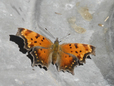
Polygonia progne, like all insects, has six legs and a segmented body. Its front legs are hairy and brush-like and are used for cleaning its antennae. The undersides of its wings are a charcoal gray with fine dark striations. When its wings are raised, the butterfly looks like a dead leaf and is camouflaged from predators. The upperside of the wing is a bright orange-brown. Its hindwings have a wide dark border covering about 1/4 of the wing. The border encloses a few small yellow spots. The wingspan of this insect is approximately 50 mm. (Arnett, 1985)
- Other Physical Features
- ectothermic
- heterothermic
- bilateral symmetry
-
- Average wingspan
- 50 mm
- 1.97 in
Development
The adult butterfly lays eggs on the leaves of gooseberries and azaleas. The eggs hatch into larval caterpillars. These caterpillars eat leaves, then build a cocoon and go into hibernation. The caterpillar emerges from hibernation as an adult butterfly. (Grzimek, 1972)
- Development - Life Cycle
- metamorphosis
Reproduction
Grey comma butterflies are most often seen flying from April to May. It is during this time that adults are searching for mates. Males perch in the afternoon sun on shrubs and small trees, watching for females. When a female is spotted, the male forces it to land. Once the female has landed the male will flutter over her and try to mate. If the female lowers its wings the male will land on top of her and mate. If the female flies away or will not lower her wings the male will leave in search on a new mate. After fertilization occurs, the female will lay multiple eggs singly on the leaves of gooseberries and azaleas. The eggs hatch and produce caterpillars. These caterpillars eat leaves until they have stored enough food to survive their metamorphosis. They then encase themselves in cocoons and emerge in October as adult butterflies. (Grzimek, 1972; Scott, 1986)
- Key Reproductive Features
- seasonal breeding
- sexual
- oviparous
-
- Breeding season
- April to May
Behavior
Grey commas emerge from their eggs as larval caterpillars. Caterpillars do nothing but feed on leaves until it has stored enough food for metamorphosis. A caterpillar then spins a cocoon and begins its metamorphosis. It emerges as a butterfly sometime around October. The butterfly feeds on tree sap and flower nectar for the next two to three weeks. It then finds a place to hibernate for the remainder of winter. Once winter is over the butterfly comes out of hibernation in search of food. In April and May the mating season begins and males spend their time in search of a mate. After mating the butterflies prepare for hibernation. (Arnett, 1985; Miller, 1992)
- Key Behaviors
- flies
- diurnal
- motile
- hibernation
Food Habits
While in its adult stage, grey commas feeds mainly on tree sap and flower nectar. They use a modified sucker tube (proboscis) as a mouth to suck up the juices of plants and trees. The butterfly uncoils its proboscis to drink its food and then curls the tube back up when it is not in use. In the larval stage, the caterpillar rarely travels from the plant where it is born, so it feeds mainly on the leaves of gooseberries and azaleas. (Arnett, 1985; Struttmann, 1997)
- Primary Diet
- herbivore
- Plant Foods
- leaves
- nectar
- sap or other plant fluids
Predation
When the wings are raised, and the undersides are exposed, the adult butterfly resembles a dead leaf.
- Anti-predator Adaptations
- cryptic
Ecosystem Roles
Adult butterflies are important pollinators, and caterpillars damage teh foliage of the plants they eat. These butterflies are also likely eaten by other organisms.
- Ecosystem Impact
- pollinates
Economic Importance for Humans: Positive
Butterflies are important pollinators. Also, butterfly watching has become a hobby for many nature lovers.
- Positive Impacts
- ecotourism
Economic Importance for Humans: Negative
The larval stage of the Grey Comma butterfly eats the leaves off of gooseberries and azaleas, a behavior which can damage these plants if they become too abundant.
Conservation Status
Grey commas are currently widespread and abundant and therefore are not considered threatened.
-
- IUCN Red List
- Not Evaluated
-
- US Federal List
- No special status
-
- CITES
- No special status
-
- State of Michigan List
- No special status
Contributors
Matthew Wund (editor), University of Michigan-Ann Arbor.
Chris Power (author), Southwestern University, Stephanie Fabritius (editor), Southwestern University.
Glossary
- Nearctic
-
living in the Nearctic biogeographic province, the northern part of the New World. This includes Greenland, the Canadian Arctic islands, and all of the North American as far south as the highlands of central Mexico.

- bilateral symmetry
-
having body symmetry such that the animal can be divided in one plane into two mirror-image halves. Animals with bilateral symmetry have dorsal and ventral sides, as well as anterior and posterior ends. Synapomorphy of the Bilateria.
- cryptic
-
having markings, coloration, shapes, or other features that cause an animal to be camouflaged in its natural environment; being difficult to see or otherwise detect.
- diurnal
-
- active during the day, 2. lasting for one day.
- ecotourism
-
humans benefit economically by promoting tourism that focuses on the appreciation of natural areas or animals. Ecotourism implies that there are existing programs that profit from the appreciation of natural areas or animals.
- ectothermic
-
animals which must use heat acquired from the environment and behavioral adaptations to regulate body temperature
- folivore
-
an animal that mainly eats leaves.
- forest
-
forest biomes are dominated by trees, otherwise forest biomes can vary widely in amount of precipitation and seasonality.
- herbivore
-
An animal that eats mainly plants or parts of plants.
- heterothermic
-
having a body temperature that fluctuates with that of the immediate environment; having no mechanism or a poorly developed mechanism for regulating internal body temperature.
- hibernation
-
the state that some animals enter during winter in which normal physiological processes are significantly reduced, thus lowering the animal's energy requirements. The act or condition of passing winter in a torpid or resting state, typically involving the abandonment of homoiothermy in mammals.
- metamorphosis
-
A large change in the shape or structure of an animal that happens as the animal grows. In insects, "incomplete metamorphosis" is when young animals are similar to adults and change gradually into the adult form, and "complete metamorphosis" is when there is a profound change between larval and adult forms. Butterflies have complete metamorphosis, grasshoppers have incomplete metamorphosis.
- motile
-
having the capacity to move from one place to another.
- mountains
-
This terrestrial biome includes summits of high mountains, either without vegetation or covered by low, tundra-like vegetation.
- native range
-
the area in which the animal is naturally found, the region in which it is endemic.
- nectarivore
-
an animal that mainly eats nectar from flowers
- oviparous
-
reproduction in which eggs are released by the female; development of offspring occurs outside the mother's body.
- seasonal breeding
-
breeding is confined to a particular season
- sexual
-
reproduction that includes combining the genetic contribution of two individuals, a male and a female
- terrestrial
-
Living on the ground.
References
Arnett, R. 1985. American Insects. New York: Van Nostrand Reinhold Company.
Grzimek, 1972. Animal Life Encyclopedia vol.2. New York: Van Nostrand Reinhold Company.
Klots, A. 1981. Living Insects of the World. New York: Doubleday & Company.
Miller, 1992. The Common Names of North American Butterflies. Washington: Smithsonian Institution.
Scott, 1986. The Butterflies of North America. Stanford: Stanford University Press.
Struttmann, J. 1997. "Butterflies of North America" (On-line). Accessed September 26, 2001 at http://www.npwrc.usgs.gov/resource/distr/lepid/bflyusa/usa/212.htm.