Pollachius virensPollock
Geographic Range
Pollachius virens occurs on both sides of the North Atlantic. In the western Atlantic, their distribution is centered between Cape Cod and the Strait of Canso, while in the eastern Atlantic they are mainly found around Iceland, in the North Sea, and off the northern coast of Norway (Steele 1963). Specimens have been found as far south as North Carolina (Coles 1926), although their abundance is very low at the southern edge of their range. They are native to much of the Atlantic and Arctic Oceans. (Coles, 1926; Steele, 1963)
- Biogeographic Regions
- arctic ocean
- atlantic ocean
Habitat
The eggs are pelagic, and are typically found at depths of 50 to 90 m. Juvenile pollock move into the shallow littoral zone for the first two years of life (Steele 1963). Juvenile pollock often use macroalgae in the rocky intertidal zone as a source of refuge and forage during this period (Rangeley and Kramer 1995). Adults leave the shallow littoral zones and swim in large schools throughout the water column. Adults show no substrate preference, but temperature is an important factor. Adults may be found at depths ranging from 5 to 325 m, but more typically between 35 and 130 m (Cargnelli et al. 1999) (Cargnelli, et al., 1999; Rangeley and Kramer, 1995; Rangeley and Kramer, 1998; Steele, 1963)
- Habitat Regions
- temperate
- saltwater or marine
- Other Habitat Features
- intertidal or littoral
-
- Range depth
- 5 to 325 m
- 16.40 to 1066.27 ft
-
- Average depth
- 35-130 m
- ft
Physical Description
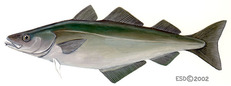
Pollock are brownish-green dorsally with the color becoming more pale ventrally. They have a pale, smooth lateral line that is interrupted. The body is fusiform. They have a small chin barbel and a terminal mouth (Cohen et al. 1990). Although there is evidence that some populations may be geographically isolated, there is no evidence that there are any important genetic differences between populations (Mayo et al. 1989). Adult pollock can reach maximum lengths of 130 cm but are usually less than 110 cm (Collette and Klein-MacPhee 2002). Mayo et al. (1989) reported that for the period 1970 to 1984 mean length was 50.5 cm for males and 47.9 cm for females. O'Brien et al. (1993) reported that for the period 1986 to 1988 mean length was 41.8 cm for males and 39.1 cm for females. This change in size has also been accompanied by a decrease in mean age at maturity (see Development). (Collette and Klein-MacPhee, 2002; Mayo, et al., 1989; O'Brien, et al., 1993)
- Other Physical Features
- ectothermic
- heterothermic
- bilateral symmetry
- Sexual Dimorphism
- male larger
-
- Range mass
- 32 (high) kg
- 70.48 (high) lb
-
- Average mass
- 0.5-5 kg
- lb
-
- Range length
- 28 to 130 cm
- 11.02 to 51.18 in
-
- Average length
- 45-85 cm
- in
Development
Pollock are characterized by a pelagic larval stage that typically lasts between three and four months. When individuals reach 3 cm in length they migrate into the shallow sublittoral zone until near the end of their second year. Individuals are often termed "harbor" pollock at this stage (Steele 1963). At the end of their second year, juveniles move to offshore regions where they will spend most of their adult life (Cargnelli et al. 1999). (Cargnelli, et al., 1999; Mayo, et al., 1989; O'Brien, et al., 1993; Steele, 1963)
Reproduction
Pollock undertake migrations to reach spawning grounds. The largest concentrations of spawning adults occur in Massachusetts Bay, the Stellwagen Bank, Cape Ann to the Isle of Shoals, the western Gulf of Maine and on the Scotian Shelf (Cargnelli et al. 1999). However, there is little information on the actual spawning event, and no knowledge of mating system (Cargnelli et al. 1999). (Cargnelli, et al., 1999)
Pollock undertake north-south migrations for spawning. Spawning occurs between September and April but peaks between December and February (Cargnelli et al. 1999) . There is more variability in spawning time in northern sites than in southern sites. Spawning occurs over hard bottoms with stony or rocky surfaces, and is highly dependent on temperature. Spawning begins when water temperatures fall below 8 C, and peaks when temperatures are below 4.5 to 6 C. Spawning is reported to occur at salinities of 32 to 32.8 ppt (Collette and Klein-MacPhee 2002). Fecundity per female ranges from 200,000 to 8,260,000 eggs. Incubation time of eggs ranges from 5 to 15 days, and optimal development occurs at 8.9 C (Cargnelli et al. 1999). (Cargnelli, et al., 1999; Collette and Klein-MacPhee, 2002)
Mayo et al. (1989) reported that for the period 1970 to 1984 mean age at maturity was 3.5 years for males and 3.2 years for females. O'Brien et al. (1993) reported that for the period 1986 to 1988 mean age at maturity had dropped to 2.3 years for males and 2.0 years for females. (Mayo, et al., 1989; O'Brien, et al., 1993)
- Key Reproductive Features
- iteroparous
- seasonal breeding
- gonochoric/gonochoristic/dioecious (sexes separate)
- sexual
- fertilization
- oviparous
-
- Breeding interval
- Pollock breed once yearly after reaching sexual maturity.
-
- Breeding season
- Spawning occurs between September and April, and is concentrated between December and February.
-
- Range number of offspring
- 200,000 to 8,260,000
-
- Range time to hatching
- 5 to 15 days
-
- Average age at sexual or reproductive maturity (female)
- 2.0 years
-
- Average age at sexual or reproductive maturity (female)
Sex: female - 730 days
- AnAge
- Average age at sexual or reproductive maturity (female)
-
- Average age at sexual or reproductive maturity (male)
- 2.3 years
-
- Average age at sexual or reproductive maturity (male)
Sex: male - 839 days
- AnAge
- Average age at sexual or reproductive maturity (male)
Parents provide no care for the young, and eggs rise in the water column and drift after fertilization. Young have a yolk sack that is absorbed after approximately five days. The rate at which yolk is absorbed is temperature dependent (Steele 1963).
- Parental Investment
- no parental involvement
-
pre-fertilization
- provisioning
-
protecting
- female
Lifespan/Longevity
Maximum reported age in pollock is 25 years. A more typical lifespan is 10 years. The majority of fish caught, however, range between 3 and 6 years of age (Mayo 1994). (Mayo, 1994)
-
- Range lifespan
Status: wild - 25 (high) years
- Range lifespan
-
- Typical lifespan
Status: wild - 10 (high) years
- Typical lifespan
-
- Average lifespan
Status: captivity - 25 years
- AnAge
- Average lifespan
Behavior
Pollock are a schooling species for the adult portion of their lifespan and are mainly in open waters during this time. Distribution changes seasonally and is related to water temperatures, depth, and feeding (Steele 1963). There is some evidence of a seasonal north-south migration within their range, particularly during breeding season. Some studies have found that there is relatively little movement during the summer (non-breeding) season (Bigelow and Schroeder 1953). Adults migrate to shallower waters to spawn. Eggs and larvae and free-floating. Juveniles move in to shallow waters for the first two years of life, but may move offshore to avoid warm temperatures. (Bigelow and Schroeder, 1953; Steele, 1963)
- Key Behaviors
- natatorial
- motile
- migratory
- social
Home Range
There is no information on home range in pollock.
Communication and Perception
Pollock rely on their lateral line system for schooling. Pitcher et al. (1976) covered the eyes of schooling ollock with opaque patches to demonstrate that vision is not necessary for schooling behavior. However pollock are not able to school if their lateral line has been severed, evidence that it is important for schooling. Pollock may use vision for prey detection and capture and for mating. (Pitcher, et al., 1976)
Food Habits
Food sources differ between life history stages. Larval pollock subsist initially on yolk contained in egg sacks. Small larvae consume larval copepods, while larger larvae consume adult copepods (Steele 1963). Juvenile pollock subsist mainly on crustaceans, particularly the euphausiid Meganyctiphanes norvegica (Collette and Klein-MacPhee 2002), and to a lesser degree on fish and mollusks. Adults feed on crustaceans, fish, and mollusks as well, but the relative importance of these varies with the size of individual. The smallest adults (41 to 65 cm) feed primarily on crustaceans, medium size adults (66 to 95 cm) feed mainly on fish such as Atlantic herring Clupea harengus, while the largest adults (> 95 cm) feed on mollusks such as squid Loligo (Bowman and Michaels 1984). (Bowman and Michaels, 1984; Collette and Klein-MacPhee, 2002; Steele, 1963)
- Primary Diet
-
carnivore
- piscivore
- eats non-insect arthropods
- molluscivore
- Animal Foods
- fish
- mollusks
- aquatic crustaceans
Predation
Major predators include seals, sea lions, whales, dolphins, and other large bony fish. Human fishing operations play a significant role in pollock mortality, and there is speculation that overfishing may be causing the decrease in age at maturity observed by Cargnelli et al. (1999). Adults and juveniles exhibit schooling as an anti-predator defense. Rangeley and Kramer (1998) found that schooling and habitat selection are important anti-predator strategies in juveniles; juveniles spend more time in algae beds in the presence of a predator. Juveniles that remain in the open were more likely to aggregate in the presence of a predator. (Cargnelli, et al., 1999; Rangeley and Kramer, 1998)
-
- Known Predators
-
- seals (Phocidae)
- sea lions (Otariidae)
- toothed whales (Odontoceti)
- dolphins (Delphinidae)
- large bony fish (Actinopterygii)
Ecosystem Roles
Pollock are an important predator in many ecosystems due to their population size and density. They play in important role in population dynamics for some crustaceans, fish, and mollusks (see 'Food Habits'). Sea lampreys Petromyzon marinus parasitize pollock.
- Sea lampreys Petromyzon marinus
Economic Importance for Humans: Positive
Pollock are an extremely important fish in commercial fisheries, and commercial fisheries on both sides of the Atlantic are well developed. The degree to which pollock are integrated into the fisheries of many nations is evidenced by the several dozen common names in several languages for P. virens. They are also an important gamefish (Steele 1963). (Steele, 1963)
- Positive Impacts
- food
Economic Importance for Humans: Negative
There are no negative impacts of Atlantic pollock on humans.
Conservation Status
Habitat loss or degradation of nearshore intertidal zones that serve as a refuge for juvenile pollock are a current concern, and there is a call for more research related to this topic (Cargnelli et al. 1999). There is some speculation that these habitats may be a bottleneck restricting population size. There are additional concerns regarding the effect of overfishing on pollock population sizes. After catch rates increased steadily throughout the 1970s and early 1980s, catch rates dropped 82% between 1986 and 1996 (Mayo 1998). This was accompanied by a 36% decrease in spawning stock biomass between 1986 and 1994. There is speculation that overfishing may be causing important changes in population structure as well, for example the decrease in mean age at maturity and mean size at maturity observed by Caragnelli et al. (1999). (Cargnelli, et al., 1999; Mayo, 1998)
-
- IUCN Red List
- Not Evaluated
-
- US Federal List
- No special status
-
- CITES
- No special status
Other Comments
Alaskan Pollock is a separate species (Theragra chalcogramma).
Atlantic Pollock are know by various common names including saithe, coalfish, billet, and many others.
Contributors
Tanya Dewey (editor), Animal Diversity Web.
Thomas Neeson (author), University of Michigan-Ann Arbor, Kevin Wehrly (editor, instructor), University of Michigan-Ann Arbor.
Glossary
- Arctic Ocean
-
the body of water between Europe, Asia, and North America which occurs mostly north of the Arctic circle.
- Atlantic Ocean
-
the body of water between Africa, Europe, the southern ocean (above 60 degrees south latitude), and the western hemisphere. It is the second largest ocean in the world after the Pacific Ocean.

- bilateral symmetry
-
having body symmetry such that the animal can be divided in one plane into two mirror-image halves. Animals with bilateral symmetry have dorsal and ventral sides, as well as anterior and posterior ends. Synapomorphy of the Bilateria.
- carnivore
-
an animal that mainly eats meat
- chemical
-
uses smells or other chemicals to communicate
- coastal
-
the nearshore aquatic habitats near a coast, or shoreline.
- ectothermic
-
animals which must use heat acquired from the environment and behavioral adaptations to regulate body temperature
- external fertilization
-
fertilization takes place outside the female's body
- fertilization
-
union of egg and spermatozoan
- food
-
A substance that provides both nutrients and energy to a living thing.
- heterothermic
-
having a body temperature that fluctuates with that of the immediate environment; having no mechanism or a poorly developed mechanism for regulating internal body temperature.
- intertidal or littoral
-
the area of shoreline influenced mainly by the tides, between the highest and lowest reaches of the tide. An aquatic habitat.
- iteroparous
-
offspring are produced in more than one group (litters, clutches, etc.) and across multiple seasons (or other periods hospitable to reproduction). Iteroparous animals must, by definition, survive over multiple seasons (or periodic condition changes).
- migratory
-
makes seasonal movements between breeding and wintering grounds
- molluscivore
-
eats mollusks, members of Phylum Mollusca
- motile
-
having the capacity to move from one place to another.
- natatorial
-
specialized for swimming
- native range
-
the area in which the animal is naturally found, the region in which it is endemic.
- oviparous
-
reproduction in which eggs are released by the female; development of offspring occurs outside the mother's body.
- pelagic
-
An aquatic biome consisting of the open ocean, far from land, does not include sea bottom (benthic zone).
- piscivore
-
an animal that mainly eats fish
- saltwater or marine
-
mainly lives in oceans, seas, or other bodies of salt water.
- seasonal breeding
-
breeding is confined to a particular season
- sexual
-
reproduction that includes combining the genetic contribution of two individuals, a male and a female
- social
-
associates with others of its species; forms social groups.
- tactile
-
uses touch to communicate
- temperate
-
that region of the Earth between 23.5 degrees North and 60 degrees North (between the Tropic of Cancer and the Arctic Circle) and between 23.5 degrees South and 60 degrees South (between the Tropic of Capricorn and the Antarctic Circle).
- visual
-
uses sight to communicate
References
Bigelow, H., W. Schroeder. 1953. Fishes of the Gulf of Maine. U.S. Fish Wildl. Serve., Fish. Bull. 53: 577p.
Bowman, R., W. Michaels. 1984. Food of seventeen species of northwest Atlantic fish. NOAA Tech. Mem., NMFS-F/NEC-28: 183 p.
Cargnelli, L., S. Griesbach, D. Packer, P. Berrien, D. Johnson, W. Morse. 1999. Pollock, Pollachius virens, life history and habitat characteristics. NOAA Technical Memorandum, NMFS-NE-131: 1-30.
Coles, R. 1926. Notes on Cape Lookout (North Carolina) fishes - 1925.. Copeia, 151: 105-106.
Collette, B., G. Klein-MacPhee. 2002. Pollock, Pollachius virens . Pp. xxxx in B Collette, G Klein-MacPhee, eds. Bigelow and Schroeder's fishes of the Gulf of Maine. Washington, D.C.: Smithsonian Institution Press.
Mayo, R. 1994. Life histories and habitat requirements of demersal fishes. Pp. 2-3 in R Langton, J Pearce, J Gibson, eds. Selected living resources, habitat conditions, and human perturbations in the Gulf of Maine: Environmental and ecological considerations for fishery management.. Tech. Mem. NMFS-NE-106: NOAA.
Mayo, R. 1998. Pollock. Pp. 67-69 in S Clark, ed. Status of the fishery resources off the northeastern United States for 1998. Tech. Mem. NMFS-NE-115: NOAA.
Mayo, R., J. McGlade, S. Clark. 1989. Patterns of exploitation and biological status of pollock (Pollachius virens (L.)) in the Scotian Shelf, Georges Bank, and Gulf of Maine area. J. Northwest Atl. Fish. Sci., 9: 13-36.
O'Brien, L., J. Burnett, R. Mayo. 1993. Maturation of nineteen species of finfish off the Northeast coast of the United States, 1985-1990.. NOAA Tech. Tep. NMFS, 113: 66 pp..
Pitcher, T., B. Partridge, C. Wardle. 1976. A Blind Fish Can School. Science, 194: 963-965.
Rangeley, R., D. Kramer. 1998. Density-dependent antipredator tactics and habitat selection in juvenile Pollock. Ecology, 79: 943-952.
Rangeley, R., D. Kramer. 1995. Use of rocky intertidal habitats by juvenile pollock Pollachius virens . Mar. Ecol. Prog. Ser., 126: 9-17.
Steele, D. 1963. Pollock (Pollachius virens (L.)) in the Bay of Fundy. J. Fish. Res. Board Can., 20: 1267-1314.