Polites peckius



Geographic Range
Peck's skippers are found in the Nearctic range, and extend from Nova Scotia to British Columbia in southern Canada. Their range extends southward from northern Oregon, southern Colorado, northwest Arkansas, to northern Georgia. They are rare in the south. (Klots, 1951; Scott, 1986)
Habitat
These grassland skippers prefer open areas with ample nectar sources, such as meadows, powerline right-of-ways, prairies, parks and vacant lots. (Glassberg, 1999; Scott, 1986; Shapiro, 1966; Struttman, )
- Habitat Regions
- temperate
- Terrestrial Biomes
- savanna or grassland
- Other Habitat Features
- suburban
- agricultural
Physical Description
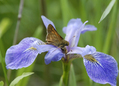
Peck's skippers are also known as yellow patch skippers because of the light colored post median spot bands on the underside of the forewings. The central spot is elongated and extends out toward the wing margin. Males have a dark black stigma on the upper surface of the forewing that separates the orange margin from the darker portion of the wing. These are small skippers, with the forewing lengths of females averaging 1.3 cm (1.2-1.4 cm). Males are slightly smaller with forewing lengths of 1.2 cm (1.1-1.3 cm). (Glassberg, 1999; Opler and Krizek, 1984)
Larvae are deep maroon colored with light brown mottling. The head is black with two white vertical streaks on the upper front and two white patches below. (Klots, 1951)
The eggs of Peck's skippers are cream colored and develop reddish mottling in irregular patterns. (Scott, 1986)
The chrysalis is reddish purple with white wing cases. (Scott, 1986)
- Other Physical Features
- ectothermic
- heterothermic
- bilateral symmetry
- Sexual Dimorphism
- female larger
- sexes colored or patterned differently
-
- Range wingspan
- 2.2 to 2.5 cm
- 0.87 to 0.98 in
Development
Peck's skippers have the ability to transform straight to the adult form of the next brood or slow down their growth and hibernate as 3rd, 4th, or 5th stage larvae. They are also reported to hibernate as pupae. (Klots, 1951; Scott, 1986)
- Development - Life Cycle
- metamorphosis
- diapause
Reproduction
Male Peck's skippers perch on low vegetation in sunny areas to await females. Courtship activities occur throughout the day. Mated pairs are observed mainly in the afternoon. (Opler and Krizek, 1984; Scott, 1986)
Peck's skippers have two broods in the north and three in the southern portion of their range. Females lay their eggs singly on appropriate substrate. (Scott, 1986)
- Key Reproductive Features
- iteroparous
- seasonal breeding
- gonochoric/gonochoristic/dioecious (sexes separate)
- sexual
- fertilization
- oviparous
-
- Breeding interval
- Peck's skippers have two broods in the north and three in the southern portion of their range.
-
- Breeding season
- The flight period ranges from May through October.
There is no parental care provided by butterflies.
- Parental Investment
- no parental involvement
Behavior
Peck's skippers have rapid flight and tend to stay close to the ground. They are often seen perching on grasses and sometimes exposed soil. Larvae live in leaf nests. (Iftner, et al., 1992)
- Key Behaviors
- flies
- diurnal
- motile
- hibernation
- colonial
Communication and Perception
Butterflies generally communicate through visual or pheremone recognition, or by tactile methods during courthship.
- Other Communication Modes
- pheromones
Food Habits
The larvae feed primarilly on rice cutgrass (Leersia oryzoides) and bluegrass (Poa pratensis), although other grasses are probably used. (Glassberg, 1999; Scott, 1986)
Adults have been recorded nectaring on clover (Trifolium spp.), alfalfa (Medcago sativa), winter cress (Bararea vulgaris), joe-pye weed (Eupatorium maculatum), teasel (Dipsacus sylvestis), thistle (Cirsium spp.), purple coneflower (Echinacae purpurea), ironweed (Vernonia spp.), and blazing star (Liatris spicata). They have also been seen sipping from mud and moist soil. (Glassberg, 1999; Iftner, et al., 1992; Shapiro, 1966)
- Primary Diet
- herbivore
- Plant Foods
- leaves
- nectar
Predation
Predators of all life stages of butterflies include a variety of insect parasatoids. These wasps or flies will consume the body fluids first, and then eat the internal organs, ultimately killing the butterfly. Those wasps that lay eggs inside the host body include species in many different groups: Ichneumonidae, Braconidae, Pteromalidae, Chalcidoidea, Encyrtidae, Eulophidae, Scelionidae, Trichogrammatidae, and others. Trichogrammatids live inside the eggs, and are smaller than a pinhead. Certain flies (Tachinidae, some Sarcophagidae, etc.) produce large eggs and glue them onto the outside of the host larva, where the hatching fly larvae then burrow into the butterfly larvae. Other flies will lays many small eggs directly on the larval hostplants, and these are ingested by the caterpillars as they feed. (Reese, 2003; Scott, 1986)
Most predators of butterflies are other insects. Praying mantis, lacewings, ladybird beetles, assasin bugs, carabid beetles, spiders, ants, and wasps (Vespidae, Pompilidae, and others) prey upon the larvae. Adult butterflies are eaten by robber flies, ambush bugs, spiders, dragonflies, ants, wasps (Vespidae and Sphecidae), and tiger beetles. The sundew plant is known to catch some butterflies. (Scott, 1986)
There are also many vertebrate predators including lizards, frogs, toads, birds, mice, and other rodents. (Scott, 1986)
Ecosystem Roles
Peck's skippers serve as minor pollinators and as prey for a variety of predators.
- Ecosystem Impact
- pollinates
Economic Importance for Humans: Positive
Peck's skippers provide enjoyment to butterfly watchers and thus provide economic benefits in the form of ecotourism.
- Positive Impacts
- ecotourism
Economic Importance for Humans: Negative
There are no known adverse affects of Peck's skippers on humans.
Conservation Status
Peck's skippers appear to be secure across their range and are not of conservation concern at this time.
-
- IUCN Red List
- No special status
-
- US Federal List
- No special status
-
- CITES
- No special status
Other Comments
Peck's skippers are also known as yellow patch skippers, yellow spotted skippers, and yellow spots. Previous scientific names include Polites coras, Papilio cora, Hesperia peckius, and Hesperia wamsutta. (Miller, 1992; Miller and Brown, 1981)
Contributors
Matthew Wund (editor), University of Michigan-Ann Arbor.
Barb Barton (author), Special Contributors.
Glossary
- Nearctic
-
living in the Nearctic biogeographic province, the northern part of the New World. This includes Greenland, the Canadian Arctic islands, and all of the North American as far south as the highlands of central Mexico.

- agricultural
-
living in landscapes dominated by human agriculture.
- bilateral symmetry
-
having body symmetry such that the animal can be divided in one plane into two mirror-image halves. Animals with bilateral symmetry have dorsal and ventral sides, as well as anterior and posterior ends. Synapomorphy of the Bilateria.
- chemical
-
uses smells or other chemicals to communicate
- colonial
-
used loosely to describe any group of organisms living together or in close proximity to each other - for example nesting shorebirds that live in large colonies. More specifically refers to a group of organisms in which members act as specialized subunits (a continuous, modular society) - as in clonal organisms.
- diapause
-
a period of time when growth or development is suspended in insects and other invertebrates, it can usually only be ended the appropriate environmental stimulus.
- diurnal
-
- active during the day, 2. lasting for one day.
- ecotourism
-
humans benefit economically by promoting tourism that focuses on the appreciation of natural areas or animals. Ecotourism implies that there are existing programs that profit from the appreciation of natural areas or animals.
- ectothermic
-
animals which must use heat acquired from the environment and behavioral adaptations to regulate body temperature
- fertilization
-
union of egg and spermatozoan
- folivore
-
an animal that mainly eats leaves.
- herbivore
-
An animal that eats mainly plants or parts of plants.
- heterothermic
-
having a body temperature that fluctuates with that of the immediate environment; having no mechanism or a poorly developed mechanism for regulating internal body temperature.
- hibernation
-
the state that some animals enter during winter in which normal physiological processes are significantly reduced, thus lowering the animal's energy requirements. The act or condition of passing winter in a torpid or resting state, typically involving the abandonment of homoiothermy in mammals.
- internal fertilization
-
fertilization takes place within the female's body
- iteroparous
-
offspring are produced in more than one group (litters, clutches, etc.) and across multiple seasons (or other periods hospitable to reproduction). Iteroparous animals must, by definition, survive over multiple seasons (or periodic condition changes).
- metamorphosis
-
A large change in the shape or structure of an animal that happens as the animal grows. In insects, "incomplete metamorphosis" is when young animals are similar to adults and change gradually into the adult form, and "complete metamorphosis" is when there is a profound change between larval and adult forms. Butterflies have complete metamorphosis, grasshoppers have incomplete metamorphosis.
- motile
-
having the capacity to move from one place to another.
- native range
-
the area in which the animal is naturally found, the region in which it is endemic.
- nectarivore
-
an animal that mainly eats nectar from flowers
- oviparous
-
reproduction in which eggs are released by the female; development of offspring occurs outside the mother's body.
- pheromones
-
chemicals released into air or water that are detected by and responded to by other animals of the same species
- seasonal breeding
-
breeding is confined to a particular season
- sexual
-
reproduction that includes combining the genetic contribution of two individuals, a male and a female
- suburban
-
living in residential areas on the outskirts of large cities or towns.
- tactile
-
uses touch to communicate
- temperate
-
that region of the Earth between 23.5 degrees North and 60 degrees North (between the Tropic of Cancer and the Arctic Circle) and between 23.5 degrees South and 60 degrees South (between the Tropic of Capricorn and the Antarctic Circle).
- tropical savanna and grassland
-
A terrestrial biome. Savannas are grasslands with scattered individual trees that do not form a closed canopy. Extensive savannas are found in parts of subtropical and tropical Africa and South America, and in Australia.
- savanna
-
A grassland with scattered trees or scattered clumps of trees, a type of community intermediate between grassland and forest. See also Tropical savanna and grassland biome.
- temperate grassland
-
A terrestrial biome found in temperate latitudes (>23.5° N or S latitude). Vegetation is made up mostly of grasses, the height and species diversity of which depend largely on the amount of moisture available. Fire and grazing are important in the long-term maintenance of grasslands.
- visual
-
uses sight to communicate
References
Cirrus Digital Imaging. "Peck's Skipper Butterfly Photos" (On-line ). Cirrus Digital Imaging. Accessed 06/21/03 at http://www.cirrusimage.com/skipper_yellowpatch.htm.
Massachusetts Butterfly Club. "Peck's Skipper" (On-line ). Massachusetts Butterfly Club. Accessed 06/21/03 at http://www.naba.org/chapters/nabambc/construct-species-page.asp?sp=Polites-peckius.
Glassberg, J. 1999. Butterflies Through Binoculars: the East. NY: Oxford University Press.
Iftner, D., J. Shuey, J. Calhoun. 1992. Butterflies and Skippers of Ohio. Columbus, OH: Ohio Biological Survey Bulletin, Vol 9 No 1.
Klots, A. 1951. A Field Guide to the Butterflies of North American, East of the Great Plains. Boston: Houghton Mifflin Company.
Miller, J. 1992. The Common Names of North American Butterflies. Washington DC: Smithsonian Institute Press.
Miller, L., F. Brown. 1981. A Catalogue/Checklist of the Butterflies of America North of Mexico. Lepidopterist' Society Memoir No. 2.
Opler, P., G. Krizek. 1984. Butterflies East of the Great Plains. Baltimore: John Hopkins University Press.
Reese, M. 2003. "Peck's Skipper and Spider" (On-line ). Butterflies of Waushara County. Accessed 06/21/03 at http://www.wautoma.k12.wi.us/WHS/FACULTY/REESE/BUTTERFL/Skippers/Pecksskipper/Pecksandspider.htm.
Scott, J. 1986. The Butterflies of North American. Stanford, CA: Stanford University Press.
Shapiro, A. 1966. Butterflies of the Delaware Valley. American Entomological Society Special Publication.
Struttman, J. "Butterflies of Pennsylvania Peck's Skipper <<Polites peckius>> (=<<coras>>)" (On-line ). Butterflies of North America. Accessed 06/21/03 at http://www.npwrc.usgs.gov/resource/distr/lepid/bflyusa/pa/548.htm.