Poicephalus senegalusSenegal parrot

Geographic Range
Poicephalus senegalus are found in western central Africa: Cameroon, Chad, Ghana, Senegal, Mali, Nigeria, Guinea, Southern Mauritania, the Island of Los and the Ivory Coast (Hilton 1997; Birdie Boutique 2000).
Habitat
Poicephalus senegalus live on the edges of the savanna, nesting in trees (Hilton 1997) .
- Terrestrial Biomes
- savanna or grassland
Physical Description
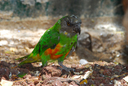
The head of P. senegalus is gray in color, including the beak. The wings, back, tailfeathers and parts of the breast are green (shades of which vary by bird). The green at the breast is in the shape of a "v", making it appear as if the P. senegalus are wearing a vest. The underside (belly) ranges from bright yellow to orange. The eyes, while starting out gray in the young, end up yellow in mature adults. Feet are either gray or pink.
It is difficult to physically distinguish male P. senegalus from female. Usually DNA tests or surgical sexing is required for 100% accuracy. There are however, a few physical traits which may identify the bird as male or female. Female P. senegalus tend to have a smaller head and beak, as well being more rounded at the crest. In addition, the feather coloring of the chest tends to extend the "v" shape further down the belly, stopping between the legs. The "v" on the male only goes halfway down the front and males also tend to have a larger head and beak.
Poicephalus senegalus range from 20-25cm in length (Birdie Boutique 2000; CNC Aviary 2001; Hilton 1997; Welch 1997).
- Other Physical Features
- endothermic
- bilateral symmetry
-
- Range mass
- 115 to 125 g
- 4.05 to 4.41 oz
Reproduction
Not much information is known about the way P. senegalus breed in the wild, except that they nest in tall trees and their mating season is from September to November.
In captivity, they are housed in pairs in a sheltered aviary. Poicephalus senegalus females sexually mature around the age of 2 years, males at 3 years, although they may not breed until much later (even as late as 6-7 years). Usually between 2-4 eggs are laid at a time and the incubation of these eggs (by the female) lasts for 25-28 days. The young begin to venture out at about nine weeks old, but are not fully independent until 12 weeks (Arndt et al. 1996; Birdie Boutique 2000; Hilton 1997) .
- Key Reproductive Features
- iteroparous
- gonochoric/gonochoristic/dioecious (sexes separate)
- sexual
- oviparous
Lifespan/Longevity
-
- Average lifespan
Status: captivity - 40 years
- AnAge
- Average lifespan
Behavior
In their natural habitats, P. senegalus have been observed both alone and in pairs. Sometimes they are seen in small flocks of 10-20 birds (not during mating season). Wild P. senegalus are skittish around humans and usually fly high overhead or roost in the tall treetops. Poicephalus senegalus use a series of short screeches and whistling noises and when alarmed, this call can be quite loud and piercing.
As pets, P. senegalus are friendly and very playful. They like chewing on wood and other toys. One of the most interesting abilities of P. senegalus is that they can mimic household sounds, such as the creak of a door or ring of the telephone. Sometimes they can pick up words or short phrases and even learn simple tricks.
They generally get along well with other birds, but are often jealous. They may even chase around the family dog or cat and may bite. Poicephalus senegalus love attention and usually become attatched to one person, although their devotion can shift to another if they are doted on enough. Poicephalus senegalus have very strong personalities and require a lot of personal attention (Arndt et al. 1996; Birdie Boutique 2000; Hilton 1997) .
- Key Behaviors
- flies
- motile
Communication and Perception
Food Habits
Poicephalus senegalus have a diet that consists mostly of fruit, seeds and grain. They may also eat locust beans and young tree buds.
When in captivity, P. senegalus are usually fed some sort of seed mixture that includes sunflower and safflower seeds, millet, pine nuts, almonds. They may also eat a variety of beans, chickpeas, soy beans, and other fresh vegetables and fruits. Some P. senegalus even enjoy chicken and mashed potatoes, or dog and cat biscuits (Hilton 1997; Welch 1997).
Economic Importance for Humans: Negative
Poicephalus senegalus are viewed as pests by farmers. They often eat seeds from the farmers' fields of maize and millet, or steal peanuts that have been left out to dry. Many P. senegalus are trapped and killed for that reason (Hilton 1997; Poole 1997).
Conservation Status
Poicephalus senegalus is considered common. Population density varies with the availabilty of food in each area (Arndt et al. 1996).
-
- IUCN Red List
-
Least Concern
More information
-
- IUCN Red List
-
Least Concern
More information
-
- US Federal List
- No special status
-
- CITES
- No special status
Other Comments
The lifespan of P. senegalus is 20-25 years (Welch 1997).
Contributors
Kristel Koehler (author), University of California, Irvine, Rudi Berkelhamer (editor), University of California, Irvine.
Glossary
- Ethiopian
-
living in sub-Saharan Africa (south of 30 degrees north) and Madagascar.

- acoustic
-
uses sound to communicate
- bilateral symmetry
-
having body symmetry such that the animal can be divided in one plane into two mirror-image halves. Animals with bilateral symmetry have dorsal and ventral sides, as well as anterior and posterior ends. Synapomorphy of the Bilateria.
- chemical
-
uses smells or other chemicals to communicate
- endothermic
-
animals that use metabolically generated heat to regulate body temperature independently of ambient temperature. Endothermy is a synapomorphy of the Mammalia, although it may have arisen in a (now extinct) synapsid ancestor; the fossil record does not distinguish these possibilities. Convergent in birds.
- iteroparous
-
offspring are produced in more than one group (litters, clutches, etc.) and across multiple seasons (or other periods hospitable to reproduction). Iteroparous animals must, by definition, survive over multiple seasons (or periodic condition changes).
- motile
-
having the capacity to move from one place to another.
- native range
-
the area in which the animal is naturally found, the region in which it is endemic.
- oviparous
-
reproduction in which eggs are released by the female; development of offspring occurs outside the mother's body.
- sexual
-
reproduction that includes combining the genetic contribution of two individuals, a male and a female
- tactile
-
uses touch to communicate
- tropical savanna and grassland
-
A terrestrial biome. Savannas are grasslands with scattered individual trees that do not form a closed canopy. Extensive savannas are found in parts of subtropical and tropical Africa and South America, and in Australia.
- savanna
-
A grassland with scattered trees or scattered clumps of trees, a type of community intermediate between grassland and forest. See also Tropical savanna and grassland biome.
- temperate grassland
-
A terrestrial biome found in temperate latitudes (>23.5° N or S latitude). Vegetation is made up mostly of grasses, the height and species diversity of which depend largely on the amount of moisture available. Fire and grazing are important in the long-term maintenance of grasslands.
- visual
-
uses sight to communicate
References
Arndt, T., T. Pittman. 1996. "Lexicon of Parrots" (On-line). Accessed February 21, 2001 at http://www.arndt-verlag.com/projekt/birds_3.cgi?Desc=E164.htm&Pic=164_1.JPG.

CNC Aviary, 2001. "CNC Aviary - African Species" (On-line). Accessed February 21, 2001 at http://www.parrotpages.com/cncaviary/african.htm.
Hilton, E. 1997. "Poicephalus Species Description" (On-line). Accessed February 21, 2001 at http://www.wingscc.com/aps/poic-int.htm.
Poole, D. 1997. "Suki the Senegal Parrot" (On-line). Accessed February 21, 2001 at http://www.ilsham.demon.co.uk/suki.html.
The Birdie Boutique, 2001. "Avian Species Library" (On-line). Accessed February 21, 2001 at http://www.birdieboutique.com/species/index.htm.
Welch, D. 1997. "An Introduction to Senegals" (On-line). Accessed February 21, 2001 at http://www.birdsnways.com/wisdom/ww15ev.htm.