Plegadis chihiwhite-faced ibis


Geographic Range
White-faced ibises are widespread, with two distinct ranges; one population is found in North and Middle America and a separate population is found in South America. Those found in North and Middle America cover most of the western and mid-western United States and most of Mexico. Breeding areas are as far north as southern Canada and as far east as Nebraska. Additionally they are found along the Gulf coast of Texas and Louisiana and in central Mexico. However, all except those found in California, Texas, Louisiana and central Mexico will migrate to southern parts of their range during the non-breeding season. Most of these winter in Mexico but other populations migrate to Guatemala, El Salvador and Honduras. South American population of white-faced ibises do not migrate for the winter. They are found from southern Brazil and southeastern Bolivia to northern Argentina. The eastern and western boundaries of their range are the Pacific and Atlantic Oceans. (BirdLife International 2004, 2006; Hancock, et al., 1992; NatureServe, 2006; Ryder and Manry, 2005; Zaun, et al., 2003)
- Biogeographic Regions
- nearctic
- neotropical
Habitat
White-faced ibises are found in both temperate and tropical regions. They tend to live in fresh and saltwater marshes containing many rushes and sedges which are used to nest on, for nesting materials, and for finding food. These birds are also found around ponds, rivers and in flooded pastures and agricultural fields. Rainy conditions are required for both foraging and nesting rainy conditions are required, limiting the areas in which they are found and influencing movement patterns. White-faced ibises are found from near sea level to 4300 m elevation in South America. (Hancock, et al., 1992; Ryder and Manry, 2005)
- Habitat Regions
- temperate
- tropical
- terrestrial
- Aquatic Biomes
- lakes and ponds
- rivers and streams
- Wetlands
- marsh
- Other Habitat Features
- agricultural
- riparian
-
- Range elevation
- 0 to 4300 m
- 0.00 to 14107.61 ft
Physical Description
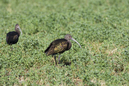
White-faced ibises weigh between 450 and 525 grams and are 46 to 56 cm in length. Those found in South America tend to be smaller than those found in North America. When white-faced ibises first hatch they are bare on the underside and sparsely covered with brown or black down. After about two weeks they start to gain their juvenile plumage, which consists of the loss of down and gaining green and purple colored feathers. Juveniles are also noticeably smaller than adults. Adults are dark in color, either maroon or brown with dark green reflections on the underside. During mating season the head, neck, upper back, wing-coverts and underside becomes more chestnut in color. In both breeding and nonbreeding seasons there is a metallic green look to the flight feathers. These ibises get their name from the white coloring, which can be seen on their face and throat. Males have the same coloring as females but males are generally bigger than females. Parts of the face, as well as the legs and feet are red or purple because bare skin is exposed. The length of the bill varys between 15 and 18 cm, males have longer bills than females. There are no described sub-species. (Anonymous, 2003; Hancock, et al., 1992; Ryder and Manry, 2005)
- Other Physical Features
- endothermic
- homoiothermic
- bilateral symmetry
- Sexual Dimorphism
- male larger
-
- Range mass
- 450 to 525 g
- 15.86 to 18.50 oz
-
- Range length
- 46 to 56 cm
- 18.11 to 22.05 in
-
- Range wingspan
- 94 to 99 cm
- 37.01 to 38.98 in
Reproduction
If conditions are favorable, the mating process begins shortly after white-faced ibises return from their wintering locations. If conditions are not favorable, mating can be delayed temporarily or not undertaken at all in that year. Nesting occurs in dense, large colonies. It is unknown when the male and female bond. Some appear to return from wintering locations already as mated pairs, some seem to form pairs in the one or two weeks proceeding mating. It is also unknown how long this pairing lasts. Males display at multiple possible nesting sites, including previously used nests. Males use “ritualized bill probing” and also give a call that interested females answer with another call. Females choose the actual nesting site. (Hancock, et al., 1992; Ryder and Manry, 2005)
- Mating System
- monogamous
White-faced ibises breed once per year. The breeding season in North America is from April to May. In the event of unfavorable breeding conditions, this season can sometimes last until mid-June or the season can be skipped altogether. In South America the breeding season occurs in November and December. Eggs are laid at a one to two day interval with the average number of eggs laid each season being three to four and a range of two to seven. The eggs hatch after 20 days (range: 17 to 26). Before the young can fly on their own they are fed by their parents. During the first week after hatching there is a 60% mortality rate for third and fourth eggs produced, compared with a 5% mortality rate for first and second eggs. Young fledge after five weeks and are independent after eight weeks. (Anonymous, 2003; Hancock, et al., 1992; Ryder and Manry, 2005; Taft, et al., 2000; Zaun, et al., 2003)
- Key Reproductive Features
- iteroparous
- seasonal breeding
- gonochoric/gonochoristic/dioecious (sexes separate)
- sexual
- oviparous
-
- Breeding interval
- White-faced ibises breed once yearly.
-
- Breeding season
- Nesting generally occurs April to June in North America and November to December in South America.
-
- Range eggs per season
- 2 to 7
-
- Average eggs per season
- 3.5
-
- Average eggs per season
- 3
- AnAge
-
- Range time to hatching
- 17 to 26 days
-
- Average time to hatching
- 20 days
-
- Average fledging age
- 5 weeks
-
- Average time to independence
- 8 weeks
-
- Average age at sexual or reproductive maturity (female)
- 2 years
-
- Average age at sexual or reproductive maturity (male)
- 2 years
White-faced ibis parents take turns in making the nest and guarding it. The male starts guarding the nest while the female gathers materials and then the role reverses while the female builds the nest the male gathers materials. Once the eggs have been laid, the parents take turns in caring for the eggs, normally the males during the day and the females at night. Both sexes will fiercely guard the nest and the area around the nest within a meter against intruders. They shade or incubate the eggs to keep them at the correct temperature. This treatment continues for the first week following hatching and occurs to a lesser extent (left alone for up to three hours) during the second week and is absent in the third week. Both male and female adults will feed the young. This is done by regurgitating partially digested food. The parents will also take the young on both a short walk and a short flight around the colony. There is no evidence to believe there is an association between the parents and young after they have reached independence. (Hancock, et al., 1992; Ryder and Manry, 2005)
- Parental Investment
- altricial
-
pre-fertilization
- provisioning
-
protecting
- female
-
pre-hatching/birth
-
provisioning
- male
- female
-
protecting
- male
- female
-
provisioning
-
pre-weaning/fledging
-
provisioning
- male
- female
-
protecting
- male
- female
-
provisioning
-
pre-independence
-
provisioning
- male
- female
-
protecting
- male
- female
-
provisioning
Lifespan/Longevity
The longest known lifespan of this species in the wild is 14 years and 6 months. In captivity they have lived to 14 years. In a study done in Utah in 1967, 111 birds that had been tagged at birth were recovered, all of which died by the age of 9. (Ryder and Manry, 2005)
-
- Range lifespan
Status: wild - 14.5 (high) years
- Range lifespan
-
- Range lifespan
Status: captivity - 14 (high) years
- Range lifespan
-
- Typical lifespan
Status: wild - 9 (high) years
- Typical lifespan
Behavior
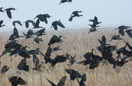
White-faced ibises are social and nomadic. If a foraging area becomes too dry they will leave in search of a more suitable location. White-faced ibises fly relatively long distances to find food. They fly at a rate of about 48 to 53 km per hour, they fly in a V formation with other birds for efficiency. Parents will shade their young while they are in the nest from the sun when it is hot out as the young tend to die quickly of heat exposure. These birds are gregarious, living in large groups. They are tolerant of other ibises outside of the breeding season. During the breeding season they will defend an area of about one meter around their nest, the average nest is two meters away from its neighbors. Sometimes landing and preening perches 3 meters away will also be defended. White-faced ibises forage in flocks, taking advantage of insects and other food items disturbed by conspecifics. (Anonymous, 2003; Attenborough, 1998; Hancock, et al., 1992; Ryder and Manry, 2005)
-
- Range territory size
- 0.5 to 10 m^2
-
- Average territory size
- 2 m^2
Home Range
White-faced ibises defend small areas around nests during the breeding season. Outside of the breeding season, they forage over large areas in flocks. The size of these foraging areas has not been reported.
Communication and Perception
White-faced ibises communicate through sounds and visual displays. There are multiple different sounds that these birds make which have different meanings. There are separate sounds for calling to their young, when a mate is returning to the nest, and a sound used as a feeding call. (Hancock, et al., 1992; Ryder and Manry, 2005)
Food Habits
White-faced ibises feed by probing the substrate with their long bill, in search of small animals. They feed in large groups of up to 1000 individuals. They feed mainly in moist areas around bodies of water and also in shallow (less than 20 cm) water. They are primarily carnivorous and feed on insects, crustaceans, spiders, snails, leeches, and amphibians. Snails and slugs are the large prey group by volume, accounting for 55 to 90% of all food eaten. Prey taken varies with the season, with more insects in the spring and summer than in other seasons. Males tend to eat more snails and slugs and females tend to eat more insects. (Hancock, et al., 1992; Ryder and Manry, 2005; Soave, et al., 2006)
- Primary Diet
- carnivore
- Animal Foods
- amphibians
- insects
- terrestrial non-insect arthropods
- mollusks
- terrestrial worms
- aquatic crustaceans
Predation
The eggs, nestlings, and fledglings of white-faced ibises are taken by many different predators, including gull species (Larus), black-billed magpies (Pica pica), black-crowned night herons (Nycticorax nycticorax), common ravens (Corvus corax), raccoons (Procyon lotor), striped skunks (Mephitis mephitis), spotted skunks (Spilogale putorius), coyotes (Canis latrans), mink (Neovison vison), and long-tailed weasels (Mustela frenata). Mammals are more likely to become predators when water levels around nests fall, making access to the nest easier. Peregrine falcons (Falco peregrinus) and red-tailed hawks (Buteo jamaicensis) are able to prey on the adult white-faced ibises, but Ryder and Manny (2005) report that predation on adults is rare. Humans (Homo sapiens) are major predators of white-faced ibises, for food, feathers, and sport. Adults are vigilant in protecting their eggs and young from predators, helping to avoid predation. Their flocking habits also help in alerting flock members to potential danger. (Hancock, et al., 1992; Ryder and Manry, 2005)
-
- Known Predators
-
- peregrine falcons (Falco peregrinus)
- red-tailed hawks (Buteo jamaicensis)
- long-tailed weasels (Mustela frenata)
- spotted skunks (Spilogale putorius)
- coyotes (Canis latrans)
- mink (Neovison vison)
- striped skunks (Mephitis mephitis)
- humans (Homo sapiens)
- black-billed magpies (Pica pica)
- gull species (Larus)
- black-crowned night herons (Nycticorax nycticorax)
- common ravens (Corvus corax)
- raccoons (Procyon lotor)
Ecosystem Roles
White-faced ibises aerate the soil with their foraging method of pushing their bill into the ground. They are important predators of many aquatic invertebrate groups, impacting their populations. Additionally, they are the hosts of several species of parasites: Ardeicola rhaphidius, Ciconiphilus blagoweschenskii, Colpocephalum leptopygos, Ibidoecus bisignatus, and Plegadiphilus plegadis. (Ryder and Manry, 2005)
- Ecosystem Impact
- soil aeration
- Ardeicola rhaphidius
- Ciconiphilus blagoweschenskii
- Colpocephalum leptopygos
- Ibidoecus bisignatus
- Plegadiphilus plegadis
Economic Importance for Humans: Positive
Ibises are hunted for food in some areas. They are also important for birding ecotourism and are essential components of the healthy, wetland habitats in which they live. (Hancock, et al., 1992)
- Positive Impacts
- food
- body parts are source of valuable material
- ecotourism
Economic Importance for Humans: Negative
White-faced ibises sometimes have an economic impact on farmers because they can trample crops in wet fields during foraging. Crayfish farmers experiences losses when white-faced ibises visit their operations. (Ryder and Manry, 2005)
- Negative Impacts
- crop pest
Conservation Status
White-faced ibises have a large geographic range and populations remain large. Population trends haven't been quantified, but populations are believed to be stable currently.
-
- IUCN Red List
-
Least Concern
More information
-
- IUCN Red List
-
Least Concern
More information
-
- US Migratory Bird Act
- Protected
-
- US Federal List
- No special status
-
- CITES
- No special status
-
- State of Michigan List
- No special status
Contributors
Tanya Dewey (editor), Animal Diversity Web.
Matthew Gumbleton (author), Kalamazoo College, Ann Fraser (editor, instructor), Kalamazoo College.
Glossary
- Nearctic
-
living in the Nearctic biogeographic province, the northern part of the New World. This includes Greenland, the Canadian Arctic islands, and all of the North American as far south as the highlands of central Mexico.

- Neotropical
-
living in the southern part of the New World. In other words, Central and South America.
- acoustic
-
uses sound to communicate
- agricultural
-
living in landscapes dominated by human agriculture.
- altricial
-
young are born in a relatively underdeveloped state; they are unable to feed or care for themselves or locomote independently for a period of time after birth/hatching. In birds, naked and helpless after hatching.
- bilateral symmetry
-
having body symmetry such that the animal can be divided in one plane into two mirror-image halves. Animals with bilateral symmetry have dorsal and ventral sides, as well as anterior and posterior ends. Synapomorphy of the Bilateria.
- carnivore
-
an animal that mainly eats meat
- chemical
-
uses smells or other chemicals to communicate
- colonial
-
used loosely to describe any group of organisms living together or in close proximity to each other - for example nesting shorebirds that live in large colonies. More specifically refers to a group of organisms in which members act as specialized subunits (a continuous, modular society) - as in clonal organisms.
- diurnal
-
- active during the day, 2. lasting for one day.
- ecotourism
-
humans benefit economically by promoting tourism that focuses on the appreciation of natural areas or animals. Ecotourism implies that there are existing programs that profit from the appreciation of natural areas or animals.
- endothermic
-
animals that use metabolically generated heat to regulate body temperature independently of ambient temperature. Endothermy is a synapomorphy of the Mammalia, although it may have arisen in a (now extinct) synapsid ancestor; the fossil record does not distinguish these possibilities. Convergent in birds.
- food
-
A substance that provides both nutrients and energy to a living thing.
- insectivore
-
An animal that eats mainly insects or spiders.
- iteroparous
-
offspring are produced in more than one group (litters, clutches, etc.) and across multiple seasons (or other periods hospitable to reproduction). Iteroparous animals must, by definition, survive over multiple seasons (or periodic condition changes).
- marsh
-
marshes are wetland areas often dominated by grasses and reeds.
- migratory
-
makes seasonal movements between breeding and wintering grounds
- molluscivore
-
eats mollusks, members of Phylum Mollusca
- monogamous
-
Having one mate at a time.
- motile
-
having the capacity to move from one place to another.
- native range
-
the area in which the animal is naturally found, the region in which it is endemic.
- nomadic
-
generally wanders from place to place, usually within a well-defined range.
- oviparous
-
reproduction in which eggs are released by the female; development of offspring occurs outside the mother's body.
- riparian
-
Referring to something living or located adjacent to a waterbody (usually, but not always, a river or stream).
- seasonal breeding
-
breeding is confined to a particular season
- sexual
-
reproduction that includes combining the genetic contribution of two individuals, a male and a female
- social
-
associates with others of its species; forms social groups.
- soil aeration
-
digs and breaks up soil so air and water can get in
- tactile
-
uses touch to communicate
- temperate
-
that region of the Earth between 23.5 degrees North and 60 degrees North (between the Tropic of Cancer and the Arctic Circle) and between 23.5 degrees South and 60 degrees South (between the Tropic of Capricorn and the Antarctic Circle).
- terrestrial
-
Living on the ground.
- territorial
-
defends an area within the home range, occupied by a single animals or group of animals of the same species and held through overt defense, display, or advertisement
- tropical
-
the region of the earth that surrounds the equator, from 23.5 degrees north to 23.5 degrees south.
- visual
-
uses sight to communicate
References
Amat, J., F. Rilla. 1994. Foraging Behavior of White-Faced Ibises (Plegadis chihi) in Relation to Habitat, Group Size, and Sex. Colonial Waterbirds, 17/1: 42-49.
Anonymous, 2003. "White-faced Ibis" (On-line). Animal Field Guide. Accessed October 16, 2006 at http://fwp.mt.gov/fieldguide/detail_ABNGE02020.aspx.
Attenborough, D. 1998. The Life of Birds. New Jersey: Princeton University Press.
Bildstein, K. 1993. White Ibis. Washington and London: Smithsonian Institution Press.
BirdLife International 2004, 2006. "Plegadis chihi" (On-line). The IUCN Redlist of Threatened Species. Accessed October 16, 2006 at http://www.iucnredlist.org/search/details.php/49621/summ.
Blanco, G., R. Rodriguez-Estrella. 1998. Human Activity May Benifit White-Faced Ibises Overwintering in Baja, California Sur, Mexico. Colonial Waterbirds, 21/2: 274-276.
Hancock, J., J. Kushlan, M. Kahl. 1992. Storks, Ibises and Spoonbills of the World. Great Britan: Harcourt Brace Jovanovich.
NatureServe, 2006. "Plegadis chihi" (On-line). Comprehensive Report Species. Accessed October 16, 2006 at http://www.natureserve.org/explorer/servlet/NatureServe?searchName=Plegadis+chihi.
Ryder, R., D. Manry. 2005. "White-faced Ibis" (On-line). Birds of North America Online. Accessed November 14, 2006 at http://bna.birds.cornell.edu/BNA/account/White-faced_Ibis/INTRODUCTION.html.
Soave, G., A. Camperi, C. Darrieu, A. Cicchino, V. Ferretti. 2006. White-faced Ibis Diet in Argentina. Waterbirds, 29/2: 191–197. Accessed October 16, 2006 at http://www.bioone.org/perlserv/?request=get-document&doi=10.1675%2F1524-4695%282006%2929%5B191%3AWIDIA%5D2.0.CO%3B2.
Taft, M., D. Mauser, T. Arnold. 2000. Breeding Ecology Of White-Faced Ibis (Pleagadis Chihi) In The Upper Klamath Basin, California. Western North American Naturalist, 60/4: 403-409.
Zaun, B., K. King, C. Hurt, M. Schotborgh. 2003. First Record Of White-Faced Ibis, Plegadis Chihi, Nesting In Arizona. The Southwestern Naturalist, 48/1: 130-131. Accessed October 16, 2006 at http://www.bioone.org/perlserv/?request=get-document&doi=10.1894%2F0038-4909%282003%29048%3C0130%3AFROWIP%3E2.0.CO%3B2.