Platyrrhinus lineatuswhite-lined broad-nosed bat
Geographic Range
P. lineatus occurs through the central portion of South America, extending south along the Andes from Colombia through Equador and Peru, east to northeastern Brazil, and further south to northern Argentina.
- Biogeographic Regions
- neotropical
Habitat
These bats prefer damp forests. They roost mainly in the tops of trees, under the leaves, but have also been found on lower branches (particularly during stormy weather) and in caves.
- Terrestrial Biomes
- forest
- rainforest
Physical Description
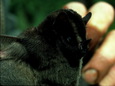
White-lined bats have a stout muzzle, fairly large ears, and a well-developed noseleaf and tragus. The calcar is short. The fur is yellowish brown to dark brown on the back, and lighter on the ventral surface. True to their name, they have several white stripes. There are two on each side of the face, one running from the base of the noseleaf to the ear and the other across the cheek below the eye. There is also a white stripe on the animal's back.
- Other Physical Features
- endothermic
- bilateral symmetry
Reproduction
In general, these bats can reproduce throughout the year and sometimes become pregnant again while still nursing the offspring from the previous pregnancy. In northeastern Brazil, however, there has been found to be a more restricted pattern of reproductive events. Pregnancies occur only from the early dry season in July through the end of the rainy season in early March, and there is a bimodal distribution of breeding and lactation during this period. Females normally give birth to a single offspring, although twinning is also possible. Gestation lasts approximately 3.5 months.
- Key Reproductive Features
- gonochoric/gonochoristic/dioecious (sexes separate)
- sexual
Lifespan/Longevity
-
- Average lifespan
Status: captivity - 13 years
- AnAge
- Average lifespan
Behavior
White-lined bats are social, and can usually be found roosting in small groups. Mothers roost with their pups, and females without young are found with a male and sometimes also with several other females. Males are thought to defend their access to groups of 1 to 15 females from other males. Groups often remain together while foraging as well. Like most other bats, this species is active mainly at night.
- Key Behaviors
- motile
Communication and Perception
Food Habits
White-lined bats eat mainly fruit, but will also consume some insects (especially moths), and nectar from flowers.
Economic Importance for Humans: Positive
White-lined bats disperse the seeds of fruit trees, pollinate some plants, and help control insect pests.
Conservation Status
-
- IUCN Red List
-
Least Concern
More information
Other Comments
This species was formerly known as Vampyrops lineatus.
Contributors
Deborah Ciszek (author), University of Michigan-Ann Arbor.
Glossary
- Neotropical
-
living in the southern part of the New World. In other words, Central and South America.

- bilateral symmetry
-
having body symmetry such that the animal can be divided in one plane into two mirror-image halves. Animals with bilateral symmetry have dorsal and ventral sides, as well as anterior and posterior ends. Synapomorphy of the Bilateria.
- chemical
-
uses smells or other chemicals to communicate
- endothermic
-
animals that use metabolically generated heat to regulate body temperature independently of ambient temperature. Endothermy is a synapomorphy of the Mammalia, although it may have arisen in a (now extinct) synapsid ancestor; the fossil record does not distinguish these possibilities. Convergent in birds.
- forest
-
forest biomes are dominated by trees, otherwise forest biomes can vary widely in amount of precipitation and seasonality.
- motile
-
having the capacity to move from one place to another.
- native range
-
the area in which the animal is naturally found, the region in which it is endemic.
- rainforest
-
rainforests, both temperate and tropical, are dominated by trees often forming a closed canopy with little light reaching the ground. Epiphytes and climbing plants are also abundant. Precipitation is typically not limiting, but may be somewhat seasonal.
- sexual
-
reproduction that includes combining the genetic contribution of two individuals, a male and a female
- tactile
-
uses touch to communicate
References
Nowak, R.M. 1994. Walker's Bats of the World. Johns Hopkins University Press, Baltimore.
Willig, M.R., and R.R. Hollander. 1987. Vampyrops lineatus. Mammalian Species, No. 275, pp. 1-4. Published by The American Society of Mammalogists.