Pimephales promelasBlack-head minnow
Geographic Range
Fathead minnows are native to the Nearctic region. The northern limits of their geographic ranges extends from Quebec to Alberta and Northwest Territories, Canada. Their southern limites of their geographic range extends as far southward as Alabama, Texas, and New Mexico. Fathead minnows are most abundant in the Prairie Pothole Region of the northern Great Plains. Bait-bucket introductions have also occurred in the Mobile Bay drainage, Colorado River drainage, Alabama, Arizona, New Mexico, and Mexico. They are generally absent in mountainous regions as well as on the Atlantic Slope of Delaware River. They have also been introduced in Europe (Belgium, France, Germany, and the United Kingdom), Puerto Rico, and Iran. (Luna, et al., 2010; Page and Burr, 1991; Zimmer, et al., 2002)
- Biogeographic Regions
- nearctic
- palearctic
Habitat
In addition to small rivers and ponds,fFathead minnows are commonly found in muddy pools of headwaters and creeks. They also appear to tolerate habitat conditions that exclude many freshwater fishes such as high turbidity and temperature, variable pH and salinity, and low oxygen. Residing in such habitats may be important in decreasing risk of predation, as many predatory fish are intolerant of such conditions. (Nelson and Paetz, 1992; Page and Burr, 1991)
- Habitat Regions
- temperate
- freshwater
- Aquatic Biomes
- lakes and ponds
- rivers and streams
- temporary pools
- Wetlands
- marsh
Physical Description
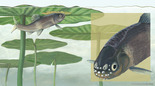
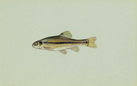
Fathead minnows are characterized by deep, compressed bodies, typically five to eight centimeters in length, and a short head that is dorsally flattened with a blunt snout, round lateral eyes, and terminal, upturned mouth. With the exception of a dark blotch at the rostral end of the dorsal fin, their fins are generally clear. Fathead minnows are dark-olive colored with a dusky, dorsal and lateral stripe, and yellow to white underbelly. They have an incomplete lateral line, 8 dorsal rays, 7 anal rays, 14 to 17 pectoral rays, 7 to 8 pelvic rays, pharyngeal teeth, and smaller scales along the nape. Males and females vary in size, banding, and secondary sexual characteristics, however, males and females are virtually indistinguishable until reproductive maturity. Adult males range from 3 to 5 g, while adult females are slightly smaller, ranging from 2 to 3 g. Additionally, males have dark heads with 2 white to gold vertical bars posterior to the head and dorsal fin. Males also have a fleshy, dorsal pad and 16 nuptial tubercles on the lower jaw. Although females do not undergo such obvious changes in morphology, they do develop a fleshy ovipositor approximately a month prior to spawning. (Ankley, et al., 2000; Page and Burr, 1991; Ross, 2001; Wisenden, et al., 2009)

- Other Physical Features
- ectothermic
- heterothermic
- bilateral symmetry
- Sexual Dimorphism
- male larger
- sexes colored or patterned differently
- male more colorful
- ornamentation
-
- Range mass
- 2 to 5 g
- 0.07 to 0.18 oz
-
- Range length
- 5 to 8 cm
- 1.97 to 3.15 in
Development
After fertilization, fathead minnow eggs are approximately 1.4 mm to 1.6 mm in diameter. Following several well-defined embryonic stages, eggs hatch within 4 to 5 days at 25°C. Upon hatching, fathead minnow larvae absorb the yolk sac within 1 to 2 days, afterwhich larvae become active feeders preying upon live food. These protolarvae range in length from 4.0 mm to 5.2 mm and can be characterized by an incomplete mouth, dark eyes, rudimentary pectoral fins, melanophores, which are widely distributed on the yolk sac and concentrated in regions posterior to the vent. Contrastingly, mesolarvae and metalarvae possess high concentrations of melanophores on the ventral surface of gill covers. The number of myomeres between protolarvae and mesolarvae, and metalarvae differ only slightly, with the metalarvae possessing a slightly more in the predorsal region and a few less in the postanal region. All larval stages have rounded rather than flattened eyes, similar to 'bluntnose minnows Pimephales notatus'. (Ankley and Villeneuve, 2006; Ankley, et al., 2000; Ross, 2001)
Reproductive maturity in fathead minnows is identified by a number of morphological changes in both males in females. For example, males develop a dorsal pad, tubercles on their lower jaw, and banding changes. Just prior to maturation, females develop urogenital papillae. Fathead minnows reach sexual maturity within 4 to 5 months after hatching in optimal habitat conditions (e.g., water temperature of 25°C and photoperiod of 16 hours of light). Once mature and under appropriate seasonal conditions, minnows can spawn continually for a period of several months. (Ankley and Villeneuve, 2006; Ankley, et al., 2000; Ross, 2001)
Reproduction
Fathead minnows are polygynandrous and spawn between the months of May and September, producing anywhere from 1000 to 10000 offspring per season. During breeding season, reproductively mature males are responsible for the selection and preparation of nest sites on the underside of horizontal objects (e.g., rocks, wood, and vegetation). Nest sites typically occur in shallow water, typically on a sandy substrate. Preparing nest sites requires males to utilize their mouth and tubercles to form a depression in the substrate. Once the nest is complete, males become highly territorial. Agonistic behavior is directed toward other male conspecifics, heterospecific intruders, and initially, mature females. In addition, males perform a variety of courting behaviors to attract females to their site. If a mature female is persistent, and not interested in consuming eggs that may already be present in the male's nest, the male grants her access to the nest site. (Andrews and Flickinger, 1974; Ankley, et al., 2000; Ross, 2001; Wisenden, et al., 2009)
Spawning behavior in fathead minnows involves close lateral contact, body vibrations, and swimming back and forth in the nest area. Once adequate stimulation is obtained, males make contact with the urogenital region of the female, causing the release of eggs along with the simultaneous release of milt prior to their sudden separation. This occurs sporadically until the male aggressively drives away the female. All of the buoyant, adhesive, fertilized eggs are then deposited in a single layer on the ceiling of the nest site and thus, the male is left to care for the eggs on his own. (Andrews and Flickinger, 1974; Ankley, et al., 2000; Ross, 2001; Wisenden, et al., 2009)
- Mating System
- polygynandrous (promiscuous)
Being oviparous and a fractional spawner (i.e., females spawn multiple times per breeding season), female fathead minnows may deposit 400 eggs per spawn, normally taking approximately 2 hours to perform each spawning sequence. Females may spawn between 16 and 26 times between May and September. Eggs are normally deposited at night, and each fertilized egg takes 4 to 5 days to hatch at 25°C, though it can take up to 13 days at cooler temperatures (15°C). Both sexes reach reproductive maturity between 4 and 5 months after fertilization. Fathead minnows grow rapidly, and despite high postspawning mortality, multiple generations may be alive at the same time. (Andrews and Flickinger, 1974; Ankley and Villeneuve, 2006; Ankley, et al., 2000; Herwig and Zimmer, 2007; Miller and Robinson, 1934; Ross, 2001; Wisenden, et al., 2009)
- Key Reproductive Features
- iteroparous
- seasonal breeding
- gonochoric/gonochoristic/dioecious (sexes separate)
- sexual
- fertilization
- oviparous
-
- Breeding interval
- Female fathead minnows may participate in 16 to 26 spawnings per season.
-
- Breeding season
- Spawning occurs from May to September at water temperatures ranging from 16°C to 30°C.
-
- Range number of offspring
- 1000 to 10000
-
- Range time to hatching
- 4 to 13 days
-
- Range time to independence
- 4 to 5 days
-
- Range age at sexual or reproductive maturity (female)
- 4 to 5 months
-
- Range age at sexual or reproductive maturity (male)
- 4 to 5 months
Male fathead minnows invest a great deal of time and energy into caring for fertilized eggs. To sustain energetic demands, males rely on somatic energy reserves. If these reserves are insufficient, male fathead minnows tend to consume a number of their eggs in order to meet energetic demands. In addition to creating the nest site, males fan nest eggs to maintain sufficient oxygenation, utilize their dorsal pad to clean eggs, and defend against predators until hatching occurs. Fathead minnows spawn numerous times a season, thus, male energy expenditure during this time is significant. In addition, females prefer to deposit eggs in the nest of males that already possess eggs, while alloparental care augments the likelihood of new fertilization. (Ankley, et al., 2000; Ross, 2001; Wisenden, et al., 2009)
- Parental Investment
- male parental care
-
pre-hatching/birth
-
protecting
- male
-
protecting
Lifespan/Longevity
On average, fathead minnows live two to three years in the wild and may be limited by high levels of postspawning mortality. Fathead minnows can live for up to 4 years in captivity. (Ross, 2001; Werner, 2004; Wisenden, et al., 2009)
-
- Range lifespan
Status: captivity - 4 (high) years
- Range lifespan
-
- Typical lifespan
Status: wild - 2 to 3 years
- Typical lifespan
Behavior
Fathead minnows are strictly aquatic and stay within schools of familiar individuals, which allows them to act as a more cooperative, cohesive unit in comparison to schools with unfamiliar individuals. Chemical cues allow minnows to discriminate between familiar and unfamiliar individuals and may also play a significant role in courtship behaviors and the degree to which reproduction is successful. For instance, the dorsal pads and tubercles of reproductively mature males act as a female attractant. Males also release pheromones to attract females to nest sites during breeding season. Males are highly territorial of nest sites. Evidence suggests that fathead minnows may select habitats that reduce risk of predation. By constructing nests in areas that are low in dissolved oxygen, fathead minnows appear to be seeking out habitats with decreased abundances of potential predators. (Sloman, et al., 2006)
- Key Behaviors
- natatorial
- motile
- territorial
- social
Home Range
There is no information available regarding the average home range size of fathead minnows.
Communication and Perception
Fathead minnows utilize chemical cues to differentiate between familiar (i.e., shoalmates) and unfamiliar individuals. Olfactory signals vary in relation to diet, social status, parasite load, and predation risk. Chemical signaling can occur involuntarily due to the release of an alarm signal as a result of mechanical cellular damage, or voluntarily as in the release of sexual pheromones during courtship. During breeding season, males also perform both stationary and dynamic courtship displays in order to attract females to nest sites. (Chivers, et al., 1996; Ross, 2001; Sloman, et al., 2006)
- Other Communication Modes
- pheromones
Food Habits
Fathead minnows are opportunistic omnivores that can be characterized as benthic filter feeders, sifting through mud and silt in order to find food. Freshwater sediments often contain a large abundance of algae and protozoans, which represent a significant proportion of the fathead minnow diet. Secondary prey items include diatoms, filamentous algae, small crustaceans, and insect larvae. In addition, brook sticklebacks represent one of few species also common within the Prairie Pothole Region that also prey heavily on zooplankton, placing a high probability of interspecific competition between brook sticklebacks and fathead minnows. Differences in size-selection and feeding strategies, however, allow fathead minnows to consume a broader variety of zooplankton prey. Flexibility in feeding may explain why greater densities of fathead minnows exist in this region as compared to brook sticklebacks. (Ankley and Villeneuve, 2006; Herwig and Zimmer, 2007; Laurich, et al., 2003; Miller and Robinson, 1934; Ross, 2001)
- Animal Foods
- insects
- aquatic crustaceans
- other marine invertebrates
- zooplankton
- Plant Foods
- algae
- phytoplankton
- Other Foods
- detritus
- Foraging Behavior
- filter-feeding
Predation
Fathead minnows are commonly preyed upon by piscivorous fish such as northern pike, yellow perch, largemouth bass and walleye. An important antipredator tactic is their ability to warn conspecifics of potential threats via pheromones. From distinctive epidermal club cells, fathead minnows release an alarm substance in response to mechanical cell damage other species of the nearby threat. Such cues also have the potential to attract additional predators that could disrupt the predation event. If others can disrupt the predation event and facilitate escape, warning signals may benefit other species as well as wounded prey. Interestingly, mature males lose this capability during the breeding months. (Chivers, et al., 1996)
-
- Known Predators
Ecosystem Roles
Secluded basins and harmful conditions in the Prairie Pothole Region result in a simple fish community, with fathead minnows and brook sticklebacks being the most common species in this region. Fathead minnows are often the dominant species and experience explosive population growth with the absence of piscivorus fish and their high reproductive rate. This allows fathead minnows to reach biomass estimates ranging from 144 to 482 kg/ha during the breeding season. With both high population numbers and biomass, it is not a surprise that fathead minnows possess significant influence on the aquatic macroinvertebrate populations, one of their primary food sources. Populations of zooplankton, aquatic insects, and ostracods are greatly affected by fathead minnow predation, with peak daily consumption ranging from 10.1 to 62.6 kg/ha. Thus, fathead minnows indirectly affect species dependent on aquatic invertebrates as food, such as ducks and their young, larval salamanders, and a number of passerine birds. Higher turbidity and phytoplankton biomass also result in wetlands with the presence of fathead minnows. However, the structure of these systems is strongly dependent on the presence and abundance of fathead minnows as a low- to middle-level consumer, whether it be due to direct or indirect effects. In addition, because they are tolerant of a broad range of environmental conditions, fathead minnows are common among in a large variety of aquatic habitats throughout its geographic range. Fathead minnows represent an important food source for piscivorous fishes, as they often the only species present in human-made retention ponds due to their habitat adaptability. (Stewart and Watkinson, 2004; Zimmer, et al., 2002)
- Ecosystem Impact
- keystone species
Economic Importance for Humans: Positive
Fathead minnows are significant contributors to global toxicology and behavioral ecology research due to their relatively short lifespan and high reproductive rate. Likewise, it has become the most widely utilized North American model for ecotoxicology since the mid-twentieth century. They also play a significant role in fisheries as prey for important commercial and recreational fish species. Albino fathead minnows, often referred to as "rosy-red minnows," are commonly used as bait for recreational fishing, and are also used as a feeder fish in bass-bream ponds. Albino fathead minnows are commonly found in aquaria, with both sexes possessing red-orange body and fins. (Ankley and Villeneuve, 2006; Page and Burr, 1991; Ross, 2001)
- Positive Impacts
- pet trade
- research and education
Economic Importance for Humans: Negative
Although widely distributed across North America, introductions of fathead minnows as a bait species in Europe have resulted in devastating effects on the wildlife in northern Europe. Its introduction in Europe resulted in the co-introduction of enteric redmouth disease, an organism that negatively affects wild and cultured trout and eels. (Ankley, et al., 2000; "NatureServe Explorer: An online encyclopedia of life", 2010)
Conservation Status
Fathead minnows are among the most prevalent fish species in eastern North America. The species is considered secure and has stable populations. The widespread nature of this species may be attributed to its ability to adapt to a variety of aquatic habitats and conditions as well as its high reproductive rate. ("NatureServe Explorer: An online encyclopedia of life", 2010; Page and Burr, 1991)
-
- IUCN Red List
- No special status
-
- US Federal List
- No special status
-
- CITES
- No special status
-
- State of Michigan List
- No special status
Contributors
Ashley Sommer (author), Indiana University-Purdue University Fort Wayne, Mark Jordan (editor), Indiana University-Purdue University Fort Wayne, John Berini (editor), Animal Diversity Web Staff.
Glossary
- Nearctic
-
living in the Nearctic biogeographic province, the northern part of the New World. This includes Greenland, the Canadian Arctic islands, and all of the North American as far south as the highlands of central Mexico.

- Palearctic
-
living in the northern part of the Old World. In otherwords, Europe and Asia and northern Africa.
- bilateral symmetry
-
having body symmetry such that the animal can be divided in one plane into two mirror-image halves. Animals with bilateral symmetry have dorsal and ventral sides, as well as anterior and posterior ends. Synapomorphy of the Bilateria.
- carnivore
-
an animal that mainly eats meat
- chemical
-
uses smells or other chemicals to communicate
- detritus
-
particles of organic material from dead and decomposing organisms. Detritus is the result of the activity of decomposers (organisms that decompose organic material).
- ectothermic
-
animals which must use heat acquired from the environment and behavioral adaptations to regulate body temperature
- external fertilization
-
fertilization takes place outside the female's body
- fertilization
-
union of egg and spermatozoan
- filter-feeding
-
a method of feeding where small food particles are filtered from the surrounding water by various mechanisms. Used mainly by aquatic invertebrates, especially plankton, but also by baleen whales.
- freshwater
-
mainly lives in water that is not salty.
- herbivore
-
An animal that eats mainly plants or parts of plants.
- heterothermic
-
having a body temperature that fluctuates with that of the immediate environment; having no mechanism or a poorly developed mechanism for regulating internal body temperature.
- introduced
-
referring to animal species that have been transported to and established populations in regions outside of their natural range, usually through human action.
- iteroparous
-
offspring are produced in more than one group (litters, clutches, etc.) and across multiple seasons (or other periods hospitable to reproduction). Iteroparous animals must, by definition, survive over multiple seasons (or periodic condition changes).
- keystone species
-
a species whose presence or absence strongly affects populations of other species in that area such that the extirpation of the keystone species in an area will result in the ultimate extirpation of many more species in that area (Example: sea otter).
- male parental care
-
parental care is carried out by males
- marsh
-
marshes are wetland areas often dominated by grasses and reeds.
- motile
-
having the capacity to move from one place to another.
- natatorial
-
specialized for swimming
- native range
-
the area in which the animal is naturally found, the region in which it is endemic.
- omnivore
-
an animal that mainly eats all kinds of things, including plants and animals
- oviparous
-
reproduction in which eggs are released by the female; development of offspring occurs outside the mother's body.
- pet trade
-
the business of buying and selling animals for people to keep in their homes as pets.
- pheromones
-
chemicals released into air or water that are detected by and responded to by other animals of the same species
- phytoplankton
-
photosynthetic or plant constituent of plankton; mainly unicellular algae. (Compare to zooplankton.)
- polygynandrous
-
the kind of polygamy in which a female pairs with several males, each of which also pairs with several different females.
- seasonal breeding
-
breeding is confined to a particular season
- sexual
-
reproduction that includes combining the genetic contribution of two individuals, a male and a female
- sexual ornamentation
-
one of the sexes (usually males) has special physical structures used in courting the other sex or fighting the same sex. For example: antlers, elongated tails, special spurs.
- social
-
associates with others of its species; forms social groups.
- tactile
-
uses touch to communicate
- temperate
-
that region of the Earth between 23.5 degrees North and 60 degrees North (between the Tropic of Cancer and the Arctic Circle) and between 23.5 degrees South and 60 degrees South (between the Tropic of Capricorn and the Antarctic Circle).
- territorial
-
defends an area within the home range, occupied by a single animals or group of animals of the same species and held through overt defense, display, or advertisement
- visual
-
uses sight to communicate
- zooplankton
-
animal constituent of plankton; mainly small crustaceans and fish larvae. (Compare to phytoplankton.)
References
NatureServe. 2010. "NatureServe Explorer: An online encyclopedia of life" (On-line). Version 7.1. NatureServe, Arlington, Virginia. Accessed May 15, 2011 at http://www.natureserve.org/explorer.
Andrews, A., S. Flickinger. 1974. Spawning requirements and characteristics of the fathead minnow. Proc Southeast Assoc Game Fish Comm, 27: 759-766.
Ankley, G., K. Jensen, M. Kahl, J. Korte, E. Makynen. 2000. Description and evaluation of a short-term reproductive test with the fathead minnow. Environmental Toxicology and Chemistry, 20: 1276-1290.
Ankley, G., D. Villeneuve. 2006. The fathead minnow in aquatic toxicology: Past, present and future. Aquatic Toxicology, 78/1: 91-102.
Chivers, D., G. Brown, J. Smith. 1996. The evolution of chemical alarm signals: attracting predators benefits alarm signal senders. The American Naturalist, 148: 649-659.
Herwig, B., K. Zimmer. 2007. Population ecology and prey consumption by fathead minnows in prairie wetlands: importance of detritus and larval fish. Ecology of Freshwater Fish, 16: 282-294.
Laurich, L., K. Zimmer, M. Butler, M. Hanson. 2003. Selectivity for zooplankton prey by fathead minnows and brook sticklebacks. Wetlands, 23: 416-422.
Luna, S., C. Garilao, A. Torres. 2010. "Pimephales promelas (Rafinesque, 1820) Fathead minnow" (On-line). Fishbase.org. Accessed May 19, 2011 at http://fishbase.org/Summary/speciesSummary.php?ID=4785&genusname=Pimephales&speciesname=promelas#.
Miller, R., H. Robinson. 1934. Fishes of Oklahoma. Oklahoma: University of Oklahoma.
Nelson, J., M. Paetz. 1992. The Fishes of Alberta. Canada: The University of Alberta Press.
Page, L., B. Burr. 1991. Peterson Field Guide to Freshwater Fish. New York: Houghton Mifflin.
Ross, S. 2001. The Inland Fishes of Mississippi. Mississippi: Mississippi Department of Wildlife, Fisheries and Parks.
Sloman, K., R. Wilson, S. Balshine. 2006. Behaviour and Physiology of Fish. San Diego, California: Elsevier Academic Press.
Stewart, K., D. Watkinson. 2004. The Freshwater Fishes of Manitoba. Canada: University of Manitoba Press.
Welcomme, R. 1993. International Introductions of Inland Aquatic Species. Rome, Italy: Food and Agricultural Organization of the United Nations.
Werner, R. 2004. Freshwater Fishes of the Northwestern United States: A Field Guide. Syracuse, New York: Syracuse University Press.
Wisenden, B., T. Dye, K. Geray, J. Hendrickson, C. Rud, M. Jensen, G. Sonstegard, M. Malott, S. Alemadi. 2009. Effects of nest substrate on egg deposition and incubation conditions in a natural population of fathead minnows. Canadian Journal of Zoology, 87: 379-387.
Zimmer, K., M. Hanson, M. Butler. 2002. Effects of fathead minnows and restoration on prairie wetland ecosystems. Freshwater Biology, 47: 2071-2086.