Pica hudsoniablack-billed magpie



Geographic Range
Black-billed magpies are found in western North America, with a range extending from northwestern Alaska through the prairie provinces of Canada to southern Manitoba, and south to northern Arizona, New Mexico, and western Texas. The boundaries of this range overlap with a region characterized by a cold, semi-arid, steppe climate. Black-billed magpie distribution may be limited by summer heat in the desert regions to the south, humidity to the east, and dense boreal forest to the north. (Birkhead, 1991; Linsdale, 1937; Trost, 2009)
Habitat
Black-billed magpies inhabit rangeland and wooded country with open fields, usually close to water. Wooded areas and shrubby thickets are needed for nesting and as a means of escape if pursued, whereas meadows and clearings are used for foraging. The other habitat requirement is trees and shrubs that are strong enough to support their relatively bulky nests. These conditions are usually met in edge and riparian habitats. Farm sites and agricultural areas have these same qualities, which make rural human settlements ideal habitat. Refuse in agricultural areas also provide scavenging opportunities, such as open compost piles. (Birkhead, 1991; Linsdale, 1937; Salt and Salt, 1976)
Black-billed magpies are found at elevations up to 3000 meters and are considered non-migratory, although post-breeding movements and winter movements do occur. Some populations move to different elevations or areas after breeding. Distances of several hundred kilometers may be covered in this period, sometimes these movements are made in large groups. (Birkhead, 1991; Linsdale, 1937; Salt and Salt, 1976)
- Habitat Regions
- temperate
- terrestrial
- Terrestrial Biomes
- savanna or grassland
- forest
- Other Habitat Features
- agricultural
- riparian
-
- Range elevation
- 3000 (high) m
- 9842.52 (high) ft
Physical Description
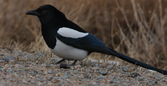
Black-billed magpies are mid-sized birds with a long tail, represent up to half of their length. They range in size from 45 to 60 cm long, with a wingspan of 56 to 61 cm. Black-billed magpies weigh between 145 and 210 g. The head, upper breast, back, and tail are black. There are large patches of white on the wings and lower breast. They have heavy black bills and black legs. At a distance, black-billed magpies are mainly black and white but have colorful iridescent patches ranging from bronze to green on the tail, body, and wings. Sexes are similar in coloration, but females are about 10% smaller in size than males. (Birkhead, 1991; Lee, et al., 2003)
Black-billed magpies and yellow-billed magpies (Pica nuttalli) are the only two magpie species in North America. They are easily distinguished by the color of the bill and breeding range since yellow-billed magpies are found only in California. Black-billed magpies of North America were formerly considered a subspecies of Pica pica, but mtDNA evidence suggests that the two North American magpie species are more closely related and may share a common ancestor. (Birkhead, 1991; Lee, et al., 2003)
- Other Physical Features
- endothermic
- homoiothermic
- bilateral symmetry
- Sexual Dimorphism
- sexes alike
- male larger
-
- Range mass
- 145 to 210 g
- 5.11 to 7.40 oz
-
- Range length
- 45 to 60 cm
- 17.72 to 23.62 in
-
- Range wingspan
- 56 to 61 cm
- 22.05 to 24.02 in
Reproduction
Black-billed magpies form monogamous pairs throughout the breeding season and may form lifelong bonds. In some regions black-billed magpies switch mates almost yearly. Courtship displays involve the male flashing his wings and flaring his tail at the female. Females will call loudly during their fertile period. Males respond by courtship-feeding of females. These behaviors continue from mating to incubation of the eggs. Since other males may be attracted by the loud calls of the fertile female, males vigilantly guard their mates to prevent extra-pair copulations. (Alsop, 2002; Birkhead, 1991; Dhindsa and Boag, 1991; Erpino, 1968; Trost, 2009)
- Mating System
- monogamous
Black-billed magpies breed from late March to early June, depending on location. There is usually one brood per season, although a second brood may be attempted if the first is not successful. Females lay up to 9 eggs (average of 6) which are greenish-gray with brown markings. The eggs are 3.3 by 2.3 cm and are sub-elliptical to oval. The first egg hatches within 25 days of being laid, hatching is asynchronous with usually only one chick hatching per day. The chicks are born without feathers and the eyes remain closed for 7 days. Fledging takes place between 24 to 30 days after hatching. The parents feed the chicks in or near the nest for the first 3 to 4 weeks and the young are beginning to fend for themselves by weeks 6 to 8. Young become independent at about 70 days. Females are likely to nest in their first year, whereas males may not breed until their second or third year. (Buitron, 1983; Dhindsa and Boag, 1991; Trost, 2009)
- Key Reproductive Features
- iteroparous
- seasonal breeding
- gonochoric/gonochoristic/dioecious (sexes separate)
- sexual
- oviparous
-
- Breeding interval
- Black-billed magpies produce one brood yearly.
-
- Breeding season
- Black-billed magpies breed from late March to early June.
-
- Range eggs per season
- 9 (high)
-
- Average eggs per season
- 6
-
- Range time to hatching
- 25 (high) days
-
- Average fledging age
- 27.5 days
-
- Range time to independence
- 70 (high) days
-
- Average age at sexual or reproductive maturity (female)
- 1 years
-
- Average age at sexual or reproductive maturity (male)
- 2 years
Both sexes help to construct an elaborate, domed nest which may take between 5 and 7 weeks to complete. Males focus on building the 60 to 120 cm high dome, while females focus on the egg bowl, which is a mud cup lined with hair, grasses, bark strips, fibrous roots, and feathers. The female is the primary defender of the nest prior to and during egg laying, and males become the defender of the nest during incubation. Like other members of the corvid family, the female is the sole incubator and is almost totally reliant on the male to feed her during this period. Because the sexes have specialized roles, if either mate dies during incubation, the brood does not survive. Both male and female help to gather food for the nestlings after hatching. The female is presumed to eat the fecal sacs of the young. The post-fledging period, during which parents continue to feed their young, is much longer than in crows. This period may be instrumental in teaching the young how to recognize danger and what the most appropriate response is for a particular predator. (Birkhead, 1991; Buitron, 1983; Buitron, 1988; Erpino, 1968; Trost, 2009)
- Parental Investment
- altricial
- male parental care
- female parental care
-
pre-fertilization
- provisioning
-
protecting
- male
- female
-
pre-hatching/birth
-
provisioning
- male
- female
-
protecting
- female
-
provisioning
-
pre-weaning/fledging
-
provisioning
- male
- female
-
protecting
- male
- female
-
provisioning
-
pre-independence
-
provisioning
- male
- female
-
protecting
- male
- female
-
provisioning
- post-independence association with parents
- extended period of juvenile learning
Lifespan/Longevity
The average lifespan of male black-billed magpies is 3.5 years, females live on average 2 years, although these numbers may represent relatively high levels of mortality of the young, with average ages being higher when first year mortality is not considered. The oldest banded bird was 15 years and one month old. The longest known lifespan in captivity is 20 years. (Birkhead, 1991; Cramp and Perrins, 1994; Linsdale, 1937)
-
- Range lifespan
Status: wild - 15 (high) years
- Range lifespan
-
- Range lifespan
Status: captivity - 20 (high) years
- Range lifespan
-
- Typical lifespan
Status: wild - 2.0 to 3.5 years
- Typical lifespan
Behavior
Black-billed magpies walk with a swaggering gait and frequently hop before flying. Horizontal flight usually consists of slow, steady wing beats, descending flight consists of a short series of wing flaps interspersed with pauses where the wings are tucked in tight to the body. This alternating pattern creates a distinctive J-shaped flight trajectory. (Alsop, 2002; Birkhead, 1991; Reebs, 1987; Reese and Kadlec, 1985; Stone and Trost, 1991; Trost, 2009)
Black-billed magpies have been known to gather around the bodies of deceased magpies for a few minutes after their discovery. This behavior has been likened to a funeral ceremony, although the purpose of such gatherings is not well understood. Another interesting behavior that differs from other corvids is their ability to flip an object over with their bill or foot. (Crosbie, et al., 2008; Miller and Brigham, 1988; Trost, 2009)
Black-billed magpies live in family flocks of 6 to 10 birds. Larger groups of birds form communal roosts in the non-breeding season, consisting of up to several hundred birds. The main purpose of group roosting is believed to be social. In cold weather, birds do not huddle together, but roost in coniferous trees with the branches acting as protection from predators and the wind. (Alsop, 2002; Birkhead, 1991; Reebs, 1987; Reese and Kadlec, 1985; Stone and Trost, 1991; Trost, 2009)
Black-billed magpies vary greatly in nesting density, from scattered nests to communal nesting areas. Variation is related to the abundance of food and resources. When food is abundant, black-billed magpies build nests in close proximity, when food is scarce, nests are found further apart. This suggests that territorial behaviour is flexible within the species. Black-billed magpies may defend a territory of 0.3 hectares during the breeding season. When territorial, they passively defend their territory by sitting silently in tree-tops to advertise their presence. (Alsop, 2002; Birkhead, 1991; Reebs, 1987; Reese and Kadlec, 1985; Stone and Trost, 1991; Trost, 2009)
-
- Average territory size
- 3000 m^2
Home Range
Home range sizes are not reported.
Communication and Perception
Two different alarm calls have been described: a basic alarm and a staccato alarm. The basic alarm is a harsh rattling, which can vary in volume and speed of call depending on the danger, and may serve to incite mobbing behaviour. The staccato alarm is quicker, more excited and may represent the signal to flee from a more dangerous predator. A wide range of vocalizations has been documented in European magpies, more research is needed in North American species. Like other members of the corvid family, black-billed magpies are highly intelligent birds. When kept captive from a young age, black-billed magpies can be taught to speak a number of words and phrases. (Buitron, 1983; Dice, 1917; Trost, 2009)
Food Habits
Black-billed magpies, like other corvids, are opportunistic omnivores. They often forage for food on the ground and their diet can partially be determined by the small pellet that they regurgitate soon after eating. They primarily eat insects and their larva, as well as the eggs and hatchlings of songbirds. They also eat fruit and grain crops and small mammals like mice and meadow voles. Black-billed magpies scavenge for carrion and are often seen along roadsides picking at roadkill and human refuse. Black-billed magpies dig small depressions in the ground or the snow to store food. (Hall, 1994; Sept, 2004)
- Primary Diet
- omnivore
- Animal Foods
- birds
- mammals
- eggs
- carrion
- insects
- terrestrial non-insect arthropods
- Plant Foods
- seeds, grains, and nuts
- fruit
- Foraging Behavior
- stores or caches food
Predation
Known predators of black-billed magpies include American crows (Corvus brachyrhynchos), common ravens (Corvus corax), great horned owls (Bubo virginianus), northern harriers (Circus cyaneus), red-tailed hawks (Buteo jamaicensis), Swainson’s hawks (Buteo swainsoni), weasels (Mustela), mink (Neovison vison), domestic cats (Felis catus), raccoons (Procyon lotor), coyotes (Canis latrans), and red squirrels (Tamiasciurus hudsonicus). Mammalian predators and American crows are most likely to eat eggs or young nestlings. Birds of prey and common ravens are the biggest threats to fledgling birds. Black-billed magpies may roost in dense thickets and coniferous trees as an adaptation against great horned owl predation. The dome above the nest may act as protection from great horned owls and common ravens. (Buitron, 1983; Erpino, 1968; Reebs, 1987; Trost, 2009)
Groups of adult and juvenile birds cooperate in mobbing predators. This group behavior is usually effective in causing the predator to abandon the hunt. Black-billed magpies have different mobbing responses to predators that are most likely to attack at that particular stage. Although functioning as a defense mechanism, mobbing may also serve as an effective learning method to teach the young which animals are more dangerous and warrant a longer and more vigorous alarm call. (Buitron, 1983; Erpino, 1968; Reebs, 1987; Trost, 2009)
-
- Known Predators
-
- American crows (Corvus brachyrhynchos)
- common ravens (Corvus corax)
- great horned owls (Bubo virginianus)
- northern harriers (Circus cyaneus)
- red-tailed hawks (Buteo jamaicensis)
- Swainson’s hawks (Buteo swainsoni)
- weasels (Mustela)
- mink (Neovison vison)
- domestic cats (Felis catus)
- raccoons (Procyon lotor)
- coyotes (Canis latrans)
- red squirrels (Tamiasciurus hudsonicus)
Ecosystem Roles
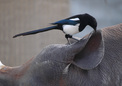
The sturdy nests built by black-billed magpies may last four years or more and are often reused by other birds. Owls and ducks may build their own nests on top or use the domed nest for shelter during the winter. Black-billed magpies have a symbiotic relationship with large ungulates such as deer, from which they sometimes eat ticks. (Erpino, 1968; Todd and Worley, 1967; Trost, 2009)
Fly maggots and wood ticks (Permacentor) will suck the blood of nestlings. Black-billed magpies may have many internal parasites such as roundworms (Nematoda), tapeworms (Cestoda), and flukes (Trematoda). These internal parasites may be due to their broad diet. (Erpino, 1968; Todd and Worley, 1967; Trost, 2009)
- mule deer (Odocoileus hemionus)
- elk (Cervus elaphus)
Economic Importance for Humans: Positive
Black-billed magpies eat pest species such as grasshoppers, cutworms (Agrotis larvae), and wireworm (Elateridae larvae), and can benefit agricultural areas by keeping down populations of these insects. When their natural foods are in abundance, black-billed magpies will not feed on food crops and livestock. (Hall, 1994)
- Positive Impacts
- controls pest population
Economic Importance for Humans: Negative
Black-billed magpies occasionally cause damage to fruit and nut crops, especially if other food sources are in decline and they are aggregated in larger flocks. Black-billed magpies will eat the eggs and hatchlings of chickens and can have a negative effect on poultry production. They also gather in areas with livestock to eat the insects living in dung and to scavenge from dead or dying animals. Black-billed magpies have gained some notoriety by picking insects out of open wounds on the backs of livestock, which may eventually kill some animals due to infection, or by eating the eyes of new-born animals. Due to these negative effects on crops, livestock, and poultry, various anti-magpie techniques have been employed by agricultural producers, such as netting, frightening devices, and live trapping. (Hall, 1994)
- Negative Impacts
- crop pest
Conservation Status
During the first half of the 1900’s, black-billed magpies were widely treated as pests due to their use of food crops, poultry, and livestock as part of their diet. Although determined efforts are still made to control magpie populations in certain agricultural areas, they are generally common throughout their range. Black-billed magpies are fully protected in the U.S. under the Migratory Bird Treaty Act but currently receive no protection in Canada. (Trost, 2009)
-
- IUCN Red List
-
Least Concern
More information
-
- IUCN Red List
-
Least Concern
More information
-
- US Migratory Bird Act
- Protected
-
- US Federal List
- No special status
-
- CITES
- No special status
-
- State of Michigan List
- No special status
Other Comments
The population of yellow-billed magpies has been decimated since West Nile virus became established in California in 2004. As West Nile virus becomes prevalent in more northerly ranges, this may become an issue for closely related black-billed magpies. (Crosbie, et al., 2008; Miller and Brigham, 1988; Trost, 2009)
Contributors
Steve Olson (author), University of Alberta, Augustana Campus, Doris Audet (editor), University of Alberta, Augustana Campus, Tanya Dewey (editor), University of Michigan-Ann Arbor, Catherine Kent (editor), Special Projects.
Glossary
- Nearctic
-
living in the Nearctic biogeographic province, the northern part of the New World. This includes Greenland, the Canadian Arctic islands, and all of the North American as far south as the highlands of central Mexico.

- acoustic
-
uses sound to communicate
- agricultural
-
living in landscapes dominated by human agriculture.
- altricial
-
young are born in a relatively underdeveloped state; they are unable to feed or care for themselves or locomote independently for a period of time after birth/hatching. In birds, naked and helpless after hatching.
- arboreal
-
Referring to an animal that lives in trees; tree-climbing.
- bilateral symmetry
-
having body symmetry such that the animal can be divided in one plane into two mirror-image halves. Animals with bilateral symmetry have dorsal and ventral sides, as well as anterior and posterior ends. Synapomorphy of the Bilateria.
- carrion
-
flesh of dead animals.
- chemical
-
uses smells or other chemicals to communicate
- colonial
-
used loosely to describe any group of organisms living together or in close proximity to each other - for example nesting shorebirds that live in large colonies. More specifically refers to a group of organisms in which members act as specialized subunits (a continuous, modular society) - as in clonal organisms.
- diurnal
-
- active during the day, 2. lasting for one day.
- endothermic
-
animals that use metabolically generated heat to regulate body temperature independently of ambient temperature. Endothermy is a synapomorphy of the Mammalia, although it may have arisen in a (now extinct) synapsid ancestor; the fossil record does not distinguish these possibilities. Convergent in birds.
- female parental care
-
parental care is carried out by females
- forest
-
forest biomes are dominated by trees, otherwise forest biomes can vary widely in amount of precipitation and seasonality.
- iteroparous
-
offspring are produced in more than one group (litters, clutches, etc.) and across multiple seasons (or other periods hospitable to reproduction). Iteroparous animals must, by definition, survive over multiple seasons (or periodic condition changes).
- male parental care
-
parental care is carried out by males
- monogamous
-
Having one mate at a time.
- motile
-
having the capacity to move from one place to another.
- native range
-
the area in which the animal is naturally found, the region in which it is endemic.
- omnivore
-
an animal that mainly eats all kinds of things, including plants and animals
- oviparous
-
reproduction in which eggs are released by the female; development of offspring occurs outside the mother's body.
- riparian
-
Referring to something living or located adjacent to a waterbody (usually, but not always, a river or stream).
- seasonal breeding
-
breeding is confined to a particular season
- sedentary
-
remains in the same area
- sexual
-
reproduction that includes combining the genetic contribution of two individuals, a male and a female
- social
-
associates with others of its species; forms social groups.
- stores or caches food
-
places a food item in a special place to be eaten later. Also called "hoarding"
- tactile
-
uses touch to communicate
- temperate
-
that region of the Earth between 23.5 degrees North and 60 degrees North (between the Tropic of Cancer and the Arctic Circle) and between 23.5 degrees South and 60 degrees South (between the Tropic of Capricorn and the Antarctic Circle).
- terrestrial
-
Living on the ground.
- tropical savanna and grassland
-
A terrestrial biome. Savannas are grasslands with scattered individual trees that do not form a closed canopy. Extensive savannas are found in parts of subtropical and tropical Africa and South America, and in Australia.
- savanna
-
A grassland with scattered trees or scattered clumps of trees, a type of community intermediate between grassland and forest. See also Tropical savanna and grassland biome.
- temperate grassland
-
A terrestrial biome found in temperate latitudes (>23.5° N or S latitude). Vegetation is made up mostly of grasses, the height and species diversity of which depend largely on the amount of moisture available. Fire and grazing are important in the long-term maintenance of grasslands.
- visual
-
uses sight to communicate
References
Alsop, F. 2002. Birds of Canada. Toronto: Dorling Kindersley, Ltd.
Birkhead, T. 1991. The Magpies. London, England: T & AD Poyser Ltd.
Buitron, D. 1988. Female and Male Specialization in Parental Care and Its Consequences in Black-Billed Magpies. The Condor, 90(1): 29-39.
Buitron, D. 1983. Variability in the Responses of Black-Billed Magpies to Natural Predators. Behaviour, 87(3/4): 209-236.
Cramp, S., C. Perrins. 1994. The birds of the Western Palearctic Vol. 8. Crows to finches. Oxford: Oxford University Press.
Crosbie, S., W. Koenig, W. Reisen, V. Kramer, L. Marcus, R. Carney, E. Pandolfino, G. Bolen, L. Crosbie, D. Bell, H. Ernest. 2008. Early Impact of West Nile Virus on the Yellow-Billed Magpie (Pica nuttalli). The Auk, 125(3): 542-550.
Dhindsa, M., D. Boag. 1991. Patterns of nest site, territory, and mate switching in black-billed magpies (Pica pica). Canadian Journal of Zoology, 70(4): 633-640.
Dice, L. 1917. Habits of the Magpie in Southeastern Washington. The Condor, 19(4): 121-124.
Erpino, M. 1968. Nest-related Activities of Black-billed Magpies. The Condor, 70(2): 154-165.
Hall, T. 1994. Prevention and Control of Wildlife Damage - Magpies. Lincoln: University of Nebraska.
Lee, S., C. Parr, Y. Hwang, D. Mindell, J. Choe. 2003. Phylogeny of magpies (genus Pica) inferred from mtDNA data. Molecular Phylogenetics and Evolution, 29(2): 250-257.
Linsdale, J. 1937. The Natural History of Magpies. Berkeley, CA: Cooper Ornithological Club.
Miller, W., R. Brigham. 1988. "Ceremonial" Gathering of Black-Billed Magpies (Pica pica) after the Sudden Death of a Conspecific. The Murrelet, 69(3): 78-79.
Reebs, S. 1987. Roost characteristics and roosting behaviour of black-billed magpies, Pica pica , in Edmonton, Alberta.. Canadian field-naturalist, 101(4): 519-525.
Reese, K., J. Kadlec. 1985. Influence of High Density and Parental Age on the Habitat Selection and Reproduction of Black-Billed Magpies. The Condor, 87(1): 96-105.
Salt, W., J. Salt. 1976. The Birds of Alberta. Edmonton, AB: Hurtig Publishers.
Sept, J. 2004. Common Birds of Alberta. Sechelt, BC: Calypso Publishing.
Stone, E., C. Trost. 1991. The Effects of Supplemental Food on Nest Dispersion in Black-Billed Magpies. The Condor, 93(2): 452-454.
Todd, K., D. Worley. 1967. Helminth Parasites of the Black-Billed Magpie, Pica pica hudsonia (Sabine, 1823), from Southwestern Montana. The Journal of Parasitology, 53(2): 364-367.
Trost, C. 2009. "The Birds of North America Online" (On-line). Accessed November 18, 2009 at http://bna.birds.cornell.edu/bna/species/389.