Physalia physalisPortuguese man-of-war


Geographic Range
This species has been found in the Atlantic Ocean, the Pacific Ocean, the Indian Ocean, the Caribbean, and the Sargasso Sea. It floats on or near the surface of the water.
- Biogeographic Regions
- indian ocean
- atlantic ocean
- pacific ocean
Habitat
The Portuguese man-of-war floats on the surface of tropical, marine waters. Generally, these colonies live in warm tropical and subtropical water such as along the Florida Keys and Atlantic coast, the Gulf Stream, the Gulf of Mexico, the Indian Ocean, the Caribbean Sea, and other warm areas of the Atlantic and Pacific oceans. They are especially common in the warm waters of the Sargasso Sea.
- Habitat Regions
- tropical
- saltwater or marine
Physical Description
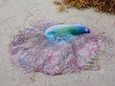
The Portuguese man-of-war is a floating hydrozoan. It is actually a colony consisting of four types of polyps: a pneumatophore, or float; dactylozooids, or tentacles; gastrozooids, or feeding zooids; and gonozooids which produce gametes for reproduction. Cnidocytes (stinging cells) are located in the tentacles. Their action is based on their individual osmotic and hydrostatic pressure. Sensory cells are numerous and are located in the epidermis of the tentacles and the region around the mouths. Generally, the sensory cells are receptors for touch and temperature.
The stinging cells, or cnidocytes, are the characteristic food-getting mechanisms of jellyfish and their close relatives. P. physalis has two sizes of cnidocytes, some small and others are large. These cells retain their potency long after an individual has been washed up along the shore, as many hikers along beaches have discovered to their dismay and discomfort.
- Other Physical Features
- ectothermic
- heterothermic
- radial symmetry
- venomous
Reproduction
An "individual" is actually a colony of unisexual organisms. Every individual has specific gonozooids (sex organs or reproductive parts of the animals, either male or female). Each gonozooid is comprised of gonophores, which are little more than sacs containing either ovaries or testes.
Physalia are dioecious. Their larvae probably develop very rapidly to small floating forms.
Fertilization of P. physalis is assumed to occur in the open water, because gametes from the gonozooids are shed into the water. This may happen as gonozooids themselves are broken off and released from the colony. The release of gonozooids may be a chemical response occurring when groups of individuals are present in one locality. Critical density is probably required for successful fertilization. Fertilization may take place close to the surface. Most reproduction takes place in the fall, producing the great abundance of young seen during the winter and spring. It is not known what triggers this spawning cycle but it probably begins in the Atlantic Ocean.
Germ Cell Development
Each gonophore has a central spadix of multinucleate endodermal cells separating the coelenteron from a layer of germ cells. Covering each germ cell is a layer of ectodermal tissue. When gonophores first bud, the germ layer is a cap of cells on top of the endodermal spadix. As gonophores mature, the germ cells develop into a layer covering the spadix. Spermatogonia form a thick layer, while oogonia form a convoluted band several cells wide, but only one cell layer thick. There is very little cytoplasmic material within these cells, except during rare instances when cell division is occurring. Oogonia begin development at approximately the same size as spermatogonia, but become considerably larger. All oogonia are apparently formed at an early stage of gonophore development prior to the occurrence of enlargement. Interestingly, there appears to be yolk globules within the cytoplasm of most oogonia.
- Key Reproductive Features
- iteroparous
- seasonal breeding
- gonochoric/gonochoristic/dioecious (sexes separate)
- sexual
- fertilization
- oviparous
- Parental Investment
- no parental involvement
Behavior
Locomotion is generally passive, driven by wind and current. The colony cannot swim, but floats by the aid of its pneumatophore, or float. The float is a long, gas-filled bladder, formed as an overgrown polyp in the shape of a closed bag. Some Men-of-War are "left-sided," while others are "right-sided." The "left-sided" individual drifts at an angle of 45 degrees to the right of the direction from which the wind is blowing, and the "right-sided" individual does the opposite. This distinction is crucial in the spreading of the animals more evenly over the warm oceans of the world.
Food Habits
The Portuguese Man-of-War traps its food in its tentacles. It feeds mainly on fish fry (young fish) and small adult fish, and it also consumes shrimp, other crustaceans, and other small animals in the plankton. Nearly 70 to 90% of the prey are fish.
The tentacles, or dactylozooids, are the Man-of-War's main mechanisms for catching its prey and are also used for defense. P. physalis sometimes traps and consumes larger fishes such as flying fish and mackerel, though fishes as large as these generally manage to escape from the tentacles. The food of the Man-of-War is digested in its bag-like stomachs (gastrozooids), which are located along the underside of the float. The gastrozooids digest the prey by secreting enzymes that break down proteins, carbohydrates and fats. Each Man-of-War has multiple gastrozooids complete with individual mouths. After the food has been digested, any undigestible remains are pushed out through the mouths. The nourishment from the digested food is absorbed into the body and eventually circulates to the different polyps in the colony.
Economic Importance for Humans: Positive
The Portuguese Man-of-War is eaten by some fish and crustaceans (e.g. the sand crab) that can be of commercial value.
Economic Importance for Humans: Negative
This species can hurt tourists and tourism in areas where it is common, due to stings (of neurotoxins) from its cnidocytes. Much money is spent each year to treat swimmers who have been stung by the tentacles of individuals that have washed up on beaches. The inflammatory response resulting from stings is due to the release of histamines from mast cells within the victim.
- Negative Impacts
-
injures humans
- bites or stings
- venomous
Conservation Status
Physalia physalis is not especially rare, and not considered to need special conservation effort at this time.
-
- IUCN Red List
- Not Evaluated
-
- US Federal List
- No special status
-
- CITES
- No special status
Other Comments
The Portuguese Man-of-War is the sole member of the Siphonophora with a unisexual colony; it is distinguished by a contractile, horizontal float. Although Siphonophora are generally considered to be the most specialized hydrozoans, some researchers claim that it is in fact the most primitive order, with the medusa and the polyp not fully differentiated. Additional support for this view comes from the observation that the regenerative powers of the man-of-war are poor, in contrast to most other jellyfish.
Contributors
Mindy B. Kurlansky (author), University of Michigan-Ann Arbor.
Glossary
- Atlantic Ocean
-
the body of water between Africa, Europe, the southern ocean (above 60 degrees south latitude), and the western hemisphere. It is the second largest ocean in the world after the Pacific Ocean.

- Pacific Ocean
-
body of water between the southern ocean (above 60 degrees south latitude), Australia, Asia, and the western hemisphere. This is the world's largest ocean, covering about 28% of the world's surface.
- coastal
-
the nearshore aquatic habitats near a coast, or shoreline.
- ectothermic
-
animals which must use heat acquired from the environment and behavioral adaptations to regulate body temperature
- external fertilization
-
fertilization takes place outside the female's body
- fertilization
-
union of egg and spermatozoan
- heterothermic
-
having a body temperature that fluctuates with that of the immediate environment; having no mechanism or a poorly developed mechanism for regulating internal body temperature.
- iteroparous
-
offspring are produced in more than one group (litters, clutches, etc.) and across multiple seasons (or other periods hospitable to reproduction). Iteroparous animals must, by definition, survive over multiple seasons (or periodic condition changes).
- native range
-
the area in which the animal is naturally found, the region in which it is endemic.
- oviparous
-
reproduction in which eggs are released by the female; development of offspring occurs outside the mother's body.
- pelagic
-
An aquatic biome consisting of the open ocean, far from land, does not include sea bottom (benthic zone).
- radial symmetry
-
a form of body symmetry in which the parts of an animal are arranged concentrically around a central oral/aboral axis and more than one imaginary plane through this axis results in halves that are mirror-images of each other. Examples are cnidarians (Phylum Cnidaria, jellyfish, anemones, and corals).
- saltwater or marine
-
mainly lives in oceans, seas, or other bodies of salt water.
- seasonal breeding
-
breeding is confined to a particular season
- sexual
-
reproduction that includes combining the genetic contribution of two individuals, a male and a female
- tropical
-
the region of the earth that surrounds the equator, from 23.5 degrees north to 23.5 degrees south.
- venomous
-
an animal which has an organ capable of injecting a poisonous substance into a wound (for example, scorpions, jellyfish, and rattlesnakes).
References
Bonnet, David D.1946.The Portuguese Man of War as a Food Source for the Sand Crab. Science.103(2666):148.
Cormier, Susan M.1981.Physalia Venom Mediates Histamine Release From Mast Cells. The Journal of Experimental Zoology.218(2):117.
Hickman, C.P.1961.Integrated Principles of Zoology. The C.V. Mosby Co., St.Louis.
Hickman, C.P. & Larry S. Roberts.1995.Animal Diversity.Wm. C. Brown Publishers, Dubuque.
Jenkins, Robert L. 1983. Observations on the commensal relationship of Nomeus gronovii with Physalia physalis. Copeia1983(1):250-252.
Kennedy, Frank S., Jr. 1972. Distribution and Abundance of Physalia in Florida Waters. Professional Paper Series Florida Department of Natural Resources Marine Research Laboratory.(18):30-31,36-37.
Lane, Charles E.1960. The Portuguese Man of War. Scientific American. 202(3):158-168.
Parker, Sybil P. 1982. Synopsis and Classification of Living Organisms. McGraw-Hill Book Co., New York.
Pennak, Robert W. 1978. Fresh-Water Invertebrates of the United States.John Wiley & Sons, New York.
Purcell, Jennifer E. 1984. Predation on Fish Larvae by Physalia physalis, The Portuguese Man of War. Marine Ecology.19(1,2):189.
Shale, David & Jennifer Coldrey.1987.The Man of War At Sea. Gareth Stevens Publishing, Milwaukee.