Phrynosoma cornutumTexas Horned Lizard
Geographic Range
Texas horned lizards (Phrynosoma cornutum) are distributed across the United States and Mexico. Their range extends as far north as southeast Colorado, Kansas, and southwest Missouri. They live as far south as the Mexican states of northeast Sonora, Chihuahua, Durango, Zacatecas, San Luis Potosí, and Tamaulipas. Their range extends as far east as Louisiana and Arkansas, and as far west as southeastern Arizona and New Mexico. Texas horned lizards are commonly found throughout Oklahoma and Texas, including the barrier islands along the Texas coast.
Texas horned lizards have been introduced to 19 states outside their native range in the United States. These introduction sites include locations as far east as the District of Colombia, as far southeast as Florida, as far northwest as Wyoming, as far southwest as Arizona, and as far north as Michigan. (Fair and Henke, 1999; Jensen, 1994; Mackessy, 2003; Montgomery, et al., 2003; Price, 1990)
- Biogeographic Regions
- nearctic
Habitat
Texas horned lizards reside in arid or semi-arid regions with access to open ground and some scattered vegetative cover. These areas include a number of early successional habitats like prairies, dunes, and deserts. They also include the edge habitat of playas, which are flat desert basins that are normally dry, but may become shallow lakes after rainfall. These areas also include bajadas, which are slopes of fertile soil found along the foot of a mountain. Texas horned lizards have been reported at elevations from 106 m to 1,330 m above sea level.
In the mornings and evenings, Texas horned lizards can be found on open ground where they bask and hunt for insects. In the hot afternoon sun they take shelter under rocks, in rodent burrows, under woody vegetation, or in crevasses to avoid predation.
Texas horned lizards hibernate from October until late March by burying themselves under soil, litterfall and foliage. Their burrows average a depth of 140 mm and tend to face the south or south-west, where sunlight exposure is highest during the winter. ("Definition of Bajada by Merriam-Webster", 2018; "Definition of Playa by Merriam-Webster", 2017; Burrow, et al., 2001; Endriss, 2006; ; Hammerson, 2007; Munger, 1984; Wolf, et al., 2015)
- Habitat Regions
- temperate
- terrestrial
- Terrestrial Biomes
- desert or dune
- savanna or grassland
-
- Range elevation
- 106 to 1,330 m
- 347.77 to ft
Physical Description
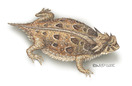
As the name suggests, Texas horned lizards are covered in horny scales. The largest horns crown their heads: two form the brow, while more protrude from the jawline and up to the temporal portion of the skull. Two rows of spikes line the lateral portions of their torso, separating the larger spikes of the dorsal side from the scaly underbelly.
Upon reaching sexual maturity, the snout-vent length of Texas horned lizards measures a minimum of 69 mm. Female Texas horned lizards are larger than the males. Females reportedly grow until they become 144 mm in length, while males grow to 94 mm. Their mass ranges from 25 to 90 g.
Their bodies are short and round, which they can flatten if they wish to hide. They can also inflate themselves full of air so their spikes protrude, making them more difficult for predators to consume.
Depending upon the geographic region, Texas horned lizards will have coloration that resembles the color of the ground. Their coloration ranges from the yellow or reddish-brown sands of a desert or playa, to the tan or brown grass of a prairie. During the breeding season, these colorations become more vibrant.
Dark bars run down the eyes to the tips of the horns, with more upon the head and across the legs. For some individuals, the two largest horns on the back of the head have a darker brown or red coloration. Their backs have large, dark blotches that are rimmed with a lighter line, and a single light line runs down their spine from the base of their neck to the tip of their tail.
Hatchlings have a dark brown coloration, which may fade into a lighter coloration upon reaching adulthood. Seven hatchlings found by Allison and Cepeda (2009) weighed from 0.57 g to 0.81 g. One hatchling had a snout-vent length of 20 mm. (Allison and Cepeda, 2009; Lynn, 1963; ; Milne and Milne, 1950; Montgomery, et al., 2003; Munger, 1984; Price, 1990)
- Other Physical Features
- ectothermic
- bilateral symmetry
- Sexual Dimorphism
- female larger
- ornamentation
-
- Range mass
- 25 to 90 g
- 0.88 to 3.17 oz
-
- Range length
- 69 to 114 (Female); 94 (Male) mm
- 2.72 to in
Development
Texas horned lizards’ white eggs develop for approximately 44 days within the female before being deposited in a burrow. The flexible, leathery eggs incubate for additional 40 to 61 days before hatching. Milne and Milne’s (1950) clutch of 23 eggs on average measured 16 mm long, 10 mm in diameter, and each egg weighed 1 gm. They reach adulthood after two years, when their snout-vent length averages 69 mm.
Cahn (1926) reported removing eggs from a new nest (in a dirt/sand burrow), and eggs were laid in groups of 10-11 with layers of sand in between the layers. Cahn placed some eggs in formalin (to arrest development). Eight hours post-laying, the embryos were 1.77m long and possessed the beginning stages of front and back limbs.
Texas horned lizards do not posses sex chromosomes. As members of the Iguanidae family, it is possible their sex is determined by the temperature of their burrow during development. As reptiles living in a temperate environment, Texas horned lizards could grow throughout their lifetimes. (Allison and Cepeda, 2009; Cavazos, 1951; Halliday and Verrell, 1988; Lynn, 1963; ; Milne and Milne, 1950; Pianka and Vitt, 2003)
- Development - Life Cycle
- temperature sex determination
- indeterminate growth
Reproduction
The breeding season for Texas horned lizards begins immediately after hibernation from mid-April and continues until mid-June. Males travel more during the first month after hibernation in search of receptive females than during all other times of the year.
To express interest in a female, male Texas horned lizards will perform their species-specific display of quickly bobbing their heads up and down. Females may reject males by simply moving away or by waving their tails. The lizards experience a type of amplexus for a couple hours, where the male is atop the female.
The mating system of the Texas horned lizard is unknown; however, females will reject all other attempts at courtship after mating. After mating ceases, the male also shows no further interest in the female. (Cahn, 1926; Lynn, 1963; ; Stark, et al., 2005)
The breeding season of Texas horned lizards begins immediately after hibernation in mid-April and continues until mid-June. Females will have only a single clutch per year. There are no records of how many times males may reproduce during a single breeding season.
Females deposit their eggs 44 days after copulation in a burrow, where the eggs will incubate for 40 to 61 days. Around 14 to 37 eggs have been reported in a single clutch, with the larger clutches laid by older, larger females. Females do not stay with the clutch.
The gestation period is typically 44 days, and incubation times are 40-61 days. Time to independence is immediately upon hatching, as parents do not protect the nest or the young. Seven hatchlings found by Allison and Cepeda (2009) weighed from 0.57 to 0.81 g. One hatchling had a snout-vent length of 20 mm. Both males and females reach sexual maturity two years after hatching. (Allison and Cepeda, 2009; Ballinger, 1974; Lynn, 1963; ; Winton, 1916)
- Key Reproductive Features
- iteroparous
- seasonal breeding
- gonochoric/gonochoristic/dioecious (sexes separate)
- sexual
- oviparous
-
- Breeding interval
- Females breed once a year, Males breed an indeterminate number of times per year
-
- Breeding season
- Mid-April through mid-June
-
- Range number of offspring
- 14 to 37
-
- Average gestation period
- 44 days
-
- Average time to independence
- 0 minutes
-
- Average age at sexual or reproductive maturity (female)
- 2 years
-
- Average age at sexual or reproductive maturity (male)
- 2 years
Approximately 44 days after copulation, female Texas horned lizards dig a tunnel to deposit their eggs. They dig with their forelimbs, pushing excess soil out of the entrance with their hind limbs, often stopping to look around their environment. The tunnels reach from 12 to 25 centimeters deep, sloping 25 to 60 degrees downward.
After laying their eggs, females refill the tunnel using their forelimbs and head, then scatter the soil around to hide evidence of their nesting site. The whole nesting process may take an individual 5 to 10 hours to complete.
Females stay near the nesting site for a few hours after finishing their work, then leave the eggs. No further parental involvement occurs. Hatchlings are independent immediately after hatching. (Lynn, 1963; ; Milne and Milne, 1950)
- Parental Investment
- no parental involvement
- precocial
Lifespan/Longevity
Texas horned lizards typically live 7 years in captivity. Baur (1986) reported a female that lived 8 years, 11 months, and 3 days.
Most health issues in captivity are due to improper care, whether that be from not providing the correct food, improperly installing heat lamps, or not providing adequate resources to prepare Texas horned lizards for hibernation.
Their lifespan in the wild is not known. (Baur, 1986; Heatley and Ferrell, 2011; Oklahoma Department of Wildlife Conservation, 1994)
-
- Range lifespan
Status: captivity - 8.9 (high) years
- Range lifespan
-
- Average lifespan
Status: captivity - 7 years
- Average lifespan
Behavior
Texas horned lizards live a solitary lifestyle and only interact with other members of their own species when searching for a mate or competing for feeding grounds. When they do communicate, they do so by quickly bobbing their heads up and down in a species-specific manner.
As hatchlings, Texas horned lizards are skittish, fleeing from even the harvester ants (Pogonomyrmex rugosus) they feed on as adults. Only after two weeks do they exhibit their species' defense of remaining motionless until danger passes.
Adults spend much of their days positioned on high vantage points with their upper bodies elevated to survey their environment for prey or predators. During the hot afternoon they take shelter in the shade. The only activity this species is known to perform at night is when females lay their eggs.
Texas horned lizards hibernate from October until late March by burying themselves under soil, litterfall and foliage. Their burrows average a depth of 140 mm and tend to face the south or south-west, where sunlight exposure is highest during the winter. (Endriss, 2006; ; Lynn, 1963; Milne and Milne, 1950)
- Key Behaviors
- terricolous
- diurnal
- motile
- hibernation
- solitary
Home Range
Texas horned lizards have a home range from 291 to 14,690 m^2. The largest home range sizes are in June, and ranges substantailly decrease until hibernation. Endriss (2006) found that within a group of Texas horned lizards of the same body size, males utilized larger home ranges than females, likely to ensure access to the females. In addition, subdominant males had larger home ranges compared to dominant males in order to avoid these dominant males. However they do not actively defend a territory. (Endriss, 2006; ; Fair and Henke, 1999)
Communication and Perception
Texas horned lizards communicate with movement, quickly bobbing their heads up and down in a species-specific manner to show interest in a conspecific or establish territorial bounds.
They are commonly observed raising the front part of their bodies, so they may have a better view of their surroundings. Movement catches their attention, which is why examinations of their stomachs often find sand or light debris.
While Texas horned lizards do not use chemical cues to distinguish between prey, they have been observed performing tongue flicks during courtship.
While mating, male Texas horned lizards will grasp the female’s shoulders with their forelimbs while biting the female’s largest horn on her head.
Whitford and Whitford (1973) observed two male Texas horned lizards battling over an ant colony. They used their horns and claws to flip their opponent onto their back to attempt to puncture the exposed throat with their horns. (Carpenter, 1983; Cooper and Sherbrooke, 2009; Milne and Milne, 1950; Milne, 1938; Whitford and Bryant, 1979; Whitford and Whitford, 1973)
- Perception Channels
- visual
Food Habits
The diet of Texas horned lizards mainly consists of harvester ants (Pogonomyrmex rugosus); however, if the opportunity arises, they will consume other insects. Pianka and Parker (1975) examined the stomach contents of 351 Texas horned lizards. Here, ants made up 69.0% of prey items found in these stomachs.
Texas horned lizards have been observed waiting at colony entrances of harvester ants between the hours of 0900-1100 h, times in which harvester ants are the most active. To catch their prey, Texas horned lizards tilt their heads sideways and downwards, then quickly lap them up into their mouths with their sticky tongues.
A single Texas horned lizard can consume from about 30 to over 100 ants per day. They will visit more than one colony during a single foraging period, a behavior which gives their prey a chance to replenish their populations. They will leave a colony entrance preemptively if they become overheated, are challenged by a fellow horned lizard, or encounter a predator.
Juvenile Texas horned lizards feed exclusively on small ant species such as Pogonomyrmex rugosus and Pogonomyrmex desertorum. (Allison and Cepeda, 2009; Cooper and Sherbrooke, 2009; Manley and Sherbrooke, 2001; Milne and Milne, 1950; Montanucci, 1989; Pianka and Parker, 1975; Whitford and Bryant, 1979)
- Primary Diet
- carnivore
Predation
Texas horned lizards are preyed upon by canids, as well as reptiles such as western diamond-backed rattlesnakes (Crotalus atrox), sidewinders (Crotalus cerastes), Sonoran whipsnakes (Masticophis bilineatus) and coachwhips (Masticophis flagellum); by birds such as prairie falcons (Falco mexicanus), American kestrels (Falco sparverius), loggerhead shrikes (Lanius ludovicianus), and red-shouldered hawks (Buteo lineatus); as well as by greater roadrunners (Geococcyx californianus).
Texas horned lizards have several defense mechanisms against predation. They know to flee from ambush predators such as western diamondback rattlesnakes, and to stand their ground against chasing predators such as Sonoran whipsnakes or coachwhips.
When standing their ground, Texas horned lizards will remain motionless until the predator passes by. If noticed, they may engage in a defensive posture by flattening their torso, lowering the tail, and facing the threat with their mouths agape. If the threat approaches, they will hiss and lunge to defend themselves.
These lizards can also squirt blood from their eyes, which they spray at predators. An individual studied by Burleson (1942) ejected blood from its left eye at a distance of nearly 1 meter. They do this by forcing the blood pressure within the sinus orbitalis to increase, causing the blood vessel to rupture and forcing a passage to be formed into the conjunctival sac.
It is thought that the horns of horned lizards are used to defend against predators. The horn of this species have been found puncturing the throats of all listed species except greater roadrunners. Greater roadrunners kill Texas horned lizards by crushing their skeletons against a rock, then consuming the lizard head first, a method of consumption which has allowed them to avoid the same fate. (Burleson, 1942; Middendorf III, et al., 2001; Milne and Milne, 1950; Sherbrooke, 2008; Wack, 2002; )
-
- Known Predators
-
- Canids
- Western diamondback rattlesnake (Crotalus atrox)
- Sidewinder (Crotalus cerastes)
- Sonoran whipsnake (Masticophis bilineatus)
- Coachwhip (Masticophis flagellum)
- Prairie falcon (Falco mexicanus)
- American kestrel (Falco sparverius)
- Loggerhead shrike (Lanius ludovicianus)
- Red-shouldered hawk (Buteo lineatus)
- Greater roadrunner (Geococcyx californianus)
Ecosystem Roles
Texas horned lizards keep harvester ant (Pogonomyrmex rugosus) populations under control. They are also known to fall prey to larger predators, such as western diamondback rattlesnakes (Crotalus atrox) or greater roadrunners (Geococcyx californianus).
Parasites include roundworms (Skrjabinoptera phrynosoma , Physaloptera phrynosoma), as well as flatworms (Diochetos phrynosomatis).
The life cycle of Skrjabinoptera phrynosoma occurs between the stomach of Texas horned lizards and harvester ants. Pregnant female roundworms are expelled from Texas horned lizards through the cloaca, then gathered by harvester ants to be fed to their larvae. The harvester ant larvae consume the eggs inside the roundworm, becoming infected. The eggs develop into juveniles inside the gut of the young harvester ant, where they wait until the host is consumed by a Texas horned lizard. Inside the gut of Texas horned lizards, the roundworms grow into their mature form then mate, repeating the life cycle. (Hilsinger, et al., 2011; Lee, 1957; Middendorf III, et al., 2001; Sherbrooke, 2008; Vincent, 1948)
- Roundworms (Skrjabinoptera phrynosoma)
- Roundworms (Physaloptera phrynosoma)
- Flatworms (Diochetos phrynosomatis)
Economic Importance for Humans: Positive
Texas horned lizards are often captured and sold as pets. However, this practice is opposed by organizations such as the Texas Wildlife and Parks Department, due to their decline within their native range. Texas horned lizards are not common pets because they do not survive well in captivity. ("Texas horned lizard watch", 2009; Milne and Milne, 1950; Montanucci, 1984; Reptiles Magazine, 2018)
- Positive Impacts
- pet trade
Economic Importance for Humans: Negative
The only harm Texas horned lizards can do to humans is bite. While normally a docile species, Texas horned lizards may lunge at a human if threatened. They clamp down, requiring them to be pried off. (Milne and Milne, 1950)
- Negative Impacts
-
injures humans
- bites or stings
Conservation Status
Texas horned lizards are categorized as a species of “Least Concern” on the IUCN Red List. They have no special status on the US Federal List, CITES, and State of Michigan List.
Within Texas, the urbanization of their habitat, collection as pets, and the loss of their main food source have all contributed to their decline. Harvester ants (Pogonomyrmex rugosus) make up 69% of their diet, but they are facing a decline due to the use of pesticides. These same pesticides also directly cause illness in Texas horned lizards. Texas horned lizards are collected and kept as pets, leaving too few in the wild to sustain declining populations. Limited by a specialized diet of harvester ants, Texas horned lizards often die after a few months in captivity.
Since the 1960s, they have declined throughout central Oklahoma and Texas. The Texas Wildlife and Parks Department does not recommend taking Texas horned lizards as pets, or releasing them onto private property. The survivability of captive Texas horned lizards released into the wild is uncertain, and so The Texas Wildlife and Parks Department is currently conducting studies to determine the best ways to reintroduce Texas horned lizards to their native habitat. In the meantime, Texas residents are encouraged by the Horned Lizard Conservation Society to make their property habitable for wild Texas horned lizards in the hopes that they will return on their own.
In Oklahoma, Texas horned lizards are classified as "species of special concern," and their collection and harm are considered unlawful.
Texas horned lizards will flee from potential predators, making them the frequent victims of road mortality.
It has been suggested that agriculture could be a threat, but no mortalities have been documented. (Endriss, 2006; "Texas horned lizard watch", 2009; Endriss, 2006; ; Oklahoma Department of Wildlife Conservation, 1994; Reptiles Magazine, 2018; Vitt, 2017)
-
- IUCN Red List
-
Least Concern
More information
-
- IUCN Red List
-
Least Concern
More information
-
- US Federal List
- No special status
-
- CITES
- No special status
-
- State of Michigan List
- No special status
Contributors
Allison Walker (author), Radford University, Alex Atwood (editor), Radford University, Layne DiBuono (editor), Radford University, Lindsey Lee (editor), Radford University, Karen Powers (editor), Radford University, Joshua Turner (editor), Radford University, Tanya Dewey (editor), University of Michigan-Ann Arbor.
Glossary
- Nearctic
-
living in the Nearctic biogeographic province, the northern part of the New World. This includes Greenland, the Canadian Arctic islands, and all of the North American as far south as the highlands of central Mexico.

- bilateral symmetry
-
having body symmetry such that the animal can be divided in one plane into two mirror-image halves. Animals with bilateral symmetry have dorsal and ventral sides, as well as anterior and posterior ends. Synapomorphy of the Bilateria.
- carnivore
-
an animal that mainly eats meat
- desert or dunes
-
in deserts low (less than 30 cm per year) and unpredictable rainfall results in landscapes dominated by plants and animals adapted to aridity. Vegetation is typically sparse, though spectacular blooms may occur following rain. Deserts can be cold or warm and daily temperates typically fluctuate. In dune areas vegetation is also sparse and conditions are dry. This is because sand does not hold water well so little is available to plants. In dunes near seas and oceans this is compounded by the influence of salt in the air and soil. Salt limits the ability of plants to take up water through their roots.
- diurnal
-
- active during the day, 2. lasting for one day.
- ectothermic
-
animals which must use heat acquired from the environment and behavioral adaptations to regulate body temperature
- hibernation
-
the state that some animals enter during winter in which normal physiological processes are significantly reduced, thus lowering the animal's energy requirements. The act or condition of passing winter in a torpid or resting state, typically involving the abandonment of homoiothermy in mammals.
- indeterminate growth
-
Animals with indeterminate growth continue to grow throughout their lives.
- insectivore
-
An animal that eats mainly insects or spiders.
- introduced
-
referring to animal species that have been transported to and established populations in regions outside of their natural range, usually through human action.
- iteroparous
-
offspring are produced in more than one group (litters, clutches, etc.) and across multiple seasons (or other periods hospitable to reproduction). Iteroparous animals must, by definition, survive over multiple seasons (or periodic condition changes).
- motile
-
having the capacity to move from one place to another.
- native range
-
the area in which the animal is naturally found, the region in which it is endemic.
- oviparous
-
reproduction in which eggs are released by the female; development of offspring occurs outside the mother's body.
- pet trade
-
the business of buying and selling animals for people to keep in their homes as pets.
- seasonal breeding
-
breeding is confined to a particular season
- sexual
-
reproduction that includes combining the genetic contribution of two individuals, a male and a female
- sexual ornamentation
-
one of the sexes (usually males) has special physical structures used in courting the other sex or fighting the same sex. For example: antlers, elongated tails, special spurs.
- solitary
-
lives alone
- tactile
-
uses touch to communicate
- temperate
-
that region of the Earth between 23.5 degrees North and 60 degrees North (between the Tropic of Cancer and the Arctic Circle) and between 23.5 degrees South and 60 degrees South (between the Tropic of Capricorn and the Antarctic Circle).
- terrestrial
-
Living on the ground.
- tropical savanna and grassland
-
A terrestrial biome. Savannas are grasslands with scattered individual trees that do not form a closed canopy. Extensive savannas are found in parts of subtropical and tropical Africa and South America, and in Australia.
- savanna
-
A grassland with scattered trees or scattered clumps of trees, a type of community intermediate between grassland and forest. See also Tropical savanna and grassland biome.
- temperate grassland
-
A terrestrial biome found in temperate latitudes (>23.5° N or S latitude). Vegetation is made up mostly of grasses, the height and species diversity of which depend largely on the amount of moisture available. Fire and grazing are important in the long-term maintenance of grasslands.
- visual
-
uses sight to communicate
- young precocial
-
young are relatively well-developed when born
References
2018. "Definition of Bajada by Merriam-Webster" (On-line). Accessed February 09, 2018 at https://www.merriam-webster.com/dictionary/bajada.
2017. "Definition of Playa by Merriam-Webster" (On-line). Accessed February 09, 2018 at https://www.merriam-webster.com/dictionary/playa.
Texas Parks and Wildlife Department. Texas horned lizard watch. None. Austin, TX: Texas Parks and Wildlife Department. 2009. Accessed March 22, 2018 at https://tpwd.texas.gov/publications/pwdpubs/media/pwd_br_w7000_0610.pdf.
Allison, P., J. Cepeda. 2009. Nesting and hatchling behavior of the Texas horned lizard (Phrynosoma Cornutum). The Southwestern Naturalist, 54/2: 211-213.
Ballinger, R. 1974. Reproduction of the Texas horned lizard, Phrynosoma cornutum. Herpetologica, 30/4: 321-327.
Baur, B. 1986. Longevity of horned lizards of the genus Phrynosoma. Bulletin of the Maryland Herpetological Society, 22: 149-151.
Burleson, G. 1942. The source of the blood ejected from the eye by horned toads. Copeia, 1942/4: 246-248.
Burrow, A., R. Kazmaier, E. Hellgren, D. Ruthven, III. 2001. Microhabitat selection by Texas horned lizards in southern Texas. The Journal of Wildlife Management, 65/4: 645-652.
Cahn, A. 1926. The breeding habits of the Texas horned toad, Phrynosoma cornutum. The American Naturalist, 60/671: 546-551.
Carpenter, C. 1983. Communication signals in lizards. The American Biology Teacher, 45/6: 306-309+342.
Cavazos, L. 1951. Spermatogenesis of the horned lizard Phrynosoma cornutum. The American Naturalist, 85/825: 373-379.
Cooper, W., W. Sherbrooke. 2009. Prey chemical discrimination by tongue flicking is absent in the Texas horned lizard, Phrynosoma cornutum. Journal of Herpetology, 43/4: 688-692.
Endriss, D. 2006. Ecology of an Urban Population of the Texas Horned Lizard (Phrynosoma cornutum) in Central Oklahoma (Thesis). Stillwater, Oklahoma: Oklahoma State University.
Fair, W., S. Henke. 1999. Movements, home ranges, and survival of Texas horned lizards (phrynosoma cornutum). Journal of Herpetology, 33/4: 517-525.
Granberg, R., G. Perry, R. Verble. 2015. Using historic evidence to inform conservation decisions for the Texas horned lizard (Phrynosoma cornutum). Post Oak & Prairie Journal, 1/2: 25-34.
Halliday, T., P. Verrell. 1988. Body size and age in amphibians and reptiles. Journal of Herpetology, 22/3: 253-265.
Hammerson, G. 2007. "Phrynosoma cornutum (Texas Horned Lizard)" (On-line). The IUCN Red List of Threatened Species 2007: e.T64072A12741535. Accessed January 31, 2018 at http://dx.doi.org/10.2305/IUCN.UK.2007.RLTS.T64072A12741535.en.
Heatley, J., S. Ferrell. 2011. A review of Phrynosoma spp. anatomy, physiology and diseases in wild and captive specimens. Proceedings of the Association of Reptilian and Amphibian Veterinarians, 2011: 132.
Hilsinger, C., R. Anderson, D. Nayduch. 2011. Seasonal dynamics of Skrjabinoptera phrynosoma (Nematoda) infection in horned lizards From the Alvord basin: Temporal components of a unique life cycle. Journal of Parasitology, 97/4: 559-564.
Jensen, J. 1994. Phrynosoma cornutum (Texas horned lizard). USA: Florida. Herpetological Review, 25/4: 165.
Lee, S. 1957. The life cycle of Skrjabinoptera phrynosoma (Ortlepp) Schulz, 1927 (Nematoda: Spiruroidea), a gastric nematode of Texas horned toads, Phrynosoma cornutum. The Journal of Parasitology, 43/1: 66-75.
Lynn, R. 1963. Comparative Behavior of the Horned Lizards, Genus Phrynosoma, of the United States (Dissertation). Norman, OK: University of Oklahoma.
Mackessy, S. 2003. Natural history of the Texas horned lizard, Phrynosoma cornutum (phrynosomatidae), in southeastern Colorado. The Southwestern Naturalist, 48/1: 111-118.
Manley, D., W. Sherbrooke. 2001. Predation on velvet ants (Hymenoptera: Mutillidae) by Texas horned lizards (Phrynosoma cornutum). The Southwestern Naturalist, 46/2: 221-222.
Middendorf III, G., W. Sherbrooke, E. Braun. 2001. Comparison of blood squirted from the circumorbital sinus and systemic blood in a horned lizard, Phrynosoma cornutum. The Southwestern Naturalist, 46/3: 384-387.
Milne, L. 1938. Mating of Phrynosoma cornutum. Copeia, 1938/4: 200-201.
Milne, L., M. Milne. 1950. Notes on the behavior of horned toads. The American Midland Naturalist, 44/3: 720-741.
Moeller, B., E. Hellgren, D. Ruthven III, R. Kazmaier, D. Synatzske. 2005. Temporal differences in activity patterns of male and female Texas horned lizards (Phrynosoma cornutum) in southern Texas. Journal of Herpetology, 39/2: 336-339.
Montanucci, R. 1989. The relationship of morphology to diet in the horned lizard genus Phrynosoma. Herpetologica, 45/2: 208-216.
Montanucci, R. 1984. Breeding, captive care and longevity of the Short-horned lizard. International Zoo Yearbook, 23/1: 148-156.
Montgomery, C., S. Mackessy, J. Moore. 2003. Body size variation in the Texas horned lizard, Phrynosoma cornutum, from central Mexico to Colorado. Journal of Herpetology, 37/3: 550-553.
Munger, J. 1984. Optimal foraging? Patch use by horned lizards (Iguanidae: Phrynosoma). The American Naturalist, 123/5: 654-680.
Munger, J. 1986. Rate of death due to predation for two species of horned lizard, Phrynosoma cornutum and P. modestum. Copeia, 1986/3: 820-824.
Oklahoma Department of Wildlife Conservation, 1994. "Oklahoma's Most Wanted: The Texas Horned Lizard" (On-line pdf). Accessed March 22, 2018 at https://www.wildlifedepartment.com/wildlifemgmt/species/lizard.PDF.
Parker, W. 1973. Notes on reproduction of some lizards from Arizona, New Mexico, Texas, and Utah. Herpetologica, 29/3: 258-264.
Pianka, E., W. Parker. 1975. Ecology of horned lizards: A review with special reference to Phrynosoma platyrhinos. Copeia, 1975/1: 141-162.
Pianka, E., L. Vitt. 2003. Lizards: Windows to the Evolution of Diversity. Berkeley, CA: University of California Press.
Price, A. 1990. Phrynosoma cornutum. Catalogue of American Amphibians and Reptiles, 469: 1-7.
Reptiles Magazine, 2018. "Texas Horned Lizard" (On-line). Accessed April 15, 2018 at http://www.reptilesmagazine.com/Lizard-Species/Texas-Horned-Lizard/.
Sherbrooke, W. 2008. Antipredator responses by Texas horned lizards to two snake taxa with different foraging and subjugation strategies. Journal of Herpetology, 42/1: 145-152.
Stark, R., S. Fox, D. Leslie Jr.. 2005. Male Texas horned lizards increase daily movements and area covered in spring: A mate searching strategy?. Journal of Herpetology, 39/1: 169-173.
Vincent, I. 1948. Studies on the endoparasites of the Texas horned lizard, Phrynosoma cornutum (Harlan). Proceedings and Transactions of the Texas Academy of Science, 1948: 250-252.
Vitt, L. 2017. "Texas Horned Lizard" (On-line). Oklahoma Department of Wildlife Conservation. Accessed March 22, 2018 at https://www.wildlifedepartment.com/wildlife/nongamespecies/texas-horned-lizard.
Wack, C. 2002. Sex, Age, and Season Effects on Plasma Steroids in Free-ranging Texas Horned Lizards (Phrynosoma cornutum) (Thesis). Stillwater, Oklahoma: Oklahoma State University.
Whitford, W., W. Whitford. 1973. Combat in the horned hizard, Phrynosoma cornutum. Herpetologica, 29/2: 191-192.
Whitford, W., M. Bryant. 1979. Behavior of a predator and its prey: The horned lizard (Phrynosoma cornutum) and harvester ants (Pogonomyrmex spp.). Ecology, 60/4: 686-694.
Winton, W. 1916. Habits and behavior of the Texas horned lizard, Phrynosoma cornutum, Harlan. I. Copeia, 36: 81-84.
Wolf, A., J. Mook, M. Vesy, R. Moody, D. Nolan. 2015. Phrynosoma cornutum (Texas horned lizard) habitat. Herpetological Review, 46/ 4: 633-634.