Phocoenidaeporpoises
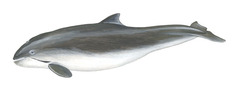
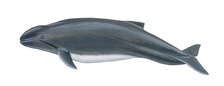
Phoecoenids include 6 species placed in 4 genera. They are found in the coastal waters of all oceans and seas of the northern hemisphere; along the coast of most of South America; and in some areas of southeastern Asia. They are also known from a few Asian rivers.
Members of this family are relatively small, from 1.5 to around 2 m in length and up to about 120 kg in weight. They have short jaws and no beak. A dorsal fin is present and triangular in some species, reduced to a ridge in others, and enormous in male Phocoena dioptrica. The flippers are fairly narrow and pointed. Some species are conspicuously marked with black, white, and gray; others are uniformly colored.
The skull is like that of the closely related delphinids, but it has distinctive swellings on the premaxillae anterior to the nares. The facial depression is broadly expanded posteriorly and hides the small zygomatic arches. The toothrows diverge posteriorly. The mandibular symphysis is relatively short, less than 20% of the length of the ramus. The teeth are numerous (from 15/15 to 30/30), and distinctively spade-shaped with 2- or 3-lobed crowns.
Some phoecoenids ( Phocoena and Neophocaena) generally occupy bays, estuaries, and inlets close to shore. These porpoises are relatively slow, travelling in small groups of fewer than 6 individuals (occasionally up to 20). Others ( Phocoenoides dalli) are found in offshore waters, are fast and agile swimmers, and are sometimes found in groups of up to thousands of individuals. Phoecoenids feed on a wide variety of fish and invertebrates.
References and literature cited:
Nowak, R.M. and J.L. Paradiso. 1983. Walker's Mammals of the World, 4th edition . John Hopkins University Press, Baltimore, MD.
Savage, R. J. G. and M. R. Long. 1986. Mammal Evolution: An Illustrated Guide. Facts on File Publications, UK. 251 pp.
Rice, D. W. 1984. Cetaceans. Pp. 447-490 in Anderson, S. and J. K. Jones, Jr. (eds). Orders and Families of Recent Mammals of the World. John Wiley and Sons, N.Y. xii+686 pp.
Vaughan, T. A. 1986. Mammalogy. Third Edition. Saunders College Publishing, N.Y. vii+576 pp.
Wilson, D. E., and D. M. Reeder. 1993. Mammal Species of the World, A Taxonomic and Geographic Reference. 2nd edition. Smithsonian Institution Press, Washington. xviii+1206 pp.
Contributors
Phil Myers (author), Museum of Zoology, University of Michigan-Ann Arbor.
Glossary
- bilateral symmetry
-
having body symmetry such that the animal can be divided in one plane into two mirror-image halves. Animals with bilateral symmetry have dorsal and ventral sides, as well as anterior and posterior ends. Synapomorphy of the Bilateria.
- chemical
-
uses smells or other chemicals to communicate
- endothermic
-
animals that use metabolically generated heat to regulate body temperature independently of ambient temperature. Endothermy is a synapomorphy of the Mammalia, although it may have arisen in a (now extinct) synapsid ancestor; the fossil record does not distinguish these possibilities. Convergent in birds.
- motile
-
having the capacity to move from one place to another.
- sexual
-
reproduction that includes combining the genetic contribution of two individuals, a male and a female
- tactile
-
uses touch to communicate