Philepittidaeasities(Also: asity and false sunbird)
Diversity
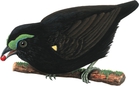
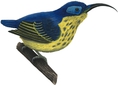
Asities belong to the order Passeriformes and the family Philepittidae. There are currently 2 recognized genera and 4 species of asities. The four species are: velvet asity (Philepitta castanea), Schlegel’s asity (Philepitta schlegeli), common sunbird-asity (Neodrepanis coruscans) and yellow-bellied sunbird-asity (Neodrepanis hypoxantha). All four species are endemic to Madagascar and are found primarily in rainforests. They are small to medium sized birds (9 to 16.5 cm long) with short tails. Males are brightly colored and have blue or green wattles around their eyes. The sunbird-asities have long downcurved bills that are well suited for extracting nectar from flowers. Asities also eat fruit, berries and insects. Little is known about the breeding behavior of asities. However, they are thought to be polygynous. (Dickinson, 2003; Hawkins, 2003; Lambert and Woodcock, 1996)
Geographic Range
Asities are endemic to and found only in Madagascar. (Campbell and Lack, 1985; Hawkins, 2003; Lambert and Woodcock, 1996; Sibley and Ahlquist, 1990)
- Other Geographic Terms
- island endemic
Habitat
Asities are found in habitats where flowering parasitic and epiphytic plants are in high abundance. They prefer rainforest habitat but can also be found in dry deciduous forest and humid valleys. Asities are found from lowlands to high altitudes (up to 2650 m). (Hawkins, 2003)
- Habitat Regions
- tropical
- terrestrial
- Terrestrial Biomes
- forest
- rainforest
Physical Description
Asities are small to medium sized birds. They are 9 to 16.5 cm long and weigh 6.2 to 38 g. There is marked sexual dimorphism in all four species; males are brighter and larger. Males have blue and/or green wattles around their eyes that are highly visible during breeding and are virtually absent at other times. Members of the genus Neodrepanis also have a bright patch of skin at the base of their beaks. They also have a small, short tail, short legs, and a long decurved bill. Their tubular tongue helps them to extract nectar from flowers. They molt twice a year, the first molt, after breeding, gives the males their eclipse plumage.
Members of the genus Philepitta are round birds with a short tail and short wings. They have yellow, black and iridescent blue feathers. Their beaks are much smaller than species in Neodrepanis and they lack the tubular tongue. They molt once a year; on males, the new feathers have a yellowish fringe that wears away over time, leaving the males all black by breeding season. Females are generally much duller in color (olive colored with some yellow or streaking on the breast) and the wattle, if present, is much less pronounced. Some males have delayed plumage maturation and may resemble females even though they are sexually mature. (Campbell and Lack, 1985; Hawkins, 2003; Kemp and Sherley, 2003; Lambert and Woodcock, 1996; Sibley and Ahlquist, 1990)
- Other Physical Features
- endothermic
- bilateral symmetry
- Sexual Dimorphism
- male larger
- sexes colored or patterned differently
- male more colorful
- ornamentation
Reproduction
Little is known about the breeding behaviors of asities. They are thought to be polygynous, but the mating system may change according to the availability of food. Male asities enlarge their wattles when they display to females and their outer primary feathers produce a buzzing sound when they fly. Velvet asities (Philepitta castanea) seem to form dispersed leks where males hold territories on which they perform mating displays. Their displays have a series of steps and involve performing a perch-somersault where the male flips around a branch. Schlegel’s asities (Philepitta schlegeli) drop their wings, fluff their breast feathers and lift up their tails while squeaking. Common sunbird-asities (Neodrepanis coruscans) and yellow-bellied sunbird-asities (Neodrepanis hypoxantha) perform a hunched display where they lower their bill and tail, raise their crown feathers and sing. Yellow-bellied sunbird-asities (Neodrepanis hypoxantha) also perform a somersault display, although this is thought to be a display to deter other males, not to attract females. (Hawkins, 2003; Lambert and Woodcock, 1996)
- Mating System
- polygynous
The timing of breeding varies from region to region. However, it usually starts with the wet season and coincides with the time of maximum food availability. Females are responsible for nest building. Nests are pear shaped, hanging and are usually made of bamboo, roots, grass, moss, strips of bark, leaves and spider webs. The entrance to the nest is created at the end of nest-building by poking a hole in the side of the structure. The hole is often sheltered by overhanging grass. Nests are usually two to five meters above the ground. Clutch size is not known, but is suspected to be two to three. There is no information available about incubation and fledging times. (Hawkins, 2003; Lambert and Woodcock, 1996)
- Key Reproductive Features
- iteroparous
- seasonal breeding
- gonochoric/gonochoristic/dioecious (sexes separate)
- sexual
- fertilization
- oviparous
Females are responsible for incubating eggs and raising young. Young are mainly fed insects. (Hawkins, 2003)
- Parental Investment
- female parental care
Lifespan/Longevity
We do not have information on lifespan/longevity for this family at this time.
Behavior
In general, asities are sedentary, though some may make altitudinal movements as food resources shift. Common sunbird-asities (Neodrepanis coruscans) may move up to 150 km within their range. Velvet asities (Philepitta castanea) are solitary and are known to be tame and approachable. Occasionally they feed in mixed-species flocks. Schlegel’s asities (Philepitta schlegeli) are usually found in the canopy. They are found in mixed-species flocks when not breeding, but are usually solitary when breeding. Males will defend feeding areas around flowering trees. Sunbird asities (genus Neodrepanis) are aggressive and compete with other species for food. They are found in mixed-species flocks when not breeding. They tend to be hostile toward humans. (Campbell and Lack, 1985; Hawkins, 2003)
- Key Behaviors
- flies
- motile
- sedentary
- solitary
- territorial
- social
Communication and Perception
The outer primary feathers make a buzzing sound when asities fly. This buzzing likely has a function in courtship. Males also enlarge their wattles to display to females and other males. All species also seem to have some form of courtship display (see Mating Systems).
For the most part, asities have quiet, squeaky calls. Some males have louder whistle calls. Velvet asities (Philepitta castanea) have a repeated “whee-doo” call, or a series of “wheet” notes. Common sunbird-asities (Neodrepanis coruscans) make a series of hisses and single, quiet, squeaky calls. Yellow-bellied sunbird-asities (Neodrepanis hypoxantha) sound like tree frogs with repeated single note calls. (Hawkins, 2003; Lambert and Woodcock, 1996)
Food Habits
Members of the genus Philepitta are primarily frugivores. They eat fruit from the families Rubiaceae, Euphorbiaceae, Piperaceae, Melastomataceae and Apocynaceae. They usually perch and pick fruit or quickly pick it while hovering in front of the plant. They also eat insects, spiders and nectar. Members of the genus Neodrepanis are primarily nectivores, although they do eat fruit. They feed on mistletoes (especially in the genus Bakerella), Balsaminaceae, Zingiberaceae, Melastomataceae and Rubiaceae. They also eat insects and other invertebrates.
The tongues of all four species are forked with a brush-like tip. This helps them to extract nectar from flowers. Common sunbird-asities (Neodrepanis coruscans) and yellow-bellied sunbird-asities (Neodrepanis hypoxantha) also have tubular shaped tongues that further aid in nectar feeding. (Hawkins, 2003; Lambert and Woodcock, 1996)
Predation
We do not have information on predation for this family at this time.
Ecosystem Roles
Asities have an impact on forest regeneration. They are important in both seed dispersal and pollination. (Hawkins, 2003)
- Ecosystem Impact
- disperses seeds
- pollinates
Economic Importance for Humans: Positive
Asities help pollinate commercially important species such as Greuillea, Albizia and Eucalyptus. They are also important in ecotourism and are sought out by birders. (Hawkins, 2003)
- Positive Impacts
- ecotourism
- pollinates crops
Economic Importance for Humans: Negative
There are no known adverse affects of asities on humans.
Conservation Status
Asities are vulnerable to human activity because they live in forests that are being cleared for agriculture, mining and timber. Their already small ranges are becoming increasingly fragmented. Yellow-bellied sunbird-asities (Neodrepanis hypoxantha) are listed as endangered by the IUCN and Schlegel’s asities (Philepitta schlegeli) are listed as near threatened. ("UNEP-WCMC Species Database: CITES-Listed Species", 2003; Campbell and Lack, 1985; Hawkins, 2003; IUCN, 2002; Kemp and Sherley, 2003)
-
- IUCN Red List [Link]
- Not Evaluated
Contributors
Alaine Camfield (author), Animal Diversity Web.
Kari Kirschbaum (editor), Animal Diversity Web.
Glossary
- Ethiopian
-
living in sub-Saharan Africa (south of 30 degrees north) and Madagascar.

- acoustic
-
uses sound to communicate
- bilateral symmetry
-
having body symmetry such that the animal can be divided in one plane into two mirror-image halves. Animals with bilateral symmetry have dorsal and ventral sides, as well as anterior and posterior ends. Synapomorphy of the Bilateria.
- carnivore
-
an animal that mainly eats meat
- chemical
-
uses smells or other chemicals to communicate
- ecotourism
-
humans benefit economically by promoting tourism that focuses on the appreciation of natural areas or animals. Ecotourism implies that there are existing programs that profit from the appreciation of natural areas or animals.
- endothermic
-
animals that use metabolically generated heat to regulate body temperature independently of ambient temperature. Endothermy is a synapomorphy of the Mammalia, although it may have arisen in a (now extinct) synapsid ancestor; the fossil record does not distinguish these possibilities. Convergent in birds.
- female parental care
-
parental care is carried out by females
- fertilization
-
union of egg and spermatozoan
- forest
-
forest biomes are dominated by trees, otherwise forest biomes can vary widely in amount of precipitation and seasonality.
- frugivore
-
an animal that mainly eats fruit
- herbivore
-
An animal that eats mainly plants or parts of plants.
- insectivore
-
An animal that eats mainly insects or spiders.
- internal fertilization
-
fertilization takes place within the female's body
- island endemic
-
animals that live only on an island or set of islands.
- iteroparous
-
offspring are produced in more than one group (litters, clutches, etc.) and across multiple seasons (or other periods hospitable to reproduction). Iteroparous animals must, by definition, survive over multiple seasons (or periodic condition changes).
- motile
-
having the capacity to move from one place to another.
- native range
-
the area in which the animal is naturally found, the region in which it is endemic.
- nectarivore
-
an animal that mainly eats nectar from flowers
- omnivore
-
an animal that mainly eats all kinds of things, including plants and animals
- oviparous
-
reproduction in which eggs are released by the female; development of offspring occurs outside the mother's body.
- polygynous
-
having more than one female as a mate at one time
- rainforest
-
rainforests, both temperate and tropical, are dominated by trees often forming a closed canopy with little light reaching the ground. Epiphytes and climbing plants are also abundant. Precipitation is typically not limiting, but may be somewhat seasonal.
- seasonal breeding
-
breeding is confined to a particular season
- sedentary
-
remains in the same area
- sexual
-
reproduction that includes combining the genetic contribution of two individuals, a male and a female
- sexual ornamentation
-
one of the sexes (usually males) has special physical structures used in courting the other sex or fighting the same sex. For example: antlers, elongated tails, special spurs.
- social
-
associates with others of its species; forms social groups.
- solitary
-
lives alone
- tactile
-
uses touch to communicate
- terrestrial
-
Living on the ground.
- territorial
-
defends an area within the home range, occupied by a single animals or group of animals of the same species and held through overt defense, display, or advertisement
- tropical
-
the region of the earth that surrounds the equator, from 23.5 degrees north to 23.5 degrees south.
- visual
-
uses sight to communicate
References
2003. "UNEP-WCMC Species Database: CITES-Listed Species" (On-line). Accessed March 15, 2004 at http://www.cites.org/eng/resources/species.html.
Campbell, B., E. Lack. 1985. A Dictionary of Birds. Vermillion: Buteo Books.
Dickinson, E. 2003. The Howard and Moore Complete Checklist of Birds of the World, 3rd edition. London: Christopher Helm.
Hawkins, A. 2003. Family Philepittidae (Asities). Pp. 94-105 in J del Hoyo, A Elliott, D Christie, eds. Handbook of the Birds of the World, Vol. 8. Barcelona: Lynx Edicions.
IUCN, 2002. "The IUCN Red List of Threatened Species" (On-line). Accessed March 15, 2004 at http://www.redlist.org/.
Kemp, A., G. Sherley. 2003. Asities. Pp. 421 in C Perrins, ed. The New Encyclopedia of Birds. Oxford: Oxford Univeristy Press.
Lambert, F., M. Woodcock. 1996. Pittas, Broadbills and Asities. Sussex: Pica Press.
Payne, R. 2003. "Bird Families of the World" (On-line). Accessed March 15, 2004 at http://www.ummz.lsa.umich.edu/birds/Bird_Families_of_the_World.html.
Prum, R., R. Morrison, G. Ten Eyck. 1994. Structural color production by constructive reflective from ordered collagen arrays in a bird (Philepitta castanea: Eurylaimidae). Journal of Morphology, 222: 61-72.
Sibley, C., J. Ahlquist. 1990. Phylogeny and Classification of Birds, A study in Molecular Evolution. New Haven: Yale University Press.