Perodicticus pottopotto


Geographic Range
The range of Perodicticus potto stretches across equatorial Africa in tropical rainforests from Gambia and Senegal to western Kenya. (Butynski, T. and Members of the Primate Specialist Group 2000, 2007; Kingdon, 1997)
Habitat
Pottos are found in areas of thick rainforest vegetation. They can live in a variety of habitats from coastal and lowland forest to mid-altitude montane forest and can inhabit primary or secondary forest growth. They occupy forest from sea level to 2089 m elevation. Normally pottos are found in trees that are 5 to 30 m tall. ("Potto", 1999; Kingdon, 1997; Nekaris and Bearder, 2007; Ravosa, 2007)
- Habitat Regions
- tropical
- terrestrial
- Terrestrial Biomes
- rainforest
-
- Range elevation
- 0 to 2089 m
- 0.00 to 6853.67 ft
Physical Description
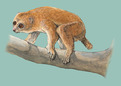
Pottos are sexually monomorphic. Pottos have long, slender bodies and limbs with forelimbs and hindlimbs of nearly equal length. They have large eyes and small, round ears that lack fur. Their coat is dense and varies from shades of brown to grey. They also possess features found in other living strepsirrhines such as a moist nose, dental comb, and a toilet claw. With the exception of the sharpened toilet claw on the reduced second digit of the hind feet, all other nails are flattened. The index finger is vestigial. The reduced second digits on the hands and feet and the opposable pollex and hallux create an excellent grip on arboreal supports. Other adaptations for prolonged grip include highly flexible wrist and ankle joints and the presence of vascular bundles in the limb vessels that allow blood circulation to contracted muscles while the animal is immobile (retia mirabilia). Pottos also possess a “scapular shield” consisting of elongated spines of the cervical vertebrae that extend above the contour of the animal’s body. The spines are covered by thick skin and fur. Patches of vibrissae are also dispersed in this area of the fur. The “scapular shield” area is believed to function in defense against predators and other pottos, and possibly to stimulate genital secretions in mates. Adult weights range from 600 to 1600 g, with smaller pottos occupying the warmer, low elevation habitats and larger pottos occupying the cooler, high elevation habitats within their range (Bergmann’s rule). Head and body measurements range from 305 to 390 mm with a tail length of 37 to 100 mm. Throughout their range, pottos vary regionally in body mass, body size, pelage, and color of eyeshine. ("Lorises, Pottos, and Galagos", 1999; "Potto", 1999; Bearder, et al., 2003; Kappeler, 1995; Kingdon, 1997; Nekaris and Bearder, 2007; Pimley, et al., 2005; Ravosa, 2007)
- Other Physical Features
- endothermic
- homoiothermic
- bilateral symmetry
- Sexual Dimorphism
- sexes alike
-
- Range mass
- 600 to 1600 g
- 21.15 to 56.39 oz
-
- Range length
- 305 to 390 mm
- 12.01 to 15.35 in
-
- Average basal metabolic rate
- 356 cm3.O2/g/hr
-
- Average basal metabolic rate
- 1.942 W
- AnAge
Reproduction
Males have home ranges that overlap those of several females, suggesting pottos are polygynous or promiscuous. When male and female pottos meet they may perform courting rituals that involve licking, mutual grooming with claws and teeth and scent-marking each other. These rituals are usually performed while both are hanging upside down from a branch. ("Lorises, Pottos, and Galagos", 1999; "Potto", 1999)
- Mating System
- polygynous
- polygynandrous (promiscuous)
Breeding season varies with region in pottos. Pottos from the central part of their range give birth between August and January, so that the time of greatest fruit abundance occurs during weaning. The duration of the ovarian cycle in females is 37 to 39 days, but the duration of sexual receptivity is not known. One offspring is born each year in breeding females after a gestation period of 193 to 205 days. At birth, pottos weigh between 30 and 52 g. Offspring are generally weaned at 120 to 180 days. Pottos reach adult size and weight at 8 to 14 months old, and become sexually mature at 18 months. Infant pottos will initially grow at a rate of 3.19 grams per day. ("Potto", 1999; Dixson, 1995; Estes, 1991; Nekaris and Bearder, 2007)
- Key Reproductive Features
- iteroparous
- year-round breeding
- gonochoric/gonochoristic/dioecious (sexes separate)
- sexual
- viviparous
-
- Breeding interval
- Pottos breed once yearly.
-
- Breeding season
- Breeding can occur throughout the year and varies regionally. Births tend to be clustered at times when greatest fruit abundance will coincide with the time of weaning.
-
- Average number of offspring
- 1
-
- Average number of offspring
- 1
- AnAge
-
- Range gestation period
- 193 to 205 days
-
- Average gestation period
- 197 days
-
- Range weaning age
- 120 to 180 days
-
- Range time to independence
- 6 to 8 months
-
- Average age at sexual or reproductive maturity (female)
- 18 months
-
- Average age at sexual or reproductive maturity (female)
Sex: female - 547 days
- AnAge
- Average age at sexual or reproductive maturity (female)
-
- Average age at sexual or reproductive maturity (male)
- 18 months
-
- Average age at sexual or reproductive maturity (male)
Sex: male - 547 days
- AnAge
- Average age at sexual or reproductive maturity (male)
Infants are altricial at birth, but are comparatively well-developed when compared to other primates because they have to climb to the mother’s belly and cling to her fur without any maternal handling. Offspring cling to their mother’s fur for the first 3 to 8 days and are rarely carried. As the infant grows, the mother will “park” the infant by leaving it hanging on a hidden tree or branch at night while she forages. The infant nurses during the day while the mother sleeps. At 3 to 4 months of age offspring will accompany the mother during foraging by riding on her back or following behind her. Offspring learn how to feed by grabbing food and prey items from their mother, and examining it with a head-cocking behavior before consumption. Male offspring will sleep with their mothers until they disperse at 6 months old. Females sleep with their mothers until they are 8 months old, and then will inherit part of their mother’s home range. ("Potto", 1999; Bearder, et al., 2003; Estes, 1991; Nekaris and Bearder, 2007)
- Parental Investment
- altricial
-
pre-fertilization
- provisioning
-
protecting
- female
-
pre-hatching/birth
-
provisioning
- female
-
protecting
- female
-
provisioning
-
pre-weaning/fledging
-
provisioning
- female
-
protecting
- female
-
provisioning
-
pre-independence
-
protecting
- female
-
protecting
- post-independence association with parents
- extended period of juvenile learning
- inherits maternal/paternal territory
Lifespan/Longevity
Information on the lifespan of pottos in the wild is lacking, but captive individuals have been recorded to live up to 26 years of age. ("Potto", 1999; Nekaris and Bearder, 2007)
-
- Range lifespan
Status: captivity - 26 (high) years
- Range lifespan
-
- Average lifespan
Sex: male
Status: captivity - 22.0 years
- Max Planck Institute for Demographic Research
- Average lifespan
-
- Average lifespan
Status: captivity - 15.0 years
- Max Planck Institute for Demographic Research
- Average lifespan
-
- Average lifespan
Status: captivity - 22.0 years
- Max Planck Institute for Demographic Research
- Average lifespan
-
- Average lifespan
Sex: male
Status: captivity - 26.0 years
- Max Planck Institute for Demographic Research
- Average lifespan
Behavior
Pottos are primarily solitary and nocturnal animals, except for females with their young. ("Lorises, Pottos, and Galagos", 1999; "Potto", 1999)
Home Range
Males and females defend home ranges large enough to provide ample foraging opportunities. Female home ranges must be large enough to support the female and her young, they are generally 6 to 9 hectares in size. Males defend larger home ranges in order to overlap with those of several females, from 9 to 40 hectares. Both males and females aggressively defend their territories against same sex conspecifics. Population densities have been estimated at 8 to 10 pottos per square kilometer. ("Lorises, Pottos, and Galagos", 1999; "Potto", 1999)
Communication and Perception
Pottos use chemical cues extensively to communicate. They leave urine trails and secretions from glands under the tail on branches to mark territory and communicate information on their reproductive state. They use a toxic or noxious glandular secretion to deter predators. Pottos have a distinct odor that some observers have called "curry-like." They have several vocalizations, the most common being a female contact call to young that sounds like "psic." Pottos have excellent vision in low light in order to navigate and find food at night. ("Lorises, Pottos, and Galagos", 1999; "Potto", 1999)
Food Habits
Pottos are primarily frugivorous, but they also commonly eat animal prey and plant gums. Because there is seasonal variation in food availability, gums are generally consumed in dry seasons, while animal prey and fruits are more readily available during wet seasons. Pottos eat fruits of the genera Ficus, Musanga, Myrianthus, Parinari, Pseudospondias, and Uapaca. They generally eat slow-moving arthropods or insects that other animals find unpalatable such as ants, foul-smelling beetles, caterpillars with irritant spines, poisonous millipedes, and spiders. They also eat snails, slugs, eggs, fungi, and insect larvae. Occasionally they will kill small vertebrate prey, such as bats or birds. Although pottos compete with many other species in the same niche for food (such as bush babies), they have adapted to eating foods that other animals leave behind such as unpalatable insects. They also have developed comparatively strong jaws for their size to eat larger, tougher fruits and large, stale chunks of plant gum. Pottos locate insects by scent and capture them with a rapid grab with their hands or mouths. Their reduced index fingers help them grasp and capture prey. Pottos have a highly expandable stomach, allowing them to eat large quantities of food and hold up to 8 percent of their body weight. This reduces the chance of predation by allowing them to eat quickly in fruiting trees with sparse vegetation, then retreat to trees with dense foliage to digest and rest. ("Potto", 1999; Estes, 1991; Kingdon, 1997; Nekaris and Bearder, 2007; Pimley, et al., 2005)
- Animal Foods
- birds
- mammals
- eggs
- insects
- terrestrial non-insect arthropods
- mollusks
- Plant Foods
- fruit
- sap or other plant fluids
- Other Foods
- fungus
Predation
The main anti-predator strategy for pottos is crypsis. Cryptic behavior in pottos includes nocturnal activity, small body size, cryptic coloration, using little vocal communication, maintaining small group sizes, possessing the ability to remain immobile for extended periods of time without fatigue (using retia mirabilia), and using slow, steady, and silent locomotion. They usually stay hidden in dense vegetation so as to not be detected by predators. If confronted by a predator, they will exhibit their defense posture which consists of grasping a branch with all four limbs, tucking the head down below their shoulders between the forelimbs, arching the back, and presenting the scapular shield. They will then bare the teeth and repeatedly bite the arboreal support they are grasping. If the predator does not retreat, the potto will then charge forward, trying to knock the predator off the branch. In extreme danger, the animal will let go of its branch and fall to the ground. Perodictus potto is one of the few nocturnal prosimians that do not use leaping to escape from predators. When parked infants are left alone by their mothers, the mother will apply a salivary liquid to her offspring by grooming it with her tooth comb. This liquid applied to the infant repels predators, and it is thought that it may possess some kind of toxin. This toxic or noxious secretion may also be used to protect adults from predation. Known predators of pottos are African palm civets (Nandinia binotata), although these civets are primarily frugivorous. (Alterman, 1995; Crompton and Sellers, 2007; Estes, 1991; Nekaris, et al., 2007)
- Anti-predator Adaptations
- cryptic
-
- Known Predators
-
- African palm civets (Nandinia binotata)
Ecosystem Roles
As frugivores, pottos are instrumental in seed dispersal. They are also a source of prey for their predators.
- Ecosystem Impact
- disperses seeds
Economic Importance for Humans: Positive
Pottos are hunted for their meat by humans, and are occasionally taken for the pet trade. Humans also benefit from seed dispersal by pottos. (Nekaris and Bearder, 2007)
Economic Importance for Humans: Negative
There are no known adverse effects P. potto on humans.
Conservation Status
The main threats to potto survival in the wild are predation, deforestation, and human hunting. The IUCN Red List of Threatened Species considers pottos “Lower Risk/Least Concern” and they are listed under CITES Appendices II and III. However, there are few studies that have effectively documented potto population size. Pottos (and other nocturnal prosimians) are impacted more severely than other arboreal primates by deforestation and human development because forests are usually cleared during the day while pottos are asleep in the trees. Due to their slow locomotion and their tendency to freeze when threatened, they are easily burned or chopped down with the trees. (Butynski, T. and Members of the Primate Specialist Group 2000, 2007; Nekaris and Bearder, 2007; "UNEP-WCMC Species Database: CITES-Listed Species", 2008)
-
- IUCN Red List
-
Least Concern
More information
-
- IUCN Red List
-
Least Concern
More information
-
- US Federal List
- No special status
-
- CITES
- Appendix II Appendix III
Contributors
Tanya Dewey (editor), Animal Diversity Web.
Kristen McCann (author), Michigan State University, Pamela Rasmussen (editor, instructor), Michigan State University.
Glossary
- Ethiopian
-
living in sub-Saharan Africa (south of 30 degrees north) and Madagascar.

- acoustic
-
uses sound to communicate
- altricial
-
young are born in a relatively underdeveloped state; they are unable to feed or care for themselves or locomote independently for a period of time after birth/hatching. In birds, naked and helpless after hatching.
- arboreal
-
Referring to an animal that lives in trees; tree-climbing.
- bilateral symmetry
-
having body symmetry such that the animal can be divided in one plane into two mirror-image halves. Animals with bilateral symmetry have dorsal and ventral sides, as well as anterior and posterior ends. Synapomorphy of the Bilateria.
- chemical
-
uses smells or other chemicals to communicate
- cryptic
-
having markings, coloration, shapes, or other features that cause an animal to be camouflaged in its natural environment; being difficult to see or otherwise detect.
- endothermic
-
animals that use metabolically generated heat to regulate body temperature independently of ambient temperature. Endothermy is a synapomorphy of the Mammalia, although it may have arisen in a (now extinct) synapsid ancestor; the fossil record does not distinguish these possibilities. Convergent in birds.
- food
-
A substance that provides both nutrients and energy to a living thing.
- frugivore
-
an animal that mainly eats fruit
- herbivore
-
An animal that eats mainly plants or parts of plants.
- iteroparous
-
offspring are produced in more than one group (litters, clutches, etc.) and across multiple seasons (or other periods hospitable to reproduction). Iteroparous animals must, by definition, survive over multiple seasons (or periodic condition changes).
- motile
-
having the capacity to move from one place to another.
- native range
-
the area in which the animal is naturally found, the region in which it is endemic.
- nocturnal
-
active during the night
- omnivore
-
an animal that mainly eats all kinds of things, including plants and animals
- pet trade
-
the business of buying and selling animals for people to keep in their homes as pets.
- polygynandrous
-
the kind of polygamy in which a female pairs with several males, each of which also pairs with several different females.
- polygynous
-
having more than one female as a mate at one time
- rainforest
-
rainforests, both temperate and tropical, are dominated by trees often forming a closed canopy with little light reaching the ground. Epiphytes and climbing plants are also abundant. Precipitation is typically not limiting, but may be somewhat seasonal.
- sedentary
-
remains in the same area
- sexual
-
reproduction that includes combining the genetic contribution of two individuals, a male and a female
- solitary
-
lives alone
- tactile
-
uses touch to communicate
- terrestrial
-
Living on the ground.
- territorial
-
defends an area within the home range, occupied by a single animals or group of animals of the same species and held through overt defense, display, or advertisement
- tropical
-
the region of the earth that surrounds the equator, from 23.5 degrees north to 23.5 degrees south.
- visual
-
uses sight to communicate
- viviparous
-
reproduction in which fertilization and development take place within the female body and the developing embryo derives nourishment from the female.
- year-round breeding
-
breeding takes place throughout the year
References
1999. Lorises, Pottos, and Galagos. Pp. 493 in R Nowak, ed. Walker's Mammals of the World, Vol. 1, 6 Edition. Baltimore and London: The Johns Hopkins University Press.
1999. Potto. Pp. 498-500 in R Nowak, ed. Walker's Mammals of the World, Vol. 1, 6 Edition. Baltimore and London: The Johns Hopkins University Press.
UNEP - WCMC. 2008. "UNEP-WCMC Species Database: CITES-Listed Species" (On-line). Accessed August 30, 2008 at http://www.cites.org/eng/resources/species.html.
Alterman, L. 1995. Toxins and Toothcombs: Potential Allospecific Chemical Defenses in Nycticebus and Perodicticus. Pp. 413-424 in L Alterman, G Doyle, M Izard, eds. Creatures of the Dark: The Nocturnal Prosimians. New York: Plenum Press.
Bearder, S., L. Ambrose, C. Harcourt, P. Honess, A. Perkin, E. Pimley, S. Pullen, N. Svoboda. 2003. Species-Typical Patterns of Infant Contact, Sleeping Site Use and Social Cohesion among Nocturnal Primates in Africa. Folia Primatologica, 74: 337-354.
Butynski, T. and Members of the Primate Specialist Group 2000, 2007. "Perodicticus potto" (On-line). IUCN Redlist of Threatened Species. Accessed August 30, 2008 at http://www.iucnredlist.org/search/details.php/16629/summ.
Crompton, R., W. Sellers. 2007. A Consideration of Leaping Locomotion as a Means of Predator Avoidance in Prosimian Primates. Pp. 127-145 in S Gursky, K Nekaris, eds. Primate Anti-predator Strategies. New York: Springer Science + Business Media LLC.
Dixson, A. 1995. Sexual Selection and the Evolution of Copulatory Behavior in Nocturnal Prosimians. Pp. 93-118 in L Alterman, G Doyle, M Izard, eds. Creatures of the Dark: The Nocturnal Prosimians. New York: Plenum Press.
Estes, R. 1991. The Behavior Guide to African Mammals. California: University of California Press.
Kappeler, P. 1995. Life History Variation among Nocturnal Prosimians. Pp. 75-92 in L Alterman, G Doyle, M Izard, eds. Creatures of the Dark: The Nocturnal Prosimians. New York: Plenum Press.
Kingdon, J. 1997. The Kingdon Field Guide to African Mammals. New Jersey: Princeton University Press.
Nekaris, A., S. Bearder. 2007. The Lorisiform Primates of Asia and Mainland Africa: Diversity Shrouded in Darkness. Pp. 24-45 in C Campbell, A Fuentes, K MacKinnon, M Panger, S Bearder, eds. Primates in Perspective. New York: Oxford University Press.
Nekaris, K., E. Pimley, K. Ablard. 2007. Predator Defense by Slender Lorises and Pottos. Pp. 222-240 in S Gursky, K Nekaris, eds. Primate Anti-predator Strategies. New York: Springer Science + Business Media LLC.
Pimley, E., S. Bearder, A. Dixson. 2005. Social Organization of the Milne-Edward's Potto. American Journal of Primatology, 66: 317-330.
Ravosa, M. 2007. Cranial Ontogeny, Diet, and Ecogeographic Variation in African Lorises. American Journal of Primatology, 69: 59-73.
Zimmerman, E. 1995. Acoustic Communication in Nocturnal Prosimians. Pp. 311-330 in L Alterman, G Doyle, M Izard, eds. Creatures of the Dark: The Nocturnal Prosimians. New York: Plenum Press.