Pelecanus onocrotalusgreat white pelican

Geographic Range
The great white pelican (Pelecanus onocrotalus) is a migratory bird. During the nonbreeding season, it can be found mostly in Africa and parts of Saudi Arabia along the Red Sea. It can be found as far south as Cape Town, South Africa. The range of the pelican is spread from the west coast of Senegal to the east coast of Ethiopia, through Africa. It can be found as far north as Egypt, Israel and Jordan along the Mediterranean Sea. The great white pelican can also be found sporadically throughout parts of India, Afghanistan, Iran, Pakistan, and Bangladesh.
During the breeding season, it can be found in areas of Europe and Central Asia. The pelican can be found as far west as Montenegro and as far east as Kyrgyzstan. Great white pelicans range as far north as Kazakhstan, and as far south as Israel. The pelican also has been found on the east coast of Romania and Bulgaria along the Black Sea during breeding season. Great white pelicans have been known to breed in parts of Turkey, northeastern Uzbekistan, the western half of Armenia, and the east coast of Azerbaijan. (BirdLife International, 2015; Hatzilacou, 1996; Izhaki, et al., 2002; Newton and Symens, 1996)
- Biogeographic Regions
- palearctic
- ethiopian
- mediterranean sea
Habitat
Pelecanus onocrotalus is found near freshwater, saline and alkaline lakes. It is also commonly found nesting near large rivers, warm lagoons, shallow marshes, deltas and inland waters. The pelican can migrate through or nest in savanna, grass lands, chaparral, desert, rainforest, and alpine biomes. The pelican can be found in mild to hot temperatures. The pelican is known as a ground nester, which uses sandbanks, mudflats, wet swamps, rocky ground, grass, or reed beds depending on which resource is abundantly supplied to make the nest. (Perrins, 2009; BirdLife International, 2015)
- Habitat Regions
- temperate
- tropical
- terrestrial
- saltwater or marine
- freshwater
- Terrestrial Biomes
- savanna or grassland
- Aquatic Biomes
- coastal
- Wetlands
- marsh
-
- Range elevation
- 1372 (high) m
- 4501.31 (high) ft
Physical Description
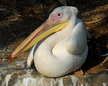
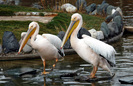
The great white pelican has white feathers with black flight feathers. It has a large bill that is bright yellow, rosy pink, and light blue. The bill is horn-shaped at the base, and frail. A large yellow pouch is underneath the bill. The pelican has short pink to yellow colored legs and has feet with 4 webbed toes. The iris is a red or red-brown. The adult male is larger than the female. The pelican can range from 9.07-11.79 kg and the wingspan ranges from 274.32- 335.28 cm. The length of the pelican ranges from 137.16-167.64 cm.
During the breeding season, the pelican’s feathers will turn a rosy pink and a yellowish-brown stain on the chest will become present. The male pelican has a pink patch of skin around the eyes and the female pelican has a yellowish orange patch of skin around the eyes during breeding season.
When the pelican first hatches, it has no feathers. As a juvenile, the pelican will grow grayish-brown feathers within 9-10 weeks. (Likoff, 2007; Clive, et al., 2005; DePuy, 1899; Tets, 1965)
- Other Physical Features
- endothermic
- bilateral symmetry
- Sexual Dimorphism
- male larger
- sexes colored or patterned differently
-
- Range mass
- 9.07 to 11.79 kg
- 19.98 to 25.97 lb
-
- Range length
- 137.16 to 167.64 cm
- 54.00 to 66.00 in
-
- Range wingspan
- 274.32 to 335.28 cm
- 108.00 to 132.00 in
Reproduction
The pelicans have annual breeding intervals. The great white pelicans are considered monogamous pairs, which are formed through courtship. The ritual courtship consist of circle flying from both sexes around the nesting site, building of the nest by the male, raising of closed bill, and expanded gular pouch in males.
Mature pelicans have a light pink coloration in the feathers during the breeding season, and the male will also grow a large bump near his eyes. This shows the female the male's strength because it affects the vision while fishing. Males with larger bumps are considered to be more successful breeders. Sexual intercourse between the two pelicans begins three to ten days before the laying of eggs.
Pair bonding can last more than one breeding season. However, one mate may not always be loyal. The un-loyal pelican can mate with other pelicans in the same or different breeding sites. (Catsadorakis, et al., 1996; Crivelli, et al., 1991; DePuy, 1899; Hatzilacou, 1996; Izhaki, et al., 2002; Likoff, 2007; Moosa, 2007; Perrins, 2009; Pyovetsi, 1989; Robert, 1985; Tets, 1965)
- Mating System
- monogamous
The pelican breeds annually in Africa year-round in three waves, and in Europe from April through August. Breeding sites consist of swamps, lakes, island and wetlands. The pelican usually goes to familiar past breeding sites but can establish a new breeding colony if habitat is lost. The female pelican will usually lay 1-3 eggs several days apart. The eggs will hatch within 29-36 days. Only one chick will usually survive because the younger chicks will get out-competed by the other chick. The chick will begin fledging in 9-10 weeks. The chick will become independent around 10 weeks.
Mature pelicans can start breeding as early as three years old. The average female pelican has multiple clutches in its lifetime. Pairing of mates can happen on land, in air, and in water. The nest is constructed in an organized manner with 2 nests per square meter. Sticks and reeds that were brought in the male pelican’s pouch will make up the nest. The great white pelican can breed and colonize with the brown pelican Pelecanus cruspus and the great cormorant Phalacrocorax carbo sinensis. (Catsadorakis, et al., 1996; Crivelli, et al., 1991; Delhey, et al., 2007; Hatzilacou, 1996; Izhaki, et al., 2002; Likoff, 2007; Moosa, 2007; Perrins, 2009; Pyovetsi, 1989; Robert, 1985; Tets, 1965)
- Key Reproductive Features
- iteroparous
- seasonal breeding
- year-round breeding
- gonochoric/gonochoristic/dioecious (sexes separate)
- sexual
- oviparous
-
- Breeding interval
- The great white pelicans breed annually
-
- Breeding season
- Year round in Africa, April-August in Europe
-
- Range eggs per season
- 1 to 3
-
- Range time to hatching
- 29 to 36 days
-
- Range fledging age
- 9 to 10 weeks
-
- Average time to independence
- 10 weeks
-
- Range age at sexual or reproductive maturity (female)
- 3 to 4 years
-
- Range age at sexual or reproductive maturity (male)
- 3 to 4 years
The male and female pelican both take care of the eggs by incubating them for 29-36 days by having them above or under the pelican's feet. While one is incubating the eggs, the other mate will be out looking for food. Both parents will take care of young until about 8-10 weeks. For the first two weeks, the young get fed regularly from both parents. The parents pour the food from their beak, into the young's beak. After 7 days, the young pelican is able to eat out of the parent's pouch. The young will be fed multiple times a day starting for the first 30 days. When the chick is 30-35 day the feeding will be cut back to once a day, and then around 50-60 days old it will be feed every other day until the young is ready to leave the nest. The young is usually ready to leave the nest in 10 weeks. Sometimes the parent pelicans feed the young pelican after it fledges. This happens because the young pelican may not be able to catch its own food due to the difficult fishing technique used. (Hatzilacou, 1996; Jones, 1979)
- Parental Investment
- altricial
-
pre-hatching/birth
- protecting
-
pre-weaning/fledging
- provisioning
- protecting
-
pre-independence
- provisioning
- protecting
- extended period of juvenile learning
- inherits maternal/paternal territory
Lifespan/Longevity
The maximum lifespan in the wild has been recorded as 28 years. The average lifespan in the wild is 15.5 years. A great white pelican has been known to live as long as 51 years in captivity. (Likoff, 2007; Perrins, 2009; BirdLife International, 2015; Carey and Judge, 2000)
-
- Range lifespan
Status: wild - 28 (high) years
- Range lifespan
-
- Range lifespan
Status: captivity - 51 (high) years
- Range lifespan
-
- Average lifespan
Status: wild - 15.5 years
- Average lifespan
-
- Average lifespan
Status: captivity - 51.0 years
- Max Planck Institute for Demographic Research
- Average lifespan
Behavior
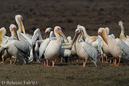
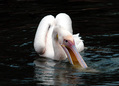
The great white pelican lives, fishes, flies and breeds in large social colonies . It typically forages in the early morning, early evening, or on full moon nights. The pelicans will use a V-shaped formation with up to 20 birds while fishing. The technique pushes all the fish inland, and the birds scoop the fish up with their large bills. The pelican will let the water drain, and then is able to swallow the fish. The pelican will fish with other birds, like the brown pelican Pelecanus crispus and the great cormorant Phalacrocorax carbo sinensis.
After the pelican is done foraging, it will roost on rocks, on the ground and in trees.
The great white pelican will groom itself with its large beak after bathing, and will use its preening gland to make its feathers waterproof for the next time it is to go into the water.
The great white pelican will have its autumn migration between late August and October, while the spring migration starts in April. The immature pelican will migrate earlier during the winter, and join the flock during the spring migration. During migration, the pelican migrates an average of 133-160 km/day. The pelican can travel at 30- 44.5 km/hour. The longer the migration, the larger the flock will be. Departure fights can have 2 to 63 birds in the flock. Arriving flocks include 2-75 individuals. This species shows difficulty in lifting off and landing because it is unable to hop, but accommodates this by having short legs. Once in the air, the pelican will use thermal updrafts to fly, which helps it keep a horizontal glide. During flight, the wings are flapping in a synchronized order so all the birds in the V-shape formation can benefit from it.
When pelican chicks reach about eight weeks, they will leave the nest to wander and form pods, which protects the young while the adult pelicans are feeding. When the parent returns from fishing, it will find and only feed its chick. The parent pelican can be rough with the young if it is not eating by dragging the young by its head. Before or after eating, the chick will collapse and lay comatose. It is unknown why the chick has this reaction. (BirdLife International, 2016; Catsadorakis, et al., 1996; Crivelli, et al., 1991; Hatzilacou, 1996; Izhaki, et al., 2002; Perrins, 2009; Pyovetsi, 1989; Robert, 1985; Tets, 1965)
- Key Behaviors
- flies
- glides
- natatorial
- diurnal
- crepuscular
- motile
- migratory
- sedentary
- solitary
- social
- colonial
Home Range
The pelican home ranges from Africa, Israel, and Europe. The great white pelican is a migratory bird that uses the Eurasian-East African Flyway. The bird will fly 60 km to 100 km away from their nest everyday for food. The pelican chooses its location for nesting away from mammalian predators and humans. The great white pelican is territorial of its nesting and breeding site. The great white pelican can live in mixed colonies with the brown pelican Pelecanus crispus because there is not a lot of competition because of the different breeding seasons. The pelicans sleep in lakes or reeds. (Catsadorakis, et al., 1996; Hatzilacou, 1996; Izhaki, et al., 2002; Tets, 1965)
Communication and Perception
Pelecanus onocrotalus communicates through sound, movement, and posture. The pelican will make hisses and grunts to warn off predators. The pelican will also bay or moo towards its mate. The pelican will make a loud grunt when taking off within a flock. It is usually silent when alone.
During the breeding season, a male pelican communicates sexual signals visually by its changing feathers, which fade to pink. The change in color might be useful in warning off predators or undesired females, or can be used to attract a mate.
To threaten predators, the pelican will open its bill, raise it, and wave it. The pelican will raise a closed bill with the gular pouch expanded towards mates, chicks, and other pelicans as a sign of threat or courtship. (Perrins, 2009; Brazil, 2009; Brown and Urban, 1969; Delhey, et al., 2007; Tets, 1965)
Food Habits
Great white pelicans mostly eat fish species, but have been known to eat cape cormorant Phalacrocorax capensis and the kelp gull Larus dominicanus eggs when other food becomes scarce. The pelicans eat fish like the southern mouthbrooder Pseudocrenilarus philander, common barbel Barbus barbus, jarbua terapon Terapon jarbua, great barracuda Sphyraena barracuda, flathead grey mullet Mugil cephalus, and smallspotted grunter Pomadasys commersonnii. Pelicans will also eat other aquatic animals like squid and shrimp. Pelicans usually eats fish weighing between 300-600 grams. A study described that the pelican's diet was 81.9% fish, 13.1% worms, 4.05% invertebrates, and 0.94% amphibians.
These birds feed on fish in warm, shallow waters. When the fish supply is scarce, the pelican will fish in a group by swimming in a V-shaped formation towards land and scoop up the fish in their pouches in a choreographed manner. Great white pelicans will fly between 60 and 100 km from the colony to feed. It is estimated to take in around 1450-2250 g of food a day depending on the climate. (Brown and Urban, 1969; Likoff, 2007; Megaze and Bekele, 2013; Perissinotto, et al., 2013; Perrins, 2009; Shmueli, et al., 2000; Tets, 1965; Underhill and Crawford, 2004)
- Animal Foods
- birds
- mammals
- amphibians
- fish
- eggs
- aquatic or marine worms
- aquatic crustaceans
- other marine invertebrates
Predation
Predators of the pelicans' eggs include mammalian animals like foxes, gulls, frigatebirds, African sea eagles Haliaeetus vocifer, crows Corvus, and skuas. Predators of adults include humans Homo sapiens.
The pelican has no marine predator, and most terrestrial predation occurs at night, when they are on the nest. To ward off predators, the pelican will release an odor from the uropygial gland, make a threatening call, move its head forward, and open/close its bill to scare off the predator. (Catsadorakis, et al., 1996; Farner, et al., 1982; Perrins, 2009; Robert, 1985; Tets, 1965)
-
- Known Predators
-
- Foxes
- Gulls
- Crows (Corvus)
- African fish eagles (Haliaeetus vocifer)
- Frigatebirds
- Skuas
- Humans (Homo sapiens)
Ecosystem Roles
The great white pelican feeds opportunistically on fish, and likely has little effect on the fish populations. The pelican has been known to transfer roundworms Contracaecum multipapillatum and Contracaecum micropapillatum to fish species. The great white pelican is a host to a variety of flukes Dendritobilharzia loossi, Clinostomum phalacrocoracis, Renicola seunda, and Renicola tertia. A mite of this bird is Pelicanoptes onocrotali. (Akramova, et al., 2011; Fain and Atyeo, 1975; Peirce and Din, 1970; Shmueli, et al., 2000; Stunkard, 1964)
- flukes Dendritobilharzia loossi, Clinostomum phalacrocoracis, Renicola seunda, Renicola tertia
- roundworms Contracaecum multipapillatum and Contracaecum micropapillatum
- mite Pelicanoptes onocrotali
Economic Importance for Humans: Positive
Great white pelicans are hunted as a sport. The pelicans are sold as food. The Great Herbal of the Ming Dynasty states that the fat from the great white pelicans would help with abscesses, rheumatoid arthritis, inflammation, clear the ears of deafness, and stimulate circulation. The bills of the great white pelicans were thought to cure diarrhea, sores, and boils. The feathers and skin of the pelicans were thought to reduce vomiting. These remedies have not been proven factual. (Perrins, 2009; BirdLife International, 2015; Vaurie, 1965)
- Positive Impacts
- food
- source of medicine or drug
Economic Importance for Humans: Negative
The great white pelican causes competition with fisherman because it eats commercial fish that humans also eat, like Mozambique tilapia Oreochromis mossambicus. (Perissinotto, et al., 2013)
Conservation Status
Great white pelicans are listed as a species of “Least Concern” on the IUCN Red List because they are widespread and do not have major threats. The pelicans are listed with no special status under the US Migratory Bird Act, US Federal List, and CITES.
There has been a decrease in the population due to human disturbances, such as sewage, pesticides, introduction of heavy metals into the waters. Development of industries and agriculture (irrigation on rivers) also have an impact. These birds also can get captured and killed in fishing nets.
The changing climate has caused a decrease in water levels in some wetlands in which the pelican forages. The water drawdown kills the fish prey because of the high salinity concentration in the water. On the other hand, floods can cause a decrease in nesting sites.
The great white pelicans only breed in one spot on the Guano Islands, which makes them more likely to have a disease outbreak within their population. Safe nesting rafts are being set out in the range of this bird to increase breeding success. Additionally, building powerlines underground has decreased deaths via the collision for the pelicans. For farmed fish ponds, farmers have placed horizontal strings across the pond to help keep pelicans from overeating the fish.
The great white pelicans' total population is approximately 75,000 pairs in Africa. (BirdLife International, 2015; Shmueli, et al., 2000; Underhill and Crawford, 2004)
-
- IUCN Red List
-
Least Concern
More information
-
- IUCN Red List
-
Least Concern
More information
-
- US Migratory Bird Act
- No special status
-
- US Federal List
- No special status
-
- CITES
- No special status
Contributors
Emily Campbell (author), Radford University, Cari Mcgregor (editor), Radford University, Zeb Pike (editor), Radford University, Karen Powers (editor), Radford University, April Tingle (editor), Radford University, Jacob Vaught (editor), Radford University, Genevieve Barnett (editor), Colorado State University.
Glossary
- Ethiopian
-
living in sub-Saharan Africa (south of 30 degrees north) and Madagascar.

- Palearctic
-
living in the northern part of the Old World. In otherwords, Europe and Asia and northern Africa.
- acoustic
-
uses sound to communicate
- altricial
-
young are born in a relatively underdeveloped state; they are unable to feed or care for themselves or locomote independently for a period of time after birth/hatching. In birds, naked and helpless after hatching.
- bilateral symmetry
-
having body symmetry such that the animal can be divided in one plane into two mirror-image halves. Animals with bilateral symmetry have dorsal and ventral sides, as well as anterior and posterior ends. Synapomorphy of the Bilateria.
- carnivore
-
an animal that mainly eats meat
- chemical
-
uses smells or other chemicals to communicate
- coastal
-
the nearshore aquatic habitats near a coast, or shoreline.
- colonial
-
used loosely to describe any group of organisms living together or in close proximity to each other - for example nesting shorebirds that live in large colonies. More specifically refers to a group of organisms in which members act as specialized subunits (a continuous, modular society) - as in clonal organisms.
- crepuscular
-
active at dawn and dusk
- diurnal
-
- active during the day, 2. lasting for one day.
- drug
-
a substance used for the diagnosis, cure, mitigation, treatment, or prevention of disease
- endothermic
-
animals that use metabolically generated heat to regulate body temperature independently of ambient temperature. Endothermy is a synapomorphy of the Mammalia, although it may have arisen in a (now extinct) synapsid ancestor; the fossil record does not distinguish these possibilities. Convergent in birds.
- food
-
A substance that provides both nutrients and energy to a living thing.
- freshwater
-
mainly lives in water that is not salty.
- iteroparous
-
offspring are produced in more than one group (litters, clutches, etc.) and across multiple seasons (or other periods hospitable to reproduction). Iteroparous animals must, by definition, survive over multiple seasons (or periodic condition changes).
- marsh
-
marshes are wetland areas often dominated by grasses and reeds.
- migratory
-
makes seasonal movements between breeding and wintering grounds
- monogamous
-
Having one mate at a time.
- motile
-
having the capacity to move from one place to another.
- natatorial
-
specialized for swimming
- native range
-
the area in which the animal is naturally found, the region in which it is endemic.
- oviparous
-
reproduction in which eggs are released by the female; development of offspring occurs outside the mother's body.
- piscivore
-
an animal that mainly eats fish
- saltwater or marine
-
mainly lives in oceans, seas, or other bodies of salt water.
- seasonal breeding
-
breeding is confined to a particular season
- sedentary
-
remains in the same area
- sexual
-
reproduction that includes combining the genetic contribution of two individuals, a male and a female
- social
-
associates with others of its species; forms social groups.
- solitary
-
lives alone
- tactile
-
uses touch to communicate
- temperate
-
that region of the Earth between 23.5 degrees North and 60 degrees North (between the Tropic of Cancer and the Arctic Circle) and between 23.5 degrees South and 60 degrees South (between the Tropic of Capricorn and the Antarctic Circle).
- terrestrial
-
Living on the ground.
- tropical
-
the region of the earth that surrounds the equator, from 23.5 degrees north to 23.5 degrees south.
- tropical savanna and grassland
-
A terrestrial biome. Savannas are grasslands with scattered individual trees that do not form a closed canopy. Extensive savannas are found in parts of subtropical and tropical Africa and South America, and in Australia.
- savanna
-
A grassland with scattered trees or scattered clumps of trees, a type of community intermediate between grassland and forest. See also Tropical savanna and grassland biome.
- temperate grassland
-
A terrestrial biome found in temperate latitudes (>23.5° N or S latitude). Vegetation is made up mostly of grasses, the height and species diversity of which depend largely on the amount of moisture available. Fire and grazing are important in the long-term maintenance of grasslands.
- visual
-
uses sight to communicate
- year-round breeding
-
breeding takes place throughout the year
References
Akramova, F., D. Azimov, E. Shakarboev. 2011. Morphology, biology and taxonomy of Dendritobilharzia loossi Skrjabin, 1924 (Trematoda: Bilhaziellidae), a parasite of Pelecanus onocrotalus (Pelecanidae) and Anas plathyrinchos (Anatidae). Parasite, 18/1: 39-48.
Barlow, C., W. Time, D. Tony. 1997. Field Guide to Birds of the Gambia and Senegal. United Kingdom: Christopher Helm.
BirdLife International, 2015. "Pelecanus onocrotalus" (On-line). The IUCN Red List of Threatened Species 2015: e.T22697590A85071806. Accessed January 28, 2016 at http://www.iucnredlist.org/details/22697590/0.
BirdLife International, 2016. "Species factsheet: Pelecanus onocrotalus" (On-line). Birdlife.org. Accessed January 28, 2016 at http://www.birdlife.org/datazone/speciesfactsheet.php?id=3809.
Brazil, M. 2009. Birds of East Asia. London, United Kingdom: Christopher Helm.
Brown, L., E. Urban. 1969. The breeding biology of the great white pelican Pelecanus onocrotalus roseus at Lake Shala, Ethiopia. Ibis, 111/2: 199-237.
Carey, J., D. Judge. 2000. Longevity Records: Life spans of Mammals, Birds, Amphibians, Reptiles, and Fish. Denmark: Odense University Press.
Catsadorakis, G., M. Malakou, A. Crivelli. 1996. The effects of the 1989/1990 drought on the colonial waterbirds nesting at Lake Mikri Prespa, Greece, with special emphasis on pelicans. Colonial Waterbirds, 19/1: 207-218.
Clive, B., T. Wacher, T. Disley. 2005. A Field Guide to Birds of the Gambia and Senegal. New Haven: CT: Yale University Press.
Crivelli, A., Y. Leshem, T. Mitchev, H. Jerrentrup. 1991. Where do palaearctic great white pelicans (Pelecanus onocrotalus) presently overwinter?. Revue d'Ecologie, 46: 145-171.
DePuy, W. 1899. The World-wide Encyclopedia and Gazetteer. New York: NY: The Christian Herald.
Delhey, K., A. Peters, B. Kempenaers. 2007. Cosmetic coloration in birds: Occurrence, function, and evolution. The American Naturalist, 169/S1: S145-S158.
Fain, A., W. Atyeo. 1975. Pelicanoptes onocrotali n.g., n. sp., an epidermoptid mite for Pelecanus onocrotalus (Avarina: Epidermoptidae). Journal of the Kansas Entomological Society, 48/1: 21-26.
Farner, D., J. King, K. Parkes. 1982. Avian Biology Volume 6. New York, NY: Academic Press.
Hatzilacou, D. 1996. Feeding ecology of the great white pelican (Pelecanus onocrotalus) nesting at Lake Mikri Prespa (northwestern Greece). Colonial Waterbirds, 19/1: 190-206.
Ian, N. 2008. The Migration Ecology of Birds. London, United Kingdom: Elsevier.
Izhaki, I., M. Shmueli, Z. Arad, Y. Steinberg, A. Crivelli. 2002. Satellite tracking of migratory and ranging behavior of immature great white pelicans. Waterbirds, 25/3: 295-304.
Jones, P. 1979. Variability of egg size and composition on the great white pelican (Pelecanus onocrotalus). The Auk, 96/2: 407-408.
Koeman, J., J. Pennings, J. Goeij, P. Tjioe, P. Olindo, J. Hopcraft. 1972. A preliminary survey of the possible contamination of Lake Nakuru in Kenya with some metals and chlorinated hydrocarbon pesticides. Journal of Applied Ecology, 9/2: 411-416.
Likoff, L. 2007. Pelecanus onocrotalus. Pp. 461-464 in The Encyclopedia of Birds, Vol. 3/1, 1 Edition. New York, New York: Facts on File.
Megaze, A., A. Bekele. 2013. Diet preference and activity patterns of great white pelicans (Pelecanus onocrotalus, Linnaeus 1758) at Lake Hawassa, Ethiopia. Ethiopian Journal of Biological Sciences, 12/2: 211-222.
Miller, R. 1973. The brood size of cranes. The Wilson Bulletin, 85/4: 438.
Moosa, I. 2007. Naturalistic explanations of apodictic moral claims: Brentano's ethical intuitionism and Nietzsche's naturalism. Ethical Theory and Moral Practice, 10/2: 159-182.
Newton, S., P. Symens. 1996. The status of the pink-backed pelican (Pelecanus rufescens) and the great white pelican (P. onocrotalus) in the Red Sea: The importance of Saudi Arabia. Colonial Waterbirds, 19/1: 56-64.
Peirce, M., N. Din. 1970. Two new hosts for Clinostomum phalacrocoracis Dubois, 193q1 (Trematoda), from Uganda. The Journal of Parasitology, 56/3: 489.
Perissinotto, R., D. Stretch, R. Taylor. 2013. Ecology and Conservations of Estuarine Ecosystems. Cambridge: Cambidge University Press.
Perrins, C. 2009. Pelecanus onocrotalus. Pp. 78-81 in The Princeton Encyclopedia of Birds, Vol. 1/1, 1 Edition. Princeton, New Jersey: Princeton University Press.
Pyovetsi, M. 1989. Foraging trips of white pelicans (Pelecanus onocrotalus) breeding on Lake Mikri Prespa, Greece. Colonial Waterbirds, 12/1: 43-50.
Robert, B. 1985. Bird Behavior. New York: Alfred A. Knopf, Inc..
Shmueli, M., I. Izhaki, A. Arieli, Z. Arad. 2000. Energy requirements of migration great white pelicans Pelecanus onocrotalus. IBIS, 142/2: 208-216.
Stunkard, H. 1964. Studies on the trematode genus Renicola: Observations on the life-history, specificity, and systematic position. Biological Bulletin, 126/3: 467-489.
Tets, G. 1965. A comparative study of some social communication patterns in the Pelecaniformes. Ornithological Monographs, 2: 1-88.
Underhill, L., R. Crawford. 2004. Indexing the health of the environment for breeding seabirds in the Benguela ecosystem. ICES Journal of Marine Science, 62/3: 360-365.
Vaurie, C. 1965. Reviewed work: China economic fauna: Birds. The Auk, 82/2: 294-295.
Weimerskirch, H., J. Martin, Y. Clerquin, P. Alexandre, S. Jiraskova. 2001. Energy saving in flight formation. Nature, 413: 697-698.
Williams, T. 2007. Responses of waterbirds to helicopter disturbance and fish poisoning by rotenone at Paardevlei, South Africa. Waterbirds, 30/3: 429-432.