Pelecanoididaediving petrels
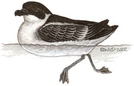
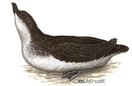
These interesting petrels, which look more like auks than other procellariiform birds, are known for diving through the crests of waves while in flight!
This unusual family of birds contains only one genus and four or five species. They are found in the southern hemisphere, in high latitudes; one species is circumpolar in distribution, and several nest on islands south of the Antarctic Convergence. The taxonomy of this family is still debated; some scientists place them within Procellariidae.
Morphologically, the diving petrels resemble northern auks (alcids) much more than they resemble other procellariiform birds, and their similarities have often been noted as a remarkable example of convergent evolution. They have short wings and small, short necks, and a notably compact body. Their bill is short, broad, and hooked, with a complex rhamphotheca, as in other petrels. They have the characteristic procellariiform external tubular nostrils, which may, at times, be the easiest way to distinguish them from the smaller alcids. In the diving petrel, these nostrils are reduced and open upwards, which is likely an adaptation for diving. These species tend to be rather similar in appearance; distinctions in bill form, shape of the lower jaw arch and small processes in the nostrils can be used to distinguish them. Their front toes are webbed, and their legs are set far back on their bodies, rendering them clumsy on land like many other procellariiform birds. Their plumage is dark grey or brown above and white below.
These birds are highly adapted to aquatic life. They dive to catch most of their prey (crustaceans, small fish, and cephalopods), and have a gular pouch in which they can carry food. When diving they use their feet and tail as rudders; experiments have shown that the Common diving petrel can dive up to 64 m, with approximately 30 m being the average depth. They will dive to evade danger as well.
Their general mode of flight (referred to as 'whirring' flight) is more similar to alcids than to other petrels. Diving petrels are excellent swimmers and fast in flight; they have the unique ability to 'fly' through waves, plunging through the crest of one wave and coming out on the other side still flying. Unlike other petrels, the flight feathers of diving petrels are moulted simultaneously, leaving the birds flightless while they grow back. They are still quite adept at feeding, however; without feathers, their wings resemble penguin flippers. Their natural body weight is near the limit that their wings can support, so an increase in body weight can also leave them flightless for a time! They approach land mainly for breeding, though individuals may start visiting breeding grounds long beforehand. They are gregarious and strictly nocturnal on land. Each pair burrows into the soil, excavating their nest holes using their claws and bill; they will even nest on snow covered islands after the land thaws. As in all Procellariiformes, females lay a single egg, and both sexes take turns incubating. The male and female switch shifts nightly, so that the diving petrels have the shortest incubation stints within Procellariiformes (in stark contrast to the great albatrosses, who may incubate an egg for several weeks before being relieved by a partner). Many individuals do seem to visit the breeding colony outside of the breeding season; in general, they are considered to be dispersive, rather than migratory, but in truth their movements are not well known.
Humans have generally had little contact with the birds in this family, and have not often abused them directly. However, at least one species is considered threatened, and was wiped out during the years of heavy guano exploitation; by removing guano from small islands, we succeeded in destroying much of the habitat that these birds rely on. They are also at risk of predation from introduced animals; cats are the worst offenders and have killed many birds.
Although there is much debate over the taxonomy within Procellariiformes, diving petrels are usually considered to be most closely related to the typical petrels, family Procellariidae.
Diving petrels are rather scarce in the fossil record, the first evidence of this family comes from the early Pliocene in South Africa.
Bocher, P., B. Labidoire, Y. Cherel. 2000. Maximum dive depths of common diving petrels (Pelecanoides urinatrix) during the annual cycle at Mayes Island, Kerguelen. J. Zool., Lond., 251:517-524.
Campbell, B. & E. Lack, eds. 1985. A dictionary of birds. Buteo Books, Vermillion, South Dakota.
del Hoyo, J., Elliott, A., & J. Sargatal. 1992. Handbook of the birds of the world. Volume 1. Lynx Edicions, Barcelona.
Feduccia, A. 1999. The origin and evolution of birds. Yale University Press, New Haven.
Thomson, A. 1964. A new dictionary of birds. British Ornithologists' Union. McGraw-Hill Book Co., NY.
Warham, J. 1996. Behaviour, population biology, and physiology of the petrels. Academic Press, Ltd., San Diego, CA.
Contributors
Danielle Cholewiak (author).
Glossary
- acoustic
-
uses sound to communicate
- bilateral symmetry
-
having body symmetry such that the animal can be divided in one plane into two mirror-image halves. Animals with bilateral symmetry have dorsal and ventral sides, as well as anterior and posterior ends. Synapomorphy of the Bilateria.
- chemical
-
uses smells or other chemicals to communicate
- endothermic
-
animals that use metabolically generated heat to regulate body temperature independently of ambient temperature. Endothermy is a synapomorphy of the Mammalia, although it may have arisen in a (now extinct) synapsid ancestor; the fossil record does not distinguish these possibilities. Convergent in birds.
- iteroparous
-
offspring are produced in more than one group (litters, clutches, etc.) and across multiple seasons (or other periods hospitable to reproduction). Iteroparous animals must, by definition, survive over multiple seasons (or periodic condition changes).
- motile
-
having the capacity to move from one place to another.
- oviparous
-
reproduction in which eggs are released by the female; development of offspring occurs outside the mother's body.
- sexual
-
reproduction that includes combining the genetic contribution of two individuals, a male and a female
- tactile
-
uses touch to communicate
- visual
-
uses sight to communicate