Pelecanoides magellaniMagellanic diving petrel(Also: Magellanic diving-petrel)
Geographic Range
Magellanic diving petrels are found in the coastal and nearshore areas of southern Chile, Tierra del Fuego, and southern Argentina. They are found in fjords and coastal waters up to 125 km from shore. (Brooke, 2004)
- Biogeographic Regions
- neotropical
- atlantic ocean
- pacific ocean
Habitat
Magellanic diving petrels are mainly found foraging in nearshore, coastal waters. They breed on small, nearshore islands in coastal channels and fjords. Breeding islands generally have soft soil and some vegetation. Magellanic diving petrels dig nesting burrows in this soil and overhanging vegetation may help to mask the burrow entrance. (del Hoyo, et al., 1992)
- Habitat Regions
- temperate
- Aquatic Biomes
- coastal
Physical Description
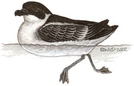
Magellanic diving petrels are about 19 cm long and recorded weights are from 145 to 174 g (although this is based on a small sample size). They are similar in appearance to other diving petrels, with black plumage dorsally and white plumage on the ventral surfaces. They have grey mottling on their flank and sides of their breasts. Soon after a molt, feathers on their back, rumps, and wings have white tips to them. They have a white line that runs from just above each eye, laterally down the neck to join with the white of the breast and flanks. Their bill is black and the feet and legs are blue, with black webbing. They are distinguished from other diving petrels by the white markings that run from their eyes along the neck and by dimensions of the bill. Wings are from 120 to 133 mm long, bill lengths are from 15 to 17 mm, and tails are from 34 to 44 mm. There are no described subspecies and sexual dimorphism is not reported. Like other diving petrels, they are able to store and transport prey items in a gular pouch, formed by a distensible portion of skin in the throat. This characteristic is hinted at by their generic name Pelecanoides, referring to its similarity to the gular sac of pelicans (Pelecanidae). (Brooke, 2004; del Hoyo, et al., 1992)
- Other Physical Features
- endothermic
- homoiothermic
- bilateral symmetry
- Sexual Dimorphism
- sexes alike
-
- Range mass
- 145 to 174 g
- 5.11 to 6.13 oz
-
- Average length
- 19 cm
- 7.48 in
Reproduction
There is no information on mating in Magellanic diving petrels. Like their relatives, they are thought to be monogamous, with pairs occupying nesting burrows in small territories at breeding colonies. (del Hoyo, et al., 1992)
- Mating System
- monogamous
There is very little information on breeding in Magellanic diving petrels. They seem to nest in burrows among vegetation on coastal, channel islands throughout their range. Eggs are laid from November to December and fledglings have been observed in March. Adults have a post-nuptial molt from April to June. Females lay a single egg. Other aspects of their reproduction are probably similar to common diving petrels. (Brooke, 2004; del Hoyo, et al., 1992)
- Key Reproductive Features
- iteroparous
- seasonal breeding
- gonochoric/gonochoristic/dioecious (sexes separate)
- sexual
- oviparous
-
- Breeding interval
- Magellanic diving petrels breed once yearly.
-
- Breeding season
- Magellanic diving petrels seem to breed from November to December.
-
- Range eggs per season
- 1 to 1
Males and females both incubate, brood, feed, and protect their single young until they become independent. (Brooke, 2004; del Hoyo, et al., 1992)
- Parental Investment
- altricial
-
pre-fertilization
- provisioning
-
protecting
- female
-
pre-hatching/birth
-
provisioning
- female
-
protecting
- male
- female
-
provisioning
-
pre-weaning/fledging
-
provisioning
- male
- female
-
protecting
- male
- female
-
provisioning
-
pre-independence
-
provisioning
- male
- female
-
protecting
- male
- female
-
provisioning
Lifespan/Longevity
Magellanic diving petrel longevity has not been documented, although it is presumed to be similar to that of common diving petrels. (del Hoyo, et al., 1992)
Behavior
Like other diving petrels, these birds fly with characteristic fast wing beats close to the water. They seem to molt all of their flight feathers at once, leaving them flightless for several weeks. However, the loss of their primary feathers doesn't impact their ability to dive and capture prey. Magellanic diving petrels are social at breeding colonies, which may be dense, but are generally seen alone or in small groups outside of the breeding season. They spend most of their time on the water when not at breeding colonies. They visit breeding colonies at night, resting in their nesting burrows, and seem to forage mainly during the day, although they will forage at night as well. Magellanic diving petrels are thought to be sedentary. They have been found up to 128 km from land, but are thought to generally occur in coastal waters near their breeding colonies. (Brooke, 2004; del Hoyo, et al., 1992)
Home Range
Home range sizes are not reported.
Communication and Perception
There is no information on communication in Magellanic diving petrels. They are likely to be similar to their close relatives, common diving petrels (Pelecanoides urinatrix), which are silent, generally, at sea but very vocal at breeding colonies at night. (Brooke, 2004; del Hoyo, et al., 1992)
- Communication Channels
- acoustic
Food Habits
Magellanic diving petrels capture aquatic invertebrates, especially crustaceans, and small fish by diving, either from flight or from a surface dive. Like their diving petrel cousins, they are likely to be strong in underwater pursuit, propelling themselves underwater with their wings and steering with their tails. They seem to feed mainly in coastal, nearshore waters. (Brooke, 2004; del Hoyo, et al., 1992)
- Animal Foods
- fish
- aquatic crustaceans
Predation
Like other diving petrels, they seem to dive in response to threats rather than fly. They seem to escape much predation by gulls and skuas by visiting their nesting colonies mainly at night, landing briefly outside of their burrows and making a quick retreat to the safety of the burrow upon arrival. If they are forced to walk any distance on land to their burrow, there is a high probability that they will fall prey to larger birds. (del Hoyo, et al., 1992)
- Anti-predator Adaptations
- cryptic
-
- Known Predators
-
- gulls (Larus)
- skuas (Stercorarius)
Ecosystem Roles
Magellanic diving petrels are important predators of marine invertebrates and small fish in the coastal channels and fjords they inhabit. (Brooke, 2004; del Hoyo, et al., 1992)
Economic Importance for Humans: Positive
Magellanic diving petrels are important members of nearshore marine environments throughout their range and may attract ecotourism interest.
Economic Importance for Humans: Negative
There are no adverse effects of Magellanic diving petrels on humans.
Conservation Status
Magellanic diving petrels have a large distribution and are considered common throughout their range. They are listed as "least concern" by the IUCN. (Brooke, 2004)
-
- IUCN Red List
-
Least Concern
More information
-
- IUCN Red List
-
Least Concern
More information
-
- US Migratory Bird Act
- No special status
-
- US Federal List
- No special status
-
- CITES
- No special status
Other Comments
Pelecanoides magellani were once considered conspecific with Pelecanoides urinatrix. (Brooke, 2004)
Diving petrels are strikingly similar physically and ecologically to the northern hemisphere puffins, murres, and auklets (Alcidae), especially little auks (Alle alle). (Brooke, 2004)
Contributors
Tanya Dewey (author), Animal Diversity Web.
Glossary
- Atlantic Ocean
-
the body of water between Africa, Europe, the southern ocean (above 60 degrees south latitude), and the western hemisphere. It is the second largest ocean in the world after the Pacific Ocean.

- Neotropical
-
living in the southern part of the New World. In other words, Central and South America.
- Pacific Ocean
-
body of water between the southern ocean (above 60 degrees south latitude), Australia, Asia, and the western hemisphere. This is the world's largest ocean, covering about 28% of the world's surface.
- acoustic
-
uses sound to communicate
- altricial
-
young are born in a relatively underdeveloped state; they are unable to feed or care for themselves or locomote independently for a period of time after birth/hatching. In birds, naked and helpless after hatching.
- bilateral symmetry
-
having body symmetry such that the animal can be divided in one plane into two mirror-image halves. Animals with bilateral symmetry have dorsal and ventral sides, as well as anterior and posterior ends. Synapomorphy of the Bilateria.
- carnivore
-
an animal that mainly eats meat
- chemical
-
uses smells or other chemicals to communicate
- coastal
-
the nearshore aquatic habitats near a coast, or shoreline.
- cryptic
-
having markings, coloration, shapes, or other features that cause an animal to be camouflaged in its natural environment; being difficult to see or otherwise detect.
- diurnal
-
- active during the day, 2. lasting for one day.
- endothermic
-
animals that use metabolically generated heat to regulate body temperature independently of ambient temperature. Endothermy is a synapomorphy of the Mammalia, although it may have arisen in a (now extinct) synapsid ancestor; the fossil record does not distinguish these possibilities. Convergent in birds.
- iteroparous
-
offspring are produced in more than one group (litters, clutches, etc.) and across multiple seasons (or other periods hospitable to reproduction). Iteroparous animals must, by definition, survive over multiple seasons (or periodic condition changes).
- monogamous
-
Having one mate at a time.
- motile
-
having the capacity to move from one place to another.
- native range
-
the area in which the animal is naturally found, the region in which it is endemic.
- nocturnal
-
active during the night
- oviparous
-
reproduction in which eggs are released by the female; development of offspring occurs outside the mother's body.
- piscivore
-
an animal that mainly eats fish
- seasonal breeding
-
breeding is confined to a particular season
- sedentary
-
remains in the same area
- sexual
-
reproduction that includes combining the genetic contribution of two individuals, a male and a female
- social
-
associates with others of its species; forms social groups.
- tactile
-
uses touch to communicate
- temperate
-
that region of the Earth between 23.5 degrees North and 60 degrees North (between the Tropic of Cancer and the Arctic Circle) and between 23.5 degrees South and 60 degrees South (between the Tropic of Capricorn and the Antarctic Circle).
- visual
-
uses sight to communicate
References
Brooke, M. 2004. Albatrosses and petrels across the world. Oxford: Oxford University Press.
del Hoyo, J., A. Elliott, J. Sargatal. 1992. Handbook of the Birds of the World, Volume I. Barcelona: Lynx Edicions.