Passerella iliacafox sparrow




Geographic Range
Fox sparrows, Passerella iliaca, are found in much of northern and western North America. In the summer during their breeding season, they are found across northern Canada and Alaska, and also south through parts of western North America. During the winter they migrate towards the Pacific coast, from southern British Columbia and south to northern Baja California. They also extend across the southern area of the United States, from northern Mexico to Illinois and Connecticut. (Byers, et al., 1995)
Habitat
Fox sparrows commonly breed in coniferous or mixed forests, which have dense undergrowth and shrub. They also breed in woodland thickets, scrub, chaparral, and riparian woodland. During the winter months, fox sparrows are commonly found in forests, forest edges, woodlots, and other woodland habitats that have dense undergrowth. (Alsop III, et al., 2001; Byers, et al., 1995)
- Habitat Regions
- temperate
- terrestrial
- Terrestrial Biomes
- chaparral
- forest
- scrub forest
- mountains
- Other Habitat Features
- riparian
Physical Description
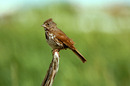
Fox sparrows are one of the largest of sparrows, measuring from 15 to 19 cm in length, and weighing from 26.9 to 49.0 grams. Their wingspan is typically from 26.67 to 29.85 cm and their basal metabolic rate is 66.9 cm^ oxygen per hour, on average. Fox sparrows are divided into 18 different races, all of which are large, but each looks slightly different. All fox sparrows also have a long tail and a bi-colored dark and pale yellow bill. They also have dark brown streaks on their breasts that meet at one common point. The 18 races are divided into three larger groups, including the northern and eastern birds, the southern Rocky Mountain and Sierra birds, and the northern Pacific coast birds. The eastern and northern races have a grayish head that is streaked with rust, and a red or rust rump and tail. They also have a blotchy white breast. The southern Rocky Mountain and Sierra group has a solid gray head, and also has a rust colored rump and tail. Finally, the northern Pacific coast group is very uniform and dark brown in color. Within each of the races, the individuals show no significant differences in coloration between males and females. The males are slightly larger than the females. Juvenile fox sparrows are very similar to the adults in appearance, however the upper-parts are slightly duller and the streaks on the breast are smaller and narrower. (Byers, et al., 1995; Canterbury, 2002; Trerres, 1980)
- Other Physical Features
- endothermic
- bilateral symmetry
- Sexual Dimorphism
- sexes alike
- male larger
-
- Range mass
- 26.9 to 49 g
- 0.95 to 1.73 oz
-
- Average mass
- 36.9 g
- 1.30 oz
-
- Range length
- 15 to 19 cm
- 5.91 to 7.48 in
-
- Range wingspan
- 26.67 to 29.85 cm
- 10.50 to 11.75 in
-
- Average basal metabolic rate
- 66.9 cm3.O2/g/hr
Reproduction
Fox sparrows tend to be monogamous and solitary while breeding. The male usually sings in the general area of the nest, while keeping himself hidden. The sounds created are identified as call-notes, and they have not been shown to be a way to attract females, but rather are a song as a protest against intrusion into the territory by other males. These typically shy birds only become defensive when their nest territory is invaded by other birds. (Alsop III, et al., 2001; Bent, 1968)
- Mating System
- monogamous
Fox sparrows may breed up to two times a year. The breeding season is from mid-May to July. The number of eggs laid per clutch ranges from 3 to 5. The eggs are pale blue to pale green with thick brown spots. The nests of fox sparrows are typically on the ground or in very low branches. They are typically no more than 7 feet above ground. The nests are made out of twigs, dried grass, stems, and bark. The cup shaped nest is lined with grass, animal hair and feathers. It takes from 12 to 14 days for the eggs to hatch; incubation is done mostly by females. The young are typically tended to and fed by both parents. The young fox sparrows fledge in 9 to 10 days after hatching. While there was no specific information on time to independence for this species, the time to independence for sparrows in general is about 10 days. On average, both sexes of fox sparrows reach reproductive maturity when they are about 1 year old. (Baicich and Harrison, 1997; Rising, 1996; Trerres, 1980)
- Key Reproductive Features
- iteroparous
- seasonal breeding
- gonochoric/gonochoristic/dioecious (sexes separate)
- sexual
- fertilization
- oviparous
-
- Breeding interval
- Fox Sparrows may breed up to two times a year.
-
- Breeding season
- Fox Sparrows breed from mid-May to July
-
- Range eggs per season
- 3 to 5
-
- Average eggs per season
- 4
- AnAge
-
- Range time to hatching
- 12 to 14 days
-
- Range fledging age
- 9 to 10 days
-
- Average time to independence
- 10 days
-
- Average age at sexual or reproductive maturity (female)
- 1 years
-
- Average age at sexual or reproductive maturity (male)
- 1 years
Fox sparrows are altricial. The eggs hatch after about 12 to 14 days (females do most of the incubation), and the young fledge about 9 to 10 days later. Fox sparrows are tended to by both parents. They provide food (mainly insects) and protection. While there was no specific information on time to independence for this species, the time to independence for sparrows in general is about 10 days. Both parents will use the broken-wing display to protect their young from predators. (Bent, 1968; Rising, 1996)
- Parental Investment
- no parental involvement
- altricial
-
pre-hatching/birth
-
protecting
- female
-
protecting
-
pre-weaning/fledging
-
provisioning
- male
- female
-
protecting
- male
- female
-
provisioning
-
pre-independence
-
provisioning
- male
- female
-
protecting
- male
- female
-
provisioning
Lifespan/Longevity
The oldest fox sparrow recovered at the Patuxent Wildlife Research Center was in 9 years and 8 months old. ("Longevity Records by Species Number", 2003)
-
- Range lifespan
Status: wild - 9.6 (high) years
- Range lifespan
-
- Average lifespan
Status: wild - 124 months
- Bird Banding Laboratory
- Average lifespan
Behavior
Fox sparrows tend to be solitary or in pairs during breeding season, and they travel in small flocks during migration. The male is a very active singer during the breeding season. They are diurnal. During the migration period, they generally migrate at night and sing during the day. During the breeding season, males are very territorial and actively defend their territories. One way they defend it is by darting at the invader, forcing them to leave. They are strong and direct fliers. They alternate short flights of rapidly beating their wings, with brief periods with their wings pulled to their sides. (Alsop III, et al., 2001; Bent, 1968; Rising, 1996; Stanford Alumni, 1999)
Home Range
We do not have information on home range for this species at this time. (Baicich and Harrison, 1997)
Communication and Perception
Fox sparrows have a voice that is thought to be one of the finest among sparrows. The song is generally presented while the sparrow sits on the top of a bush or on a low branch in a tree. The male usually sings in a concealed area in the territory around its nest. Fox sparrows sing very often during breeding season, but keep themselves hidden at the same time. A distinctive song is one that is used when the bird is alarmed. It is commonly heard when fox sparrows are in some way disturbed near their nest. Singing is occasional, but not common, in the winter. (Alsop III, et al., 2001; Bent, 1968; Byers, et al., 1995; Trerres, 1980)
- Communication Channels
- acoustic
Food Habits
Fox sparrows are omnivorous. They forage on the ground by double scratching and quickly kicking backwards with both feet simultaneously. They dig holes in the leaf litter and ground, which allows them to reach buried seeds or insects. They look for weed seeds, blueberries, other wild fruit and especially Polygonum (knotweed). They also look for spiders (Araneae), insects, millipedes (Diplopoda), and small snails (class Gastropoda). Nestlings are fed primarily insects. (Alsop III, et al., 2001; Byers, et al., 1995; Trerres, 1980)
- Primary Diet
- omnivore
- Animal Foods
- insects
- terrestrial non-insect arthropods
- mollusks
- Plant Foods
- seeds, grains, and nuts
- fruit
Predation
Because their nests are placed on the ground, fox sparrows face predation by hawks (family Accipitridae), mammalian carnivores (order Carnivora), and possibly snakes (suborder Serpentes). In order to protect their young when there is a predator, adults give a broken wing display. During the display the adult limps around with one wing up, acting as if it was broken, and calls sharply. Once the predator is distracted, the adult flies back to the nest and young. (Bent, 1968; Trerres, 1980)
-
- Known Predators
-
- hawks (Accipitridae)
- mammalian carnivores (Carnivora)
- snakes (Serpentes)
Ecosystem Roles
Fox sparrows act as predators of insects, spiders, millipedes and small snails and are important prey for their predators. It is also interesting to note that fox sparrows are occasionally parasitized by brown-headed cowbirds (Molothrus ater). (Alsop III, et al., 2001; Trerres, 1980)
Economic Importance for Humans: Positive
While fox sparrows do not play a large economically important role, they are important in the bird watching community. (Bent, 1968)
- Positive Impacts
- ecotourism
Economic Importance for Humans: Negative
There are no known adverse affects of Paserella iliaca on humans.
Conservation Status
Fox sparrows are protected under the US Migratory Bird Treaty Act. They are particularly vulnerable to habitat destruction as a result of logging operations. (Alsop III, et al., 2001; "Birds Protected By the Migratory Bird Treaty Act", Date Unknown)
-
- IUCN Red List
-
Least Concern
More information
-
- IUCN Red List
-
Least Concern
More information
-
- US Migratory Bird Act
- Protected
-
- US Federal List
- No special status
-
- CITES
- No special status
-
- State of Michigan List
- No special status
Other Comments
Fox sparrows are also referred to as ferruginous finches, foxy finches, fox-colored sparrows, and fox tails. They get their common name from the red or rusty color of their feathers. (Trerres, 1980)
Contributors
Alaine Camfield (editor), Animal Diversity Web.
Sherrill Kilgore (author), University of Michigan-Ann Arbor, Phil Myers (editor), Museum of Zoology, University of Michigan-Ann Arbor.
Glossary
- Nearctic
-
living in the Nearctic biogeographic province, the northern part of the New World. This includes Greenland, the Canadian Arctic islands, and all of the North American as far south as the highlands of central Mexico.

- acoustic
-
uses sound to communicate
- altricial
-
young are born in a relatively underdeveloped state; they are unable to feed or care for themselves or locomote independently for a period of time after birth/hatching. In birds, naked and helpless after hatching.
- bilateral symmetry
-
having body symmetry such that the animal can be divided in one plane into two mirror-image halves. Animals with bilateral symmetry have dorsal and ventral sides, as well as anterior and posterior ends. Synapomorphy of the Bilateria.
- chaparral
-
Found in coastal areas between 30 and 40 degrees latitude, in areas with a Mediterranean climate. Vegetation is dominated by stands of dense, spiny shrubs with tough (hard or waxy) evergreen leaves. May be maintained by periodic fire. In South America it includes the scrub ecotone between forest and paramo.
- chemical
-
uses smells or other chemicals to communicate
- diurnal
-
- active during the day, 2. lasting for one day.
- ecotourism
-
humans benefit economically by promoting tourism that focuses on the appreciation of natural areas or animals. Ecotourism implies that there are existing programs that profit from the appreciation of natural areas or animals.
- endothermic
-
animals that use metabolically generated heat to regulate body temperature independently of ambient temperature. Endothermy is a synapomorphy of the Mammalia, although it may have arisen in a (now extinct) synapsid ancestor; the fossil record does not distinguish these possibilities. Convergent in birds.
- fertilization
-
union of egg and spermatozoan
- forest
-
forest biomes are dominated by trees, otherwise forest biomes can vary widely in amount of precipitation and seasonality.
- iteroparous
-
offspring are produced in more than one group (litters, clutches, etc.) and across multiple seasons (or other periods hospitable to reproduction). Iteroparous animals must, by definition, survive over multiple seasons (or periodic condition changes).
- migratory
-
makes seasonal movements between breeding and wintering grounds
- monogamous
-
Having one mate at a time.
- motile
-
having the capacity to move from one place to another.
- mountains
-
This terrestrial biome includes summits of high mountains, either without vegetation or covered by low, tundra-like vegetation.
- native range
-
the area in which the animal is naturally found, the region in which it is endemic.
- omnivore
-
an animal that mainly eats all kinds of things, including plants and animals
- oviparous
-
reproduction in which eggs are released by the female; development of offspring occurs outside the mother's body.
- riparian
-
Referring to something living or located adjacent to a waterbody (usually, but not always, a river or stream).
- scrub forest
-
scrub forests develop in areas that experience dry seasons.
- seasonal breeding
-
breeding is confined to a particular season
- sexual
-
reproduction that includes combining the genetic contribution of two individuals, a male and a female
- social
-
associates with others of its species; forms social groups.
- solitary
-
lives alone
- tactile
-
uses touch to communicate
- temperate
-
that region of the Earth between 23.5 degrees North and 60 degrees North (between the Tropic of Cancer and the Arctic Circle) and between 23.5 degrees South and 60 degrees South (between the Tropic of Capricorn and the Antarctic Circle).
- terrestrial
-
Living on the ground.
- territorial
-
defends an area within the home range, occupied by a single animals or group of animals of the same species and held through overt defense, display, or advertisement
- visual
-
uses sight to communicate
References
U.S. Fish and Wildlife Service. Date Unknown. "Birds Protected By the Migratory Bird Treaty Act" (On-line). Accessed April 02, 2004 at http://migratorybirds.fws.gov/intrnltr/mbta/mbtandx.html#s.
California Interagency Wildlife Task Group. 2003. "California Wildlife Habitat Relationships System" (On-line). Accessed April 02, 2004 at http://www.dfg.ca.gov/whdab/html/B504.html.
USGS Patuxent Wildlife Research Center. 2003. "Longevity Records by Species Number" (On-line). Accessed April 02, 2004 at http://www.pwrc.usgs.gov/BBL/homepage/longvlst.htm.
Alsop III, F., J. Hamilton, M. Clayton, C. Wills, R. Greenberg, S. DeLuca. 2001. Fox Sparrow. Pp. 901 in Birds Of North America, 1st Edition. DK Publishing.
Anne King, Date Unknown. "California Partners in Flight" (On-line). Accessed April 02, 2003 at http://www.prbo.org/calpif/htmldocs/species/conifer/fospacct.html.
Baicich, P., C. Harrison. 1997. A Guide to the Nests, Eggs, and Nestlings of North American Birds. Academic Press.
Bent, A. 1968. Life Histories of North American Cardinals, Grosbeaks, Buntings, Towhees, Finches, Sparrows, and Allies. Washington D.C.: Smithsonian Institution.
Byers, C., J. Curson, U. Olsson. 1995. Sparrows and Buntings. New York: Houghton Mifflin Company.
Canterbury, G. 2002. Metabolic adaptation and climatic constraints on winter bird distribution. Pp. 946-957 in Ecology, Vol. 83. Accessed April 02, 2004 at http://www.esapubs.org/archive/ecol/E083/014/appendix-A.htm.
Rising, J. 1996. A Guide to the Identification and Natural History of The Sparrows of the United States and Canada. Academic Press.
Stanford Alumni, 1999. "Fox Sparrow" (On-line). Accessed April 02, 2004 at http://www.stanfordalumni.org/birdsite/text/species/Fox_Sparrow.html.
Trerres, J. 1980. Finch Family. Pp. 342-343 in Encyclopedia of North American Birds, 1st Edition. United States Of America: Alfred A. Knopf, Inc.