Parus rufescenschestnut-backed chickadee

Geographic Range
The Chestnut-Backed Chickadee is a permanent resident of the Pacific Northwest forests, ranging from central California to south central Alaska. (Gilson 1994)
Habitat
Chestnut-Backed Chickadees make their nest along streams and rivers of the low-elevations of the Pacific Northwest. The nest of these birds are found in mature conifers, but especially in pine, cedar, and hemlock trees. (Fellows)
Physical Description
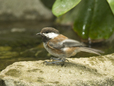
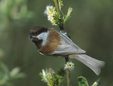
The Chestnut-Backed Chickadee measures 12.5 cm in length with a small body and a long tail. Chestnut-Backed Chickadees have a chestnut colored back and behind, and a black bib with white cheeks.(Pearson 1936) You can identify this chickadee by its call. It is very distinct and has a chipper ring. (Mathews 1967)
- Other Physical Features
- endothermic
- bilateral symmetry
Reproduction
The Chestnut-Backed Chickadee usually nests in trees ranging in size from 3.7 to 12.2 meters high. The nest consists of fur, feathers, moss, and various other materials found in the forest. Each clutch size is between 5 to 7 eggs. The eggs are usually unmarked and have a white color, but some may have a reddish tint with chestnut spotting. (Pearson 1936)
- Key Reproductive Features
- iteroparous
- gonochoric/gonochoristic/dioecious (sexes separate)
- sexual
- oviparous
Lifespan/Longevity
-
- Average lifespan
Status: wild - 114 months
- Bird Banding Laboratory
- Average lifespan
Behavior
It is not uncommon to see this chickadee swinging down off branches in search of insects to consume. Chestnut-Backed Chickadees are very friendly birds. These birds are social birds traveling in flocks of mixed birds consisting of creepers, woodpeckers, kinglets, and other species of birds. ("Infoplease 'Timous'" 1994)
- Key Behaviors
- flies
- motile
Communication and Perception
Food Habits
The Chestnut-Backed Chickadee is an omnivore. Their diet includes a variety of different seeds, spiders, caterpillars, and many other different insects. It is not uncommon to see this type of bird swinging off the tips of branches in search of insects to consume. ("Infoplease 'Chickadee'" 1994)
Economic Importance for Humans: Positive
The Chestnut-Backed Chickadees benefit humans by decreasing the insect population. Also, many people like to build houses for these birds and watch how they live, considering that they are a very social and pleasant bird to have living in a backyard. (Gough 1998)
Conservation Status
The only factor that may affect the Chestnut-Backed Chickadee is the acid rain polluting the forests of the United States. ("Wildlife Fact-File 'Acid Rain and its Effect on Wildlife'" 1997)
-
- IUCN Red List
-
No special status
More information
-
- IUCN Red List
-
No special status
More information
-
- US Federal List
- No special status
-
- CITES
- No special status
Other Comments
A playful and friendly bird, the Chestnut-Backed Chickadee can be trained to take food from the hand of a human. (Pearson 1936)
Contributors
Krystal Miller (author), Milford High School, George Campbell (editor), Milford High School.
Glossary
- Nearctic
-
living in the Nearctic biogeographic province, the northern part of the New World. This includes Greenland, the Canadian Arctic islands, and all of the North American as far south as the highlands of central Mexico.

- acoustic
-
uses sound to communicate
- bilateral symmetry
-
having body symmetry such that the animal can be divided in one plane into two mirror-image halves. Animals with bilateral symmetry have dorsal and ventral sides, as well as anterior and posterior ends. Synapomorphy of the Bilateria.
- chemical
-
uses smells or other chemicals to communicate
- endothermic
-
animals that use metabolically generated heat to regulate body temperature independently of ambient temperature. Endothermy is a synapomorphy of the Mammalia, although it may have arisen in a (now extinct) synapsid ancestor; the fossil record does not distinguish these possibilities. Convergent in birds.
- forest
-
forest biomes are dominated by trees, otherwise forest biomes can vary widely in amount of precipitation and seasonality.
- iteroparous
-
offspring are produced in more than one group (litters, clutches, etc.) and across multiple seasons (or other periods hospitable to reproduction). Iteroparous animals must, by definition, survive over multiple seasons (or periodic condition changes).
- motile
-
having the capacity to move from one place to another.
- native range
-
the area in which the animal is naturally found, the region in which it is endemic.
- oviparous
-
reproduction in which eggs are released by the female; development of offspring occurs outside the mother's body.
- sexual
-
reproduction that includes combining the genetic contribution of two individuals, a male and a female
- tactile
-
uses touch to communicate
- taiga
-
Coniferous or boreal forest, located in a band across northern North America, Europe, and Asia. This terrestrial biome also occurs at high elevations. Long, cold winters and short, wet summers. Few species of trees are present; these are primarily conifers that grow in dense stands with little undergrowth. Some deciduous trees also may be present.
- visual
-
uses sight to communicate
References
1997. Wlidlife Fact-File. USA: Wildlife Fact-File tm International Masters Publisher AB.
1994. "Infoplease" (On-line). Accessed December 5, 2000 at http://www.infoplease.com/ce6/AO81179.html.
Fellows, D. Accessed (Date Unknown) at http://www.npwrc.usgs.gov.
Gillson, G. 1994. "The Bird Guide" (On-line). Accessed October 10, 2000 at http://www.teleport.com/~guide/index.shtml.
Gough, G.A., S., Ilif, M.. 1998. "Patuxent Bird Identification Inforcer" (On-line). Accessed October 1, 2000 at http://www.mbr-pwrc.usus.gov/inforcer/infocenter.html.
Infoplease, 1994. "Titmouse" (On-line). Accessed December 10, 2000 at http://www.infoplease.com/ce6/sci/A0848881.html.
Mathews, F. 1967. Field Book of Wild Birds and Their Songs. New York: Dover Publications, INC..
Pearson, T., J. Burroughs, E. Forbush, W. Finley, G. Gladden. 1936. Birds Of America. Garden City, New York: Garden City Books.