Parula americananorthern parula


Geographic Range
Commonly known as northern parulas, Parula americana is found across the Nearctic and Neotropical regions. As a Neotropical migrant, Parula americana inhabits different regions in each season. In the spring and summer, this species breeds across the southeastern edge of Canada including the southern portions of Manitoba, Ontario, Quebec, and Maritime Provinces. This northernmost breeding range includes Minnesota, Wisconsin, Michigan, New York, New Hampshire and Maine. Below this range, there is a narrow band of states that Parula americana does not breed in. This warbler migrates through, but does not breed in, Iowa and southern Minnesota eastward to Massachusetts and New Jersey. Below this belt, Parula americana breeds in every state in the southeastern United States.
During the winter, these warblers inhabits the very southern tip of Florida, Caribbean Islands, and Bermuda. They may also be found in Mexico and portions of Central America from Veracruz to Honduras. (Moldenhauer and Regelski, 1996; Sibley, 2000)
- Biogeographic Regions
- nearctic
- neotropical
Habitat
Parula americana inhabits various habitats depending on season and location. This is primarily a forest-dwelling species, but the northern and southern breeding populations select different habitats. In general, abundance of this species has been found to be positively correlated with increased tree species diversity, canopy height, and percent canopy cover. Northern populations breed in mature, moist coniferous forests. This species constructs its pendulum nests in hanging vegetation and so it is often attracted to suspended clumps of moss or coniferous twigs that are more abundant in moist spruce bogs or hemlock swamps. Southern populations breed in mature, moist, bottomland forest where Spanish moss is prevalent.
Outside of the breeding season, Parula americana becomes more of a habitat generalist and may be found in a wide variety of habitats during migration and winter. These habitats may include: pastures; moist, dry or wet forests; and agricultural fields or plantations. (Ehrlich, et al., 1988; Moldenhauer and Regelski, 1996; Palmer-Ball, 1996)
- Habitat Regions
- temperate
- tropical
- terrestrial
- Terrestrial Biomes
- forest
- scrub forest
- Other Habitat Features
- agricultural
Physical Description
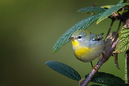
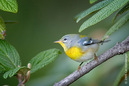
Parula americana is a small wood-warbler that measures 11.4 cm in length and weighs 8.6 g. This species molts twice annually, before and after the summer breeding season. Both males and females have distinct plumage during the breeding season. During this time, both are blue-gray above with a green, triangular mantle. Tail and wing feathers are a darker shade of blue-gray and they feature a pair of bold, white wing-bars. Both sexes also have bright yellow throats that extend through the breast. The bill is two-toned, with a black upper mandible and a yellow lower mandible that blends with the yellow throat. The bellies and undertail coverts are unmarked white. Breeding males feature distinct white eye-arcs surrounding a black eye stripe that connects to the base of the bill. Breeding males also feature prominent black and rufous breastbands that are often referred to as "necklaces". Breeding females are similar in appearance but are overall duller. At the end of the breeding season, individuals molt into a duller version of the breeding plumage. The unique breastband fades in males and may disappear altogether in females.
Parula americana juveniles are similar in appearance to wintering adults, but are more greenish-gray above and have shorter wing-bars. These young birds lack any breastband and the yellow throat and breast are not as extensive. (Moldenhauer and Regelski, 1996; Sibley, 2000)
- Other Physical Features
- endothermic
- homoiothermic
- bilateral symmetry
- Sexual Dimorphism
- male more colorful
-
- Average mass
- 8.6 g
- 0.30 oz
-
- Average length
- 11.4 cm
- 4.49 in
-
- Average wingspan
- 17.8 cm
- 7.01 in
Reproduction
Like most warblers, Parula americana is a monogamous species, however, a few cases of polygamy have been reported. Little is known about mating displays or behaviors and more research is needed in this area. (Ehrlich, et al., 1988; Moldenhauer and Regelski, 1996)
- Mating System
- monogamous
Parula americana is a Neotropical migrant that begins breeding shortly after arriving at the breeding grounds. Arrival dates vary with geographic location, but southern populations begin breeding in March while northern populations do not begin until mid-May. Due to the longer breeding season, southern populations frequently have two broods, as opposed to northern populations which have one.
After pair formation, the female selects a suitable nest location within her mate's territory. Parula americana nests in hanging pendulum shaped nests, usually located in hanging epiphytes such as Spanish moss. Sites located near water sources are preferred and many nests are found at the end of branches suspended over water. Females complete most of the nest construction with little to no help from males. The female hollows out a clump of vegetation and proceeds to fill the cavity with vegetation fibers, animal hair, grass, or pine needles. These nests average 7 cm in outside diameter.
After building her nest, the female lays an average of 4 to 5 white or cream-colored eggs speckled with varying amounts of brown. After eggs are laid, the incubation period typically lasts 12 to 14 days and the young fledge at 10 to 11 days old. Currently the length of the fledgling stage is unknown. Juvenile northern parulas may breed during the following breeding season. (Ehrlich, et al., 1988; Moldenhauer and Regelski, 1996; Palmer-Ball, 1996)
- Key Reproductive Features
- iteroparous
- seasonal breeding
- gonochoric/gonochoristic/dioecious (sexes separate)
- sexual
- oviparous
-
- Breeding interval
- Northern breed parulas once or twice yearly.
-
- Breeding season
- The breeding season may occur from March to August, depending on location.
-
- Range eggs per season
- 2 to 7
-
- Average eggs per season
- 4 to 5
-
- Range time to hatching
- 12 to 14 days
-
- Range fledging age
- 10 to 11 days
-
- Average age at sexual or reproductive maturity (female)
- <1 years
-
- Average age at sexual or reproductive maturity (male)
- <1 years
Upon arriving on the breeding grounds, males establish territories and aggressively defend them against intruders. The male is responsible for selecting a suitable territory and defending and protecting his territory, mate, and young. After pair-formation, the female selects a nesting site within her mate's territory and constructs the nest with little to no help from the male. The female then lays the clutch and is the sole incubator. The male occasionally assists by feeding the female while she broods the clutch. After the young have hatched, the female continues to perform most of the parental care. The female performs all brooding and most of the feeding. Both parents participate in nest sanitation and remove fecal sacs to prevent disease or reduce chance of predation. The young fledge 10 to 11 days after hatching and will remain under both parents' care for an unknown period of time. The female performs most of the feeding, but the male remains near to sing and defend his brood. (Ehrlich, et al., 1988; Moldenhauer and Regelski, 1996)
- Parental Investment
- altricial
- male parental care
- female parental care
-
pre-fertilization
- provisioning
-
protecting
- female
-
pre-hatching/birth
-
provisioning
- female
-
protecting
- male
- female
-
provisioning
-
pre-weaning/fledging
-
provisioning
- male
- female
-
protecting
- male
- female
-
provisioning
-
pre-independence
-
provisioning
- male
- female
-
protecting
- male
- female
-
provisioning
Lifespan/Longevity
The average lifespan for Parula americana is currently unknown. Current longevity record is held by a 7 year old, recaptured individual. Previously the longest lived bird was a recaptured female estimated at 4.5 years old. As this species is not kept in captivity, no captive lifespan data exists. Predation, especially during the nesting period, is likely the most common cause of mortality. Like most Neotropical migrants, many parulas perish after collisions with tall man-made structures during night migrations. (Klimkiewicz, et al., 1983; Moldenhauer and Regelski, 1996)
-
- Range lifespan
Status: wild - 4.5 to 7 years
- Range lifespan
Behavior
As a Neotropical migrant, Parula americana spends portions of each year in different regions. This species breeds in the eastern half of North America, but overwinters in Central America during the non-breeding season. Individuals may be seen migrating between these two regions in mixed-species flocks with other wood-warblers during the fall and spring. Migration typically takes place at night, although this species is diurnal for all other activities. Many small woodland species are known for high activity levels and are constantly flitting about within vegetation. In contrast, Parula americana is more stationary and will often perch for periods of time in the upper canopy. (Ehrlich, et al., 1988; Moldenhauer and Regelski, 1996)
- Key Behaviors
- arboreal
- flies
- diurnal
- motile
- migratory
- territorial
-
- Range territory size
- 1600 to 4000 m^2
Home Range
Parula americana is a relatively territorial species during the breeding season and males are known to defend territories ranging in size from 0.16 to 0.40 hectares. Like most birds, territory size is influenced by resource availability, however territory size for Parula americana is known to increase with increased presence of American beech (Fagus grandifolia) or stand size. (Moldenhauer and Regelski, 1996)
Communication and Perception
Parula americana communicates mainly through a combination of vocal calls and physical movements or postures. The primary call for this species is an ascending, buzzy trill that abruptly ends with a short note of lower tone. This call is aptly described as "trills up, falls over". Parula americana also gives a second call that is a buzzy, rapid string of short phrases that varies in length. Only males sing entire songs, which are used to establish or defend territory, as well as to attract mates. Males seem to use the primary call for attracting or interacting with females, while the more rapid calls are used in territorial disputes. Both sexes are capable of producing short chip notes which are often used to stay in contact with mates or young.
Male Parula americana are highly territorial during the breeding season, and use a combination of calls and physical displays to deter competitors. Threatened males may spread their wings while also holding their bodies horizontally. Males also vigorously swipe their bills against perches when intruders are nearby, which is likely a threatening display. If body postures and displays do not cause the intruder to retreat, the defending male will perform an aggressive aerial attack. Like most birds, Parula americana perceives its environment through visual, auditory, tactile and chemical stimuli. (Moldenhauer and Regelski, 1996)
Food Habits
Parula americana is an insectivorous species, that forages mostly or entirely on terrestrial invertebrates. Prey items include spiders, damselflies, locusts, true bugs, hoppers, aphids, beetles, caterpillars, flies, wasps, bees, and ants. Regardless of season, caterpillars and spiders are consumed most often. During the winter, Parula americana consumes more beetles and occasionally forages on berries, seeds, and nectar. Parula americana primarily captures prey from vegetation by a hover-glean method, however this species is versatile in using a variety of foraging methods. It may make short flights from a perch to snatch prey in mid-flight or even hang upside-down to forage. It is most often seen foraging in the mid- to upper canopy levels of vegetation. Though most foraging activity occurs in vegetation, this species occasionally forages on the ground as well. (Ehrlich, et al., 1988; Johnson, 2000; Moldenhauer and Regelski, 1996)
- Primary Diet
- carnivore
- Animal Foods
- insects
- terrestrial non-insect arthropods
- Plant Foods
- seeds, grains, and nuts
- fruit
- nectar
Predation
Currently there are no formal records of predation on Parula americana. Red squirrels, blue jays, and snakes are all likely predators of this species, especially predators of eggs and young in nests. Parula americana may exhibit mobbing behavior when a nest predator is near. (Moldenhauer and Regelski, 1996; Stevenson and Anderson, 1994)
-
- Known Predators
-
- red squirrels (Tamiasciurus hudsonicus)
- blue jays (Cyanocitta cristata)
- snakes (Serpentes)
Ecosystem Roles
Parula americana is an insectivorous species and thus likely has an impact on local insect communities. Although predation has not yet been reported, Parula americana probably serves as prey for several predators. (Moldenhauer and Regelski, 1996)
Economic Importance for Humans: Positive
There are no known economic benefits that Parula americana provides for humans. It is a popular bird with bird watchers, and seasonal migrations of this and other warblers can attract commerce to popular stopover areas.
Economic Importance for Humans: Negative
There are no known negative affects of Parula americana on humans.
Conservation Status
Parula americana is considered "least concern" by the International Union for Conservation of Nature and Natural Resources' (IUCN) Red List. This species inhabits an expansive geographical range and the population appears to be increasing. Despite this abundance, Parula americana has been extirpated from several regions where it previously bred. Massachusetts, New Jersey, Connecticut, New York, Rhode Island, and Vermont have recently experienced increased levels of air pollution and have consequently lost most of the epiphytes that this species prefers to nest in. Clearcutting and bog draining have also significantly reduced the amount of preferred breeding habitats available. Though this species is of least concern, efforts should still be made to develop sustainable forestry practices and decrease air pollutants to increase habitat quality for this and other species. (Moldenhauer and Regelski, 1996)
-
- IUCN Red List
-
Least Concern
More information
-
- IUCN Red List
-
Least Concern
More information
-
- US Migratory Bird Act
- Protected
-
- US Federal List
- No special status
-
- CITES
- No special status
-
- State of Michigan List
- No special status
Contributors
Rachelle Sterling (author), Special Projects, George Hammond (editor), Animal Diversity Web Staff, Tricia Jones (editor), University of Michigan-Ann Arbor, ADW Zookeeper (editor), University of Michigan-Ann Arbor, Tanya Dewey (editor), University of Michigan-Ann Arbor.
Glossary
- Nearctic
-
living in the Nearctic biogeographic province, the northern part of the New World. This includes Greenland, the Canadian Arctic islands, and all of the North American as far south as the highlands of central Mexico.

- Neotropical
-
living in the southern part of the New World. In other words, Central and South America.
- acoustic
-
uses sound to communicate
- agricultural
-
living in landscapes dominated by human agriculture.
- altricial
-
young are born in a relatively underdeveloped state; they are unable to feed or care for themselves or locomote independently for a period of time after birth/hatching. In birds, naked and helpless after hatching.
- arboreal
-
Referring to an animal that lives in trees; tree-climbing.
- bilateral symmetry
-
having body symmetry such that the animal can be divided in one plane into two mirror-image halves. Animals with bilateral symmetry have dorsal and ventral sides, as well as anterior and posterior ends. Synapomorphy of the Bilateria.
- bog
-
a wetland area rich in accumulated plant material and with acidic soils surrounding a body of open water. Bogs have a flora dominated by sedges, heaths, and sphagnum.
- carnivore
-
an animal that mainly eats meat
- chemical
-
uses smells or other chemicals to communicate
- diurnal
-
- active during the day, 2. lasting for one day.
- endothermic
-
animals that use metabolically generated heat to regulate body temperature independently of ambient temperature. Endothermy is a synapomorphy of the Mammalia, although it may have arisen in a (now extinct) synapsid ancestor; the fossil record does not distinguish these possibilities. Convergent in birds.
- female parental care
-
parental care is carried out by females
- forest
-
forest biomes are dominated by trees, otherwise forest biomes can vary widely in amount of precipitation and seasonality.
- insectivore
-
An animal that eats mainly insects or spiders.
- iteroparous
-
offspring are produced in more than one group (litters, clutches, etc.) and across multiple seasons (or other periods hospitable to reproduction). Iteroparous animals must, by definition, survive over multiple seasons (or periodic condition changes).
- male parental care
-
parental care is carried out by males
- migratory
-
makes seasonal movements between breeding and wintering grounds
- monogamous
-
Having one mate at a time.
- motile
-
having the capacity to move from one place to another.
- native range
-
the area in which the animal is naturally found, the region in which it is endemic.
- oviparous
-
reproduction in which eggs are released by the female; development of offspring occurs outside the mother's body.
- scrub forest
-
scrub forests develop in areas that experience dry seasons.
- seasonal breeding
-
breeding is confined to a particular season
- sexual
-
reproduction that includes combining the genetic contribution of two individuals, a male and a female
- swamp
-
a wetland area that may be permanently or intermittently covered in water, often dominated by woody vegetation.
- tactile
-
uses touch to communicate
- temperate
-
that region of the Earth between 23.5 degrees North and 60 degrees North (between the Tropic of Cancer and the Arctic Circle) and between 23.5 degrees South and 60 degrees South (between the Tropic of Capricorn and the Antarctic Circle).
- terrestrial
-
Living on the ground.
- territorial
-
defends an area within the home range, occupied by a single animals or group of animals of the same species and held through overt defense, display, or advertisement
- tropical
-
the region of the earth that surrounds the equator, from 23.5 degrees north to 23.5 degrees south.
- visual
-
uses sight to communicate
References
Ehrlich, P., D. Dobkin, D. Wheye. 1988. The Birder's Handbook: A Field Guide to the Natural History of North American Birds. New York, NY: Simon and Schuster.
Johnson, M. 2000. Evaluation of an arthopod sampling technique for measuring food availability for forest insectivorous birds. Journal of Field Ornithology, 71/1: 88-109.
Klimkiewicz, M., R. Clapp, A. Futcher. 1983. Longevity records of North American birds: Remizidae through Parulinae. Journal of Field Ornithology, 54/3: 287-294.
Moldenhauer, R., D. Regelski. 1996. "Northern Parula (Parula americana)" (On-line). The Birds of North America Online. Accessed June 28, 2011 at http://bna.birds.cornell.edu/bna/species/215.
Palmer-Ball, B. 1996. The Kentucky Breeding Bird Atlas. Kentucky: University Press of Kentucky.
Sibley, D. 2000. The Sibley Guide to Birds. New York: Alfred A. Knopf, Inc.
Stevenson, H., B. Anderson. 1994. The Birdlife of Florida. Gainesville, FL: University Press of Florida.