Papilio glaucus



Geographic Range
The eastern tiger swallowtail ranges from Alaska and the Hudsonian zone of Canada to the southern United States, east of the Rocky Mountains.
Habitat
This species occurs in nearly every area where deciduous woods are present, including towns and cities. It is most numerous along streams and river, and in wooded swamps.
- Terrestrial Biomes
- savanna or grassland
- forest
- mountains
Physical Description
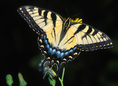
The forewing spans 4 to 7.6 cm. The males are yellow, with black tiger stripes. A large black border surrounds the edges of the wings. In Georgia, the coloring has more of an orange hint. The subspecies australis has been applied to these southeastern tiger swallowtails. Females are dimorphic. Some female swallowtails have the same color pattern as the males, while some are completely black. A variety of patterns between completely black, and yellow with black stripes can be seen in female swallowtails. These two extreme female colorings are thought to coexist because they both have equally beneficial effects. While the tiger striping causes a distracts predators, the dark coloring imitates the unpalatable blue swallowtail.
- Other Physical Features
- ectothermic
- bilateral symmetry
Reproduction
Eastern tiger swallowtails reach maturity in the spring. Many generations are produced each year and the last mature butterflies remain into mid-autumn.
Behavior
As with most butterflies, Eastern tiger swallowtails tend to be solitary. Males "patrol" for a mate, flying from place to place actively searching for females. "Patrolling" male tiger swallowtails can recognize areas of high moisture absorbtion by the sodium ion concentration of the area. It is believed that the moisture found by these males helps cool them by initiating an active-transport pump. Both male and female tiger swallowtails are known to be high fliers. Groups of fifty butterflies have been spotted in Maryland flying 50 meters high, around the tops of tulip trees.
Food Habits
Larvae are polyphagous, meaning they feed externally on the leaves of various woody plants. Foodplants include a variety of poplars, mountain ash, birch, cherry, tulip tree, ash, basswood, apple, maple, willow, magnolia, and occasionally sassafras.
Conservation Status
The eastern tiger swallowtails are not yet threatened by human impact on their ecosystem.
-
- IUCN Red List
- No special status
-
- US Federal List
- No special status
-
- CITES
- No special status
-
- State of Michigan List
- No special status
Other Comments
The tiger swallowtail is thought of as the American insect, in much the same way as the Bald Eagle is thought of as the American bird. It was the first American insect pictured in Europe; a drawing was sent to England from Sir Walter Raleighs' third expedition to Virginia.
Contributors
Jennifer Roof (author), University of Michigan-Ann Arbor.
Glossary
- Nearctic
-
living in the Nearctic biogeographic province, the northern part of the New World. This includes Greenland, the Canadian Arctic islands, and all of the North American as far south as the highlands of central Mexico.

- bilateral symmetry
-
having body symmetry such that the animal can be divided in one plane into two mirror-image halves. Animals with bilateral symmetry have dorsal and ventral sides, as well as anterior and posterior ends. Synapomorphy of the Bilateria.
- ectothermic
-
animals which must use heat acquired from the environment and behavioral adaptations to regulate body temperature
- forest
-
forest biomes are dominated by trees, otherwise forest biomes can vary widely in amount of precipitation and seasonality.
- mountains
-
This terrestrial biome includes summits of high mountains, either without vegetation or covered by low, tundra-like vegetation.
- native range
-
the area in which the animal is naturally found, the region in which it is endemic.
- tropical savanna and grassland
-
A terrestrial biome. Savannas are grasslands with scattered individual trees that do not form a closed canopy. Extensive savannas are found in parts of subtropical and tropical Africa and South America, and in Australia.
- savanna
-
A grassland with scattered trees or scattered clumps of trees, a type of community intermediate between grassland and forest. See also Tropical savanna and grassland biome.
- temperate grassland
-
A terrestrial biome found in temperate latitudes (>23.5° N or S latitude). Vegetation is made up mostly of grasses, the height and species diversity of which depend largely on the amount of moisture available. Fire and grazing are important in the long-term maintenance of grasslands.
References
Sbordoni, Valerio and Forestiero, Saverio. Butterflies of the World. Times Books, 1984.
Scriber J.M., Lintereur G.L., and Evans M.H. Great Lakes Entomologist." Foodplant Suitabilities and New Oviposition Record for Papilio Glaucus". Vol 15, 1982.
Clarke, Cyril and Clarke, F.M.M. Systematic Entomology. "Abnormalities of wing pattern in the Eastern Tiger Swallowtail butterfly, Papilio glaucus". Vol. 8, 1983.
Preston-Mafham, Rod and Ken. Butterflies of the World. Facts on File Publications, 1988.