Oxyura jamaicensisruddy duck


Geographic Range
Ruddy ducks are native to North and South America. These stiff-tailed ducks nest in western and central Canada and much of the western United States as far east as the Great Lakes region and south to central Texas, throughout Baja California, and to the transvolcanic belt in Mexico. Wintering range extends throughout most of southern North America, from California through the Great Lakes region and the Atlantic coast south of southern Maine to as far south as western Guatemala and El Salvador. Ruddy ducks were introduced to England in 1960 in Gloucestershire. From there these ducks have colonized Ireland and Belgium. Ruddy ducks introduced in Europe are migratory birds from the eastern United States and Mexico. Two subspecies including Oxyura jamaicensis ferruginea and Oxura jamaicensis andina can be found in the West Indies, Columbia, and throughout the Andes Mountains. (Gooders and Boyer, 1986; Pough, 1951)
- Biogeographic Regions
- nearctic
- palearctic
- neotropical
Habitat
Ruddy ducks inhabit permanent freshwater marshes, lakes, and ponds during their breeding season. These pools contain a considerable amount of vegetation in which these ducks hide their nests. During the winter ruddy ducks prefer shallow marshes and coastal bays. (Gooders and Boyer, 1986)
- Habitat Regions
- temperate
- saltwater or marine
- freshwater
- Aquatic Biomes
- lakes and ponds
- coastal
- brackish water
- Wetlands
- marsh
- Other Habitat Features
- estuarine
Physical Description
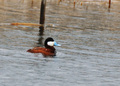
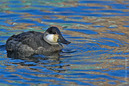
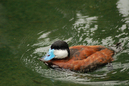
The morphology of ruddy ducks varies between sexes as well as seasonally. During the summer male ruddy ducks have rich chestnut necks and bodies. The crown, nape, and tail, which are held erect or horizontal to the water, are dark brown. Males have pure white faces, whereas females have a dark line across the face. Females and juveniles have barred bodies that lack any chesnut coloring. During the winter, male ruddy ducks resemble females. Their pure white face remains the primary distinguishing characteristic. Ruddy ducks have large, spatulate, pale blue bills. Males tend to be larger than females in weight and wingspan. Males are 142 to 154 mm from wing tip to wing tip and weigh from 540 to 795 g. Females are 135 to 149 mm from wing tip to wing tip and weigh 310 to 650 g. Body length is from 35 to 43 cm.
Male ruddy ducks have two molts. The prenuptial molt occurs in the summer months and reveals a plumage that is similar to that of females. The postnuptial molt occurs from August to October and reveals their winter plumage of bright chestnut. During this time the bill becomes bright blue as well. (Gooders and Boyer, 1986; Kortright, 1967)
- Other Physical Features
- endothermic
- homoiothermic
- bilateral symmetry
- Sexual Dimorphism
- male larger
- sexes colored or patterned differently
-
- Range mass
- 310 to 795 g
- 10.93 to 28.02 oz
-
- Range length
- 35 to 43 cm
- 13.78 to 16.93 in
-
- Range wingspan
- 135 to 154 mm
- 5.31 to 6.06 in
Reproduction
Ruddy ducks breed seasonally, migrating to breeding grounds in late winter. According to Gooders and Boyer (1986), they form pairs in late winter. However, it is unclear whether males are monogamous or polygamous. Following arrival at the breeding grounds, males perform a striking courtship display. To attract a female the male swims around her, his tail tilted forward and neck outstretched. He then slaps his chestnut-colored chest with his bright blue bill while making his courtship call. The male also uses his tail to stand and scoot across the surface of the water. When the female is satisfied with this performance, she stretches her neck with her bill open. (Gooders and Boyer, 1986; Kortright, 1967; Pough, 1951; Siegfried, 1976)
- Mating System
- monogamous
- polygynous
Ruddy ducks breed seasonally in spring and summer months, from May to August. Following arrival at the breeding grounds, females construct nests and platforms on which males and females can rest. The nest is typically constructed just above water level and among the previous year's vegetation. Females also use these materials to form a dome over the nest to protect it from being seen by predators. (Gooders and Boyer, 1986; Hughes, 2006; Siegfried, 1976)
Approximately 4 weeks after arriving at the breeding grounds, females are ready to nest. Siegfried (1976a) suggests that a female's readiness to lay eggs is sometimes poorly coordinated with the availability of suitable nesting sites. This may result in egg-dropping on the ground or in other birds' nests. This is observed frequently in Oxyura jamaicensis and is known as parasitic laying. Females lay 6 to 10 white eggs which are large, relative to the size of the bird. The incubation period lasts 23 to 26 days. Young are precocial, they are brooded in the nest for their first day after hatching, after which the parents lead them from the nest. At this point young ruddy ducks are capable of diving well and of aggressive behavior towards other birds. Parents abandon their brood 20 to 30 days following hatching. These young ducks do not reach the fledgling stage, however, until 50 to 55 days after hatching. (Gooders and Boyer, 1986; Hughes, 2006; Siegfried, 1976)
- Key Reproductive Features
- iteroparous
- seasonal breeding
- gonochoric/gonochoristic/dioecious (sexes separate)
- sexual
- oviparous
-
- Breeding interval
- Ruddy ducks breed once yearly.
-
- Breeding season
- Breeding is from May to August.
-
- Range eggs per season
- 6 to 10
-
- Average eggs per season
- 8
- AnAge
-
- Range time to hatching
- 23 to 26 days
-
- Range fledging age
- 50 to 55 days
-
- Range time to independence
- 20 to 30 days
-
- Average age at sexual or reproductive maturity (female)
- 1 years
-
- Average age at sexual or reproductive maturity (male)
- 1 years
Female ruddy ducks invest heavily in young. This is evident in the care the female takes in constructing and covering the nest, the nutritional resources invested in each egg, and the time taken in incubation. Incubation lasts 23 to 26 days and is carried out solely by the female. From the time of hatching to 2 to 4 weeks of age the female is very attentive to the brood. She remains close during feeding and also exhibits aggressive behavior when ducks of other ages approach. Females also reduce the amount of time they spend diving while the young brood dives so as to watch over and protect them.
Male ruddy ducks show little or no parental investment. Males often abandon females during the incubation period. Males that remain with females through the incubation and hatchling period show no protective behavior toward their ducklings when they are harassed by other avian species. (Gooders and Boyer, 1986; Joyner, 1977; Siegfried, 1976)
- Parental Investment
- precocial
-
pre-fertilization
- provisioning
-
protecting
- female
-
pre-hatching/birth
-
provisioning
- female
-
protecting
- female
-
provisioning
-
pre-weaning/fledging
-
provisioning
- female
-
protecting
- female
-
provisioning
Lifespan/Longevity
The maximum lifespan of ruddy ducks in the wild is 13 years. However, in Great Britain, where the species is considered invasive, individuals rarely reach that age. According to the Global Invasive Species Database, those ducks banded and tracked in the wild rarely survive past 2 years. Those birds kept in captivity have an average lifespan of 2.4 years. (Hughes, 2006)
-
- Range lifespan
Status: wild - 13 (high) years
- Range lifespan
-
- Average lifespan
Status: captivity - 2.4 years
- Average lifespan
-
- Average lifespan
Status: wild - 163 months
- Bird Banding Laboratory
- Average lifespan
Behavior
Ruddy ducks are clumsy on land because of the position of their legs on the body. Their legs are set far back on the body, making it difficult for them to walk. However, this morphology makes them exceptionally fast and agile in the water. They can dive or sink into the water with little effort. Compelled by a single power stroke of their feet these ducks dive approximately a meter below the surface until they reach the substrate, where they forage for food. While diving, the feet paddle simultaneously and wings remain closed. In order to become airborne these ducks must beat their wings rapidly and run along the surface of the water. Once in flight, ruddy ducks fly at relatively low heights above the water. This is true even during migration when they travel in medium to large sized flocks primarily at night to their summer breeding grounds.
These ducks usually occur alone, in pairs, or in small groups of eight to twelve. They rarely associate with other birds and the young tend to be aggressive toward other species. (Kortright, 1967; Pough, 1951)
Home Range
Ruddy ducks do not actively defend a territory, nor do they restrict themselves to a given home range for any part of the year.
Communication and Perception
Ruddy ducks usually don't make many calls or other sounds. During courtship, males perform an elaborate display accompanied by a call in order to attract a mate. The voice is as follows: chuck-chuck-chuck-chuck-chur-r-r; and ip-ip-ip-ip-u-cluck; and tick, tick, tick, tickety, quo-ack; as well as chica, chica, chica, chica, quak. (Kortright, 1967)
Food Habits
Ruddy ducks are omnivorous. Their diet consists primarily of aquatic invertebrates and vegetation. Their spatulate bill is used to sieve food material from mud taken in during diving. Primary plant material consumed includes angiosperm seeds and other green plants. Aquatic invertebrates constitute a fraction of the diet, depending on seasonal abundance, including mostly Crustacea and Chironomidae larvae and pupae. (Gooders and Boyer, 1986; Sanchez, et al., 2000)
- Primary Diet
- omnivore
- Animal Foods
- insects
- mollusks
- aquatic or marine worms
- aquatic crustaceans
- Plant Foods
- leaves
- seeds, grains, and nuts
Predation
Ruddy ducks have the ability to sink below the surface of the water. This adaptation allows them to elude predators. During breeding season they construct nests using surrounding vegetation. This provides shelter and camouflage to protect their eggs from known nest predators. Females may sometimes perform a display to distract predators away from nests. Females and nestlings are cryptically colored.
Eggs and nestlings are taken by predators such as racoons (Procyon lotor), mink (Neovison vison), American crows (Corvus brachyrhynchos), black-crowned night herons (Nycticorax nycticorax), ring-billed gulls (Larus delawarensis), and California gulls (Larus californicus). Adults are preyed on by red-tailed hawks (Buteo jamaicensis), great horned owls (Bubo virginianus), red foxes (Vulpes vulpes), mink (Neovison vison), and possibly Swainson's hawks (Buteo swainsoni). Ruddy ducks are also legally hunted in North America and Europe. (Brua, 1999; Gooders and Boyer, 1986; Korschgen, et al., 1985; Kortright, 1967)
- Anti-predator Adaptations
- cryptic
-
- Known Predators
-
- racoons (Procyon lotor)
- mink (Neovison vison)
- American crows (Corvus brachyrhynchos)
- red-tailed hawks (Buteo jamaicensis)
- great horned owls (Bubo virginianus)
- humans (Homo sapiens)
- red foxes (Vulpes vulpes)
- black-crowned night herons (Nycticorax nycticorax)
- Swainson's hawks (Buteo swainsoni)
- ring-billed gulls (Larus delawarensis)
- California gulls (Larus californicus)
Ecosystem Roles
In the ecosystems in which they live, ruddy ducks act as predators on soft-bodied invertebrates such as chironomid midge larvae and crustaceans. They also eat aquatic vegetation. Ruddy ducks are preyed on by many organisms, including raccoons, mink, American crows, red-tailed hawks, and great horned owls. Ruddy ducks are used as a host by parasites that reside in their intestinal tracts such as Polymorphus obtusus and Corynosoma constrictum. They also act as hosts to tapeworms such as Hymenolepis cyrtoides and Diorchis excentrica.
Since their introduction to Europe in the 1960s, ruddy ducks have also impacted ecosystems by threatening native white-headed ducks (Oxyura leucocephala). Their continuing spread throughout Europe threatens white-headed ducks through hybridization and competition for nesting sites and food. For this reason ruddy ducks are considered invasive and are hunted. (Munoz-Fuentes, et al., 2006; Pough, 1951; Sanchez, et al., 2000)
- Polymorphus obtusus
- Corynosoma constrictum
- Hymenolepis cyrtoides
- Diorchis excentrica
Economic Importance for Humans: Positive
In the past, ruddy ducks were hunted for the quality of their meat. There continues to be regulated sport hunting in the United States and Europe. (Gooders and Boyer, 1986)
- Positive Impacts
- food
Economic Importance for Humans: Negative
There are no adverse effects of Oxyura jamaicensis on humans.
Conservation Status
Ruddy duck populations are considered stable throughout their range, and are considered a species of "Least Concern" on the IUCN list.
-
- IUCN Red List
-
Least Concern
More information
-
- IUCN Red List
-
Least Concern
More information
-
- US Migratory Bird Act
- Protected
-
- US Federal List
- No special status
-
- CITES
- No special status
-
- State of Michigan List
- No special status
Contributors
Tanya Dewey (editor), Animal Diversity Web.
Lana Hall (author), Radford University, Karen Powers (editor, instructor), Radford University.
Glossary
- Nearctic
-
living in the Nearctic biogeographic province, the northern part of the New World. This includes Greenland, the Canadian Arctic islands, and all of the North American as far south as the highlands of central Mexico.

- Neotropical
-
living in the southern part of the New World. In other words, Central and South America.
- Palearctic
-
living in the northern part of the Old World. In otherwords, Europe and Asia and northern Africa.
- acoustic
-
uses sound to communicate
- bilateral symmetry
-
having body symmetry such that the animal can be divided in one plane into two mirror-image halves. Animals with bilateral symmetry have dorsal and ventral sides, as well as anterior and posterior ends. Synapomorphy of the Bilateria.
- brackish water
-
areas with salty water, usually in coastal marshes and estuaries.
- chemical
-
uses smells or other chemicals to communicate
- coastal
-
the nearshore aquatic habitats near a coast, or shoreline.
- cryptic
-
having markings, coloration, shapes, or other features that cause an animal to be camouflaged in its natural environment; being difficult to see or otherwise detect.
- diurnal
-
- active during the day, 2. lasting for one day.
- endothermic
-
animals that use metabolically generated heat to regulate body temperature independently of ambient temperature. Endothermy is a synapomorphy of the Mammalia, although it may have arisen in a (now extinct) synapsid ancestor; the fossil record does not distinguish these possibilities. Convergent in birds.
- estuarine
-
an area where a freshwater river meets the ocean and tidal influences result in fluctuations in salinity.
- food
-
A substance that provides both nutrients and energy to a living thing.
- freshwater
-
mainly lives in water that is not salty.
- introduced
-
referring to animal species that have been transported to and established populations in regions outside of their natural range, usually through human action.
- iteroparous
-
offspring are produced in more than one group (litters, clutches, etc.) and across multiple seasons (or other periods hospitable to reproduction). Iteroparous animals must, by definition, survive over multiple seasons (or periodic condition changes).
- marsh
-
marshes are wetland areas often dominated by grasses and reeds.
- migratory
-
makes seasonal movements between breeding and wintering grounds
- monogamous
-
Having one mate at a time.
- motile
-
having the capacity to move from one place to another.
- natatorial
-
specialized for swimming
- native range
-
the area in which the animal is naturally found, the region in which it is endemic.
- omnivore
-
an animal that mainly eats all kinds of things, including plants and animals
- oviparous
-
reproduction in which eggs are released by the female; development of offspring occurs outside the mother's body.
- polygynous
-
having more than one female as a mate at one time
- saltwater or marine
-
mainly lives in oceans, seas, or other bodies of salt water.
- seasonal breeding
-
breeding is confined to a particular season
- sexual
-
reproduction that includes combining the genetic contribution of two individuals, a male and a female
- social
-
associates with others of its species; forms social groups.
- solitary
-
lives alone
- tactile
-
uses touch to communicate
- temperate
-
that region of the Earth between 23.5 degrees North and 60 degrees North (between the Tropic of Cancer and the Arctic Circle) and between 23.5 degrees South and 60 degrees South (between the Tropic of Capricorn and the Antarctic Circle).
- visual
-
uses sight to communicate
- young precocial
-
young are relatively well-developed when born
References
Brua, R. 1999. Ruddy Duck Nesting Success: Do Nest Characteristics Deter Nest Predation?. The Condor, 101/4: 867-870. Accessed October 19, 2007 at http://links.jstor.org/sici?sici=0010-5422%28199911%29101%3A4%3C867%3ARDNSDN%3E2.0.CO%3B2-R.
Cleave, H., W. Starrett. 1940. The Acanthocephala of Wild Ducks in Central Illinois, with Descriptions of Two New Species. Transactions of the American Microscopical Society, 59/3: 348-353.
Gooders, J., T. Boyer. 1986. Ducks of North America and the Northern Hemisphere. New York: Facts On File, Inc..
Hohman, W., C. Ankney, D. Roster. 1992. Body Condition, Food Habits, and Molt Status of Late-Wintering Ruddy Ducks in California. The Southwestern Naturalist, 37(3): 268-273.
Hughes, B. 2006. "Global Invasive Species Database" (On-line). Accessed November 09, 2007 at http://www.invasivespecies.net/database/species/ecology.asp?si=152&fr=1&sts=.
Jehl, J., E. Johnson. 2004. Wing and Tail Molts of the Ruddy Duck. Waterbirds, 27(1): 54-59.
Joyner, D. 1977. Behavior of Ruddy Duck Broods in Utah. The Auk, 94: 343-349.
Korschgen, C., L. George, W. Green. 1985. Disturbance of Diving Ducks by Boaters on a Migrational Staging Area. Wildlife Society Bulletin, 13(3): 290-296.
Kortright, F. 1967. The Ducks, Geese, and Swans of North American. Harrisburg, Pennsylvania: The Stackpole Company.
Matthias, D. 1963. Helminths of Some Waterfowl from Western Nevada and Northeastern California. The Journal of Parasitology, 49/1: 155.
Munoz-Fuentes, V., A. Green, M. Sorenson, J. Negro. 2006. The ruddy duck Oxyura jamaicensis in Europe: natural colonization or human introduction?. Molecular Ecology, 15: 1441-1453.
Pough, R. 1951. All the Birds of Eastern and Central North America. Garden City, New York: Doubleday & Company Inc..
Priebe, M. 1952. Acanthocephalan Parasites of Waterbirds in Eastern Washington. Transactions of the American Microscopical Society, 71/4: 347-349.
Sanchez, M., A. Green, J. Dolz. 2000. The diets of the White-headed Duck Oxyura leucocephala, Ruddy Duck O. jamaicensis and their hybrids from Spain. Bird Study, 47: 275-284.
Siegfried, W. 1976. Breeding Biology and Parasitism in the Ruddy Duck. The Wilson Bulletin, 88(4): 566-574.
Siegfried, W. 1976. Social Organization in Ruddy and Maccoa Ducks. Auk, 93: 560-570.
Tome, M. 1991. Diunral Activity Budget of Female Ruddy Duck Breeding in Manitoba. Wilson Bulletin, 103(2): 183-189.
Tome, M., D. Wrubleski. 1988. Underwater Foraging Behavior of Canvasbacks, Lesser Scaups, and Ruddy Ducks. The Condor, 90(1): 168-172.