Osteopilus septentrionalisCuban Treefrog
Geographic Range
The Cuban treefrog (Osteopilus septentrionalis) is native to Cuba, the Cayman Islands, and the Bahamas. The Cuban treefrog was introduced to the coast of Florida, just south of Tampa and from Orlando to Miami, as well as parts of Puerto Rico and is now considered an invasive species in those places. Osteopilus septentrionalis also has been introduced to Anguilla, Costa Rica, Guadeloupe, Turks and Caicos Islands. and the British and U.S. Virgin Islands. ("The Cuban treefrog (Osteopilus septentrionalis) in Florida", 2013; Hedges, et al., 2010; Maskell, et al., 2003; Meshaka Jr, 1996)
- Biogeographic Regions
- nearctic
Habitat
The Cuban treefrog inhabits freshwater, tropical, and terrestrial habitats. This species can be found in mountain, forest, and coastal biomes, as well as urban and suburban areas. The Cuban treefrog typically inhabits xeric habitats. The maximum elevation the Cuban treefrog inhabits is 1110 m. The Cuban treefrog is successful in the dry habitat of Florida. This frog is often found around buildings and disturbed areas in suburban southern Florida, including in houses. The surplus of insects and other prey in suburban areas, attracts this species to urban areas. The determining factor in the distribution of this species in the southeastern United States is climate. ("The Cuban treefrog (Osteopilus septentrionalis) in Florida", 2013; Hedges, et al., 2010; Maskell, et al., 2003; Meshaka Jr, 1996)
- Habitat Regions
- tropical
- terrestrial
- freshwater
- Aquatic Biomes
- coastal
-
- Range elevation
- 1110 (high) m
- 3641.73 (high) ft
Physical Description
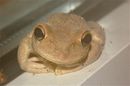
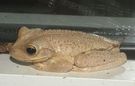
On average, Osteopilus septentrionalis is 2.5 to 12 cm long. Its size is a distinguishing feature as one of the largest of the treefrog species found in Florida. The female can be almost twice as large as the male. The Cuban treefrog has bulging eyes. This frog can be identified by its expanded pads on the end of its toes, giving it the ability to climb. Coloration varies across individuals. Most tend to be white to light brown, but can include green to dark brown, with a white, coarse abdomen. These frogs develop into froglets when the tadpoles reach a length of 1.25 to 1.91 cm. Osteopilus septentrionalis weighs 57 g, on average. ("The Cuban treefrog (Osteopilus septentrionalis) in Florida", 2013; Crump, 1986; Dorcas and Gibbons, 2008; Lannoo, 2005; McGarrity and Johnson, 2009)
- Other Physical Features
- ectothermic
- heterothermic
- bilateral symmetry
- Sexual Dimorphism
- female larger
-
- Average mass
- 57 g
- 2.01 oz
-
- Range length
- 2.5 to 12 cm
- 0.98 to 4.72 in
Development
Once a female Cuban treefrog lays a clutch of eggs, the eggs float on the surface of the water and will only survive in temperatures above 27° Celsius. The eggs hatch quickly, within a day. In the presence of temperatures above 35° Celsius a tadpole will undergo metamorphosis relatively quickly, in 3 weeks. However, with cooler temperatures metamorphosis typically takes up to a month. The tadpole is round-bodied with dorsal darker colors and lighter colors on the ventral side. It can be identified by a transparent pointed tail fin with spots and a brown tint. Dorcas and Gibbons (2008) report that the tadpole develops into a froglet when it reaches a length of 1.27 to 1.91 cm. The female Cuban treefrog grows quicker yet matures later than the male. No exact growth rates have been reported. More data are needed to evaluate the accuracy of the relationship between growth and maturation. Growth is indeterminate. (Dorcas and Gibbons, 2008; Lannoo, 2005)
- Development - Life Cycle
- metamorphosis
- indeterminate growth
Reproduction
Males and females are polygynandrous which means males and females have multiple mates. The mating ritual of this treefrog involves a large chorus call by the male to attract the female. Beyond this chorus, breeding is random. (Lannoo, 2005)
- Mating System
- polygynandrous (promiscuous)
The most suitable habitat for breeding for the Cuban treefrog is a warm, humid area. After heavy rainstorms during the wet season in the Everglades, large populations of adults move to breeding sites and the male attracts the female through chorus calls. Breeding is typically random. The male Cuban treefrog reaches sexual maturity at 120 days, on average. The female treefrog reaches sexual maturity at 255 days, on average.
In the Cuban treefrog's native habitat of Cuba and in Florida, breeding in aquatic environments occurs throughout the year, with peaks during the wet season from May to October. This frog is oviparous with external fertilization by the male. The female Cuban treefrog lays over 3,000 eggs, laying them 75 to 1,000 at a time. As female body size increases, female fecundity increases. The eggs float on the surface of the water and will only survive in the presence of adequate ambient temperatures above 27° Celsius. The eggs hatch quickly, within 24 to 32 hours. In water temperatures above 35° Celsius, tadpoles will undergo metamorphosis relatively quickly, in 3 weeks. However with temperatures below 29° Celsius, metamorphosis typically takes a month. There is no parental care and this treefrog is immediately independent. (AnAge, 2014; Dorcas and Gibbons, 2008; Lannoo, 2005; McGarrity and Johnson, 2009; Salinas, 2006)
- Key Reproductive Features
- iteroparous
- year-round breeding
- gonochoric/gonochoristic/dioecious (sexes separate)
- sexual
- fertilization
- oviparous
-
- Breeding interval
- The Cuban treefrog breeds throughout the year, with peaks from May to October.
-
- Breeding season
- Breeding occurs from May to October.
-
- Range time to hatching
- 24 to 32 hours
-
- Average time to independence
- 0 minutes
-
- Average age at sexual or reproductive maturity (female)
- 255 days
-
- Average age at sexual or reproductive maturity (male)
- 120 days
The male Cuban treefrog does not exhibit parental care or defensive nature of territories. The female treefrog does not invest in offspring beyond egg-laying. (Dorcas and Gibbons, 2008; McGarrity and Johnson, 2009; Salinas, 2006)
- Parental Investment
- no parental involvement
- female parental care
-
pre-fertilization
- provisioning
-
pre-hatching/birth
-
provisioning
- female
-
provisioning
Lifespan/Longevity
The Cuban treefrog can live up to 12.9 years in captivity. This species has an approximate lifespan of 5 to 10 years in the wild. ("The Cuban treefrog (Osteopilus septentrionalis) in Florida", 2013; AnAge, 2014; Mattison, 2011; Salinas, 2006)
-
- Range lifespan
Status: wild - 5 to 10 years
- Range lifespan
-
- Average lifespan
Status: captivity - 12.9 years
- Average lifespan
-
- Average lifespan
Status: captivity - 12.9 years
- AnAge
- Average lifespan
Behavior
The Cuban treefrog is generally nocturnal, being most active from dusk to dawn. When temperatures are below 9.5° Celsius, the Cuban treefrog goes into a state of torpor. The Cuban treefrog is generally a terrestrial species, but migrates en masse to breeding sites following heavy rainstorms.
Mating behaviors are fairly generic. The male Cuban treefrog attracts the female through large chorus mating calls. The female Cuban treefrog non-selectively mates with a male and the male fertilizes eggs from any female.
This frog is saltatorial and motile. The Cuban treefrog is an ambush predator. When captured by a predator, the Cuban treefrog will inflate its body and release defensive compounds that are toxic to humans and other mammalian predators. (Dorcas and Gibbons, 2008; Lannoo, 2005)
- Key Behaviors
- saltatorial
- nocturnal
- motile
- sedentary
- hibernation
Home Range
Home range has not been reported for this species. However, when McGarrity and Johnson (2010) moved treefrog individuals 200m away from their original location, movements measured per day averaged just 9 and 21 m when moved to a field and a forest, respectively. They do not appear to be territorial. (McGarrity and Johnson, 2010)
Communication and Perception
During breeding season, males attract females with a large chorus call, a combination of a "quahh" (Dorcas and Gibbons 2008) and a croak. Cuban treefrogs have a distinct call that sounds similar to that of a southern leopard frog Lithobates sphenocephalus. Adult treefrogs have skin with defensive compounds that are extremely toxic to humans and other mammalian predators. When this treefrog is taken by a predator, a loud distress call is emitted and the body inflates. This may attract other animals to distract the predator. Limited research is available on visual function in the family Hylidae. It is known that amphibians have two photoreceptor rod classes, green rods and red rods, allowing for color vision and vision at low light levels. (Dorcas and Gibbons, 2008; King, et al., 1993)
- Other Communication Modes
- choruses
- pheromones
- vibrations
Food Habits
The Cuban treefrog is a generalist feeder, with invertebrates making up the majority of prey consumed. Prey include beetles and roaches and vertebrates, such as other frogs: southern leopard frogs (Lithobates sphenocephalus) and eastern narrow-mouthed toads (Gastrophryne carolinensis) and lizards: brown anoles (Anolis sagrei). Osteopilus septentrionalis is known to feed on tropical house geckos (Hemidactylus mabouia) and Florida brown snakes (Storeria dekayi victa). This frog species is an ambush predator. As a tadpole, it primarily feeds on algae, but is known to engage in cannibalism. (Dorcas and Gibbons, 2008; Glorioso, et al., 2010)
- Primary Diet
-
carnivore
- eats terrestrial vertebrates
- insectivore
-
herbivore
- algivore
- Animal Foods
- amphibians
- reptiles
- insects
- Plant Foods
- algae
Predation
Rat snakes (Pantherophis), eastern garter snakes (Thamnophis sirtalis), ribbon snakes (Thamnophis sauritus), black racers (Coluber constrictor), American crows (Corvus brachyrhynchos), Cuban knight anoles (Anolis equestris), and humans (Homo sapiens) are known predators of Cuban treefrogs. Tadpoles and juveniles are preyed upon at breeding sites by American crows. When captured, the Cuban treefrog will inflate its body and release defensive compounds that are toxic to mammalian predators. Cannibalism by young tadpoles of this species has been observed. (Dorcas and Gibbons, 2008)
-
- Known Predators
-
- rat snakes (Pantherophis)
- eastern garter snakes (Thamnophis sirtalis)
- ribbon snakes (Thamnophis sauritus)
- black racers (Coluber constrictor)
- American crows (Corvus brachyrhynchos)
- Cuban knight anoles (Anolis equestris)
- humans (Homo sapiens)
- Cuban treefrog (Osteopilus septentrionalis)
Ecosystem Roles
The Cuban treefrog negatively impacts ecosystems and native species in Florida because it is a known predator of native treefrogs in Florida, colonizing and taking over natural areas populated by native species. The Cuban treefrog, specifically in Tampa, Florida, is susceptible to various parasites whether introduced or acquired, including nematodes (Oswaldocruzie lenteixeirai, Aplectana species, Physaloptera species, and Rhabdias species), trematodes (Digenean metacercaria) and cestodes Cylindrotaenia americana). Aplectana species are most prevalent in the Cuban treefrog species found in Tampa, Florida. In its native range in Cuba, reported parasites include nematodes (Parapharyngodon osteopilli) and trematodes (Mesocoelium crossophorum), which infect the small intestines and stomach of the treefrog. ("The Cuban treefrog (Osteopilus septentrionalis) in Florida", 2013; Ortega, et al., 2015)
- nematodes (Oswaldocruzie lenteixeirai)
- nematodes (Aplectana species)
- nematodes (Rhabdias species)
- nematodes (Physaloptera species)
- trematodes (Digenean metacercaria)
- cestodes (Cylindrotaenia americana)
- nematodes (Parapharyngodon osteopilli)
- trematodes (Mesocoelium crossophorum)
Economic Importance for Humans: Positive
This frog species has no positive economic importance for humans.
Economic Importance for Humans: Negative
The Cuban treefrog is poisonous and releases a skin mucous that is toxic and a potential health hazard to humans. The Cuban treefrog is a household pest that negatively impacts humans by entering homes through plumbing systems, clogging toilets and sink drains. This frog species is also known to invade bird nesting boxes, which can be a troublesome for wildlife enthusiasts. (Maclean, 1989)
- Negative Impacts
- injures humans
- household pest
Conservation Status
The Cuban treefrog is listed by the IUCN as "Least Concern." In southern Florida and along the coastline, the Cuban treefrog is a predator and competitor to native frog species which has led to anti-conservation efforts to protect native species. Blaustein et al. (2010) reports that various climate change predictions show the possibility of further expansion of the Cuban treefrog in North America. This frog is not given any special conservation status on the US Federal List or CITES. (Blaustein, et al., 2010; Dorcas and Gibbons, 2008; Maskell, et al., 2003)
-
- IUCN Red List
-
Least Concern
More information
-
- IUCN Red List
-
Least Concern
More information
-
- US Federal List
- No special status
-
- CITES
- No special status
Contributors
Marisa Dameron (author), Radford University, Cari Mcgregor (editor), Radford University, Zeb Pike (editor), Radford University, Karen Powers (editor), Radford University, April Tingle (editor), Radford University, Jacob Vaught (editor), Radford University, Tanya Dewey (editor), University of Michigan-Ann Arbor.
Glossary
- Nearctic
-
living in the Nearctic biogeographic province, the northern part of the New World. This includes Greenland, the Canadian Arctic islands, and all of the North American as far south as the highlands of central Mexico.

- acoustic
-
uses sound to communicate
- bilateral symmetry
-
having body symmetry such that the animal can be divided in one plane into two mirror-image halves. Animals with bilateral symmetry have dorsal and ventral sides, as well as anterior and posterior ends. Synapomorphy of the Bilateria.
- carnivore
-
an animal that mainly eats meat
- chemical
-
uses smells or other chemicals to communicate
- choruses
-
to jointly display, usually with sounds, at the same time as two or more other individuals of the same or different species
- coastal
-
the nearshore aquatic habitats near a coast, or shoreline.
- ectothermic
-
animals which must use heat acquired from the environment and behavioral adaptations to regulate body temperature
- external fertilization
-
fertilization takes place outside the female's body
- female parental care
-
parental care is carried out by females
- fertilization
-
union of egg and spermatozoan
- forest
-
forest biomes are dominated by trees, otherwise forest biomes can vary widely in amount of precipitation and seasonality.
- freshwater
-
mainly lives in water that is not salty.
- herbivore
-
An animal that eats mainly plants or parts of plants.
- heterothermic
-
having a body temperature that fluctuates with that of the immediate environment; having no mechanism or a poorly developed mechanism for regulating internal body temperature.
- hibernation
-
the state that some animals enter during winter in which normal physiological processes are significantly reduced, thus lowering the animal's energy requirements. The act or condition of passing winter in a torpid or resting state, typically involving the abandonment of homoiothermy in mammals.
- indeterminate growth
-
Animals with indeterminate growth continue to grow throughout their lives.
- insectivore
-
An animal that eats mainly insects or spiders.
- introduced
-
referring to animal species that have been transported to and established populations in regions outside of their natural range, usually through human action.
- iteroparous
-
offspring are produced in more than one group (litters, clutches, etc.) and across multiple seasons (or other periods hospitable to reproduction). Iteroparous animals must, by definition, survive over multiple seasons (or periodic condition changes).
- metamorphosis
-
A large change in the shape or structure of an animal that happens as the animal grows. In insects, "incomplete metamorphosis" is when young animals are similar to adults and change gradually into the adult form, and "complete metamorphosis" is when there is a profound change between larval and adult forms. Butterflies have complete metamorphosis, grasshoppers have incomplete metamorphosis.
- motile
-
having the capacity to move from one place to another.
- mountains
-
This terrestrial biome includes summits of high mountains, either without vegetation or covered by low, tundra-like vegetation.
- native range
-
the area in which the animal is naturally found, the region in which it is endemic.
- nocturnal
-
active during the night
- oviparous
-
reproduction in which eggs are released by the female; development of offspring occurs outside the mother's body.
- pheromones
-
chemicals released into air or water that are detected by and responded to by other animals of the same species
- poisonous
-
an animal which has a substance capable of killing, injuring, or impairing other animals through its chemical action (for example, the skin of poison dart frogs).
- polygynandrous
-
the kind of polygamy in which a female pairs with several males, each of which also pairs with several different females.
- saltatorial
-
specialized for leaping or bounding locomotion; jumps or hops.
- sedentary
-
remains in the same area
- sexual
-
reproduction that includes combining the genetic contribution of two individuals, a male and a female
- suburban
-
living in residential areas on the outskirts of large cities or towns.
- tactile
-
uses touch to communicate
- terrestrial
-
Living on the ground.
- tropical
-
the region of the earth that surrounds the equator, from 23.5 degrees north to 23.5 degrees south.
- urban
-
living in cities and large towns, landscapes dominated by human structures and activity.
- vibrations
-
movements of a hard surface that are produced by animals as signals to others
- visual
-
uses sight to communicate
- year-round breeding
-
breeding takes place throughout the year
References
UF/IFAS Extension. The Cuban treefrog (Osteopilus septentrionalis) in Florida. WEC218. Gainesville, FL: UF/IFAS Extension. 2013. Accessed February 04, 2016 at http://edis.ifas.ufl.edu/pdffiles/UW/UW25900.pdf.
AnAge, 2014. "Osteopilus septentrionalis" (On-line). AnAge: The Animal Ageing and Longevity Database. Accessed April 11, 2016 at http://genomics.senescence.info/species/entry.php?species=Osteopilus_septentrionalis.
Babbitt, K., W. Meshaka Jr. 2000. Benefits of eating conspecifics: Effects of background diet on survival and metamorphosis in the Cuban treefrog (Osteopilus septentrionalis). Copeia, 2000/2: 469-474.
Blaustein, A., S. Walls, B. Bancroft, J. Lawler, C. Searle. 2010. Direct and indirect effects of climate change on amphibian populations. Diversity, 2/2: 281-313.
Crump, M. 1986. Cannibalism by younger tadpoles: Another hazard of metamorphosis. Copeia, 1986/4: 1007-1009.
Dorcas, M., W. Gibbons. 2008. Frogs & Toads of the Southeast. Athens, GA: University of Georgia Press.
Glorioso, B., J. Waddle, M. Crockett, K. Rice, H. Percival. 2010. Diet of the invasive Cuban treefrog (Osteopilus septentrionalis) in pine rockland and mangrove habitats in south Florida. Caribbean Journal of Science, 46/2-3: 346-355.
Hedges, B., L. Díaz, B. Ibéné, R. Joglar, R. Powell. 2010. "Osteopilus septentrionalis" (On-line). The IUCN Red List of Threatened Species. Accessed February 04, 2016 at http://www.iucnredlist.org/details/55811/0.
King, R., J. Douglass, J. Phillips, C. Baube. 1993. Scotopic spectral sensitivity of the optomotor response in the green treefrog Hyla cinerea. Journal of Experimental Zoology, 267/1: 40-46.
Lannoo, M. 2005. Amphibian Declines: The Conservation Status of United States Species. Los Angeles, CA: University of California Press.
Maclean, W. 1989. Reptiles and Amphibians of the Virgin Islands. London: Macmillan Caribbean.
Maskell, A., J. Waddle, K. Rice. 2003. Osteopilus septentrionalis (Cuban treefrog) diet. Herpetological Review, 34/2: 137.
Mattison, C. 2011. Frogs and Toads of the World. New York: Princeton University Press.
McGarrity, M., S. Johnson. 2009. Geographic trend in sexual size dimporphism and body size of Osteopilus septentrionalis (Cuban treefrog): Implications for invasion of the southeastern United States. Biological Invasions, 11/6: 1411-1420.
McGarrity, M., S. Johnson. 2010. A radio telemetry study of invasive cuban treefrogs. Florida Scientist, 73/3: 225-235.
Meshaka Jr, W. 1996. Retreat use by the Cuban treefrog (Osteopilus septentrionalis): Implications for successful colonization in Florida. Journal of Herpetology, 30/3: 443-445.
Meshka Jr, W., B. Ferster. 1995. Two species of snakes prey on Cuban treefrogs in southern Florida. Florida Field Naturalist, 23/4: 97-98.
Ortega, N., W. Price, T. Campbell, J. Rohr. 2015. Acquired and introduced macroparasites of the invasive Cuban treefrog, Osteopilus septentrionalis. International Journal for Parasitology, 4/3: 379-384.
Punzo, F., S. Law. 2006. Effects of nitrate-related compounds on growth, survival, and hematological responses in tadpoles of the Cuban treefrog, Osteopilus septentrionalis (Boulenger). Journal of Environmental Biology, 27/2: 187-190.
Rodder, D., F. Weinsheimer. 2009. Will future anthropogenic climate change increase the potential distribution of the alien invasive Cuban treefrog (Anura:Hylidae)?. Journal of Natural History, 43/19-20: 1207-1217.
Salinas, F. 2006. Breeding behavior and colonization success of the Cuban treefrog Osteopilus septentrionalis. Herpetologica, 62/4: 398-408.
Wyatt, J., E. Forys. 2004. Conservation implications of predation by Cuban treefrogs (Osteopilus septentrionalis) on native hylids in Florida. Southeastern Nationalist, 3/4: 695-700.