Orconectes rusticusrusty crayfish


Geographic Range
The rusty crayfish is an invader species in northern lakes and streams of the Great Lakes region. Native to the Ohio River Basin and Ohio, Kentucky, Tennessee, Indiana, and Illinois, they have expanded their range to Michigan, Minnesota, Wisconsin, Missouri, Iowa, Pennsylvania, New York, New Jersey, New England (except Rhode Island), and parts of Ontario, Canada. (Gunderson, 1995)
- Biogeographic Regions
- nearctic
Habitat
This crayfish inhabits permanent streams, lakes and ponds that have rocky substrate and logs or debris as cover. They will inhabit pools of still water or fast-flowing streams. (Crandall and Fetzner, 2003; Gunderson, 1995)
- Habitat Regions
- freshwater
Physical Description
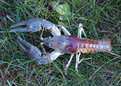
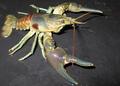
Rusty crayfish have robust claws unlike other members of the genus Orconectes. They are dark reddish, brown and have dark, rusty spots on each side of the carapace at the base of the cephalothorax. (Gunderson, 1995)
- Other Physical Features
- ectothermic
- heterothermic
- bilateral symmetry
-
- Range length
- 10.2 (high) cm
- 4.02 (high) in
Development
Depending on the water temperature, rusty crayfish eggs hatch in 3 to 6 weeks. Young crayfish will undergo 3 to 4 molts while attached to the mother's swimmerets and remain with the mother for several weeks. Once the young have left, they undergo 8 to 10 molts before becoming mature. Maturity usually occurs the following year. Maturity is considered to be at a length of 4.4 cm. After mature, adult males will molt twice annually, and adult females will molt once annually. (Gunderson, 1995)
Reproduction
Rusty crayfish mate in late summer, early fall or early spring. Males transfer sperm to the females, but external fertilization does not occur until the water temperature increases. The expelled eggs are fertilized by the sperm and are attached to the swimmerets underneath the crayfish's abdomen with white patches. These white patches are called glair, and and the eggs adhere to this mucus-like substance. From 80 to 575 eggs are laid. (Gunderson, 1995)
- Key Reproductive Features
- fertilization
- delayed fertilization
Lifespan/Longevity
The rusty crayfish typically lives to be 3 to 4 years old. (Gunderson, 1995)
Behavior
The rusty crayfish does not excavate deep burrows. They may dig shallow pockets under rocks or debris. The rusty crayfish are aggressive and will force native crayfish from daytime hiding areas. When threatened, they assume a "claws-up" posture to prevent fish predation.
In addition, their aggression occurs with discrete postures that lead to fighting. When one rusty crayfish comes in contact with another, the meral spread is the first threat display posture to occur. Next, wrestling occurs, but claw use is restrained as the rusty crayfish partake in this phase of an aggressive encounter over a period of time. Finally, unrestrained use of the claws occurs during a brief period of time. (Gunderson, 1995; Huber, 1999)
- Key Behaviors
- motile
- territorial
- dominance hierarchies
Communication and Perception
During encounters, rusty crayfish respond to each other depending on the presence of urine. The stronger the odor, which serves as a chemical cue, the shorter in duration and the lesser the aggression during a first agonistic interaction. In addition, urine serves as a recognition cue in that a rusty crayfish that won a first fight over an opponent will recognize that opponent and display dominance during a second aggressive encounter, but the second encounter will be shorter in duration. (Zulandt-Schneider, et al., 2001)
- Communication Channels
- chemical
Food Habits
The rusty crayfish is a voracious feeder because of its high metabolic rate. Juvenilles feed on benthic invertebrates and fish eggs.
Foods eaten include: aquatic plants, snails, clams, leeches, aquatic insects, other aquatic crustaceans and fish eggs. (Gunderson, 1995)
Predation
Rusty crayfish will used their hooked claws in a defensive posture to protect themselves from fish predators. (Gunderson, 1995)
-
- Known Predators
-
- fish
Ecosystem Roles
Because of its aggressive nature, the rusty crayfish is replacing native Great Lakes crayfish such as Orconectes propinquus. Many organisms live on the exoskeleton and other organisms are internally parasitic in crayfish. (Crocker and Barr, 1968; Gunderson, 1995)
- ostracods
- branchiobdellids
Economic Importance for Humans: Positive
Among agencies concerned about ecosystem management in the Great Lakes region, there is a debate about using rusty crayfish to control Eurasian watermilfoil, an invasive aquatic plant. (Gunderson, 1995)
Economic Importance for Humans: Negative
These crayfish have displaced native species. They may affect the fisheries industry since they feed heavily on aquatic plants that are important habitat for other invertebrates (foodstuffs for fish), shelter for fish, nesting substrate for fish, and aid in erosion control. (Gunderson, 1995)
Conservation Status
This species is not afforded any special conservation status.
-
- IUCN Red List
-
Least Concern
More information
-
- IUCN Red List
-
Least Concern
More information
-
- US Federal List
- No special status
-
- CITES
- No special status
-
- State of Michigan List
- No special status
Other Comments
Initially, the rusty crayfish was introduced to the northern part of the Great Lakes region by fishermen who used them as bait. As the population of rusty crayfish increased, they were harvested for use as fish bait and sold to biological supply companies. This provided impetus to breeding rusty crayfish, and subsequently, releasing them, intentionally or otherwise, into non-native waters.
There is also concern about hybridization of this species with the native northern clearwater crayfish, Orconectes propinquus.
Another common name for crayfish is crawfish or crawdad. (Gunderson, 1995; Lodge and Feder, 2001)
Contributors
Renee Sherman Mulcrone (editor).
Janice Pappas (author), University of Michigan-Ann Arbor.
Glossary
- Nearctic
-
living in the Nearctic biogeographic province, the northern part of the New World. This includes Greenland, the Canadian Arctic islands, and all of the North American as far south as the highlands of central Mexico.

- bilateral symmetry
-
having body symmetry such that the animal can be divided in one plane into two mirror-image halves. Animals with bilateral symmetry have dorsal and ventral sides, as well as anterior and posterior ends. Synapomorphy of the Bilateria.
- chemical
-
uses smells or other chemicals to communicate
- delayed fertilization
-
a substantial delay (longer than the minimum time required for sperm to travel to the egg) takes place between copulation and fertilization, used to describe female sperm storage.
- dominance hierarchies
-
ranking system or pecking order among members of a long-term social group, where dominance status affects access to resources or mates
- ectothermic
-
animals which must use heat acquired from the environment and behavioral adaptations to regulate body temperature
- external fertilization
-
fertilization takes place outside the female's body
- fertilization
-
union of egg and spermatozoan
- freshwater
-
mainly lives in water that is not salty.
- heterothermic
-
having a body temperature that fluctuates with that of the immediate environment; having no mechanism or a poorly developed mechanism for regulating internal body temperature.
- introduced
-
referring to animal species that have been transported to and established populations in regions outside of their natural range, usually through human action.
- motile
-
having the capacity to move from one place to another.
- native range
-
the area in which the animal is naturally found, the region in which it is endemic.
- territorial
-
defends an area within the home range, occupied by a single animals or group of animals of the same species and held through overt defense, display, or advertisement
References
Crandall, K., J. Fetzner. 2003. "Orconectes (Procericambarus) rusticus" (On-line). The Crayfish Home Page. Accessed October 02, 2003 at http://crayfish.byu.edu/astacidea/cambaridae/orconectes/procericambarus/orconectes_rusticus.html.
Crocker, D., D. Barr. 1968. Handbook of the Crayfishes of Ontario. Life Sciences Miscellaneous Publications, Royal Ontario Museum. University of Toronto Press: Toronto.
Gunderson, J. 1995. "Minnesota Sea Grant/rusty crayfish factsheet" (On-line). Accessed January 23, 2002 at http://www.seagrant.umn.edu/exotics/rusty.html.
Huber, R. 1999. "Lab Exercise 3-Agonistic Behavior in Crayfish, Animal Behavior-Biology 420/543, Bowling Green State University, Fall 2001" (On-line). Accessed January 24, 2002 at http://caspar.bgsu.edu/~courses/Ethology/Labs/CrayfishAgon/.
Lodge, D., J. Feder. 2001. "Illinois-Indiana Sea Grant College Program" (On-line). Dispersal of Exotic Species in the Great Lakes:Crayfish as a Model System for Benthic Species. Accessed July 19, 2004 at http://iisgcp.org/research/projects/biolresc/res0598.htm.
Zulandt-Schneider, R., R. Huber, P. Moore. 2001. Individual and status recognition in the crayfish, Orconectes rusticus: the effects of urine release on fight dynamics. Behaviour, 138: 137-153.