Opheodrys vernalisSmooth Green Snake

Geographic Range
Smooth green snakes (Opheodrys vernalis) live in the northeastern and Midwestern United States, as well as southern Canada, including southern Quebec, Ontario, Manitoba, as far west as Saskatchewan. The largest continuous portion of their range stretches from Maine westward to North Dakota, with disjunct populations in the Midwestern United States. There are populations as far south as the southern coast of Texas. Their geographic range also includes North Carolina, Kansas, Iowa, Illinois, Tennessee, Missouri, Mississippi, and western Virginia. (Gilbart, 2012; Grobman, 1992; Mitchell, 1974; Stuart, et al., 2014)
Habitat
Smooth green snakes are found in grassy, open areas, such as meadows, bogs, and open woods. The areas they inhabit typically include wetlands or open water. Smooth green snakes are primarily terrestrial, but they may also hang in low branches. During the day, they can be found basking on boulders or logs. (Gilbart, 2012; Grobman, 1941; Grobman, 1992; Mitchell, 1974; Mitchell, 2006; Stuart, et al., 2014)
- Habitat Regions
- temperate
- terrestrial
- Terrestrial Biomes
- savanna or grassland
- forest
- scrub forest
- Aquatic Biomes
- lakes and ponds
Physical Description
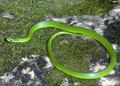
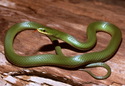
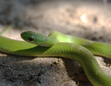
Smooth green snakes have smooth, bright green dorsal scales and white or yellow ventral scales. Their coloration helps them camouflage in grass or on low branches. Their dorsal scales are arranged in 15 rows with apical pits close to the center of each scale. Juveniles measure 8.3 to 16.5 cm upon hatching. Their coloring is duller than adults and tends to range from olive-green to bluish grey.
Adult smooth green snakes measure 30 to 50 cm and weigh 15.3 to 19.5 g. Their tails make up nearly half of their total body length. Their vertebral scales range in width from 0.50 to 0.71 mm, with an average of 0.62 mm. Smooth green snakes have heads ranging from 0.74 to 0.83 mm in width.
Smooth green snakes exhibit subtle sexual dimorphism. Females tend to be wider than males and males have longer, more slender tails. (Gray, 2005; Grobman, 1941; Grobman, 1992; Mitchell, 1974; Mitchell, 2006; Stuart, et al., 2014)
- Other Physical Features
- ectothermic
- Sexual Dimorphism
- female larger
- sexes shaped differently
-
- Range mass
- 15.3 to 19.5 g
- 0.54 to 0.69 oz
-
- Average mass
- 17 g
- 0.60 oz
-
- Range length
- 30 to 66 cm
- 11.81 to 25.98 in
-
- Average length
- 50 cm
- 19.69 in
Development
Smooth green snakes hatch from eggs, which incubate for up to 30 days and hatch in late April to September. Hatchlings are 8 to 16 cm long and weigh 1.1 g at birth.
Juvenile smooth green snakes are not as brightly colored as adults and are around half the length. Juveniles are grayish brown in color, which helps them camouflage with their environment. Adults reach 30 to 66 cm in length and reach sexual maturity at around 2 years old. Smooth green snakes shed their scales as they grow, gradually developing their adult coloration with each shed. They exhibit indeterminate growth, meaning they do not stop growing throughout their lifespans.
Smooth green snakes exhibit temperature-dependent sex determination. For eggs that develop at temperatures above 28 °C, hatchlings are more likely to be female. For eggs that develop below 28 °C, hatchlings are more likely to be males. Initial incubation temperature is an important determinant of sex. For example, if the initial incubation temperature is below 28 °C and changes to a higher temperature later during incubation, the resulting hatchlings will be males. Typically, all of the hatchlings from a single clutch of eggs will be one sex. Clutches of eggs typically fail when temperatures vary more than 10 °C above or below 28 °C. (Aldridge and Semlitsch, 1992; Mitchell, 1974; Plummer, 1985a; Plummer, 1985b; Sacerdote-Velat, et al., 2013)
- Development - Life Cycle
- temperature sex determination
- indeterminate growth
Reproduction
Smooth green snakes are polygynandrous. Females release pheromones to signal their sexual maturity. Males detect the pheromones that females release and congregate in large numbers to mate. Males crawl over and bump into females before mating. When females are ready to mate, they lift their tail and expose their cloaca. During copulation, males insert their hemipenes into the cloaca of their mate and release sperm. (Grobman, 1992; Naulleau and Bonnet, 1995; Plummer, 1985a; Shine, 2003)
- Mating System
- polygynandrous (promiscuous)
Smooth green snakes reproduce sexually. They breed once a year, and females gestate eggs for an average of 50 days, laying them between June and September. Smooth green snakes lay 3 to 13 eggs per clutch, and eggs incubate for 4 to 30 days, depending on the temperature, with an average of 27 days. Higher incubation temperatures result in shorter incubation periods before eggs hatch.
Female smooth green snakes lay their eggs in warm, protected sites, such as mounds or burrows with rotting vegetation, or underneath fallen logs. Smooth green snakes are secondary cavity nesters, choosing existing burrows that have been vacated rather than constructing their own.
Both male and female smooth green snakes reach reproductive maturity at around two years old. (Aldridge and Semlitsch, 1992; Grobman, 1992; Naulleau and Bonnet, 1995; Plummer, 1985a; Seigel and Collins, 2001)
- Key Reproductive Features
- iteroparous
- seasonal breeding
- sexual
- oviparous
-
- Breeding interval
- Smooth green snakes breed once each year
-
- Breeding season
- Females lay eggs from June to September, young hatch in August or September
-
- Range number of offspring
- 3 to 13
-
- Average gestation period
- 50 days
-
- Average time to independence
- 0 minutes
-
- Average age at sexual or reproductive maturity (female)
- 2 years
-
- Average age at sexual or reproductive maturity (male)
- 2 years
Smooth green snakes exhibit limited parental investment. Young are immediately independent upon hatching. Females lay their eggs in communal nesting sites, typically in areas that are protected and encourage egg development. Males exhibit no parental investment beyond the act of mating. (Aldridge and Semlitsch, 1992; Grobman, 1992; Naulleau and Bonnet, 1995; Plummer, 1985a; Sacerdote-Velat, et al., 2013; Shine, 2003)
- Parental Investment
-
pre-hatching/birth
-
provisioning
- female
-
protecting
- female
-
provisioning
Lifespan/Longevity
Smooth green snakes live an average of 5 years in the wild, with a maximum recorded lifespan of 8 years. In captivity, smooth green snakes live 6 years on average. Mortality in the wild is most often attributed to predation or environmental factors such as flooding. (Plummer, 1985a; Plummer, 1985b; Plummer, 1997a; Plummer, 1997b; Sacerdote-Velat, et al., 2013)
-
- Range lifespan
Status: wild - 8 (high) years
- Range lifespan
-
- Range lifespan
Status: captivity - 6 (high) years
- Range lifespan
-
- Average lifespan
Status: wild - 5 years
- Average lifespan
-
- Typical lifespan
Status: captivity - 6 (high) years
- Typical lifespan
Behavior
Smooth green snakes are mostly solitary, although large groups form during breeding and nesting season and during winter, when individuals brumate together. Smooth green snakes stay in the same general area throughout their life, but move around to find prey, mates, and shelter.
Smooth green snakes are diurnal and active from April to October. They are secondary cavity nesters, meaning they take shelter in abandoned mounds or burrows created by other animals such as rodents.
Smooth green snakes are docile. In captivity, they are not aggressive to other animals that do not threaten them. However, when provoked, smooth green snakes often release a foul-smelling substance from their anal glands, which can deter potential predators.
Smooth green snakes mate between late April and September. They are promiscuous, meaning that males and females both have multiple mates within a single breeding period. (Grobman, 1992; Plummer, 1997a; Plummer, 1997b)
Home Range
Smooth green snakes have an average home range of 25 km^2. They are not known to actively defend a territory.
Communication and Perception
Smooth green snakes have forked tongues, which they use to detect chemical signals in their environment. Smooth green snakes rely on their vomeronasal system, which directs chemicals from their tongue and nose to their Jacobson’s organ. Jacobson’s organs help smooth green snakes determine the directionality of chemical signals, which allows them to effectively track prey, find mates, and avoid predators.
Smooth green snakes also use tactile and acoustic methods of communicating and perceiving their environment. (Filoramo and Schwenk, 2009; Grobman, 1941; Mitchell, 1974; Seigel and Collins, 2001; Shine, 2003; Stuart, et al., 2014)
- Other Communication Modes
- pheromones
- Perception Channels
- visual
- vibrations
- chemical
Food Habits
Smooth green snakes are opportunistic predators. Around 85% of their diet consists of insects, such as ants (family Formicidae), moths (order Lepidoptera), centipedes (class Chilopoda), spiders (order Araneae), slugs (class Gastropoda), and terrestrial worms (phylum Annelida). Smooth green snakes use their vomeronasal systems to detect chemicals released by prey species. (Mitchell, 1974)
- Primary Diet
-
carnivore
- insectivore
- eats non-insect arthropods
- vermivore
- Animal Foods
- insects
- terrestrial non-insect arthropods
- mollusks
- terrestrial worms
Predation
Smooth green snakes serve as prey for a variety of mammalian, avian, and reptilian predators. Known mammalian predators include humans (Homo sapiens), black bears (Ursus americanus), raccoons (Procyon lotor), red foxes (Vulpes vulpes), and domestic cats (Felis domesticus). Avian predators include red-tailed hawks (Buteo jamaicensis), great blue herons (Ardea herodias), rough-legged hawks (Buteo lagopus). Larger snakes, such as milk snakes (Lampropeltis triangulum), are also known predators of smooth green snakes.
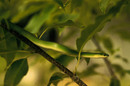
Smooth green snakes have bright green dorsal scales, which help them camouflage in the grassland and forest habitats where they typically live. Smooth green snakes are also small and fast, making them difficult to catch if detected. (Aldridge, et al., 1990)
- Anti-predator Adaptations
- cryptic
-
- Known Predators
-
- Humans (Homo sapeans)
- Red-tailed hawks (Buteo jamaicensis)
- Great blue herons (Ardea herodias)
- Rough-legged hawks (Buteo lagopus)
- Black bears (Ursus americanus)
- Raccoons (Procyon lotor)
- Red foxes (Vulpes vulpes)
- Domestic cats (Felis catus)
- Milk snakes (Lampropeltis triangulum)
Ecosystem Roles
Smooth green snakes serve as prey for mammals, birds, and other snake species. They also serve as hosts for parasitic tapeworms (class Cestoda), parasitic nematodes (genus Baylisascaris), and red mites (Dermanyssus gallinae). (Aldridge, et al., 1990; Grobman, 1941; Grobman, 1992; Mitchell, 2006; Redder, et al., 2006)
- Red mites (Dermanyssus gallinae)
- Tapeworms (order Cestoda)
- Parasitic nematodes (genus Baylisascaris)
Economic Importance for Humans: Positive
Smooth green snakes are a part of the international pet trade and are occasionally found in zoos. They also serve as a source of ecotourism throughout their range. (Aldridge, et al., 1990; Grobman, 1941; Redder, et al., 2006; Sacerdote-Velat, et al., 2013)
- Positive Impacts
- pet trade
- ecotourism
Economic Importance for Humans: Negative
Smooth green snakes are not venomous, but can still bite humans or pets. If left untreated, their bites can cause infections. There are no other known adverse effects of smooth green snakes on humans. (Aldridge, et al., 1990; Grobman, 1941; Redder, et al., 2006; Stuart, et al., 2014; Aldridge, et al., 1990; Grobman, 1941; Redder, et al., 2006; Stuart, et al., 2014)
- Negative Impacts
-
injures humans
- bites or stings
Conservation Status
Smooth green snakes are considered a species of "least concern" on the IUCN Red List. They have no special status on other national or international conservation lists. However, habitat loss due to anthropogenic development has negatively impacted populations of smooth green snakes. In the Rocky Mountain region, individuals are being reintroduced to habitats where deforestation is not currently a threat. (Aldridge, et al., 1990; Grobman, 1941; Redder, et al., 2006; Stuart, et al., 2014)
-
- IUCN Red List
-
Least Concern
More information
-
- IUCN Red List
-
Least Concern
More information
-
- US Federal List
- No special status
-
- CITES
- No special status
-
- State of Michigan List
- No special status
Contributors
Lauren McClaugherty (author), Radford University, Karen Powers (editor), Radford University, April Tingle (editor), Radford University, Emily Clark (editor), Radford University, Cari Mcgregor (editor), Radford University, Jacob Vaught (editor), Radford University, Galen Burrell (editor), Special Projects.
Glossary
- Nearctic
-
living in the Nearctic biogeographic province, the northern part of the New World. This includes Greenland, the Canadian Arctic islands, and all of the North American as far south as the highlands of central Mexico.

- acoustic
-
uses sound to communicate
- arboreal
-
Referring to an animal that lives in trees; tree-climbing.
- bog
-
a wetland area rich in accumulated plant material and with acidic soils surrounding a body of open water. Bogs have a flora dominated by sedges, heaths, and sphagnum.
- carnivore
-
an animal that mainly eats meat
- chemical
-
uses smells or other chemicals to communicate
- cryptic
-
having markings, coloration, shapes, or other features that cause an animal to be camouflaged in its natural environment; being difficult to see or otherwise detect.
- diurnal
-
- active during the day, 2. lasting for one day.
- ecotourism
-
humans benefit economically by promoting tourism that focuses on the appreciation of natural areas or animals. Ecotourism implies that there are existing programs that profit from the appreciation of natural areas or animals.
- ectothermic
-
animals which must use heat acquired from the environment and behavioral adaptations to regulate body temperature
- forest
-
forest biomes are dominated by trees, otherwise forest biomes can vary widely in amount of precipitation and seasonality.
- hibernation
-
the state that some animals enter during winter in which normal physiological processes are significantly reduced, thus lowering the animal's energy requirements. The act or condition of passing winter in a torpid or resting state, typically involving the abandonment of homoiothermy in mammals.
- indeterminate growth
-
Animals with indeterminate growth continue to grow throughout their lives.
- insectivore
-
An animal that eats mainly insects or spiders.
- iteroparous
-
offspring are produced in more than one group (litters, clutches, etc.) and across multiple seasons (or other periods hospitable to reproduction). Iteroparous animals must, by definition, survive over multiple seasons (or periodic condition changes).
- marsh
-
marshes are wetland areas often dominated by grasses and reeds.
- motile
-
having the capacity to move from one place to another.
- native range
-
the area in which the animal is naturally found, the region in which it is endemic.
- oviparous
-
reproduction in which eggs are released by the female; development of offspring occurs outside the mother's body.
- pet trade
-
the business of buying and selling animals for people to keep in their homes as pets.
- pheromones
-
chemicals released into air or water that are detected by and responded to by other animals of the same species
- polygynandrous
-
the kind of polygamy in which a female pairs with several males, each of which also pairs with several different females.
- scrub forest
-
scrub forests develop in areas that experience dry seasons.
- seasonal breeding
-
breeding is confined to a particular season
- sedentary
-
remains in the same area
- sexual
-
reproduction that includes combining the genetic contribution of two individuals, a male and a female
- solitary
-
lives alone
- tactile
-
uses touch to communicate
- temperate
-
that region of the Earth between 23.5 degrees North and 60 degrees North (between the Tropic of Cancer and the Arctic Circle) and between 23.5 degrees South and 60 degrees South (between the Tropic of Capricorn and the Antarctic Circle).
- terrestrial
-
Living on the ground.
- tropical savanna and grassland
-
A terrestrial biome. Savannas are grasslands with scattered individual trees that do not form a closed canopy. Extensive savannas are found in parts of subtropical and tropical Africa and South America, and in Australia.
- savanna
-
A grassland with scattered trees or scattered clumps of trees, a type of community intermediate between grassland and forest. See also Tropical savanna and grassland biome.
- temperate grassland
-
A terrestrial biome found in temperate latitudes (>23.5° N or S latitude). Vegetation is made up mostly of grasses, the height and species diversity of which depend largely on the amount of moisture available. Fire and grazing are important in the long-term maintenance of grasslands.
- vibrations
-
movements of a hard surface that are produced by animals as signals to others
- visual
-
uses sight to communicate
References
Aldridge, R., J. Greenhaw, M. Plummer. 1990. The male reproductive cycle of the rough green snake (Opheodrys aestivus). Amphibia-Reptilia, 13/3: 165-172.
Aldridge, R., R. Semlitsch. 1992. Female reproductive biology of the southeastern crowned snake (Tantilla coronata). Amphibia-Reptilia, 13/3: 209-218.
Filoramo, N., K. Schwenk. 2009. The mechanism of chemical delivery to the vomeronasal organs in squamate reptiles: A comparative morphological approach. Journal of Experimental Zoology Part B: Molecular & Developmental Evolution, 311A/1: 20.
Gilbart, M. 2012. Under Cover: Wildlife of Shrublands and Young Forest. Wildlife Management Institute: US Fish & Wildlife Publications.
Gray, B. 2005. The Serpent's Cast. Lansing, Michigan: Herpetological Publishing and Distribution.
Grobman, A. 1941. A Contribution to the Knowledge of Variation in Opheodrys vernalis (Harlan), with the Description of a New Subspecies. University of Michigan: Miscellaneous Publications.
Grobman, A. 1992. Metamerism in the snake Opheodrys vernalis, with a description of a new subspecies. Journal of Herpetology, 26/2: 175-186.
Mitchell, J. 1974. The Snakes of Virginia. University of Richmond: Virginia Wildlife.
Mitchell, J. 2006. Status of the smooth green snake (Opheodrys vernalis) in North Carolina and Virginia. Banisteria, 28: 37-43.
Naulleau, G., X. Bonnet. 1995. Reproductive ecology, body fat reserves and foraging mode in females of two contrasted snake species: Vípera aspis (terrestrial, viviparous) and Elaphe longíssima (semi-arboreal, oviparous). Amphibia-Reptilia, 16/1: 37-46.
Plummer, M. 1985. Demography of green snakes (Opheodrys aestivus). Copeia, 41/4: 373-381.
Plummer, M. 1985. Growth and maturity in green snakes (Opheodrys aestivus). Copeia, 41/1: 28-33.
Plummer, M. 1997. Population ecology of green snakes (Opheodrys aestivus) revisited. Herpetological Monographs, 11/1997: 102-123.
Plummer, M. 1997. Speed and endurance of gravid and nongravid green snakes, Opheodrys aestivus. Copeia, 41/1: 191-194.
Redder, A., B. Smith, D. Keinath. 2006. "Smooth Green Snake (Opheodrys vernalis): A Technical Conservation Assessment" (On-line pdf). Society for Conservation Biology. Accessed March 27, 2015 at http://www.fs.fed.us/r2/projects/scp/assessments/smoothgreensnake.pdf.
Sacerdote-Velat, A., J. Earnhardt, D. Mulkerin, D. Boehm, G. Glowacki. 2013. Evaluation of headstarting and release techniques for population augmentation and reintroduction of the smooth green snake. Animal Conservation, 17/1: 65-73.
Seigel, R., J. Collins. 2001. Snakes: Ecology and Behavior. Caldwell, N.J: Blackburn Press.
Shine, R. 2003. Reproductive strategies in snakes. Proceedings of the Royal Society of London B, 270/1519: 995-1004.
Stuart, B., J. Rosado, P. Brinkman. 2014. Albert Rogers Crandall's smooth green snake (Opheodrys vernalis) from North Carolina. Southeastern Naturalist, 13/4: 36-43.