Oncorhynchus nerkaKickininee(Also: Land-locked sockeye; Little redfish; Red caviar; Red salmon)

Geographic Range
Sockeye salmon, Oncorhynchus nerka, are native to the western coast of North America in the Pacific Ocean. They can be located as far north as northern Alaska and as far south as northern California. During the mating season, Sockeye salmon travel inland as far as mid-west Idaho. Populations of this species have also been introduced in some areas of Asia and Russia. (Bickham, et al., 1995; Hasegawa, et al., 2004; Quinn, 2005)
- Biogeographic Regions
- nearctic
- palearctic
- pacific ocean
- Other Geographic Terms
- holarctic
Habitat
Sockeye salmon are born in lakes, rivers, or streams, which are calmer than the Pacific Ocean. After fry, or young salmon, develop, they migrate to the Pacific Ocean where they spend most of their life. They are generally found at depths of 15 to 33 m. (Busch, 2000; Groot, 1966; Quinn, et al., 1989; Wood and Foote, 1996)
- Habitat Regions
- temperate
- polar
- saltwater or marine
- freshwater
- Aquatic Biomes
- pelagic
- lakes and ponds
- rivers and streams
- coastal
- brackish water
- Other Habitat Features
- estuarine
-
- Range depth
- 15 to 33 m
- 49.21 to 108.27 ft
Physical Description
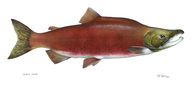
When sockeye salmon hatch, they lack pigment and thus color. As they grow into fry, they become green and can have black spots. Sockeye salmon are typically blue in color until they reach reproductive age, when they brighten in color; their bodies turn read and their heads green. Additional distinctive markings appear on the head of males and sides of females during the spawning period. When ready to reproduce, sockeye salmon weigh 1 to 4 kg and measure on average 63 cm in length. Sockeye salmon are commonly misidentified. The otolith, or inner ear, of this species is distinct in size and shape from other members of the genus g. Oncorhynchus. This, however, is not always exact as there can be overlap among species in addition to intraspecific differences. (Busch, 2000; Casteel, 1974; Quinn, 2005)
- Other Physical Features
- ectothermic
- bilateral symmetry
- Sexual Dimorphism
- male more colorful
-
- Range mass
- 1 to 4 kg
- 2.20 to 8.81 lb
-
- Average length
- 63 cm
- 24.80 in
Development
Sockeye salmon follow the developmental patterns of many pacific salmon. Eggs are externally fertilized by the male. Embryos begin as a single cell with a yolk. After this cell divides, the resulting cells differentiate into specific body type cells until the fetus is developed and ready to hatch, at which time it is called an alevin. Alevins carry the yolk on the anterior end of their body and appear to be clear because they have no pigment. As alevins develop into adults, the yolk shrinks and coloration occurs. Sex of sockeye salmon is initially difficult to determine, but is easily determined later in life by their body shape and coloration. (Quinn, 2005; Williams, 2006)
- Development - Life Cycle
- metamorphosis
- indeterminate growth
Reproduction
Sockeye salmon mate seasonally. Females lay their eggs and are then to select a mate. Males are chosen after they have come along her side and presented themselves multiple times. They are judged on their color and size. During this process, males can be attacked by females and other males. Larger dominant males reproduce more often than other males and, because sockeye salmon are polygynous, the dominant male can mate with many females. Some subordinate males may not have the opportunity to mate at all. (Busch, 2000; Foote, 1990; Quinn, 2005)
- Mating System
- polygynous
Sockeye salmon breed from July to October, although some members of this speices located in the southern-most point of their geographic range have been known to breed into December. When females arrive, they create a nest in the gravel in which they lay their eggs. After fertilization, eggs stay in the gravel nest for 32 to 42 days. Females produce 47 to as many as 206 offspring. Sockeye salmon are independent when hatched and are able to reproduce at 4 to 5 years of age. (Busch, 2000; Lichatowich, 1999; Moore, et al., 2007; Quinn, 2005)
- Key Reproductive Features
- iteroparous
- seasonal breeding
- gonochoric/gonochoristic/dioecious (sexes separate)
- sexual
- fertilization
- broadcast (group) spawning
- oviparous
-
- Breeding interval
- Sockeye salmon breed once a year.
-
- Breeding season
- Sockeye salmon generally breed from July to October.
-
- Range number of offspring
- 47 to 206
-
- Range time to hatching
- 32 to 42 days
-
- Average time to independence
- 0 years
-
- Range age at sexual or reproductive maturity (female)
- 4 to 5 years
-
- Average age at sexual or reproductive maturity (female)
- 4 to years
-
- Range age at sexual or reproductive maturity (male)
- 4 to 5 years
Mothers invest time creating gravel nests, in which eggs incubate. After fertilization, however, the newly hatched alevin have no parental investment. (Quinn, 2005; Quinn, et al., 1995)
- Parental Investment
- no parental involvement
- female parental care
-
pre-fertilization
-
protecting
- female
-
protecting
-
pre-hatching/birth
-
provisioning
- female
-
provisioning
Lifespan/Longevity
The average lifespan for sockeye salmon in the wild is 4 to 5 years. The oldest salmon caught was 8 years of age. Typically, sockeye salmon die after mating. ("Longevity, ageing and life history of Oncorhynchus nerka", 2009; Groot, 1966)
-
- Range lifespan
Status: wild - 8 (high) years
- Range lifespan
-
- Typical lifespan
Status: wild - 4 to 5 years
- Typical lifespan
Behavior
Sockeye salmon are social, and they swim in runs when migrating to freshwater streams to spawn. They also establish social hierarchies, usually at times of reproduction. Typically the largest male is most dominant. (Crutchfield and Pontecorvo, 1969; Quinn, 2005)
- Key Behaviors
- natatorial
- motile
- migratory
- social
Home Range
Sockeye salmon have no home range and do not defend a territory. (Groot, 1966; Quinn, 2005)
Communication and Perception
The eyes of sockeye salmon are located on opposite sides of their head, and they thus have a greater field of vision than animals with two eyes facing forward. The spectrum of visibility of sockeye salmon includes color, from indigo to red, as well as ultraviolet light. Members of this species have nostrils and an enhanced sense of smell. This also adds to their sense of taste. Additionally, sockeye salmon have lateral lines, which detect vibrations, allowing them to hear. (Busch, 2000; Groot, 1966)
- Perception Channels
- visual
- ultraviolet
- tactile
- vibrations
- chemical
Food Habits
While in the ocean, sockeye salmon primarily consume zooplankton. In freshwater environments, they are known to eat insects, and, when upstream, occasionally snails. (Graynoth, et al., 1986)
- Primary Diet
- planktivore
- Animal Foods
- insects
- mollusks
- zooplankton
Predation
Adult sockeye salmon are easily spotted and caught because of their size, and they are eaten by bears, including brown bears and black bears, and birds, such as the mew gull. Predators of frys (young sockeye salmon) include lake trout, squawfish, and mountain whitefish. Most predation occurs in streams and rivers. As frys, sockeye salmon can often escape predators because of their smaller size. Humans also consume a considerable about of sockeye salmon. (Groot and Margolis, 1991; Olson, et al., 1998; Quinn and Kinnison, 1999)
-
- Known Predators
-
- Brown Bear Ursus arctos
- Black Bear Ursus americanus
- Bald Eagle Haliaeetus leucocephalus
- Rainbow Trout Oncorhynchus mykiss)
- Cutthroat Trout Oncorhynchus clarkii clarkii
- Sculpins Cottus asper
- Mountain Whitefish Prosopium williamsoni
- Arctic Turns Sterna paradisaea
- Lake Trout Salvelinus namaycush
- Squawfish Ptychocheilus oregonensis
- Mew Gulls Larus canus
- Humans Homo sapiens
Ecosystem Roles
Sockeye salmon are host to a variety of parasites, which are generally found within the kidney. Most of these parasites release spores when in freshwater where excretion of water by sockeye salmon is high. These parasites include Myxidium salvelini and Parvicapsula minibicornis, both myxosporeans. Sockeye salmon also contribute to the diet of black bears and brown bears. (Higgins, et al., 1993; Jones, et al., 2004; Kent, et al., 1997)
- Myxidium salvelini
- Parvicapsula minibicornis
Economic Importance for Humans: Positive
Sockeye salmon are commonly fished and are the most common species of salmon caught around British Columbia and Alaska. (Iudicello, et al., 1999; Walters and Martell, 2004)
- Positive Impacts
- food
Economic Importance for Humans: Negative
Salmon, including sockeye salmon, are caught in and destroyed by hydroelectric dams when they attempt to swim through to spawn. This decreases salmon populations and thus availability for fishing. (Pringle, 2001)
Conservation Status
Although listed as a species of least concern by the IUCN Red List, the U.S. Fish and Wildlife Service Species Report listed O. nerka as endangered in 1992. In some areas, sockeye salmon are only listed as threatened, as populations have stabilized. Many programs have been implemented to prevent over-fishing and to rejuvenate sockeye populations in areas where over-fishing has occurred. (Iudicello, et al., 1999; Walters and Martell, 2004)
-
- IUCN Red List
-
Least Concern
More information
-
- IUCN Red List
-
Least Concern
More information
-
- US Federal List
- Endangered Threatened
-
- CITES
- No special status
-
- State of Michigan List
- No special status
Contributors
Stephan Kennedy (author), Radford University, Karen Powers (editor), Radford University, Gail McCormick (editor), Animal Diversity Web Staff.
Glossary
- Nearctic
-
living in the Nearctic biogeographic province, the northern part of the New World. This includes Greenland, the Canadian Arctic islands, and all of the North American as far south as the highlands of central Mexico.

- Pacific Ocean
-
body of water between the southern ocean (above 60 degrees south latitude), Australia, Asia, and the western hemisphere. This is the world's largest ocean, covering about 28% of the world's surface.
- Palearctic
-
living in the northern part of the Old World. In otherwords, Europe and Asia and northern Africa.
- bilateral symmetry
-
having body symmetry such that the animal can be divided in one plane into two mirror-image halves. Animals with bilateral symmetry have dorsal and ventral sides, as well as anterior and posterior ends. Synapomorphy of the Bilateria.
- brackish water
-
areas with salty water, usually in coastal marshes and estuaries.
- chemical
-
uses smells or other chemicals to communicate
- coastal
-
the nearshore aquatic habitats near a coast, or shoreline.
- ectothermic
-
animals which must use heat acquired from the environment and behavioral adaptations to regulate body temperature
- estuarine
-
an area where a freshwater river meets the ocean and tidal influences result in fluctuations in salinity.
- external fertilization
-
fertilization takes place outside the female's body
- female parental care
-
parental care is carried out by females
- fertilization
-
union of egg and spermatozoan
- food
-
A substance that provides both nutrients and energy to a living thing.
- freshwater
-
mainly lives in water that is not salty.
- holarctic
-
a distribution that more or less circles the Arctic, so occurring in both the Nearctic and Palearctic biogeographic regions.
Found in northern North America and northern Europe or Asia.
- indeterminate growth
-
Animals with indeterminate growth continue to grow throughout their lives.
- introduced
-
referring to animal species that have been transported to and established populations in regions outside of their natural range, usually through human action.
- iteroparous
-
offspring are produced in more than one group (litters, clutches, etc.) and across multiple seasons (or other periods hospitable to reproduction). Iteroparous animals must, by definition, survive over multiple seasons (or periodic condition changes).
- metamorphosis
-
A large change in the shape or structure of an animal that happens as the animal grows. In insects, "incomplete metamorphosis" is when young animals are similar to adults and change gradually into the adult form, and "complete metamorphosis" is when there is a profound change between larval and adult forms. Butterflies have complete metamorphosis, grasshoppers have incomplete metamorphosis.
- migratory
-
makes seasonal movements between breeding and wintering grounds
- motile
-
having the capacity to move from one place to another.
- natatorial
-
specialized for swimming
- native range
-
the area in which the animal is naturally found, the region in which it is endemic.
- oviparous
-
reproduction in which eggs are released by the female; development of offspring occurs outside the mother's body.
- pelagic
-
An aquatic biome consisting of the open ocean, far from land, does not include sea bottom (benthic zone).
- planktivore
-
an animal that mainly eats plankton
- polar
-
the regions of the earth that surround the north and south poles, from the north pole to 60 degrees north and from the south pole to 60 degrees south.
- polygynous
-
having more than one female as a mate at one time
- saltwater or marine
-
mainly lives in oceans, seas, or other bodies of salt water.
- seasonal breeding
-
breeding is confined to a particular season
- sexual
-
reproduction that includes combining the genetic contribution of two individuals, a male and a female
- social
-
associates with others of its species; forms social groups.
- tactile
-
uses touch to communicate
- temperate
-
that region of the Earth between 23.5 degrees North and 60 degrees North (between the Tropic of Cancer and the Arctic Circle) and between 23.5 degrees South and 60 degrees South (between the Tropic of Capricorn and the Antarctic Circle).
- threatened
-
The term is used in the 1994 IUCN Red List of Threatened Animals to refer collectively to species categorized as Endangered (E), Vulnerable (V), Rare (R), Indeterminate (I), or Insufficiently Known (K) and in the 1996 IUCN Red List of Threatened Animals to refer collectively to species categorized as Critically Endangered (CR), Endangered (EN), or Vulnerable (VU).
- vibrations
-
movements of a hard surface that are produced by animals as signals to others
- visual
-
uses sight to communicate
- zooplankton
-
animal constituent of plankton; mainly small crustaceans and fish larvae. (Compare to phytoplankton.)
References
2009. "Longevity, ageing and life history of Oncorhynchus nerka" (On-line). Accessed November 11, 2010 at http://genomics.senescence.info/species/entry.php?species=Oncorhynchus_nerka.
Bickham, J., C. Wood, J. Patton. 1995. Biogeographic Implications of Cytochrome b Sequences and Allozymes in Sockeye (Oncorhynchus nerka). Journal of Heredity, 86/2: 140-144.
Busch, R. 2000. Salmon Country: A History of the Pacific Salmon. Toronto, Ontario: Key Porter Books.
Casteel, R. 1974. Identification of the Species of Pacific Salmon (Genus Oncorhynchus) Native to North America Based upon Otoliths. Copeia, 1974/2: 305-311.
Craig, J., C. Foote. 2001. Countergradient Variation and Secondary Sexual Color: Phenotypic Convergence Promotes Genetic Divergence in Carotenoid Use Between Sympatric Anadromous and Nonanadromous Morphs of Sockeye Salmon (Oncorhynchus nerka). Evolution, 55/2: 380-391.
Crutchfield, J., G. Pontecorvo. 1969. The Pacific Salmon Fisheries. Washington, D.C.: Resources For the Future, Inc..
Fleming, I., M. Gross. 1990. Latitudinal Clines: A Trade-Off between Egg Number and Size in Pacific Salmon. Ecology, 71/1: 1-3.
Foote, C. 1990. An Experimental Comparison of Male and Female Spawning Territoriality in a Pacific Salmon. Behaviour, 115/3-4: 283-314.
Foote, C. 1988. Male Mate Choice Dependent on Male Size in Salmon. Behaviour, 106/1-2: 63-65.
Graynoth, E., L. Bennett, J. Pollard. 1986. Diet of landlocked sockeye salmon (Oncorhynchus nerka) and trout in the Waitaki lakes, New Zealand. New Zealand Journal of Marine and Freshwater Research, 20: 537-547.
Groot, C. 1966. On the Orientation of Young Sockeye Salmon (Oncorhynchus nerka) During Their Seaward Migration Out of Lakes. Behaviour Supplement, 13: 8-13.
Groot, C., L. Margolis. 1991. Pacific Salmon: Life Histories. Vancouver: UBC Press.
Hasegawa, K., T. Yamamoto, M. Murakami, K. Maekawa. 2004. Comparison of competitive ability between native and introduced salmonids: evidence from pairwise contests. Ichthyological Research, 51/3: 191-194.
Higgins, M., L. Margolis, M. Kent. 1993. Arrested Development in a Freshwater Myxosporean, Myxidium salvelini, Following Transfer of Its Host, the Sockeye Salmon (Oncorhynchus nerka), to Sea Water. The Journal of Parasitology, 79/3: 403-406.
Iudicello, S., M. Weber, R. Wieland. 1999. Fish, Markets, and Fishermen: The Economics of Overfishing. Washington, DC: Island Press.
Jones, S., G. Prosperi-Porta, S. Dawe, K. Taylor, B. Goh. 2004. Parvicapsula minibicornis in Anadromous Sockeye (Oncorhynchus nerka) and Coho (Oncorhynchus kisutch) Salmon from Tributaries of the Columbia River. The Journal of Parasitology, 90/4: 882-885.
Kent, M., D. Whitaker, S. Dawe. 1997. Parvicapsula minibicornis n. sp. (Myxozoa, Myxosporea) from the Kidney of Sockeye Salmon (Oncorhynchus nerka) from British Columbia, Canada. The Journal of Parasitology, 83/6: 1153-1156.
Lichatowich, J. 1999. Salmon Without Rivers. Washington, DC: Island Press.
Moore, J., D. Schindler, J. Carter, J. Fox, J. Griffiths, G. Holtgrieve. 2007. Biotic Control of Stream Fluxes: Spawning Salmon Drive Nutrient and Matter Export. Ecology, 88/5: 1278-1291.
Morbey, Y. 2002. The Mate-Guarding Behaviour of Male Kokanee Oncorhynchus nerka. Behaviour, 139/4: 507-511.
Olson, T., R. Squibb, B. Gilbert. 1998. Brown Bear Diurnal Activity and Human Use: A Comparison of Two Salmon Streams. Ursus, 10: 547-548.
Pringle, C. 2001. Hydrologic Connectivity and the Management of Biological Reserves: A Global Perspective. Ecological Applications, 11/4: 981-998.
Quinn, T. 2005. The Bahavior and Ecology of Pacific Salmon and Trout. Canada: University of Washington Press.
Quinn, T., A. Hendry, L. Wetzel. 1995. The Influence of Life History Trade-Offs and the Size of Incubation Gravels on Egg Size Variation in Sockeye Salmon (Oncorhynchus nerka). Oikos, 74/3: 425-427.
Quinn, T., M. Kinnison. 1999. Size-Selective and Sex-Selective Predation by Brown Bears on Sockeye Salmon. Oecologia, 121/2: 273-274.
Quinn, T., B. Terhart, C. Groot. 1989. Animal Behaviour. Migratory orientation and vertical movements of homing adult sockeye salmon, Oncorhynchus nerka, in coastal waters, 37/4: 587-599.
Restani, M., A. Harmata, E. Madden. 2000. Numerical and Functional Responses of Migrant Bald Eagles Exploiting a Seasonally Concentrated Food Source. The Condor, 102/3: 561-568.
Scheuerell, M., D. Schindler. 2003. Diel Vertical Migration by Juvenile Sockeye Salmon: Empirical Evidence for the Antipredation Window. Ecology, 84/7: 1713-1720.
Walters, C., S. Martell. 2004. Fisheries Ecology and Management. Princeton, New Jersey: Princeton University Press.
Williams, R. 2006. Return to the River: Restoring Salmon to the Columbia River. China: Elsevier Academic Press.
Wood, C., C. Foote. 1996. Evidence for Sympatric Genetic Divergence of Anadromous and Nonanadromous Morphs of Sockeye Salmon (Oncorhynchus nerka). Evolution, 50/3: 1265-1267.