Ocypode quadrataAtlantic ghost crab
Geographic Range
The range of Ocypode quadrata extends from Block Island, Rhode Island to Santa Catarina, Brazil. It has also been found in Bermuda, and larvae have been found as far north as Woods Hole, MA, however no adults have been found at this latitude. Their basic range is 40 degrees N to 30 degrees S on the eastern coasts of North and South America. (Fisher and Tevesz, 1979; Knott, 2010)
- Biogeographic Regions
- atlantic ocean
Habitat
Ghost crabs inhabit tropical and subtropical areas and can be found on both oceanic and more protected estuarine beaches. They are found on the supralittoral zone (the area above the spring high tide line) of sand beaches, from the water line up to the dunes. (Branco, et al., 2010; Fisher and Tevesz, 1979; da Rosa and Borzone, 2008)
- Habitat Regions
- tropical
- saltwater or marine
- Aquatic Biomes
- coastal
- Other Habitat Features
- estuarine
- intertidal or littoral
-
- Range elevation
- 0 to 3.05 m
- 0.00 to 10.01 ft
-
- Average elevation
- 2 m
- 6.56 ft
Physical Description
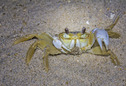
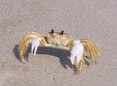
Ocypode quadrata is small, having a carapace length of about 5 cm (2 inches) at maturity. They are either straw-colored or grayish-white. They have a quadrate carapace, large club-shaped eyestalks, unequal chelipeds (claws) and long walking legs. Males are generally larger than females. (Fisher and Tevesz, 1979)
- Other Physical Features
- ectothermic
- bilateral symmetry
- Sexual Dimorphism
- male larger
-
- Average length
- 50 mm
- 1.97 in
Development
After hatching from an egg, Ocypode quadrata has five zoea stages and one megalopa stage. The megalopa stage requires at least 35 days for development. The larvae develop in saline water. The megalopa stage of Ocypode quadrata is one of the largest of the brachyuran crabs. Metamorphosis into the first crab stage takes place at the surf-beach interface. (Diaz and Costlow, 1972; McDermott, 2009)
- Development - Life Cycle
- metamorphosis
Reproduction
Mating can occur throughout the year. Unlike other crab species, ghost crabs can mate even when the female’s integument is hard, which means that they can mate anytime after sexual maturation. This is an adaptation to terrestrial life. Mating occurs while both the male and the female have a hard shell. Usually mating will occur somewhere in or near the burrow of the male. Often copulatory plugs are found in ghost crabs; the male will release a seminal fluid along with his sperm that will become hard and prevent rival sperm from reaching the female’s ova. (; Burggren, 1988; Rothschild, 2004)
- Mating System
- monogamous
In the Carolinas, ghost crabs spawn from April through July. Females will mature and ovulate in April and again in August. Females reach sexual maturity when their carapace is larger than 25 mm. Males reach sexual maturity when their carapace is larger than 24 mm. This usually occurs when they are about a year old. (Haley, 1969; Haley, 1972; Hobbs, et al., 2008; Portell, et al., 2003; Rothschild, 2004)
- Key Reproductive Features
- year-round breeding
- sexual
-
- Breeding season
- Mating occurs throughout the year.
-
- Average age at sexual or reproductive maturity (female)
- 1 years
-
- Average age at sexual or reproductive maturity (male)
- 1 years
The female will carry the eggs beneath her body, which will be released into the surf. While carrying the eggs, she must keep them wet by frequently entering the water. Some females may turn upside down in the water to ventilate their eggs. (Mitchell, 2007; Rothschild, 2004)
- Parental Investment
- female parental care
-
pre-hatching/birth
-
protecting
- female
-
protecting
Lifespan/Longevity
The typical lifespan of Ocypode quadrata is about 3 years. (Portell, et al., 2003)
Behavior
Ocypode quadrata is primarily nocturnal. A crab constructs new burrows or repairs older ones during the morning. In the early afternoon it plugs the burrows and stay in them until after sunset. Burrows range from 0.6 to 1.2 m long and the width of burrows approximates the carapace size of the burrower. The width of the burrow tends to be about equal to the width of the carapace. Younger, smaller crabs tend to burrow closer to the water. While foraging at night, a crab can travel up to 300 m, so it will not return to the same burrow each day. Ghost crabs hibernate in their burrows from October to April. Ocypode quadrata is considered semiterrestrial. It has developed an interesting adaptation for life on land: A crab will occasionally will return to the water to wet its gills; however it can also get water from damp sand. Ghost crabs use fine hairs on the base of their legs to wick water from the sand up onto its gills. (Branco, et al., 2010; Hobbs, et al., 2008; Knott, 2010)
- Key Behaviors
- fossorial
- nocturnal
- motile
- sedentary
- hibernation
-
- Range territory size
- 0 to 400 m^2
Home Range
Ghost crab burrows can be found from the high tide line to 400 m shoreward. (Hobbs, et al., 2008)
Communication and Perception
Ghost crabs communicate using many sounds, including striking the ground with their claws, stridulation (rubbing together) of their legs and making a “bubbling sound”. Males compete in a ritualized matter that avoids the need for physical contact. (Shields, 1998)
- Communication Channels
- acoustic
Food Habits
Ghost crabs are both predators and scavengers, and they feed at night. Their prey can be influenced by the type of beach they live on. Crabs on oceanfront beaches tend to feed on bean clams (Donax spp.) and mole crabs (Emerita talpoida), while crabs on more protected beaches will feed on the eggs and hatchlings of loggerhead turtles (Caretta caretta). (Knott, 2010)
- Primary Diet
-
carnivore
- eats non-insect arthropods
- Animal Foods
- eggs
- carrion
- terrestrial non-insect arthropods
- mollusks
- Foraging Behavior
- stores or caches food
Predation
Ghost crabs have few terrestrial predators. They are largely nocturnal to reduce the risk of being eaten by shorebirds and gulls. When they do leave their burrows during the day, they are able to slightly change their color to match the surrounding sand. Another predator is the raccoon. (Knott, 2010; Mitchell, 2007)
- Anti-predator Adaptations
- cryptic
-
- Known Predators
-
- Raccoons, Procyon
- Burrowing Owl, Speotyto cunicularia
- Gulls, multiple genera
Ecosystem Roles
The main role of Ocypode quadrata in its ecosystem is the role of top predator in the filter-feeding based food chain. The majority of their food is live prey, although they are also facultative scavengers. Ghost crabs can consume the majority of the production of both Donax and Emerita talpoida crabs. They are a crucial part of the food chain, playing an important role in the energy transfer from organic detritus and smaller invertebrates to larger predators. (Fisher and Tevesz, 1979)
Economic Importance for Humans: Positive
Ghost crabs have been used as indicators for measuring the impacts of human use on beaches. Their population is relatively easy to monitor; the density of ghost crabs on a beach can be estimated by counting the number of burrows in a certain area. Population densities have declined due to habitat modification and heavy, continuous trampling. Because ghost crabs are apex predators of the habitat, monitoring their population can allow humans to assess the impact of human activity on sandy beach ecosystems. (Hobbs, et al., 2008; Schlacher and Lucrazi, 2009)
- Positive Impacts
- research and education
Economic Importance for Humans: Negative
There are no known adverse effects of Ocypode quadrata on humans.
Conservation Status
Currently, ghost crabs are not considered threatened or endangered. One of the main threats to ghost crabs is off-road vehicles (ORVs). The ORVs can crush or bury the crabs and interfere with their reproductive cycle. ORVs can greatly affect ghost crabs at night when they are feeding. Another threat is a decline in their habitat; construction in the upper intertidal zone for residential or commercial use can caused increased mortality and a potential decline in the population. (Hobbs, et al., 2008; Knott, 2010)
-
- IUCN Red List
- Not Evaluated
-
- US Federal List
- No special status
-
- CITES
- No special status
-
- State of Michigan List
- No special status
Other Comments
While there is no directly negative influence of ghost crabs on humans, Ocypode quadrata has been shown to have a negative impact on turtle populations. There have been efforts to control ghost crab populations due to their predation on turtle eggs. Studies have found that ghost crabs consume up to 10% of turtle eggs when they prey on a nest, and they have also been known to prey on the hatchlings. Measures to control populations around turtle nesting sites have included destroying burrows and using raccoons that prey on the crabs. (Barton and Roth, 2008)
Contributors
Lisa Izzo (author), Rutgers University, Nikhita Kothari (author), Rutgers University, David V. Howe (editor), Rutgers University, Renee Mulcrone (editor), Special Projects.
Glossary
- Atlantic Ocean
-
the body of water between Africa, Europe, the southern ocean (above 60 degrees south latitude), and the western hemisphere. It is the second largest ocean in the world after the Pacific Ocean.

- acoustic
-
uses sound to communicate
- bilateral symmetry
-
having body symmetry such that the animal can be divided in one plane into two mirror-image halves. Animals with bilateral symmetry have dorsal and ventral sides, as well as anterior and posterior ends. Synapomorphy of the Bilateria.
- carnivore
-
an animal that mainly eats meat
- carrion
-
flesh of dead animals.
- coastal
-
the nearshore aquatic habitats near a coast, or shoreline.
- cryptic
-
having markings, coloration, shapes, or other features that cause an animal to be camouflaged in its natural environment; being difficult to see or otherwise detect.
- ectothermic
-
animals which must use heat acquired from the environment and behavioral adaptations to regulate body temperature
- estuarine
-
an area where a freshwater river meets the ocean and tidal influences result in fluctuations in salinity.
- female parental care
-
parental care is carried out by females
- fossorial
-
Referring to a burrowing life-style or behavior, specialized for digging or burrowing.
- hibernation
-
the state that some animals enter during winter in which normal physiological processes are significantly reduced, thus lowering the animal's energy requirements. The act or condition of passing winter in a torpid or resting state, typically involving the abandonment of homoiothermy in mammals.
- intertidal or littoral
-
the area of shoreline influenced mainly by the tides, between the highest and lowest reaches of the tide. An aquatic habitat.
- metamorphosis
-
A large change in the shape or structure of an animal that happens as the animal grows. In insects, "incomplete metamorphosis" is when young animals are similar to adults and change gradually into the adult form, and "complete metamorphosis" is when there is a profound change between larval and adult forms. Butterflies have complete metamorphosis, grasshoppers have incomplete metamorphosis.
- monogamous
-
Having one mate at a time.
- motile
-
having the capacity to move from one place to another.
- native range
-
the area in which the animal is naturally found, the region in which it is endemic.
- nocturnal
-
active during the night
- saltwater or marine
-
mainly lives in oceans, seas, or other bodies of salt water.
- sedentary
-
remains in the same area
- sexual
-
reproduction that includes combining the genetic contribution of two individuals, a male and a female
- stores or caches food
-
places a food item in a special place to be eaten later. Also called "hoarding"
- tropical
-
the region of the earth that surrounds the equator, from 23.5 degrees north to 23.5 degrees south.
- year-round breeding
-
breeding takes place throughout the year
References
Barton, B., J. Roth. 2008. Implications of intraguild predation for sea turtle nest protection. Biological Conservation, 141:8: 2139-2145.
Branco, J., J. Hillesheim, H. Fracasso, M. Christoffersen, C. Evangelista. 2010. Bioecology of the ghost crab Ocypode quadrata (Fabricius, 1787) (Crustacea: Brachyura) compared with other intertidal crabs in the Southwestern Atlantic. Journal of Shellfish Research, 29 (2): 503-512. Accessed June 06, 2011 at http://www.avesmarinhas.com.br/Bioecoloy%20of%20the%20ghost%20crab%20Ocypode%20quadrata.pdf.
Burggren, W. 1988. Biology of the Land Crabs. New York, NY: Cambridge University Press.
Diaz, H., J. Costlow. 1972. Larval development of Ocypode quadrata (Brachyura: Crustacea) under laboratory conditions. Marine Biology, 15: 120-131. Accessed June 06, 2011 at http://www.springerlink.com/content/x5wtn75201827841/fulltext.pdf.
Fisher, J., M. Tevesz. 1979. Within-habitat spatial patterns of Ocypode quadrata (Fabricius) (Decapoda Brachyura). Crustaceana, Supplement No. 5: 31-36.
Haley, S. 1969. Relative growth and sexual maturity of the Texas ghost crab, Ocypode quadrata (Fabr.) (Brachyura, Ocypodidae). Crustaceana, 17 (3): 285-297.
Haley, S. 1972. Reproductive cycling in the ghost crab, Ocypode quadrata (Fabr.) (Brachyura, Ocypodidae). Crustaceana, 23 (1): 1-11.
Hobbs, C., C. Landry, J. Perry. 2008. Assessing anthropogenic and natural impacts on ghost crabs (Ocypode quadrata) at Cape Hatteras National Seashore, North Carolina. Journal of Coastal Research, 24 (6): 1450-1458.
Knott, D. 2010. "Atlantic ghost crab: Ocypode quadrata" (On-line). Accessed June 06, 2011 at http://www.dnr.sc.gov/cwcs/pdf/Ghostcrab.pdf.
McDermott, J. 2009. Notes on the unusual megalopae of the ghost crab Ocypode quadrata and related species (Decapoda: Brachyura: Ocypodidae). Northeastern Naturalist, 16 (4): 637-646.
Mitchell, P. 2007. "Ghost Crab: hungry nocturnal ghosties" (On-line). Mitchells Publications. Accessed June 06, 2011 at http://www.mitchellspublications.com/guides/shells/articles/0057.
Portell, R., R. Turner, J. Beerensson. 2003. Occurance of the Atlantic ghost crab Ocypode quadrata from the Upper Pleistocene to Holocene Anastasia formation of Florida. Journal of Crustacean Biology, 23 (3): 712-722.
Rothschild, S. 2004. Beachcomber’s Guide to Gulf Coast Marine Life: Third Edition: Texas, Louisiana, Mississippi, Alabama and Florida. Lanham, MD: Taylore Trade Publishing.
Schlacher, T., S. Lucrazi. 2009. Monitoring beach impacts: a case for ghost crabs as ecological indicators?. 2nd Queensland Coastal Conference, Gold Coast: 1-15.
Shields, J. 1998. "The ghost crab, Ocypode quadrata" (On-line). Virginia Institute of Marine Science. Accessed June 06, 2011 at http://www.vims.edu/~jeff/ghost.htm.
Wolcott, T. 1978. Ecological role of ghost crabs, Ocypode quadrata (Fabricius) on an ocean beach: scavengers or predators?. Journal of Experimental Marine Biology and Ecology, 31 (1): 67-82.
da Rosa, L., C. Borzone. 2008. Spatial distribution of the Ocypode quadrata (Crustacea: Ocypodidae) along estuarine environments in the Paranagua Bay Complex, southern Brazil. Revista Brasileira de Zoologia, 25 (3): 383-388. Accessed June 06, 2011 at http://submission.scielo.br/index.php/zool/article/view/1636/313.