Ochotona pallasiPallas's pika
Geographic Range
Ochotona pallasi lives in the mountains of central Asia. It ranges from the southern parts of the Karkaralinsk Mountians south to Xinjiang, China (northeastern China). Ochotona pallasi is also found in the Altai Mountains north to Tuva in Russia. Pallas's pikas are mainly found in the country of Kazakhstan. (Wilson and Reeder, 1993)
- Biogeographic Regions
- palearctic
Habitat
Pallas's pikas live in mountain and steppe regions. They usually live in semi-arid areas, although they are also found in arid areas. Mean annual precipitation in these areas is approximately 130 mm. (Smirnov, 1974)
Some common plants that live in the steppes and mountains where Pallas’s pika lives are spiraea (Spiraea hypericifolia), yellow pea trees (Caragna pygmaes) and wild roses (Rosa spp.). (Smirnov, 1974)
- Habitat Regions
- temperate
- terrestrial
- Terrestrial Biomes
- savanna or grassland
- mountains
Physical Description
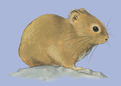
Pallas's pikas are small mammals, from 175 to 200 g in weight and up to 25 cm long. They have short, rounded ears. Pallas's pikas change pelage color throughout the year. In the summer, they have a light color while in the winter the pelage becomes darker. ("Mongolian Pishchuha", 2006; Smirnov, 1974)
- Other Physical Features
- endothermic
- homoiothermic
- bilateral symmetry
- Sexual Dimorphism
- sexes alike
-
- Range mass
- 0.18 to 0.2 kg
- 0.40 to 0.44 lb
-
- Range length
- 25 (high) cm
- 9.84 (high) in
Reproduction
Pallas's pikas are monogamous, with males and females forming mating pairs. (Smirnov, 1974)
- Mating System
- monogamous
Pallas’s pikas reproduce during the summer months. They have an average of 2.7 litters per year, each with an average of 5 young. Each young has a neonatal mass of about 7.0 grams. Young eat their first solid food around day 19, and are weaned soon after. Pallas’s pikas are sexually mature at about 4 weeks old. (Langer, 2002; Retzer, 2006)
Pallas’s pika populations occur at higher denisties in the summer than in the winter because of their high reproductive rate during warm months. There are an average of 70 pikas per ha in the summer, while there are only 30 pikas per ha in winter months. (Retzer, 2006)
- Key Reproductive Features
- iteroparous
- seasonal breeding
- gonochoric/gonochoristic/dioecious (sexes separate)
- sexual
- viviparous
-
- Breeding interval
- Pallas's pika have an average of 2.7 litters per year.
-
- Breeding season
- Breeding occurs throughout the warm months of the year.
-
- Range number of offspring
- 1 to 12
-
- Average gestation period
- 25 days
-
- Range weaning age
- 20 to 22 days
-
- Average age at sexual or reproductive maturity (female)
- 4 weeks
-
- Average age at sexual or reproductive maturity (male)
- 4 weeks
Both parents care for their young in nests until they reach independence, within 3 to 4 weeks after birth. (Smirnov, 1974)
- Parental Investment
- altricial
-
pre-fertilization
- provisioning
-
protecting
- female
-
pre-hatching/birth
-
provisioning
- female
-
protecting
- female
-
provisioning
-
pre-weaning/fledging
-
provisioning
- female
-
protecting
- male
- female
-
provisioning
-
pre-independence
-
protecting
- male
- female
-
protecting
Lifespan/Longevity
No information could be found about the lifespan of O. pallasi. In general, pikas have short lives, with a fairly low proportion reaching 1 year of age and probably reaching a maximum of 3 years old.
Behavior
Pallas' pikas are diurnal and semi-fossorial. They emerge from their burrows at sunrise and return by dusk. During the day, Pallas' pikas burrow, gather food, eat, and socialize. During peak daylight hours, they lay near the mouth of the burrow with the head towards the hole, the nose elevated and the front feet slightly extended. Young bask in the sun more often than adults. (Smirnov, 1974)
Pallas' pikas are active during the winter and do not hibernate. (Retzer, 2006; Smirnov, 1974)
Pallas' pikas can be quite aggressive towards conspecifics. Young of the same litter will fight to the death. In the wild, the young usually disperse at this point. (Smirnov, 1974)
Home Range
Pallas' pikas are semi-fossorial and remain close to their burrow systems. Specific home range values are not reported.
Communication and Perception
Pallas' pikas communicate with scent markings. They have scent glands under their lower jaw, which in adults is a rust color. They use these scent glands to mark legdes and twigs. They also use high-pitched whistles to communicate with other pikas and to warn of the presence of predators. (Smirnov, 1974)
- Other Communication Modes
- scent marks
Food Habits
Pallas’s pikas are herbivorous. They eat grasses in the genera Stipa and Agopyron and spireas (Spiraea). They collect grasses and other forage and form "haystacks" inside their burrows, covering them with stones and scat. These collections of forage are saved for winter when there is little food. (Retzer, 2006; Smirnov, 1974)
Pallas’s pikas eat their herbaceous food to ground level. This gives them a competitive advantage over livestock because they can eat the whole plant, not just the top of it. Occasionally, Pallas’s pikas will engage in coprophagy. This is to maintain a balance of salt in their bodies when there's a lack of free water. (Retzer, 2006; Smirnov, 1974)
- Plant Foods
- leaves
- seeds, grains, and nuts
- Other Foods
- dung
- Foraging Behavior
- stores or caches food
Predation
No information could be found about predators of O. pallasi. It is likely that raptors, snakes, and medium-sized mammalian predators prey on Pallas’s pikas. Pikas in general remain vigilant for predators and use high-pitched whistles to warn of predator presence. They also use their burrows and nests to avoid and escape predation.
- Anti-predator Adaptations
- cryptic
Ecosystem Roles
Pallas's pikas are the most abundant small mammals in Gobi Guran Saykhan National Park. In parts of their range they co-occur with livestock, resulting in competition for forage. While pikas sometimes eat plants to soil level, they also aerate the soil through burrowing. Pallas's pikas are hosts for fleas, which carry the plague (Yersinia pestis) and other diseases. ("Innokenteva: Epizootological role of fleas in the Gorno-Altai natural plague focus (a review)", 2004; Retzer, 2006; Smirnov, 1974)
- Ecosystem Impact
- soil aeration
- fleas (Siphonaptera)
- Yersinia pestis altaica
Economic Importance for Humans: Positive
Pallas's pikas have a positive impact on the ecosystems in which they live. Their burrow systems help to cycle soil nutrients, improving plant growth near the burrows. (Retzer, 2006)
Economic Importance for Humans: Negative
Pallas's pikas can be pests where they co-occur with livestock grazing. They are also carriers of fleas that carry Yersinia pestis altaica, which causes plague. ("Innokenteva: Epizootological role of fleas in the Gorno-Altai natural plague focus (a review)", 2004; Retzer, 2006; "Innokenteva: Epizootological role of fleas in the Gorno-Altai natural plague focus (a review)", 2004; Retzer, 2006; "Innokenteva: Epizootological role of fleas in the Gorno-Altai natural plague focus (a review)", 2004; Retzer, 2006; "Innokenteva: Epizootological role of fleas in the Gorno-Altai natural plague focus (a review)", 2004; Retzer, 2006)
- Negative Impacts
-
injures humans
- carries human disease
- causes or carries domestic animal disease
Conservation Status
Ochotona pallasi is considered at low risk or of least concern according to the IUCN Red List. It is not given protection under CITES. (Lagomorph Specialist Group 1996, 2006a)
The subspecies Ochotona pallasi sunidica is considered endangered and the population is expected to be reduced by half within the next ten years or three generations. The subspecies Ochotona pallasi hamica is considered critically endangered. There has been an 80% decrease in the population over the last ten years and it is continuing to decline. (Lagomorph Specialist Group 1996, 2006b; Lagomorph Specialist Group 1996, 2006c)
-
- IUCN Red List
-
Least Concern
More information
-
- IUCN Red List
-
Least Concern
More information
-
- US Federal List
- No special status
-
- CITES
- No special status
-
- State of Michigan List
- No special status
Contributors
Tanya Dewey (editor), Animal Diversity Web.
Anna DeMers (author), University of Wisconsin-Stevens Point, Chris Yahnke (editor, instructor), University of Wisconsin-Stevens Point.
Glossary
- Palearctic
-
living in the northern part of the Old World. In otherwords, Europe and Asia and northern Africa.

- acoustic
-
uses sound to communicate
- altricial
-
young are born in a relatively underdeveloped state; they are unable to feed or care for themselves or locomote independently for a period of time after birth/hatching. In birds, naked and helpless after hatching.
- bilateral symmetry
-
having body symmetry such that the animal can be divided in one plane into two mirror-image halves. Animals with bilateral symmetry have dorsal and ventral sides, as well as anterior and posterior ends. Synapomorphy of the Bilateria.
- causes or carries domestic animal disease
-
either directly causes, or indirectly transmits, a disease to a domestic animal
- chemical
-
uses smells or other chemicals to communicate
- cryptic
-
having markings, coloration, shapes, or other features that cause an animal to be camouflaged in its natural environment; being difficult to see or otherwise detect.
- diurnal
-
- active during the day, 2. lasting for one day.
- endothermic
-
animals that use metabolically generated heat to regulate body temperature independently of ambient temperature. Endothermy is a synapomorphy of the Mammalia, although it may have arisen in a (now extinct) synapsid ancestor; the fossil record does not distinguish these possibilities. Convergent in birds.
- folivore
-
an animal that mainly eats leaves.
- fossorial
-
Referring to a burrowing life-style or behavior, specialized for digging or burrowing.
- herbivore
-
An animal that eats mainly plants or parts of plants.
- iteroparous
-
offspring are produced in more than one group (litters, clutches, etc.) and across multiple seasons (or other periods hospitable to reproduction). Iteroparous animals must, by definition, survive over multiple seasons (or periodic condition changes).
- monogamous
-
Having one mate at a time.
- motile
-
having the capacity to move from one place to another.
- mountains
-
This terrestrial biome includes summits of high mountains, either without vegetation or covered by low, tundra-like vegetation.
- native range
-
the area in which the animal is naturally found, the region in which it is endemic.
- scent marks
-
communicates by producing scents from special gland(s) and placing them on a surface whether others can smell or taste them
- seasonal breeding
-
breeding is confined to a particular season
- sedentary
-
remains in the same area
- sexual
-
reproduction that includes combining the genetic contribution of two individuals, a male and a female
- soil aeration
-
digs and breaks up soil so air and water can get in
- solitary
-
lives alone
- stores or caches food
-
places a food item in a special place to be eaten later. Also called "hoarding"
- tactile
-
uses touch to communicate
- temperate
-
that region of the Earth between 23.5 degrees North and 60 degrees North (between the Tropic of Cancer and the Arctic Circle) and between 23.5 degrees South and 60 degrees South (between the Tropic of Capricorn and the Antarctic Circle).
- terrestrial
-
Living on the ground.
- territorial
-
defends an area within the home range, occupied by a single animals or group of animals of the same species and held through overt defense, display, or advertisement
- tropical savanna and grassland
-
A terrestrial biome. Savannas are grasslands with scattered individual trees that do not form a closed canopy. Extensive savannas are found in parts of subtropical and tropical Africa and South America, and in Australia.
- savanna
-
A grassland with scattered trees or scattered clumps of trees, a type of community intermediate between grassland and forest. See also Tropical savanna and grassland biome.
- temperate grassland
-
A terrestrial biome found in temperate latitudes (>23.5° N or S latitude). Vegetation is made up mostly of grasses, the height and species diversity of which depend largely on the amount of moisture available. Fire and grazing are important in the long-term maintenance of grasslands.
- visual
-
uses sight to communicate
- viviparous
-
reproduction in which fertilization and development take place within the female body and the developing embryo derives nourishment from the female.
References
2004. Innokenteva: Epizootological role of fleas in the Gorno-Altai natural plague focus (a review). Parazitologiia, 38/4: 273-287.
2006. "Mongolian Pishchuha" (On-line). Accessed November 25, 2006 at http://www.apus.ru/site.xp/049048051051124051055053055124.html.
Lagomorph Specialist Group 1996, 2006. "Ochotona pallasi spp. hamica" (On-line). IUCN Red List of Threatened Species. Accessed November 24, 2006 at www.iucnredlist.org.
Lagomorph Specialist Group 1996, 2006. "Ochotona pallasi spp. sunidica" (On-line). IUCN Red List of Threatened Species. Accessed November 24, 2006 at www.iucnredlist.org.
Lagomorph Specialist Group 1996, 2006. "Ochotona pallasi" (On-line). IUCN Red List of Threatened Species. Accessed November 24, 2006 at www.iucnredlist.org.
Langer, P. 2002. The digestive tract and life history of small animals. Mammal Review, 32: 118-119. Accessed November 24, 2006 at http://www.med.uni-giessen.de/anat/originale/langer-hp-MammalReview.pdf.
Retzer, V. 2006. "Forage competition between livestock and Mongolian Pika (Ochotona pallasi) in Southern Mongolian mountain steppes" (On-line pdf). Bayreuther Institut für Terrestrische Ökosystemforschung. Accessed November 25, 2006 at http://www.bitoek.uni-bayreuth.de/biogeo/de/pub/pub/38946/competition_preprint.pdf.
Smirnov, P. 1974. Adaptation to environmental temperature and certain behavioral characteristics of the Mongolian pika (Ochotona pricei). The Soviet Journal of Ecology, 4: 233-237.
Wilson, D., D. Reeder. 1993. Mammal Species of the World, 2nd Ed.. Washington: Smithsonian Institution Press.