Nycticebus coucangslow loris

Geographic Range
Sunda slow lorises (Nycticebus coucang) live mainly in Indonesia (Sumatra, Batam and Galang in the Riau Archipelago, and Pulau Tebingtinggi and Bunguran in the North Natuna Islands), Malaysia (on the Peninsula and the island of Pulau Tioman), the southern peninsular area of Thailand (from the Isthmus of Kra southward) and throughout Singapore. (Nekaris and Streicher, 2008)
Habitat
Sunda slow lorises mainly inhabit primary and secondary tropical lowland forests. They have also been found in each of the following habitats: tropical evergreen and semi-evergreen forests, seasonal wet evergreen forests, dry evergreen forests, mixed deciduous tropical forests, sub-tropical broadleaf hill forests, swamp forests, savannahs, montane and submontane forests, shrub forests, peat swamps and hardwood forests, as well as degraded habitats such as highly disturbed forests, secondary forests, disturbed primary forests and logged forests. (Barrett, 1981; Choudhury, 1992; Duckworth, 1994; Huynh, 1998; Nekaris, et al., 2008; Wiens, et al., 2006)
- Habitat Regions
- tropical
- terrestrial
- Terrestrial Biomes
- forest
- rainforest
- scrub forest
-
- Range elevation
- 0 to 1300 m
- 0.00 to 4265.09 ft
Physical Description
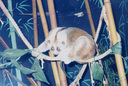
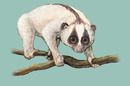
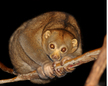
Sunda slow lorises range in length from 27 to 38 centimeters and weight from 599 to 685 grams. They have a mostly white stripe between their eyes, beginning near the top of their forehead and descending to the end of their nose. They usually have light brown pelage with a darker-colored stripe running down their back. Thick fur hides their ears. Their highly-reduced (to a stump) vestigial tail is also hidden underneath their fur. Their eyes are large due to their primarily nocturnal activity. Their second digit is reduced; their hands act as powerful clamps for grasping. Male and female Sunda slow lorises do not vary by color, size or weight, in general, there is little to no sexual dimorphism displayed by this species. They have a toothcomb and six procumbent teeth on their lower jaw, consisting of the lower incisors and the canine teeth. Lorises use their toothcomb to scrape off gum when foraging, and rarely use their toothcomb for grooming (a common practice among other primates with toothcombs). Like other slow lorises, these animals have wet noses, round heads, small ears hidden in thick fur, a flat face and large eyes. (Ankel-Simons, 2007; Choudhury, 1992; Groves, 2001; Martin, 1979; Nekaris, et al., 2008)
- Other Physical Features
- endothermic
- homoiothermic
- bilateral symmetry
- poisonous
- Sexual Dimorphism
- sexes alike
-
- Range mass
- 599 to 685 g
- 21.11 to 24.14 oz
-
- Range length
- 27 to 38 cm
- 10.63 to 14.96 in
-
- Average basal metabolic rate
- 1.5040 cm3.O2/g/hr
-
- Average basal metabolic rate
- 1.504 W
- AnAge
Reproduction
Males track females in estrus; however, females initiate the act of copulation. To initiate, the female hangs from a branch within sight of the male, often vocalizing to draw further attention. The male then holds the female and the branch, while simultaneously copulating with her. Urine-marking may also be used by the female to solicit mating. The male may create a mating plug following copulation. (Fitch-Snyder and Jurke, 2003; Izard, et al., 1988; Zimmermann, 1985)
Slow lorises have been observed in groups of up to six conspecifics including a female in estrus and five males. This may suggest a promiscuous mating system, where females mate with more than one male. No further evidence for polyandrous mating has been recorded, but the possibility is likely given their mating structure. (Wiens, 2002)
Sunda slow lorises are polyestrous, having many periods of sexual receptivity during a year. Their estrus cycle lasts 29 to 45 days, with most copulations occurring in succession. Their gestation period averages 188 days, after which one offspring is born, although twinning has been observed. Offspring are weaned between three and six months of age. Sexual maturity is reached between 18 and 24 months of age in females, and can be reached as early as 17 months in males, although males typically become sexually mature around 20 months. (Fitch-Snyder and Jurke, 2003; Izard, et al., 1988)
- Key Reproductive Features
- year-round breeding
- gonochoric/gonochoristic/dioecious (sexes separate)
- sexual
- fertilization
- viviparous
-
- Breeding interval
- Sunda slow lorises typically breed once per year.
-
- Breeding season
- Sunda slow lorises are polyestrous.
-
- Average number of offspring
- 1
-
- Average number of offspring
- 1
- AnAge
-
- Average gestation period
- 188 days
-
- Average gestation period
- 188 days
- AnAge
-
- Range weaning age
- 3 to 6 months
-
- Average weaning age
- 4 months
-
- Range time to independence
- 16 to 26 months
-
- Average time to independence
- 20 months
-
- Range age at sexual or reproductive maturity (female)
- 18 to 24 months
-
- Average age at sexual or reproductive maturity (female)
- 20 months
-
- Range age at sexual or reproductive maturity (male)
- 17 to 20 months
-
- Average age at sexual or reproductive maturity (male)
- 18 months
Only females care for their young. Before and during weaning, females lick their young, covering them in toxic oil, so the young may be protected while the female leaves to forage. Females also provide an example from which the young will learn to move through the trees. (Izard, et al., 1988; Wiens and Zitzmann, 2003)
- Parental Investment
- female parental care
-
pre-hatching/birth
-
provisioning
- female
-
protecting
- female
-
provisioning
-
pre-weaning/fledging
-
provisioning
- female
-
protecting
- female
-
provisioning
-
pre-independence
-
provisioning
- female
-
protecting
- female
-
provisioning
Lifespan/Longevity
In the wild, this species average life span is 20 years, including one individual that survived 22 years. Their average life span in captivity is 24 years, including the longest-lived individual on record, which survived 25.8 years. In captivity, Sunda slow lorises tend to be more stressed and aggressive, which may result in a shorter life span of 12 to 14 years. (Daschbach, 1983; Human Ageing Genomic Resources, 2013)
-
- Range lifespan
Status: wild - 22 (high) years
- Range lifespan
-
- Range lifespan
Status: captivity - 25.8 (high) years
- Range lifespan
-
- Average lifespan
Status: wild - 20 years
- Average lifespan
-
- Average lifespan
Status: captivity - 24 years
- Average lifespan
-
- Average lifespan
Sex: female
Status: captivity - 26.5 years
- Max Planck Institute for Demographic Research
- Average lifespan
-
- Average lifespan
Sex: female
Status: captivity - 20.0 years
- Max Planck Institute for Demographic Research
- Average lifespan
Behavior
Sunda slow lorises move slowly through trees on all four limbs, typically with three limbs attached to support at any given time. Their locomotion is similar to crawling. They move with little noise or change in speed. At times they may hang below a branch by one or both feet for long periods. In captivity, movement includes quadrupedal locomotion (24%), climbing (21%), suspension (including cantilevering) (29%), bridging (23%) and other forms of locomotion (3%). (Erhlich and Musicant, 1977; Gebo, 1987; Ishida, et al., 1986; Rigel, 2004; Wiens, 2002)
Sunda slow lorises are mainly solitary, spending only 8% of their active time near other individuals. In cases of home range overlap spatial groups form, usually consisting of one male, one female and 1 to 3 younger individuals. Interactions among spatial groups are mainly positive: allogrooming, following, pant-growling and click-calling are all observed. Despite this, only 3% of active time is spent within the spatial group. This evidence may suggest a monogamous social system, though polyandrous activity has been observed. (Gron, 2013; Wiens and Zitzmann, 2003; Wiens, 2002)
-
- Range territory size
- .004 to .25 km^2
Home Range
Upon witnessing a conspecific inside their home range, or when entering the home range of another individual, this species generally shows no visible reaction; home ranges do not appear to be defended. Although Sunda slow lorises commonly stay within their own home range, they show no hesitation in entering another individual's home range or in having others enter their own home range. The individual's range serves as a general ground for activity, with no actual attachment to the range except by habit. (Gron, 2013; Wiens, 2002)
Communication and Perception
Adults exhibit eight distinct calls of one of two types: contact calls (whistles, short keckers) and aggressive or defensive calls (long keckers, grunts, snarls, screams). During mating, females may whistle when in visual contact with a male, in order to draw attention. No alarm calls are used for signaling predators, as crypsis is the most common response for avoidance. Infants may exhibit squeaks or clicks when disturbed. Young individuals especially, but also adults, use ultrasonic vocalization when exploring new environments or during complex handling (locomotion). (Daschbach, 1983; Zimmermann, 1985)
Olfactory senses play a central role in species interaction, with uses ranging from alerting others of identity, to physical state and even positioning of the individual. Their elbows contain glands that exude oils, which are licked and spread by the individual to communicate position and status. This species also uses perineal rubbing to deposit urine combined with the oil, from a separate gland on their anus. When locating the scent of another, the individual will usually rub its face on the surface where the scent was found. The oil is poisonous, with enough power to kill an adult human if not treated properly. Stressed individuals may grin, baring their teeth to present aggression or fear, but they may also grin during play. (Gron, 2013; Hagey, et al., 2007; Rasmussen, 1986; Tenaza and Fitch, 1984)
- Other Communication Modes
- scent marks
- Perception Channels
- visual
- tactile
- ultrasound
- chemical
Food Habits
Sunda slow lorises are dietary generalists, feeding on saps, gums, nectars, stems, fruits and occasionally arthropods such as spiders and insects. They have also been observed consuming snails and bird eggs. Roughly one third of their diet is saps and gums, another third consists of nectar and nectar-producing plants and approximately one fourth of their diet is fruit. The remainder of their diet consists of random items, such as snails and eggs. Despite a very slow metabolic rate, this species has a high-energy diet, most likely due to the energy costs of detoxifying certain ingested plant compounds. (Wiens and Zitzmann, 1999; Zimmermann, 1985)
- Animal Foods
- eggs
- insects
- terrestrial non-insect arthropods
- mollusks
- Plant Foods
- wood, bark, or stems
- fruit
- nectar
- sap or other plant fluids
Predation
All slow loris species, including Sunda slow lorises, produce a toxin in glands on the insides of their elbows. Using their toothcomb during grooming, the toxin is spread across their fur. If threatened, lorises will roll into a ball, leaving nothing but toxic fur exposed to the predator. Lorises may also roll into a ball and drop from the trees if the predator is arboreal. They may also bite, though this is very rare compared to their more passive defenses such as crypsis. Their predators include reticulated pythons, changeable hawk-eagles and Bornean orangutans. (Alterman, et al., 1995; Tenaza and Fitch, 1984; Wiens and Zitzmann, 1999; Wiens and Zitzmann, 2003)
- Anti-predator Adaptations
- cryptic
-
- Known Predators
-
- reticulated pythons (Python reticulatus)
- changeable hawk-eagles (Nisaetus cirrhatus)
- Bornean orangutans (Pongo pygmaeus)
Ecosystem Roles
Sunda slow lorises have no major effect on their immediate environment. As a consumer, they affect populations of flowering plants (consuming nectar and fruits), birds (consuming eggs) and other taxa (namely insects and mollusks). As prey, they serve as food for larger taxa, such as reticulated pythons and Bornean orangutans. Sunda slow lorises do not defend their home range or territory, allowing individuals of the same species and other species to pass through uninhibited. (Hagey, et al., 2007; Wiens, 2002; Wiens, et al., 2006)
- None
- Bengal slow loris (Nycticebus bengalensis)
- None
Economic Importance for Humans: Positive
Sunda slow lorises are sold as exotic pets throughout Southeast Asia and more recently in the western world. Slow lorises are the most commonly traded of the protected primates in Southeast Asia. This species is also used for traditional medicines. Their fur is reported to heal wounds, their flesh is used to cure epilepsy, their eyes are used in love potions and their meat is reported to cure asthma and stomach problems. ("Notification to Parties: Consideration of Proposals for Amendment of Appendices I and II", 2007; Nekaris and Bearder, 2007; Nekaris and Nijman, 2007; Nekaris and Streicher, 2008; Schulze and Groves, 2004)
- Positive Impacts
- pet trade
- source of medicine or drug
Economic Importance for Humans: Negative
Sunda slow lorises pose no serious threats for humans. Their only possible negative effects include poisoning, caused either by consuming lorises or from being bitten by a loris (an extremely rare event). The species is also treated as a crop pest in some areas, though it has no actual effect on crop production or quality. ("Notification to Parties: Consideration of Proposals for Amendment of Appendices I and II", 2007; Nekaris and Streicher, 2008)
- Negative Impacts
-
injures humans
- bites or stings
- poisonous
- crop pest
Conservation Status
This species is greatly threatened by the pet trade. To prevent injury for owners, their teeth are often removed, which almost always (90% of the time) leads to infection and painful death. Once their teeth have been removed it is also impossible to re-introduce them into the wild. Because of extreme mortality rates, mainly due to infection, improper nutrition and heightened stress, the trade is further inflated by the constant need for replacements. Likewise, human developments continue to encroach on their habitats. ("Notification to Parties: Consideration of Proposals for Amendment of Appendices I and II", 2007; Nekaris and Streicher, 2008)
The species is also threatened by gathering for illegal traditional medicine. They are also killed as a crop pest. In addition to poaching, severe habitat loss and degradation over large areas of their range have caused large population declines, despite the species being more adaptable to human habitats than most other primates in the region. The resulting fragmentation has restricted species dispersal as they depend on continuous canopy cover to move from tree to tree. (Nekaris and Bearder, 2007; Nekaris and Nijman, 2007; Schulze and Groves, 2004)
-
- IUCN Red List
-
Vulnerable
More information
-
- IUCN Red List
-
Vulnerable
More information
-
- US Federal List
- No special status
-
- CITES
- Appendix I
-
- State of Michigan List
- No special status
Other Comments
The etymology of their common name, Sunda slow loris, refers to the Sunda Islands, a group of islands in the western part of the Malay archipelago where they are found. Another common name for the species is the greater slow loris. The specific name, coucang, derives from kukang, their common name in Indonesia. They are commonly known as malu-malu, meaning "shy" in Indonesian, and also as bukang or Kalamasan. In the vernacular they are sometimes called Kuskus because local people in Indonesia do not distinguish between the slow loris and Cuscus, a group of Australasian possums. In Malaysia, they are sometimes known as kongkang or kera duku; kera is Malay for monkey while duku is the fruit-bearing tree Lansium domesticum. In Thailand, they are called ling lom, which translates as "wind monkey". ("Notification to Parties: Consideration of Proposals for Amendment of Appendices I and II", 2007; Nekaris and Streicher, 2008; Schulze, 2004)
Contributors
Paul Peña (author), Yale University, Eric Sargis (editor), Yale University, Leila Siciliano Martina (editor), Animal Diversity Web Staff.
Glossary
- acoustic
-
uses sound to communicate
- arboreal
-
Referring to an animal that lives in trees; tree-climbing.
- bilateral symmetry
-
having body symmetry such that the animal can be divided in one plane into two mirror-image halves. Animals with bilateral symmetry have dorsal and ventral sides, as well as anterior and posterior ends. Synapomorphy of the Bilateria.
- carnivore
-
an animal that mainly eats meat
- chemical
-
uses smells or other chemicals to communicate
- cryptic
-
having markings, coloration, shapes, or other features that cause an animal to be camouflaged in its natural environment; being difficult to see or otherwise detect.
- drug
-
a substance used for the diagnosis, cure, mitigation, treatment, or prevention of disease
- endothermic
-
animals that use metabolically generated heat to regulate body temperature independently of ambient temperature. Endothermy is a synapomorphy of the Mammalia, although it may have arisen in a (now extinct) synapsid ancestor; the fossil record does not distinguish these possibilities. Convergent in birds.
- female parental care
-
parental care is carried out by females
- fertilization
-
union of egg and spermatozoan
- forest
-
forest biomes are dominated by trees, otherwise forest biomes can vary widely in amount of precipitation and seasonality.
- frugivore
-
an animal that mainly eats fruit
- herbivore
-
An animal that eats mainly plants or parts of plants.
- insectivore
-
An animal that eats mainly insects or spiders.
- motile
-
having the capacity to move from one place to another.
- native range
-
the area in which the animal is naturally found, the region in which it is endemic.
- nectarivore
-
an animal that mainly eats nectar from flowers
- nocturnal
-
active during the night
- omnivore
-
an animal that mainly eats all kinds of things, including plants and animals
- oriental
-
found in the oriental region of the world. In other words, India and southeast Asia.

- pet trade
-
the business of buying and selling animals for people to keep in their homes as pets.
- poisonous
-
an animal which has a substance capable of killing, injuring, or impairing other animals through its chemical action (for example, the skin of poison dart frogs).
- rainforest
-
rainforests, both temperate and tropical, are dominated by trees often forming a closed canopy with little light reaching the ground. Epiphytes and climbing plants are also abundant. Precipitation is typically not limiting, but may be somewhat seasonal.
- scent marks
-
communicates by producing scents from special gland(s) and placing them on a surface whether others can smell or taste them
- scrub forest
-
scrub forests develop in areas that experience dry seasons.
- sedentary
-
remains in the same area
- sexual
-
reproduction that includes combining the genetic contribution of two individuals, a male and a female
- solitary
-
lives alone
- tactile
-
uses touch to communicate
- terrestrial
-
Living on the ground.
- tropical
-
the region of the earth that surrounds the equator, from 23.5 degrees north to 23.5 degrees south.
- ultrasound
-
uses sound above the range of human hearing for either navigation or communication or both
- visual
-
uses sight to communicate
- viviparous
-
reproduction in which fertilization and development take place within the female body and the developing embryo derives nourishment from the female.
- year-round breeding
-
breeding takes place throughout the year
References
Management Authority of Cambodia. Notification to Parties: Consideration of Proposals for Amendment of Appendices I and II. Unknown. Netherlands: CITES. 2007.
Alterman, L., G. Doyle, M. Izard. 1995. Toxins and toothcombs: Potential allospecific chemical defenses in Nycticebus and Perodicticus. Pp. Various in Creatures of the Dark: The Nocturnal Prosimians. New York: Plenem Press.
Ankel-Simons, F. 2007. Primate Anatomy: An Introduction. San Diego: Elsevier.
Barrett, E. 1981. The present distribution and status of the slow loris in peninsular Malaysia. Malaysian Applied Biology, Vol. 10 Iss. 2: 205-11.
Choudhury, A. 1992. The slow loris (Nycticebus coucang) in north-east India. Primate Reproduction Strategies, Vol. 34: 77-83.
Daschbach, N. 1983. Cage-size effects on locomotor, grooming and agonistic behaviours of the slow loris, Nycticebus coucang (Primates, Lorisidae). Applied Animal Ethology, Vol. 9: 317.
Duckworth, J. 1994. Field sightings of the pygmy loris, Nycticebus pygmaeus, in Laos. Folia Primatologica, Vol. 63 Iss. 2: 99-101.
Erhlich, A., A. Musicant. 1977. Social and individual behaviors in captive slow lorises. Animal Behaviour, Vol. 60 Iss. 3-4: 195-219.
Fitch-Snyder, H., M. Jurke. 2003. Reproductive patterns in pygmy lorises (Nycticebus pygmaeus): Behavioral and physiological correlates of gonadal activity. Zoo Biology, Vol. 22 Iss. 1: 15-32.
Gebo, D. 1987. Locomotor diversity in prosimian primates. American Journal of Primatology, Vol. 13 Iss. 3: 271-81.
Gron, K. 2013. "Primate Factsheets: Slow loris (Nycticebus) Taxonomy, Morphology, & Ecology" (On-line). Accessed April 14, 2014 at http://pin.primate.wisc.edu/factsheets/entry/slow_loris.
Groves, C. 2001. Primate Taxonomy. Washington, D.C.: Smithsonian Institution.
Hagey, L., B. Fry, H. Fitch-Snyder. 2007. Talking defensively, a dual use for the brachial gland exudate of slow and pygmy lorises. Pp. Various in S Gursky, K Nekaris, eds. Primate Anti-Predator Strategies and Developments in Primatology: Progress and Prospects. USA: Springer.
Human Ageing Genomic Resources, 2013. "AnAge entry for Nycticebus coucang" (On-line). Animal Ageing and Longevity Database. Accessed April 18, 2013 at http://genomics.senescence.info/species/entry.php?species=Nycticebus_coucang.
Huynh, D. 1998. Ecology, biology and conservation status of prosimian species in Vietnam. Folia Primatologica, Vol. 69 Iss. 1: 101-8.
Ishida, H., F. Jouffroy, Y. Nakano. 1986. Comparative dynamics of pronograde and upside down horizontal quadrupedalism in the slow loris (Nycticebus coucang). Pp. Various in F Jouffroy, M Stack, C Niemitz, eds. Gravity, posture and locomotion in primates. Florence, Italy: Sedicesimo.
Izard, M., K. Weisenseel, R. Ange. 1988. Reproduction in the slow loris (Nycticebus coucang). American Journal of Primatology, Vol. 16: 331-39.
Martin, R. 1979. Phylogenetic aspects of prosimian behavior. Pp. Various in G Doyle, R Martin, eds. The Study of Prosimian Behavior. New York: Academic Press.
Nekaris, A., U. Streicher. 2008. "Nycticebus coucang" (On-line). IUCN Red List of Threatened Species. Accessed April 13, 2013 at http://www.iucnredlist.org/details/full/39759/0.
Nekaris, K., G. Blackman, V. Nijman. 2008. Conservation implications of low encounter rates of five nocturnal primate species (Nycticebus spp.) in Asia. Biodiversity Conservation, Vol. 17 Iss. 4: 733-47.
Nekaris, K., S. Bearder. 2007. The Lorisiform primates of Asia and mainland Africa. Pp. Various in C Campbell, A Fuentes, K MacKinnon, M Panger, S Bearder, eds. Primates in Perspective. New York: Oxford University Press.
Nekaris, K., V. Nijman. 2007. CITES Proposal Highlights Rarity of Asian Nocturnal Primates (Lorisidae: Nycticebus). Folia Primatologica, Vol. 78: 211-14.
Rasmussen, D. 1986. Life history and behavior of slow lorises and slender lorises: implications for the lorisine-galagine divergence. PhD Thesis, Various: Various.
Rigel, E. 2004. Analysis of Lorisidae taxonomy using postcranial skeletal material. MA Thesis, Various: Various.
Schulze, H. 2004. Lorises and pottos: species, subspecies, local populations. Vernacular names: English, French, German, others (countries of origin), Conservation Database for Lorises: Various.
Schulze, H., C. Groves. 2004. Asian Lorises: taxonomic problems caused by illegal trade. Pp. Various in T Nadler, U Streicher, T Ha, eds. Conservation of Primates in Vietnam. Hanoi, Vietnam: Frankfurt Zoological Society.
Tenaza, R., H. Fitch. 1984. The slow loris. Zoonooz, Vol. 57 Iss. 4: 10-12.
Wiens, F. 2002. Behavior and ecology of wild slow lorises (Nycticebus coucang): social organization, infant care system, and diet. PhD Thesis, Various: Various.
Wiens, F., A. Zitzmann. 1999. Predation on a Wild Slow Loris (Nycticebus coucang) by a Reticulated Python (Python reticulatus). Folia Primatologica, Vol. 70: 362.
Wiens, F., A. Zitzmann. 2003. Social dependence of infant slow lorises to learn diet. International Journal of Primatology, Vol. 24 Iss. 5: 1007-1021.
Wiens, F., A. Zitzmann, N. Hussein. 2006. Fast food for slow lorises: is low metabolism related to secondary compounds in high-energy plant diet?. Journal of Mammology, Vol. 87 Iss. 4: 790-8.
Zimmermann, E. 1985. Vocalizations and Associated Behaviours in Adult Slow Loris (Nycticebus coucang). Folia Primatologica, Vol. 44: 52.