Nucifraga columbianaClark's nutcracker

Geographic Range
Clark’s nutcracker has a wide distribution in zones of coniferous vegetation from the coastal ranges in Canada throughout the mountainous areas of the western United States. It is a native, permanent resident of the mountainous regions of western North America. Migration is only altitudinal with a shift to lower elevations beginning in late September (Burleigh, 1972; Coues, 1874; Tomback, 1998).
Habitat
In summer it prefers habitat in the sub-alpine zone near the tree line. The habitat of choice is semi-open, mixed stands of pines, fir and spruce growing on steep slopes and ridges interspersed with meadows and streams. Species of trees within the habitat varies geographically. Nutcrackers will remain on their summer range as long as food is available. In winter they migrate to lower elevations and spend the winter foraging and retrieving caches there (Tomback, 1998; Coues, 1874).
- Habitat Regions
- temperate
-
- Range elevation
- 1000 to 3840 m
- 3280.84 to 12598.43 ft
Physical Description
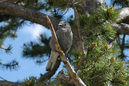
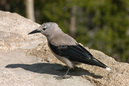
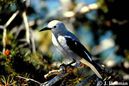
Clark’s nutcracker is a chunky, jay-sized bird averaging 11 inches long. Its plumage is powder-gray and of loose texture. Wings and central tail feathers are glossy black. Wings are long, when folded reaching nearly to tip of tail. Flight is crow-like with deep wing beats and when in flight white wing patches and white outer retricies can be seen. There is moderate size dimorphism between sexes with males being bigger. (National Geographic Society, 1999; Tomback, 1998).
- Other Physical Features
- endothermic
- bilateral symmetry
-
- Average mass
- 141 g
- 4.97 oz
-
- Average length
- 28.8 cm
- 11.34 in
Reproduction
Apparently monogamous with long lasting pair bonds. Pairs form in winter months. Courtship displays can be seen throughout the year but are most intense in the breeding season. Courtship behavior includes rapid flights where one bird follows its mate at high speed, both performing various swoops and dives. Begging calls, feeding and other vocalizations have been observed as part of courtship. Territories are only established for nesting purposes and a pair may hold the same nesting territory for several years.
- Mating System
- monogamous
Both members of the pair contribute to nest construction. Timing of nesting vary seasonally based on elevation, weather, and food availability. Nest location is often near food stores and may not be well concealed. Nests, which average 11 inches in diameter, are placed on the more sheltered side of nesting tree, often on a south-facing slope. Height of nest varies from seven to 70 feet above ground depending on the nesting tree. Placed on one or more branches, the nest platform construction materials include small twigs woven together. The nest bowl is well insulated with the outer part built of rotten wood pulp and the inner bowl lined with fine material.
Brood size averages three eggs, which are laid usually two days after nest construction is completed. The altricial young with sparse down hatch almost synchronously after an 18 day incubation. Growth is rapid and fledging occurs approximately 20-22 days after hatching. The family group forages together for the remainder of the summer but the young are completely independent by the end of summer (Tomback, 1998).
- Key Reproductive Features
- iteroparous
- seasonal breeding
- gonochoric/gonochoristic/dioecious (sexes separate)
- sexual
- fertilization
- oviparous
-
- Breeding season
- Late winter to spring
-
- Average eggs per season
- 3
-
- Average eggs per season
- 2
- AnAge
-
- Average time to hatching
- 18 days
-
- Average time to hatching
- 17 days
- AnAge
-
- Average fledging age
- 21 days
-
- Average age at sexual or reproductive maturity (female)
- One years
-
- Average age at sexual or reproductive maturity (male)
- One years
Unusual for corvids, both males and females incubate. Male has well developed incubation/brood patches, which allows him to tend the nest while female retrieves seeds from her caches. Both also care for the young after they hatch.
- Parental Investment
- altricial
- male parental care
- female parental care
Lifespan/Longevity
Little is known about the average lifespan of Clark's nutcracker. However, the longest recorded lifespan was seventeen years.
-
- Range lifespan
Status: wild - 17 (high) years
- Range lifespan
-
- Average lifespan
Status: wild - 209 months
- Bird Banding Laboratory
- Average lifespan
Behavior
Behavior is distinctive and easily recognizable. Distance flight is strong and direct. When flying between trees, flight is similar to a woodpecker, alternating between flapping and gliding. On the ground, it hops, turning head from side to side, as it harvests seeds. As with other members of the Corvidae family, Clark’s nutcrackers are extremely intelligent. Studies have been conducted on their highly developed spatial memory related to food caching and retrieval abilities.
Family groups join together after the young have fledged to form loose flocks. Nutcrackers often forage harmoniously with other species of birds as well. When predator threat arises, flocks react by mobbing the predator. Occasionally nutcrackers may harass small raptors, which they can easily outmaneuver (National Geographic Society, 1999; Tomback, 1998).
Communication and Perception
Food Habits
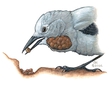
Though conifer seeds make up the majority of this nutcracker's diet, they will feed opportunistically on other food resources. Other food items present in their diets include flying insects and ants, small vertebrates, eggs and nestlings, and occasionally carrion. They use their sturdy pointed bills to pry seeds out of unripe cones, or to hammer and crush seeds out of their shells. Then they will either eat the seeds or place them in their sublingual pouches for caching later.
Ponderosa seeds are their most important food by volume but seed use changes with annual variations in seed availability. Seeds are cached at varying elevations, with each cache averaging three to four seeds. A single individual may have thousands of caches. Seed stores are recovered using visual cues and spatial memory up to nine months after being cached (Tomback, 1998).
- Animal Foods
- birds
- eggs
- carrion
- insects
- Plant Foods
- seeds, grains, and nuts
- Foraging Behavior
- stores or caches food
Predation
Clark's nutcrackers respond to predator threats with mobbing behavior. Alarm calls (squalling) alert other flock members (Tomback, 1998).
-
- Known Predators
-
- red-tailed hawks (Buteo jamaicensis)
- Cooper's hawks (Accipiter cooperii)
- prairie falcons (Falco mexicanus)
- northern goshawks (Accipiter gentilis)
- Swainson's hawks (Buteo swainsoni)
- goldes eagles (Aquila chrysaetos)
- great horned owls (Bubo virginianus)
Ecosystem Roles
Clark's Nutcracker plays a major role in the dispersal of wingless pine seeds. Ranges of seed dispersal by these birds affect the population structure of various conifer species (Tomback, 1998).
- Ecosystem Impact
- disperses seeds
Economic Importance for Humans: Positive
Though additional studies are needed, Clark's nutcracker plays a role in the dispersal and establishment of conifer species. Its spatial memory abilities are an area of interest for future research as well (Tomback, 1998).
- Positive Impacts
- research and education
Economic Importance for Humans: Negative
Again, future research is needed to determine the actual effects of the role Clark's nutcracker has in pine population structure, with regard to the selective pressures it exerts as a seed predator (Tomback, 1998).
Conservation Status
Limited data is available on actual population density of Clark's Nutcracker. Currently no specific management plans are in place. Long-term fire suppression has resulted in advanced forest succession. This coupled with loss of conifer stands due to disease or insect outbreaks has resulted in loss or degradation of some historic habitat areas. Changes to piñon pine communities related to grazing have also resulted in some decreases in habitat quality. These factors may result in a reduction in their numbers in certain areas (Tomback 1998).
-
- IUCN Red List
-
Least Concern
More information
-
- IUCN Red List
-
Least Concern
More information
-
- US Migratory Bird Act
- Protected
-
- US Federal List
- No special status
-
- CITES
- No special status
Other Comments
Generally populations are stable or have increased slightly in most parts of the species range. Habitat loss has resulted in declining numbers in some areas (Burleigh, 1972; Tomback, 1998).
Contributors
Mary Taylor (author), University of Arizona, Jorge Schondube (editor), University of Arizona.
Glossary
- Nearctic
-
living in the Nearctic biogeographic province, the northern part of the New World. This includes Greenland, the Canadian Arctic islands, and all of the North American as far south as the highlands of central Mexico.

- acoustic
-
uses sound to communicate
- altricial
-
young are born in a relatively underdeveloped state; they are unable to feed or care for themselves or locomote independently for a period of time after birth/hatching. In birds, naked and helpless after hatching.
- bilateral symmetry
-
having body symmetry such that the animal can be divided in one plane into two mirror-image halves. Animals with bilateral symmetry have dorsal and ventral sides, as well as anterior and posterior ends. Synapomorphy of the Bilateria.
- carrion
-
flesh of dead animals.
- chemical
-
uses smells or other chemicals to communicate
- endothermic
-
animals that use metabolically generated heat to regulate body temperature independently of ambient temperature. Endothermy is a synapomorphy of the Mammalia, although it may have arisen in a (now extinct) synapsid ancestor; the fossil record does not distinguish these possibilities. Convergent in birds.
- female parental care
-
parental care is carried out by females
- fertilization
-
union of egg and spermatozoan
- forest
-
forest biomes are dominated by trees, otherwise forest biomes can vary widely in amount of precipitation and seasonality.
- granivore
-
an animal that mainly eats seeds
- herbivore
-
An animal that eats mainly plants or parts of plants.
- internal fertilization
-
fertilization takes place within the female's body
- iteroparous
-
offspring are produced in more than one group (litters, clutches, etc.) and across multiple seasons (or other periods hospitable to reproduction). Iteroparous animals must, by definition, survive over multiple seasons (or periodic condition changes).
- male parental care
-
parental care is carried out by males
- monogamous
-
Having one mate at a time.
- motile
-
having the capacity to move from one place to another.
- mountains
-
This terrestrial biome includes summits of high mountains, either without vegetation or covered by low, tundra-like vegetation.
- native range
-
the area in which the animal is naturally found, the region in which it is endemic.
- oviparous
-
reproduction in which eggs are released by the female; development of offspring occurs outside the mother's body.
- seasonal breeding
-
breeding is confined to a particular season
- sexual
-
reproduction that includes combining the genetic contribution of two individuals, a male and a female
- social
-
associates with others of its species; forms social groups.
- stores or caches food
-
places a food item in a special place to be eaten later. Also called "hoarding"
- tactile
-
uses touch to communicate
- taiga
-
Coniferous or boreal forest, located in a band across northern North America, Europe, and Asia. This terrestrial biome also occurs at high elevations. Long, cold winters and short, wet summers. Few species of trees are present; these are primarily conifers that grow in dense stands with little undergrowth. Some deciduous trees also may be present.
- temperate
-
that region of the Earth between 23.5 degrees North and 60 degrees North (between the Tropic of Cancer and the Arctic Circle) and between 23.5 degrees South and 60 degrees South (between the Tropic of Capricorn and the Antarctic Circle).
- visual
-
uses sight to communicate
References
Burleigh, T. 1972. Birds of Idaho. Caldwell, Idaho: Caxton Printing.
Coues, E. 1874. Birds of the Northwest: A Handbook of The Ornithology of the Region Drained by the Missouri River and Its Tributaries. Washington: Government Printing Office.
National Geographic Society, 1999. The Field Guide to the Birds of North America. Washington, D.C.: National Geographic Society.
Tomback, D. 1998. Clark's Nutcracker (Nucifraga columbiana). in The Birds of North America, No. 331(A. Poole and F. Gill, eds.). Philadelphia, PA.: The Birds of North America Inc..