Notoryctes typhlopssouthern marsupial mole
Geographic Range
Southern marsupial moles (Notoryctes typhlops) inhabit central Australian deserts along the borders of South Australia, West Australia, and Northern Territory. ("Southern Marsupial Mole- Itjaritjari", 2006; Nowak, 1999)
- Biogeographic Regions
- australian
Habitat
Precise habitat preferences of southern marsupial moles is not well defined, as most records and sightings are scattered or based on second-hand Aboriginal accounts. They inhabit temperate deserts and are most commonly found burrowing in sandy dunes that have dense vegetation. These animals seek out habitats with abundant shrubs and grasses, including sandy plains and old river flats. They prefer areas of soft sand and are unable to cross hard-packed sand or loamy soil. ("National recovery plan for marsupial moles (Notoryctes typhlops and N. caurinus), 2005–2010", 2004; "Southern Marsupial Mole- Itjaritjari", 2006; Corbett, 1975; Johnson and Walton, 1989)
- Habitat Regions
- temperate
- tropical
- terrestrial
- Terrestrial Biomes
- desert or dune
Physical Description
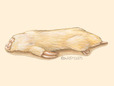
Southern marsupial moles range from 13 to 15.5 cm in total length, with masses ranging from 30 to 60 g. Their short tail ranges from 2 to 2.5 cm in length. Sexual dimorphism has not been reported in this species. Their fur grows in bunches and is silky and short. Fur color varies regionally across their geographic range from creamy white to reddish brown, perhaps because the fur picks up colors from the soil in which the animals burrow. ("Southern Marsupial Mole- Itjaritjari", 2006; Benshemesh and Johnson, 2003; Johnson and Walton, 1989; Macdonald, 2009; Strahan, 1995)
Notoryctes typhlops lacks eyes and an optic nerve; only small black vestigial buds beneath the surface of the skin remain of the eyes. No external ears or ear pinnae exist and each external auditory meatus consists of a small hole surrounded by a dense covering of fur. Nostrils are reduced to tiny vertical slits and are located directly below the horny, keratinous shield that overlies the rostrum. Limbs are short with digits three and four having large, flattened, shovel-like claws. Both males and females have a backwards facing pouch, and that of females is better developed and contains two nipples. Dental formulas appear to vary among individuals as MacDonald (2009) lists the dental formula as I4/3, C1/1, P2/3, M4/4=44, whereas Benshemesh and Johnson (2003) report a dental formula of I4/4, C1/1, P3/3, M4/4=48. Their teeth are poorly rooted with incisors, canines and premolars being blunt. Upper molars are more developed and zalambdodont. (Benshemesh and Johnson, 2003; Howe, 1975; Johnson and Walton, 1989; Macdonald, 2009)
- Other Physical Features
- endothermic
- homoiothermic
- bilateral symmetry
- Sexual Dimorphism
- sexes alike
-
- Range mass
- 30 to 60 g
- 1.06 to 2.11 oz
-
- Range length
- 13 to 14.5 cm
- 5.12 to 5.71 in
Reproduction
There is no information available regarding the mating system of southern marsupial moles.
Very little is known about reproduction in Notoryctes typhlops, as there have been no observations of reproductive behavior made in the field or in captivity. Aboriginal people claim to have never seen N. typhlops young and do not know any information about the reproduction of this species. Gestation, weaning, and age of maturity are unknown. Based on several pregnant female specimens, breeding season may take place in November. The number of young produced is not well known; however, there are examples of specimens with one or two young in their pouch. ("National recovery plan for marsupial moles (Notoryctes typhlops and N. caurinus), 2005–2010", 2004; Fuller, 1988; Johnson and Walton, 1989; Sterling, 1891)
- Key Reproductive Features
- gonochoric/gonochoristic/dioecious (sexes separate)
- sexual
- viviparous
-
- Breeding interval
- The breeding interval is not known.
-
- Breeding season
- Precise breeding season is unknown, however, pregnant females have been found in November.
-
- Average number of offspring
- 2
There is no information available regarding parental care in Notoryctes typhlops.
- Parental Investment
-
pre-fertilization
- provisioning
-
protecting
- female
-
pre-hatching/birth
-
provisioning
- female
-
protecting
- female
-
provisioning
-
pre-weaning/fledging
-
provisioning
- female
-
provisioning
Lifespan/Longevity
Very little in known about the lifespan of Notoryctes typhlops in the wild. Based on two records of southern marsupial moles kept in captivity, 1 animal survived for 10 weeks and the other for approximately 1 month. Both specimens may have died due to exposure to cold temperatures. ("National recovery plan for marsupial moles (Notoryctes typhlops and N. caurinus), 2005–2010", 2004; Sterling, 1891)
-
- Range lifespan
Status: captivity - 2.5 (high) months
- Range lifespan
Behavior
Few observations of Notoryctes typhlops have been made in its natural environment and little is known of its general behavior. It is primarily fossorial. When creating new burrows, Notoryctes typhlops begins diggin with its forefeet, and once underground it uses its hind limbs and tail as shovels to push excavated sand behind itself. Burrows often lie 20 to 100 cm below the surface; however, some are found at depths of more than 2 m. These horizontal tunnels are constantly backfilled, and permanent burrows have been observed. ("National recovery plan for marsupial moles (Notoryctes typhlops and N. caurinus), 2005–2010", 2004; Benshemesh and Johnson, 2003; Strahan, 1995)
Aboriginal people state that Notoryctes typhlops is most often seen above ground after rains or during the windy season. When above ground, they move with urgency, slowly traveling only a few meters before returning underground. When traveling above ground they drag their feet and tail, leaving conspicuous trails in the sand, especially after a rain. In captivity, N. typhlops often scurries above ground, stopping suddenly to change directions or to begin burrowing. Notoryctes typhlops sleeps in temporary underground cavities and occasionally above ground after feeding. ("National recovery plan for marsupial moles (Notoryctes typhlops and N. caurinus), 2005–2010", 2004; Benshemesh and Johnson, 2003; Howe, 1975; Strahan, 1995)
There is no information available regarding the social behavior of Notoryctes typhlops. It has been suggested that they are solitary as no permanent burrows are formed, eliminating means for contact between individuals. Above ground observations also do not indicate any social contact between individuals. Confusion persists as to when N. typhlops is most active, as Notoryctes is classified as both nocturnal and diurnal in the primary literature. ("National recovery plan for marsupial moles (Notoryctes typhlops and N. caurinus), 2005–2010", 2004; Benshemesh and Johnson, 2003; Nowak, 1999)
Home Range
There is no information available regarding the home range of Notoryctes typhlops.
Communication and Perception
Very little is known about communication in southern marsupial moles. In captivity, they have been observed making sharp squeaking sounds when held or when feeding was interrupted. Their brain is considered to be extremely simple and primitive, however, their olfactory bulbs are large and well developed, suggesting that communication and perception are primarily through olfaction. (Benshemesh and Johnson, 2003; Howe, 1975; Johnson and Walton, 1989)
Food Habits
Notoryctes typhlops is an insectivore. Based on gut contents, preferred forage consists of ants and ant eggs from the genus Iridomyrmex and the subfamily Myrmeciinae. Ants belonging to Rhytidoponera and Camponotus are also consumed. Termites, burrowing sawfly larvae, and several species of nematode are occasionally found in the gut contents of N. typhlops along with small reptiles and seeds. It has been suggested that seeds are only consumed as a result of feeding in underground ant nests. In captivity, eggs, earthworms, ant pupae, fly larvae, and beetle larvae have been used with limited success to feed these animals. (Benshemesh and Johnson, 2003; Corbett, 1975; Fuller, 1988; Howe, 1975; Macdonald, 2009; Winkel and Humphrey-Smith, 1988)
Southern marsupial moles are not well adapted for feeding on larger prey items, which are difficult for them to manipulate with their shovel-like claws. Small larvae are held down with the forelimbs, and some prey items are squeezed with the forelimbs before being eaten, presumably to make them softer. Larger prey are either lapped up or not consumed. Above-ground feeding has been observed, however, prey is often taken underground to be eaten. (Benshemesh and Johnson, 2003; Corbett, 1975; Howe, 1975)
- Primary Diet
- carnivore
- Animal Foods
- reptiles
- insects
- Plant Foods
- seeds, grains, and nuts
Predation
No direct observations of predation on Notoryctes typhlops have been made. N. typhlops remains have been found in fecal pellets of feral cats, dingoes, and the introduced red fox. Its fossorial lifestyle likely helps them significantly reduce risk of predation. When on the surface, N. typhlops are particularly susceptible to predation by birds and snakes. The ability to absorb various colors in the soil in which they burrow likely helps camouflage them from potential predators when above ground. ("National recovery plan for marsupial moles (Notoryctes typhlops and N. caurinus), 2005–2010", 2004; Benshemesh and Johnson, 2003; Paltridge, 1998)
-
- Known Predators
-
- red fox, Vulpes vulpes
- dingos, Canis lupus dingo
- cats, Felis catus
- birds, Aves
- snakes, Serpentes
Ecosystem Roles
Southern marsupial moles are insectivores and may help control insect pest populations. They also aerate the soil adn increase water penetration by burrowing. It is unlikely that they are a significant prey item for other species as their remains have been found in only a small percentage of predator scat. Southern marsupial moles are host to nematode parasites in the superfamily Trichostrongyloidea. ("National recovery plan for marsupial moles (Notoryctes typhlops and N. caurinus), 2005–2010", 2004; Johnson and Walton, 1989; Paltridge, 1998)
- Ecosystem Impact
- soil aeration
- nematodes, Trichostrongyloidea
Economic Importance for Humans: Positive
Notoryctes typhlops is rarely used as a source of food by aboriginals. Historically pelts were traded and sold for a significant amount of money, however, this rarely occurs today. Notoryctes typhlops is primarily found in areas where few humans are present, thus their potential importance to humans is limited. ("National recovery plan for marsupial moles (Notoryctes typhlops and N. caurinus), 2005–2010", 2004; "Southern Marsupial Mole (Notoryctes typhlops)", 2009; Fuller, 1988; Johnson and Walton, 1989)
- Positive Impacts
- food
- body parts are source of valuable material
Economic Importance for Humans: Negative
There are no known adverse affects of Notoryctes typhlops on humans.
Conservation Status
The ICUN Red List of Threatened Species classifies Notoryctes typhlops as data deficient; however, the Australian government lists it as endangered. Notoryctes typhlops faces many threats including increased predation by the red fox as well as other human-induced factors. Changed fire regimens and increased cattle farming cause declines in native plant populations, leading to reduced invertebrate populations. This limits the amount of food available for N. typhlops. The increasing presence of roads and railways is believed to limit the dispersal of southern marsupial moles. Conservation research has been ongoing since 1999 and aims to collaborate with aboriginal people and biologists to focus on gaining a better understanding of the ecology of this species. ("National recovery plan for marsupial moles (Notoryctes typhlops and N. caurinus), 2005–2010", 2004; "Southern Marsupial Mole (Notoryctes typhlops)", 2009; Dickman, et al., 2010)
-
- IUCN Red List
-
Data Deficient
More information
-
- IUCN Red List
-
Data Deficient
More information
Contributors
Paul Glyshaw (author), University of Michigan-Ann Arbor, Phil Myers (editor), University of Michigan-Ann Arbor, John Berini (editor), Animal Diversity Web Staff.
Glossary
- Australian
-
Living in Australia, New Zealand, Tasmania, New Guinea and associated islands.

- acoustic
-
uses sound to communicate
- bilateral symmetry
-
having body symmetry such that the animal can be divided in one plane into two mirror-image halves. Animals with bilateral symmetry have dorsal and ventral sides, as well as anterior and posterior ends. Synapomorphy of the Bilateria.
- carnivore
-
an animal that mainly eats meat
- chemical
-
uses smells or other chemicals to communicate
- desert or dunes
-
in deserts low (less than 30 cm per year) and unpredictable rainfall results in landscapes dominated by plants and animals adapted to aridity. Vegetation is typically sparse, though spectacular blooms may occur following rain. Deserts can be cold or warm and daily temperates typically fluctuate. In dune areas vegetation is also sparse and conditions are dry. This is because sand does not hold water well so little is available to plants. In dunes near seas and oceans this is compounded by the influence of salt in the air and soil. Salt limits the ability of plants to take up water through their roots.
- endothermic
-
animals that use metabolically generated heat to regulate body temperature independently of ambient temperature. Endothermy is a synapomorphy of the Mammalia, although it may have arisen in a (now extinct) synapsid ancestor; the fossil record does not distinguish these possibilities. Convergent in birds.
- food
-
A substance that provides both nutrients and energy to a living thing.
- fossorial
-
Referring to a burrowing life-style or behavior, specialized for digging or burrowing.
- insectivore
-
An animal that eats mainly insects or spiders.
- motile
-
having the capacity to move from one place to another.
- native range
-
the area in which the animal is naturally found, the region in which it is endemic.
- sexual
-
reproduction that includes combining the genetic contribution of two individuals, a male and a female
- soil aeration
-
digs and breaks up soil so air and water can get in
- solitary
-
lives alone
- tactile
-
uses touch to communicate
- temperate
-
that region of the Earth between 23.5 degrees North and 60 degrees North (between the Tropic of Cancer and the Arctic Circle) and between 23.5 degrees South and 60 degrees South (between the Tropic of Capricorn and the Antarctic Circle).
- terrestrial
-
Living on the ground.
- tropical
-
the region of the earth that surrounds the equator, from 23.5 degrees north to 23.5 degrees south.
- viviparous
-
reproduction in which fertilization and development take place within the female body and the developing embryo derives nourishment from the female.
References
Northern Territory Department of Infrastructure, Planning and Environment. National recovery plan for marsupial moles (Notoryctes typhlops and N. caurinus), 2005–2010. Alice Springs NT, Australia: Australian Government. 2004. Accessed March 13, 2011 at http://www.environment.gov.au/biodiversity/threatened/publications/pubs/marsupial-moles.pdf.
2009. "Southern Marsupial Mole (Notoryctes typhlops)" (On-line). Accessed March 14, 2011 at http://www.environment.gov.au/biodiversity/threatened/publications/south-mole.html.
Northern Territory Government Department of Naturan Resources, Environment and the Arts. Southern Marsupial Mole- Itjaritjari. Australia: Australian Government. 2006. Accessed March 31, 2011 at http://www.nt.gov.au/nreta/wildlife/animals/threatened/pdf/mammals/southern_marsupial_mole_vu.pdf.
Benshemesh, J., K. Johnson. 2003. Biology and conservation of marsupial moles (notoryctes). Pp. 464-474 in M Jones, C Dickman, M Archer, eds. Predators with pouches : the biology of carnivorous marsupials. Collingwood, VIC: CSIRO Publishing.
Corbett, L. 1975. Geographical distribution and habitat of the Marsupial Mole, Notoryctes typhlops. Australian Mammalogy, 1: 375-378.
Dickman, C., A. Burbidge, K. Aplin, J. Benshemesh. 2010. "Notoryctes typhlops" (On-line). IUCN Red List of Threatened Species. Accessed March 31, 2011 at http://www.iucnredlist.org/apps/redlist/details/14879/0.
Fuller, P. 1988. Aboriginal knowledge of the mammals of the centeral deserts of Australia. Australian Wildlife Research, 15/1: 9 -39.
Howe, D. 1975. Observations on a captive marsupial mole, Notoryctes typhlops. Australian Mammalogy, 1/4: 361-365.
Johnson, K., D. Walton. 1989. Fauna of Australia Volume 1B. Australia: AGPS Canberra. Accessed March 31, 2011 at http://www.environment.gov.au/biodiversity/abrs/publications/fauna-of-australia/pubs/volume1b/23-ind.pdf.
Macdonald, D. 2009. The encyclopedia of mammals. Oxford: Oxford University Press.
Nowak, R. 1999. Walker's mammals of the world. Baltimore: Johns Hopkins University Press.
Paltridge, R. 1998. Occurrence of marsupial mole (Notoryctes typhlops) remains in the faecal pellets of cats, foxes and dingoes in the Tanami Desert. Australian Mammalogy, 20: 427-429.
Pearson, D., J. Turner. 2000. Marsupial mole pops up in the Great Victoria and Gibson deserts. Australian Mammalogy, 22: 115-119.
Sterling, E. 1891. Further notes on the habits and anatomy of Notoryctes typhlops. Transactions of the Royal Society of South Australia, 14: 283–291. Accessed March 31, 2011 at http://www.samuseum.sa.gov.au/Journals/TRSSA/TRSSA_V014/TRSSA_V014_p283p991.pdf.
Strahan, R. 1995. The mammals of Australia. Chatswood, N.S.W: Reed Books.
Westerman, M. 1991. Phylogenetic Relationships of the Marsupial Mole, Notoryctes typhlops (Marsupialia: Notoryctidae). Australian Journal of Zoology, 39/5: 529-537.
Winkel, K., I. Humphrey-Smith. 1988. Diet of the marsupial mole, Notoryctes typhlops (Stirling 1889) (Marsupialia: Notoryctidae). Australian Mammalogy, 11: 159-161. Accessed March 14, 2011 at http://books.google.com/books?id=WI3v4E_Xb-AC&pg=PA159&lpg=PA159&dq=%22Diet+of+the+Marsupial+Mole,+Notoryctes+typhlops+%28Stirling+1889%29+%28Marsupialia:+Notoryctidae%29&source=bl&ots=6N6nLFLhV-&sig=Ju0T9ZXpxQMqcCGlMwLttUSKCHw&hl=en&ei=nZ19TeHfLqrk0gHG4rzyAw&sa=X&oi=book_result&ct=result&resnum=5&ved=0CDkQ6AEwBA#v=onepage&q=%22Diet%20of%20the%20Marsupial%20Mole%2C%20Notoryctes%20typhlops%20%28Stirling%201889%29%20%28Marsupialia%3A%20Notoryctidae%29&f=false.