Notophthalmus viridescensEastern Newt
Geographic Range
The eastern newt, Notophthalmus viridescens, is one of only a few species in the Family Salamandridae native to North America. This newt ranges throughout most of eastern North America, from the Canadian Maritime Provinces west to the Great Lakes and south to Texas, Alabama, Georgia, and Florida (Dunn and Hagen 1999; Petranka 1998; Richmond 1997). There are four recognized subspecies: the red-spotted newt (N. v. viridescens) of the eastern and northeastern U.S. and Canada, the central newt (N. v. louisianensis) of the central states and the deep south, the broken-striped newt (N. v. dorsalis) of the Carolina coastal plains, and the peninsula newt (N. v. piaropicola) of peninsular Florida. (Dunn and Hagen, 1999; Petranka, 1998; Richmond, 1997)
Habitat
Notophthalmus viridescens inhabits both deciduous and coniferous forests. Immature larvae and the adult newts live in small bodies of freshwater (ponds, small lakes, ditches, and marshes) usually with mud bottoms. Adults can survive on land if their aquatic habitat becomes unsuitable; adults may move onto land during dry periods when the water is low or to rid themselves of ectoparasites. The juvenile "eft" stage lives in lakeshore and woodland habitats and is often seen in forest litter on rainy nights. (Petranka, 1998; Richmond, 1997)
- Habitat Regions
- temperate
- terrestrial
- freshwater
- Terrestrial Biomes
- forest
- Aquatic Biomes
- lakes and ponds
- Wetlands
- marsh
Physical Description
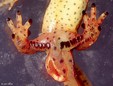
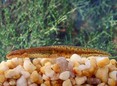
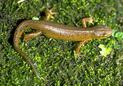
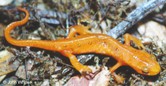
The aquatic larvae have laterally compressed tails, olive colored skin, and feathery gills. The hatchlings range in length from 7 to 9mm and have fairly smooth skin with little toxicity. Although the length of the larval period and the size at metamorphosis varies, they usually transform into a terrestrial "eft" stage after 2 to 5 months. The eft is reddish-orange in color with two rows of black-bordered red spots. It has well-developed lungs, limbs, and eyelids. The eft's skin is dry and somewhat rough and its color is a sign of its toxicity to predators. The eft has a long-slender body with a laterally flattened tail and ranges in length from 3.4 to 4.5 cm. The eft usually transforms into the mature, breeding stage after 2 to 3 years on land. The adult newt varies in color depending on its age and sex, ranging from yellowish-brown to greenish-brown dorsally and have black-bordered red spots. Its ventral color is yellow and black spots speckle the belly. The newt is slightly moist (just enough to keep its skin from drying out), with rough-scaleless skin and indistinct coastal grooves. Its size ranges in length from 7 to 12.4 cm and it has small eyes with a horizontal pupil. During the breeding season, males can be easily identified by their enlarged hind legs, with black-horny structures on the inner surfaces of their thighs and toe tips (used for gripping females during mating), swollen vents, and broadly keeled (high-wavy crest) tails. (Behler and King, 1979, 1998; Lazell, 1976; Petranka, 1998; Richmond, 1997)
- Other Physical Features
- ectothermic
- heterothermic
- bilateral symmetry
- poisonous
- Sexual Dimorphism
- ornamentation
-
- Range length
- 7 to 12.4 cm
- 2.76 to 4.88 in
Development
The incubation of the eggs is somewhat dependent on temperature, but generally lasts from 3 to 8 weeks. In early fall, 3 to 4 months later, the aquatic larvae lose their gills, acquire sac-like lungs (heart transforms from two chambered heart to three, capable of supporting lungs), and emerge onto land as an eft. Two to 3 years later, the eft develops a powerful, flattened tail and returns to the water to breed, as an adult, and remains there the rest of its life, if water is permanent. (Lacking permanent water, adult newts will estivate and overwinter on land and enter vernal ponds in spring to breed.) Some eastern newt populations skip the eft stage and immediately transform into breeding adults. There are some coastal populations of eastern newts that become reproductively mature while retaining a gilled "larval" form (i.e., are neotenic). In other populations, newts enter the eft stage but never undergo a complete second metamorphosis, and enter the water only to breed. Both of these latter two cases may be in response to harsher than average environmental conditions. (Behler and King, 1979, 1998; Lazell, 1976; Petranka, 1998; Richmond, 1997)
- Development - Life Cycle
- neotenic/paedomorphic
- metamorphosis
Reproduction
The breeding season begins in late winter and lasts until early spring; at this time, the female is heavy with eggs and actively seeking a male. The courtship involves a unique form of amplexus. Females are attracted by the male's spots and he lures them to him by making fanning motions with his tail and wiggling, causing an enticing odor (a pheromone) to be released. The male positions himself above and forward of the female, gripping her sides just behind her forelegs with his hindlimbs and rubbing her snout with the side of his head. Males will deposit a sperm packet on the bottom of the pond and the female will proceed to pick it up with her cloaca, later using the sperm to fertilize her eggs. Males are often in competition with each other, but rival males who try to break up a pair already involved in amplexus are rarely successful. Sometimes the rival male may drop his sperm packet anyway and the female may pick up the packet when courtship with the other male is over. Male to male courtship is also common. Males tend to eat the sperm packets that are dropped in this case. (Behler and King, 1979, 1998; Lazell, 1976; Petranka, 1998; Richmond, 1997)
- Mating System
- polygynandrous (promiscuous)
Oviposition can take several weeks, because the female will only lay a few, widely scattered eggs, each day. It's still uncertain whether or not females will lay all of their eggs in a breeding season, however they do lay between 200 and 400 single, jelly-covered eggs on submerged vegetation, each season. As soon as the process is finished, the female newt swims away leaving her eggs to survive on their own. Both males and females reach sexual maturity around the age of 3. (Behler and King, 1979, 1998; Lazell, 1976; Petranka, 1998; Richmond, 1997)
- Key Reproductive Features
- iteroparous
- seasonal breeding
- gonochoric/gonochoristic/dioecious (sexes separate)
- sexual
- fertilization
- oviparous
-
- Breeding interval
- Eastern newts breed once per year.
-
- Breeding season
- The breeding season varies with latitude, beginning in late winter and lasting until early spring.
-
- Range number of offspring
- 200 to 400
-
- Range time to hatching
- 3 to 8 weeks
-
- Average age at sexual or reproductive maturity (female)
- 3 years
-
- Average age at sexual or reproductive maturity (female)
Sex: female - 2000 days
- AnAge
- Average age at sexual or reproductive maturity (female)
-
- Average age at sexual or reproductive maturity (male)
- 3 years
-
- Average age at sexual or reproductive maturity (male)
Sex: male - 2000 days
- AnAge
- Average age at sexual or reproductive maturity (male)
Females do not provide parental care after they deposit their eggs. Males do not invest in young past sperm production and mating. (Behler and King, 1979, 1998; Lazell, 1976; Petranka, 1998; Richmond, 1997)
- Parental Investment
- no parental involvement
-
pre-fertilization
- provisioning
-
protecting
- female
-
pre-hatching/birth
-
provisioning
- female
-
provisioning
Lifespan/Longevity
Eastern newts have a lifespan of up to 12 to 15 years. However, mortality is high in eggs and larvae. (Petranka, 1998)
-
- Range lifespan
Status: captivity - 15 (high) years
- Range lifespan
-
- Average lifespan
Status: captivity - 15.0 years
- Max Planck Institute for Demographic Research
- Average lifespan
Behavior
With the aid of its flattened tail, Notophthalmus viridescens moves quickly in water, yet is slow on land. Larvae are fairly sedentary, settling at the bottom of the water to hide. They appear to segregate by size in ponds, which probably serves as a defense against larger, cannibalistic adults, however few are lucky enough to survive the first winter. The eft is nocturnal (active during the night) and more active on rainy nights. In dry, sunny weather, the eft will find a cool, moist place to rest and crawl out to feed when damp, darker weather approaches. The adult newt returns to the water and spends the rest of its life there, often foraging both day and night. Winter is spent underground, unless the adults are in permanent water. Newts can often be seen foraging in winter beneath the ice. (Behler and King, 1979, 1998; Lazell, 1976; Petranka, 1998)
- Key Behaviors
- natatorial
- nocturnal
- motile
- sedentary
- aestivation
- solitary
Communication and Perception
Carnivorous throughout their lives, eastern newts use both chemical and visual cues to locate food. Adults seem to rely more on visual cues when feeding. They don't have a specialized diet, but temperature and water clarity, as well as prey density, can effect the feeding process. (Behler and King, 1979, 1998; Petranka, 1998)
Food Habits
The aquatic larvae eat small invertebrates including water fleas, snails, and beetle larvae; the terrestrial efts eat small invertebrates, mainly those found in humus and leaf litter, including snails, spring tails, and soil mites; the adult newts eat mainly midge larva and other aquatic immature stages of insects. Adults don't have a specialized diet, eating any small invertebrate that they can find. (Behler and King, 1979, 1998; Petranka, 1998)
- Primary Diet
-
carnivore
- insectivore
- eats non-insect arthropods
- Animal Foods
- insects
- terrestrial non-insect arthropods
- mollusks
- terrestrial worms
- aquatic crustaceans
- zooplankton
Predation
Predators of N. viridescens include birds, mammals, fish, and other amphibians, however many of them are deterred by the newt's toxic skin secretions. (Petranka, 1998)
- Anti-predator Adaptations
- aposematic
- cryptic
-
- Known Predators
-
- birds (Aves)
- carnivorous mammals (Mammalia)
- fish (Actinopterygii)
- amphibians (Amphibia)
Ecosystem Roles
Eastern newts are important predators of small invertebrates in the freshwater ecosystems of eastern North America. (Petranka, 1998)
Leeches appear to be a major source of adult mortality. Adults will generally flee the water and begin biting or scratching themselves in an attempt to rid their bodies of these ectoparasites, however they're not always successful. (Petranka, 1998)
- leeches (Hirudinea)
Economic Importance for Humans: Positive
The eastern newt may benefit humans by helping to control the populations of aquatic insects, including mosquitoes. They are aesthetically interesting and may play an important ecological role in freshwater and woodland habitats. Eastern Newts are sometimes kept as aquarium or terrarium pets and have even been commercially collected for the pet trade. Effects of this trade on exploited populations is not well documented. (Lazell, 1976)
- Positive Impacts
- pet trade
Economic Importance for Humans: Negative
This species does not have any significant negative economic importance.
- Negative Impacts
- injures humans
Conservation Status
There is no special status listed for Notophthalmus viridescens. Newts have declined in the face of habitat degradation by humans, but remain locally common in parts of their range. Adult newts will readily colonize man-made bodies of water, even in the presence of predatory fish, as their toxic skin secretions may reduce fish predation. Researchers do believe, however, that eastern newts may be suffering at higher than normal rates from diseases caused by viruses, bacteria, and fungi, due to a variety of environmental problems including pollution. Acid precipitation and deforestation may be other cause of depleted populations. (Dunn and Hagen, 1999)
-
- IUCN Red List
-
Least Concern
More information
-
- IUCN Red List
-
Least Concern
More information
-
- US Federal List
- No special status
-
- CITES
- No special status
-
- State of Michigan List
- No special status
Other Comments
N. viridescens appears to be involved in a Mullerian mimicry complex, with several other salamander species possibly mimicking the red eft, with its toxic skin secretions.
This newt is capable of locating its home pond through true navigation using its olfaction and light-dependent magnetic compass. (Petranka, 1998)
Contributors
George Hammond (editor), Animal Diversity Web.
Shannon Riemland (author), Michigan State University, James Harding (editor), Michigan State University.
Glossary
- Nearctic
-
living in the Nearctic biogeographic province, the northern part of the New World. This includes Greenland, the Canadian Arctic islands, and all of the North American as far south as the highlands of central Mexico.

- aposematic
-
having coloration that serves a protective function for the animal, usually used to refer to animals with colors that warn predators of their toxicity. For example: animals with bright red or yellow coloration are often toxic or distasteful.
- bilateral symmetry
-
having body symmetry such that the animal can be divided in one plane into two mirror-image halves. Animals with bilateral symmetry have dorsal and ventral sides, as well as anterior and posterior ends. Synapomorphy of the Bilateria.
- carnivore
-
an animal that mainly eats meat
- chemical
-
uses smells or other chemicals to communicate
- cryptic
-
having markings, coloration, shapes, or other features that cause an animal to be camouflaged in its natural environment; being difficult to see or otherwise detect.
- ectothermic
-
animals which must use heat acquired from the environment and behavioral adaptations to regulate body temperature
- fertilization
-
union of egg and spermatozoan
- forest
-
forest biomes are dominated by trees, otherwise forest biomes can vary widely in amount of precipitation and seasonality.
- freshwater
-
mainly lives in water that is not salty.
- heterothermic
-
having a body temperature that fluctuates with that of the immediate environment; having no mechanism or a poorly developed mechanism for regulating internal body temperature.
- insectivore
-
An animal that eats mainly insects or spiders.
- internal fertilization
-
fertilization takes place within the female's body
- iteroparous
-
offspring are produced in more than one group (litters, clutches, etc.) and across multiple seasons (or other periods hospitable to reproduction). Iteroparous animals must, by definition, survive over multiple seasons (or periodic condition changes).
- marsh
-
marshes are wetland areas often dominated by grasses and reeds.
- metamorphosis
-
A large change in the shape or structure of an animal that happens as the animal grows. In insects, "incomplete metamorphosis" is when young animals are similar to adults and change gradually into the adult form, and "complete metamorphosis" is when there is a profound change between larval and adult forms. Butterflies have complete metamorphosis, grasshoppers have incomplete metamorphosis.
- motile
-
having the capacity to move from one place to another.
- natatorial
-
specialized for swimming
- native range
-
the area in which the animal is naturally found, the region in which it is endemic.
- nocturnal
-
active during the night
- oviparous
-
reproduction in which eggs are released by the female; development of offspring occurs outside the mother's body.
- pet trade
-
the business of buying and selling animals for people to keep in their homes as pets.
- poisonous
-
an animal which has a substance capable of killing, injuring, or impairing other animals through its chemical action (for example, the skin of poison dart frogs).
- polygynandrous
-
the kind of polygamy in which a female pairs with several males, each of which also pairs with several different females.
- seasonal breeding
-
breeding is confined to a particular season
- sedentary
-
remains in the same area
- sexual
-
reproduction that includes combining the genetic contribution of two individuals, a male and a female
- sexual ornamentation
-
one of the sexes (usually males) has special physical structures used in courting the other sex or fighting the same sex. For example: antlers, elongated tails, special spurs.
- solitary
-
lives alone
- tactile
-
uses touch to communicate
- temperate
-
that region of the Earth between 23.5 degrees North and 60 degrees North (between the Tropic of Cancer and the Arctic Circle) and between 23.5 degrees South and 60 degrees South (between the Tropic of Capricorn and the Antarctic Circle).
- terrestrial
-
Living on the ground.
- visual
-
uses sight to communicate
- zooplankton
-
animal constituent of plankton; mainly small crustaceans and fish larvae. (Compare to phytoplankton.)
References
Behler, J., F. King. 1979, 1998. National Audubon Society Field Guide to North American Reptiles and Amphibians. New York: Chanticleer Press, Inc..
Dunn, L., A. Hagen. 1999. "Habitat Rehabilitation in the Great Lakes" (On-line). Accessed November 2, 1999 at http://www.on.ec.gc.ca/wildlife/docs/habitat-rehabilitation4-e.html#red.
Lazell, J. 1976. This Broken Archipelago: Cape Cod and the Islands, Amphibians, and Reptiles.. New York: Quadrangle/New York Times Book Company.
Petranka, J. 1998. Salamanders of the United States and Canada. Washington, D.C., USA: Smithsonian Institution Press.
Richmond, A. 1997. "The Red-Spotted Newt" (On-line). The Connecticut River Homepage. Accessed 03/14/06 at http://www.bio.umass.edu/biology/conn.river/newt.html.