Notomys alexisspinifex hopping mouse
Geographic Range
Notomys alexis is found in the sandy soils of Central Australia to Western Australia. Found abundantly in the Great Victoria Desert of Western Australia, N. alexis is the most abundant of all hopping mice in Australia (Watts and Aslin, 1981).
- Biogeographic Regions
- australian
Habitat
Notomys alexis lives in sandy soils in areas of plains and dunes. They have been found in eucalypt woods, acacia shrubland, and tussock grassland. Notomys alexis characteristically live in areas with hummocks of spiky spinifex. This vegetation gives N. alexis the common name of Spinifex Hopping Mouse. These hopping mice live in deep, simple burrows in the sand (Watts and Aslin, 1981).
- Habitat Regions
- temperate
- terrestrial
- Terrestrial Biomes
- desert or dune
- scrub forest
Physical Description
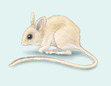
Notomys alexis are light brown to chestnut dorsally and gray to white ventrally. They are relatively large for a mouse species. The tail is relatively long and colored brown on the top and lighter on the bottom. The tip of the tail has a brush on it but the brush is smaller than in related species. A throat pouch is present in both sexes and may vary in appearance as the sexual state of the animal changes (Watts and Aslin, 1981). Adults weigh 20 to 50 grams. Body and head length ranges from 91 to 177 mm, average tail length is from 125 to 225 mm (Verberne, 2002).
- Other Physical Features
- endothermic
- bilateral symmetry
-
- Range mass
- 20 to 50 g
- 0.70 to 1.76 oz
-
- Range length
- 91 to 177 mm
- 3.58 to 6.97 in
-
- Average basal metabolic rate
- 0.252 W
- AnAge
Reproduction
Although females can mate with multiple partners, no obvious intermale competition occurs. In captivity, females have been observed mating with more than one male during a single estrous cycle. When the paternity of the litter was tested, all the young were found to be from the same male (Hyde and Elgar, 1992).
- Mating System
- polygynandrous (promiscuous)
Notomys alexis are opportunistic breeders. Although they can breed when conditions are not perfect, reproduction increases after periods of rain. Females can start breeding at 85 days old and have an estrous cycle of seven to eight days. Gestation ranges from 32 to 34 days if the female is not lactating. If a female is lactating, the gestation period can increase to about 40 days. Estrus continues during lactation and finding a female that is pregnant and lactating is not uncommon. Breeding can be inhibited by a high population density of N. alexis (Watts and Aslin, 1981).
- Key Reproductive Features
- iteroparous
- year-round breeding
- gonochoric/gonochoristic/dioecious (sexes separate)
- sexual
- viviparous
-
- Breeding season
- Breeding occurs throughout the year but particularly after rains.
-
- Average number of offspring
- 3.9
- AnAge
-
- Range gestation period
- 32 to 40 days
-
- Average weaning age
- 28 days
-
- Range age at sexual or reproductive maturity (female)
- 85 (low) days
-
- Range age at sexual or reproductive maturity (male)
- 85 (low) days
Pink and sparsely furred, the young weigh about 3 grams when they are born. It takes about 15 days for the ears to open and 20 days for the eyes to open. They are cared for and nursed in the nest by their mother until they are weaned, at about 28 days (Watts and Aslin, 1981).
- Parental Investment
- altricial
- female parental care
Lifespan/Longevity
Spinifex hopping mice live as long as 3 years in captivity but probably much less in the wild. Most may live less than a year.
-
- Average lifespan
Status: captivity - 3 years
- Average lifespan
-
- Average lifespan
Status: captivity - 5.2 years
- Max Planck Institute for Demographic Research
- Average lifespan
Behavior
Notomys alexis are social animals and live in groups of up to 10 individuals. These groups live in single deep burrows but often these burrows are clustered into a system connecting many groups. Although these groups may communicate, the immediate family grouping is the strongest. When groups exceed the normal number, cooperative behavior ceases. In captivity, large group size may result in the killing of young. Notomys alexis are very abundant and very active creatures. Quadrupedal and bipedal hopping are only two of the seven modes of locomotion recorded (Watts and Aslin, 1981). Water loss is limited in many ways. Urination and defecation is minimized and the urine is the most concentrated of any mammal. Living in burrows also reduces water lost to heat because the environment stays close to one temperature. Notomys alexis sleep in one nest chamber huddled close together to reduce water loss due to evaporation. They are active after dark to decrease water loss also (Watts and Aslin, 1981).
Communication and Perception
Food Habits
Notomys alexis individuals eat mainly seeds, but also consume green plants and insects when available. They are not completely granivorous. A study has shown that they eat about 50% seeds and 50% invertebrates and supplement their diet with green plants (Murray and Dickman, 1994). These hopping mice can survive without free water by utilizing water in their food and efficiently using metabolic water.
- Primary Diet
- omnivore
- Animal Foods
- insects
- Plant Foods
- leaves
- seeds, grains, and nuts
Predation
Being active after dark and hopping quickly, in varying directions, helps N. alexis to avoid predators (Watts and Aslin, 1981). Most small to medium-sized predators in the regions where they live probably prey on spinifex hopping mice.
-
- Known Predators
-
- domestic cats (Felis silvestris)
- dingos (Canis lupus dingo)
- owls (Strigiformes)
- snakes (Serpentes)
Ecosystem Roles
Notomys alexis serve as seed dispersers for many different plants. They occupy a unique niche and coexist with 10 to 12 other small mammal species. Most of these species are other rodents, but some are dasyurid marsupials (Murray and Dickman, 1994).
- Ecosystem Impact
- disperses seeds
Economic Importance for Humans: Positive
These small mice are sometimes kept as pets (Verberne, 2002). They are also used extensively in laboratories in Australia (Murray and Dickman, 1994).
- Positive Impacts
- pet trade
- research and education
Economic Importance for Humans: Negative
Population explosions have been recorded for N. alexis. In 1975, a plague of N. alexis occurred. At this time, several hundred were reported being seen by spotlight by observers. It was also reported that they would enter campsites and steal scraps of food (Watts and Aslin, 1981).
Conservation Status
Spinifex hopping mice are abundant and widespread, they are not threatened.
-
- IUCN Red List
-
Least Concern
More information
-
- IUCN Red List
-
Least Concern
More information
-
- US Federal List
- No special status
-
- CITES
- No special status
Contributors
Barbara Lundrigan (author), Michigan State University, Kim Pfotenhauer (author), Michigan State University.
Glossary
- Australian
-
Living in Australia, New Zealand, Tasmania, New Guinea and associated islands.

- altricial
-
young are born in a relatively underdeveloped state; they are unable to feed or care for themselves or locomote independently for a period of time after birth/hatching. In birds, naked and helpless after hatching.
- bilateral symmetry
-
having body symmetry such that the animal can be divided in one plane into two mirror-image halves. Animals with bilateral symmetry have dorsal and ventral sides, as well as anterior and posterior ends. Synapomorphy of the Bilateria.
- chemical
-
uses smells or other chemicals to communicate
- desert or dunes
-
in deserts low (less than 30 cm per year) and unpredictable rainfall results in landscapes dominated by plants and animals adapted to aridity. Vegetation is typically sparse, though spectacular blooms may occur following rain. Deserts can be cold or warm and daily temperates typically fluctuate. In dune areas vegetation is also sparse and conditions are dry. This is because sand does not hold water well so little is available to plants. In dunes near seas and oceans this is compounded by the influence of salt in the air and soil. Salt limits the ability of plants to take up water through their roots.
- endothermic
-
animals that use metabolically generated heat to regulate body temperature independently of ambient temperature. Endothermy is a synapomorphy of the Mammalia, although it may have arisen in a (now extinct) synapsid ancestor; the fossil record does not distinguish these possibilities. Convergent in birds.
- female parental care
-
parental care is carried out by females
- iteroparous
-
offspring are produced in more than one group (litters, clutches, etc.) and across multiple seasons (or other periods hospitable to reproduction). Iteroparous animals must, by definition, survive over multiple seasons (or periodic condition changes).
- motile
-
having the capacity to move from one place to another.
- native range
-
the area in which the animal is naturally found, the region in which it is endemic.
- nocturnal
-
active during the night
- nomadic
-
generally wanders from place to place, usually within a well-defined range.
- omnivore
-
an animal that mainly eats all kinds of things, including plants and animals
- pet trade
-
the business of buying and selling animals for people to keep in their homes as pets.
- polygynandrous
-
the kind of polygamy in which a female pairs with several males, each of which also pairs with several different females.
- scrub forest
-
scrub forests develop in areas that experience dry seasons.
- sedentary
-
remains in the same area
- sexual
-
reproduction that includes combining the genetic contribution of two individuals, a male and a female
- social
-
associates with others of its species; forms social groups.
- tactile
-
uses touch to communicate
- temperate
-
that region of the Earth between 23.5 degrees North and 60 degrees North (between the Tropic of Cancer and the Arctic Circle) and between 23.5 degrees South and 60 degrees South (between the Tropic of Capricorn and the Antarctic Circle).
- terrestrial
-
Living on the ground.
- viviparous
-
reproduction in which fertilization and development take place within the female body and the developing embryo derives nourishment from the female.
- year-round breeding
-
breeding takes place throughout the year
References
Hyde, L., M. Elgar. 1992. Why do Hopping Mice Have Such Tiny Testes?. Trends in Ecology and Evolution, 7(11): 359-396.
Murray, B., C. Dickman. 1994. Granivory and Microhabitat Use in Australian Desert Rodents: Are Seeds Important?. Oecologia, 99: 216-225.
Verberne, P. 2002. "Notomys alexis" (On-line). Accessed April 25, 2002 at http://users.bart.nl/~freveen/Nalexis.htm.
Watts, C., H. Aslin. 1981. The Rodents of Australia. Sydney: Angus & Robertson Publishers.