Nicrophorus americanusAmerican burying beetle

Geographic Range
American burying beetles, Nicrophorus americanus, at one time may have ranged throughout the United States and Canada. Many populations in Canada, however, are now extinct, and their range is now largely confined to Alaska and the east and west coasts of the United States. They are currently found in only 6 states in United States and are being reintroduced in some areas. ("American Burying Beetle (Nicrophorus americanus) Recovery Plan", 1991; Lomolino and Creighton, 1996; Lomolino, et al., 1995; Ramel, 2008)
Habitat
Specific habitat preference of American burying beetles is unknown. Like many endangered species, this species seems largely confined to areas with the least human influence. American burying beetles thrive in areas with an abundance of carrion and have been found in grasslands, scrublands and forest edges. (Ramel, 2008; Ratcliffe, 2008)
- Habitat Regions
- temperate
- terrestrial
- Terrestrial Biomes
- savanna or grassland
- forest
- scrub forest
Physical Description
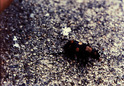
American burying beetles are the largest carrion-feeding insects in North America, growing up to 35 mm in length. Most carrion beetles of the genus Nicrophorus, including American burying beetles, have shiny black wings with distinctively marked bright orange bands on each wing cover. Unlike other species, however, American burying beetles also have a pronotum, a shield-like area just behind the head. They also have a small orange patch on their face between the eyes. In males this patch is square, while it is triangular in females (Backlund, et al., 2001; Backlund, et al., 2001)
- Other Physical Features
- ectothermic
- bilateral symmetry
- Sexual Dimorphism
- sexes colored or patterned differently
-
- Range length
- 30 to 35 mm
- 1.18 to 1.38 in
Development
American burying beetles lay their eggs on a carcass of an animal 50 to 200 g in size, and eggs hatch within a few days of being laid. Parents regurgitate food for the larvae until they are able to feed themselves. After larvae feed on the carcass for about a week, parents leave and larvae pupate in the nearby soil. After another month, they emerge as adult beetles. (Backlund, et al., 2001)
- Development - Life Cycle
- metamorphosis
Reproduction
Male and female American burying beetles have highly sensitive organs on their antennas that can detect the smell of decaying flesh up to 3.2 km away. They meet at a carcass of of suitable size, generally 50 to 200 g. If a male arrives at a carcass first, he waits for a female. If no female arrives after a period of time, the male sits on top of the carcass in a particular posture and broadcasts pheromones to attract a female. Once a male and female are present at a carcass, they cooperate to move it to suitable substrate and bury it under several inches of soil, chewing through roots as necessary. Once buried, hair or feathers are removed from the carcass, and the two beetles mate. The female creates a chamber above the carcass, in which she lays approximately 30 eggs. (Backlund, et al., 2001; Ramel, 2008; Ratcliffe, 2008)
- Mating System
- monogamous
American burying beetles require a vertebrate carcass of sufficient size in order to successfully breed (between 50 and 200 g). Females breed once a year in June or July and lay their eggs in a chamber above the carcass. If the carcass is too small, it cannot provide sufficient food for all the larvae, and parents may eat some of their young. Larvae pupate and emerge as adults 48 to 68 days after hatching. New adults spend winter in the soil and breed the following summer. (Ramel, 2008; Ratcliffe, 2008)
- Key Reproductive Features
- semelparous
- seasonal breeding
- sexual
- fertilization
- oviparous
-
- Breeding interval
- American burying beetles breed once yearly.
-
- Breeding season
- American burying beetles breed in June or July.
-
- Range eggs per season
- 30 (high)
-
- Average eggs per season
- 23
-
- Range time to independence
- 48 (high) days
-
- Average time to independence
- 68 days
-
- Range age at sexual or reproductive maturity (female)
- 48 to 68 days
-
- Range age at sexual or reproductive maturity (male)
- 48 to 68 days
American burying beetles provide care for their young from the time of birth until adolescence. This type of behavior is typically not observed among invertebrates outside of social bees, wasps, and termites.
Prior to birth, both parents regurgitate partially digested food in the nesting chamber, which accumulates as food for the larvae. They continue to do so until larvae are able to feed directly from the carcass. Parents also regularly maintain the carcass by removing fungi and covering the carrion ball with antibacterial secretions. (Ramel, 2008; Ratcliffe, 2008)
- Parental Investment
- male parental care
- female parental care
-
pre-fertilization
- provisioning
-
pre-hatching/birth
-
provisioning
- male
- female
-
protecting
- male
- female
-
provisioning
-
pre-weaning/fledging
-
provisioning
- male
- female
-
protecting
- male
- female
-
provisioning
-
pre-independence
-
provisioning
- male
- female
-
protecting
- male
- female
-
provisioning
Lifespan/Longevity
American burying beetles typical live 1 year. Newly emerged adults remain in the soil during the winter season and mate in the summer. Adults die after raising their offspring. (Ratcliffe, 2008)
-
- Average lifespan
Status: wild - 1 years
- Average lifespan
Behavior
American burying beetles are very social. They are nocturnal and are usually active when temperatures exceed 15 ˚C. ("American Burying Beetle (Nicrophorus americanus) Recovery Plan", 1991; Backlund, et al., 2001; Kozol, et al., 1988; Lomolino and Creighton, 1996; Lomolino, et al., 1995)
- Key Behaviors
- fossorial
- nocturnal
- motile
- hibernation
- social
Home Range
Little information is available regarding the home range of American burying beetles.
Communication and Perception
Adult American burying beetles can detect dead or decaying flesh up to 3.2 km away using chemical receptors on their antennae. Both males and females are attracted to carcasses, and there is often competition between members of each sex at a carcass until a single pair remains. When necessary, males use pheromones to attract females to a carcass. Males and females cooperatively move and bury a carcass, though how they communicate to do so is unknown. ("American Burying Beetle (Nicrophorus americanus) Recovery Plan", 1991; Lomolino and Creighton, 1996)
- Communication Channels
- chemical
- Other Communication Modes
- pheromones
Food Habits
American burying beetles are scavengers. Adults hunt for decaying carcasses, which are either used as a source of food or are buried for future use by larvae. (Kozol, et al., 1988; Lomolino and Creighton, 1996; Lomolino, et al., 1995)
- Animal Foods
- carrion
Predation
There are no known predators of American burying beetles.
Ecosystem Roles
As scavengers, American burying beetles play an important role in recycling decaying materials.
American burying beetles have a symbiotic relationship with mites Poecilochirus. A beetle provides mites with access to food and means of dispersal, and the mites clean the beetle of microbes and fly eggs that are carried up from carrions. ("American Burying Beetle (Nicrophorus americanus) Recovery Plan", 1991)
- Ecosystem Impact
- biodegradation
- Poecilochirus
Economic Importance for Humans: Positive
There are no known direct positive effects of American burying beetles on humans.
Economic Importance for Humans: Negative
There are no known adverse effects of American burying beetles on humans.
Conservation Status
American burying beetles were listed as an endangered species by U.S. Fish and Wildlife Service in 1989. They are currently considered critically endangered by the IUCN and are likely extirpated from Michigan. Habitat fragmentation and habitat loss are largely held responsible for the decline of this species. Habitat fragmentation and deforestation has reduced populations of species that become carrion in which this species broods. Increased competition with other scavengers has also contributed to the population decline of American burying beetles. ("American Burying Beetle (Nicrophorus americanus) Recovery Plan", 1991; Kozol, et al., 1988; Lomolino and Creighton, 1996; Lomolino, et al., 1995)
-
- IUCN Red List
-
Critically Endangered
More information
-
- IUCN Red List
-
Critically Endangered
More information
-
- US Federal List
- Endangered
-
- CITES
- No special status
-
- State of Michigan List
- Probably Extirpated
Contributors
Shivani Khetani (author), Rutgers University, Taniyah Parker (author), Rutgers University, David V. Howe (editor), Rutgers University, Gail McCormick (editor), Animal Diversity Web Staff.
Glossary
- Nearctic
-
living in the Nearctic biogeographic province, the northern part of the New World. This includes Greenland, the Canadian Arctic islands, and all of the North American as far south as the highlands of central Mexico.

- bilateral symmetry
-
having body symmetry such that the animal can be divided in one plane into two mirror-image halves. Animals with bilateral symmetry have dorsal and ventral sides, as well as anterior and posterior ends. Synapomorphy of the Bilateria.
- biodegradation
-
helps break down and decompose dead plants and/or animals
- carnivore
-
an animal that mainly eats meat
- carrion
-
flesh of dead animals.
- chemical
-
uses smells or other chemicals to communicate
- ectothermic
-
animals which must use heat acquired from the environment and behavioral adaptations to regulate body temperature
- female parental care
-
parental care is carried out by females
- fertilization
-
union of egg and spermatozoan
- forest
-
forest biomes are dominated by trees, otherwise forest biomes can vary widely in amount of precipitation and seasonality.
- fossorial
-
Referring to a burrowing life-style or behavior, specialized for digging or burrowing.
- hibernation
-
the state that some animals enter during winter in which normal physiological processes are significantly reduced, thus lowering the animal's energy requirements. The act or condition of passing winter in a torpid or resting state, typically involving the abandonment of homoiothermy in mammals.
- internal fertilization
-
fertilization takes place within the female's body
- male parental care
-
parental care is carried out by males
- metamorphosis
-
A large change in the shape or structure of an animal that happens as the animal grows. In insects, "incomplete metamorphosis" is when young animals are similar to adults and change gradually into the adult form, and "complete metamorphosis" is when there is a profound change between larval and adult forms. Butterflies have complete metamorphosis, grasshoppers have incomplete metamorphosis.
- monogamous
-
Having one mate at a time.
- motile
-
having the capacity to move from one place to another.
- native range
-
the area in which the animal is naturally found, the region in which it is endemic.
- nocturnal
-
active during the night
- oviparous
-
reproduction in which eggs are released by the female; development of offspring occurs outside the mother's body.
- pheromones
-
chemicals released into air or water that are detected by and responded to by other animals of the same species
- scavenger
-
an animal that mainly eats dead animals
- scrub forest
-
scrub forests develop in areas that experience dry seasons.
- seasonal breeding
-
breeding is confined to a particular season
- semelparous
-
offspring are all produced in a single group (litter, clutch, etc.), after which the parent usually dies. Semelparous organisms often only live through a single season/year (or other periodic change in conditions) but may live for many seasons. In both cases reproduction occurs as a single investment of energy in offspring, with no future chance for investment in reproduction.
- sexual
-
reproduction that includes combining the genetic contribution of two individuals, a male and a female
- social
-
associates with others of its species; forms social groups.
- temperate
-
that region of the Earth between 23.5 degrees North and 60 degrees North (between the Tropic of Cancer and the Arctic Circle) and between 23.5 degrees South and 60 degrees South (between the Tropic of Capricorn and the Antarctic Circle).
- terrestrial
-
Living on the ground.
- tropical savanna and grassland
-
A terrestrial biome. Savannas are grasslands with scattered individual trees that do not form a closed canopy. Extensive savannas are found in parts of subtropical and tropical Africa and South America, and in Australia.
- savanna
-
A grassland with scattered trees or scattered clumps of trees, a type of community intermediate between grassland and forest. See also Tropical savanna and grassland biome.
- temperate grassland
-
A terrestrial biome found in temperate latitudes (>23.5° N or S latitude). Vegetation is made up mostly of grasses, the height and species diversity of which depend largely on the amount of moisture available. Fire and grazing are important in the long-term maintenance of grasslands.
- visual
-
uses sight to communicate
References
Rhode Island Division of Fish and Wildlife. American Burying Beetle (Nicrophorus americanus) Recovery Plan. Newton Corner, Massachusetts: U.S. Fish and Wildlife Service. 1991. Accessed December 12, 2008 at http://www.fws.gov/southwest/es/Documents/R2ES/AmericanBuryingBeetle.pdf.
NatureServe. 2008. Nicrophorus Americanus. NatureServe Explorer: An online encyclopedia of life [web application], 7.0 Edition. Arlington, Virginia: NatureServe. Accessed December 12, 2008 at http://www.natureserve.org/explorer/servlet/NatureServe?searchName=Nicrophorus+americanus.
Backlund, D., M. Marcuson, D. Ashton. 2001. "American Burying Beetle" (On-line). The Natural Source: An Educator's Guide to South Dakota's Natural Resources. Accessed October 13, 2008 at http://www3.northern.edu/natsource/ENDANG1/Buryin1.htm.
Kozol, A., M. Scott, J. Traniello. 1988. The American Burying Beetle, Nicrophorus Americanus: Studies on the Natural History of a Declining Species. Psyche, 95/3-4: 167-176. Accessed December 12, 2008 at http://www.hindawi.com/GetArticle.aspx?doi=10.1155/1988/79403&e=cta.
Lomolino, M., J. Creighton. 1996. Habitat selection, breeding success and conservation of endangered American burying beetle Nicrophorus americanus. Biological Conservation, 77/2-3: 235- 241. Accessed December 12, 2008 at http://www.sciencedirect.com/science?_ob=ArticleURL&_udi=B6V5X-3Y0RSB8-H&_user=10&_coverDate=12%2F31%2F1996&_rdoc=1&_fmt=high&_orig=gateway&_origin=gateway&_sort=d&_docanchor=&view=c&_searchStrId=1736308362&_rerunOrigin=google&_acct=C000050221&_version=1&_urlVersion=0&_userid=10&md5=ae8948e2d37cc281ab2230acd41e4ee0&searchtype=a.
Lomolino, M., J. Creighton, G. Schnell, D. Certain. 1995. Ecology and Conservation of the Endangered American Burying Beetle (Nicrophorus americanus). Conservation of Biology, 9/3: 605-614. Accessed December 12, 2008 at http://www.jstor.org/pss/2386614.
Ramel, G. 2008. "Gordon's Burying Beetle Page" (On-line). The Earthlife Web. Accessed October 13, 2008 at http://www.earthlife.net/insects/nicrophorus.html.
Ratcliffe, B. 2008. "The American Bury Beetle: An endangered species" (On-line). Entomology:University of Nebraska State Museum. Accessed October 13, 2008 at http://www.museum.unl.edu/research/entomology/endanger.htm.