Nestor notabiliskea


Geographic Range
Kea are found only in the mountains of South Island, New Zealand. (del Hoyo, et al., 1996; Tebbich, et al., 1996)
- Biogeographic Regions
- australian
- Other Geographic Terms
- island endemic
Habitat
Kea live in wooded valleys and southern beech (Nothofagus) forests that line sub-alpine scrublands at 600 to 2000 m. In summer, kea inhabit high elevation scrub and alpine tundra areas. In autumn, they move to higher elevations to forage for berries. In winter, kea move below the timberline. (del Hoyo, et al., 1996)
- Habitat Regions
- temperate
- terrestrial
-
- Range elevation
- 600 to 2000 m
- 1968.50 to 6561.68 ft
Physical Description
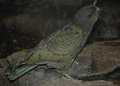
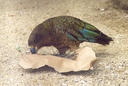
Kea are crow-sized parrots, about 48 cm long as adults. They have brownish-green heads and underparts with blackish edges. Their bodies have dull bronze-green plumage. The outer webs of their primaries are dull blue, and the underwing coverts are orange red with yellow barring and notching that extends to the undersides of the flight feathers. The lower back is dull red in color, reaching to the uppertail coverts. The upper surface of the tail is bronze-green, and the under surface of the tail is dull yellow. Kea have decurved upper bills (culmens). Females have shorter, less curved culmens and weigh about 20 percent less than males. Juvenile kea have yellowish crowns and ceres. (Bond, et al., 1991; del Hoyo, et al., 1996; Diamond and Bond, 1999)
- Other Physical Features
- endothermic
- homoiothermic
- bilateral symmetry
- Sexual Dimorphism
- male larger
-
- Average mass
- 922 g
- 32.49 oz
-
- Average length
- 48 cm
- 18.90 in
Reproduction
Kea have a polygynous mating system. Males fight for dominance, and the hierarchy is strict: as few as 10% of males may be allowed to breed in certain years. Copulation is often initiated the female, who approaches the male and invites play or adopts a submissive posture and solicits preening. The male then feeds the female a regurgitated meal and mounts her. (del Hoyo, et al., 1996; Diamond and Bond, 1999; Tebbich, et al., 1996)
- Mating System
- polygynous
Kea have been observed breeding at all times of the year, except late autumn. Their main reproductive period lasts from July to January. They nest in burrows under rocks or among tree roots. Kea have clutches of two to four eggs, and incubate the eggs for three to four weeks. The altricial hatchlings fledge after 13 weeks, and then disperse from their natal ranges after another five to six weeks. Males are sexually mature after four or five years, while females become sexually mature as early as three years of age. (del Hoyo, et al., 1996; Diamond and Bond, 1999; Tebbich, et al., 1996)
- Key Reproductive Features
- iteroparous
- year-round breeding
- gonochoric/gonochoristic/dioecious (sexes separate)
- sexual
- oviparous
-
- Breeding interval
- Kea breed once yearly.
-
- Breeding season
- Kea breed mainly between January and July.
-
- Range eggs per season
- 2 to 4
-
- Range time to hatching
- 3 to 4 weeks
-
- Average fledging age
- 13 weeks
-
- Range time to independence
- 18 to 19 weeks
-
- Range age at sexual or reproductive maturity (female)
- 3 (low) years
-
- Range age at sexual or reproductive maturity (male)
- 4 to 5 years
One a female kea lays her eggs, she sits on the nest and incubates them for three weeks. During this time, she rarely leaves the nest and the male feeds her. After the eggs hatch, the male continues to feed the female, and she, in turn, feeds the chicks. After a month, the male begins feeding the chicks himself. The chicks fledge at 9 to 13 weeks of age, and the male assumes sole responsibility for feeding them. He continues feeding his fledglings for up to six weeks. Afterward, the juveniles disperse from their natal area and travel together in flocks for two to three years before settling down. (Diamond and Bond, 1999)
- Parental Investment
- altricial
-
pre-fertilization
-
protecting
- female
-
protecting
-
pre-hatching/birth
-
provisioning
- female
-
protecting
- female
-
provisioning
-
pre-weaning/fledging
-
provisioning
- male
- female
-
protecting
- male
- female
-
provisioning
-
pre-independence
-
provisioning
- male
-
protecting
- male
- female
-
provisioning
- extended period of juvenile learning
Lifespan/Longevity
Kea can live 14.4 years in captivity. Life span in the wild has not been reported. (Carey and Judge, 2002)
-
- Range lifespan
Status: captivity - 14.4 (high) years
- Range lifespan
-
- Average lifespan
Status: captivity - 14.4 years
- Max Planck Institute for Demographic Research
- Average lifespan
Behavior
Kea are highly intelligent, social birds. They live in family groups, and aggregations of 30 to 40 birds often forage at prime feeding grounds, such as garbage dumps. Kea exhibit a variety of social behaviors, including intricate play. They have dominance hierarchies, but these hierarchies are not necessarily linear. For example, an adult male may be dominant to a subadult male, who is dominant to a juvenile male, who, in turn, is dominant to the adult male. Experiments on cooperation in kea suggest that dominant individuals can force subordinants to cooperate in tasks that benefit only the dominant birds. Also, it has been shown that kea in captivity can learn complicated tasks from observing others, though this ability has not been shown for kea in the wild. It has been proposed that life in an extreme alpine environment has encouraged kea to opportunistically explore their surroundings. They commonly investigate human belongings, and are known to destroy car accessories and ski lodge equipment. Kea are diurnal, rising in the early morning to begin calling and then foraging until late morning. They generally roost during the middle of the day, and begin foraging again in the evening, sometimes until after dark, when they go to roost for the night on tree branches. The timing of these daily activities varies with the weather; kea are fairly heat-intolerant and spend more time roosting on hot days. (Diamond and Bond, 1999; Gajdon, et al., 2004; Huber and Taborsky, 2001; Tebbich, et al., 1996)
Home Range
Home range size in kea are not reported.
Communication and Perception
Kea perceive visual, tactile, auditory, and chemical stimuli. They communicate with a wide repetoire of vocalizations, including the "kee-ah" flight call for which they are named. They also communicate by fluffing their head feathers into various "facial expressions" and by posturing. (Diamond and Bond, 1999)
Food Habits
Kea are opportunistic, omnivorous parrots. The leaves, buds, and nuts of southern beeches (Nothofagus) are especially important in the kea diet. The foods consumed vary by season, however. In spring they eat mountain daisies (Celmisia) and dig in the soil for small plants and insects. In summer kea consume the nectar and pollen of flowering mountain flax (Phorium colensoi) and rata (Metrosideros). They eat berries of coprosma (Coprosma) and snow totara (Podocarpus nivalis), and eat the leaves, fruit, seeds, and flowers of other plants. In summer they also eat beetle grubs, grasshoppers, and land snails. In fall kea feed on mountain beech leaves and buds and continue foraging on the roots, bulbs, fruit, seeds, and stems of other plants. Kea scavenge on trash heaps year round and relish the flesh and bone marrow from carcasses. These food sources become particularly important in winter, when plant foods are scarce. Finally, kea have been reported to eat rabbits and mice, and they have gained a reputation for attacking sheep, although they usually only prey on wounded or diseased sheep. (del Hoyo, et al., 1996; Diamond and Bond, 1999; Mathewson, 1991)
- Primary Diet
- omnivore
- Animal Foods
- mammals
- carrion
- insects
- mollusks
- Plant Foods
- leaves
- roots and tubers
- seeds, grains, and nuts
- fruit
- nectar
- pollen
- flowers
Predation
New Zealand falcons (Falco novaezeelandiae) have been observed attacking kea, but no one has reported an incidence of successful predation. Kea remain alert for air attacks when foraging, and they band together to chase falcons that threaten a member of their group. (Diamond and Bond, 1999)
-
- Known Predators
-
- New Zealand falcons (Falco novaezeelandiae)
Ecosystem Roles
Kea, being opportunistic, generalist foragers, are primary, secondary, and higher-level consumers. In the past, kea probably had an array of competitors, such as kaka (Nestor meridionalis), moa (Anomalopteryx, Dinornis, Emeus, Euryapteryx, Megalapteryx, and Pachyornis spp.), kakapo (Strigops habroptila), takahe (Porphyrio mantelli), and New Zealand ravens (Corvus moriorum). But human settlement fueled a mass extinction of New Zealand's native birds. Moa, takahe, and New Zealand ravens are now extinct, and kakapo are extremely rare. Only kaka remain to compete with kea and, where their ranges overlap, these two closely related species use many of the same food resources. (Diamond and Bond, 1999)
- kaka (Nestor meridionalis)
Economic Importance for Humans: Positive
Kea are important for New Zealand's tourism industry. These birds have been called "the clown of New Zealand's Southern Alps" by the Department of Conservation, attracting crowds when they convene on automobiles. (Diamond and Bond, 1999; Mathewson, 1991)
- Positive Impacts
- ecotourism
Economic Importance for Humans: Negative
Kea have been known to attack sheep, and the wounds can become infected with Clostridium bacteria. The bacteria can cause blood poisoning, which can be fatal to sheep. Increasingly, the parrots have come into contact with human habitations, sometimes foraging at dumps and cabins. Kea have been known to destroy car accessories, such as windshield wipers and weather stripping. These birds also have shredded hiking boots and have stolen objects such as sunglasses. The damage can cause serious problems, such as when the birds rip out car wiring and destroy ski-lift warning systems. (Diamond and Bond, 1999)
- Negative Impacts
- causes or carries domestic animal disease
Conservation Status
Kea are currently classified as vulnerable by the IUCN, and they are a BirdLife "restricted-range" species. They are subject to international trade regulations under CITES appendix II, as are most parrots. Kea are also protected within New Zealand by the Wildlife Act of 1953, the National Parks Act, the Animals Protection Act, and the Trade in Endangered Species Act. These laws prohibit the capture of kea on private and public lands, prohibit their mistreatment, and ban their export. However, parrot-smuggling is a lucrative business, and kea are often captured and exported for the black market pet trade. It is unknown exactly how many kea are left in the wild. Estimates range from only 2,000 to 5,000 birds, but for now, kea populations appear to be stable--especially in national parks and other protected areas. (del Hoyo, et al., 1996; Diamond and Bond, 1999)
-
- IUCN Red List
-
Vulnerable
More information
-
- IUCN Red List
-
Vulnerable
More information
-
- US Migratory Bird Act
- No special status
-
- US Federal List
- No special status
-
- CITES
- Appendix II
Contributors
Allison Poor (), University of Michigan-Ann Arbor.
Allison Poor (author), University of Michigan-Ann Arbor.
Rebecca Williams (author), University of Michigan-Ann Arbor, Terry Root (editor), University of Michigan-Ann Arbor.
Glossary
- Australian
-
Living in Australia, New Zealand, Tasmania, New Guinea and associated islands.

- acoustic
-
uses sound to communicate
- altricial
-
young are born in a relatively underdeveloped state; they are unable to feed or care for themselves or locomote independently for a period of time after birth/hatching. In birds, naked and helpless after hatching.
- arboreal
-
Referring to an animal that lives in trees; tree-climbing.
- bilateral symmetry
-
having body symmetry such that the animal can be divided in one plane into two mirror-image halves. Animals with bilateral symmetry have dorsal and ventral sides, as well as anterior and posterior ends. Synapomorphy of the Bilateria.
- carrion
-
flesh of dead animals.
- causes or carries domestic animal disease
-
either directly causes, or indirectly transmits, a disease to a domestic animal
- chemical
-
uses smells or other chemicals to communicate
- diurnal
-
- active during the day, 2. lasting for one day.
- dominance hierarchies
-
ranking system or pecking order among members of a long-term social group, where dominance status affects access to resources or mates
- ecotourism
-
humans benefit economically by promoting tourism that focuses on the appreciation of natural areas or animals. Ecotourism implies that there are existing programs that profit from the appreciation of natural areas or animals.
- endothermic
-
animals that use metabolically generated heat to regulate body temperature independently of ambient temperature. Endothermy is a synapomorphy of the Mammalia, although it may have arisen in a (now extinct) synapsid ancestor; the fossil record does not distinguish these possibilities. Convergent in birds.
- forest
-
forest biomes are dominated by trees, otherwise forest biomes can vary widely in amount of precipitation and seasonality.
- island endemic
-
animals that live only on an island or set of islands.
- iteroparous
-
offspring are produced in more than one group (litters, clutches, etc.) and across multiple seasons (or other periods hospitable to reproduction). Iteroparous animals must, by definition, survive over multiple seasons (or periodic condition changes).
- migratory
-
makes seasonal movements between breeding and wintering grounds
- motile
-
having the capacity to move from one place to another.
- mountains
-
This terrestrial biome includes summits of high mountains, either without vegetation or covered by low, tundra-like vegetation.
- native range
-
the area in which the animal is naturally found, the region in which it is endemic.
- omnivore
-
an animal that mainly eats all kinds of things, including plants and animals
- oviparous
-
reproduction in which eggs are released by the female; development of offspring occurs outside the mother's body.
- polygynous
-
having more than one female as a mate at one time
- sexual
-
reproduction that includes combining the genetic contribution of two individuals, a male and a female
- social
-
associates with others of its species; forms social groups.
- tactile
-
uses touch to communicate
- temperate
-
that region of the Earth between 23.5 degrees North and 60 degrees North (between the Tropic of Cancer and the Arctic Circle) and between 23.5 degrees South and 60 degrees South (between the Tropic of Capricorn and the Antarctic Circle).
- terrestrial
-
Living on the ground.
- visual
-
uses sight to communicate
- year-round breeding
-
breeding takes place throughout the year
References
Bond, A., K. Wilson, J. Diamond. 1991. Sexual dimorphism in the kea (Nestor notabilis). Emu, 91: 12-19.
Carey, J., D. Judge. 2002. "Longevity records: Life spans of mammals, birds, amphibians, reptiles, and fish" (On-line). Max Planck Institute for Demographic Research. Accessed October 03, 2005 at http://www.demogr.mpg.de/.
Diamond, J., A. Bond. 1999. Kea, bird of paradox: the evolution and behavior of a New Zealand parrot. Berkeley, CA: University of California Press, Ltd..
Gajdon, G., N. Fijn, L. Huber. 2004. Testing social learning in a wild mountain parrot, the kea (Nestor notabilis). Learning & Behavior, 32 (1): 62-71.
Huber, L., M. Taborsky. 2001. Social effects on object-exploration in keas. Advances in Ethology, 36: 181-182.
Mathewson, W. 1991. Coping with the killer kea. International Wildlife, 21: 36-7.
Tebbich, S., M. Taborsky, H. Winkler. 1996. Social manipulation causes cooperation in keas. Animal Behaviour, 52: 1-10.
del Hoyo, J., A. Elliot, J. Sargatal. 1996. Handbook of the Birds of the World: Volume 4: Sandgrouse to Cuckoos. Barcelona: Lynx Edicions.