Neogobius melanostomusGobie arrondie
Geographic Range
Round gobies are native to the Black, Caspian, Marmara, and Azov Seas and their tributaries in Eurasia. (Fuller, et al., 2007; Jude, 1995; Marsden and Jude, 1995; Pascualita, 2008; Sapota, 2006)
Round gobies have been introduced in several areas outside of their native range. They are an invasive species in the Great Lakes region of North America, with a rapidly expanding range there. Round gobies are beginning to enter the river drainages of the Great Lakes, including the Chicago River, eventually resulting in the invasion of the Mississippi River drainage. (Sapota, 2006)
They have also been introduced into the Moscow River and the Baltic Sea. They are especially problematic in the Gulf of Gdansk, where populations densities have exploded, but they have been subsequently found in many parts of the Baltic Sea and into the Danube River. It is not clear how round gobies were introduced to the Baltic Sea. (Sapota, 2006)
- Biogeographic Regions
- nearctic
- palearctic
Habitat
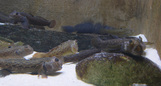
Bottom dwellers in the nearshore region of lakes and in rivers, round gobies prefer rocky habitats that provide lots of hiding opportunities. These habitats also include areas with sunken objects, piers, and mussel beds. Round gobies can be found in fresh or brackish water and at depths of 0 to 30 meters. They can survive in water temperatures of 0 to 30 degrees Celsius, but tend to thrive in warmer waters. Round gobies are able to survive in areas with poor water quality. They can also withstand low oxygen concentrations. Both of these qualities made them well-suited to surviving in ballast water, which is how they were introduced in the Great Lakes. (Fuller, et al., 2007; Jude, 1995; Marsden and Jude, 1995; Pascualita, 2008; Sapota, 2006)
- Habitat Regions
- temperate
- freshwater
- Aquatic Biomes
- lakes and ponds
- rivers and streams
- brackish water
-
- Range depth
- 0 to 30 m
- 0.00 to 98.43 ft
Physical Description
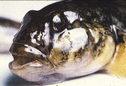
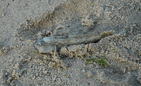
Typically under 18 centimeters in length, but with some individuals reaching 30 centimeters, round gobies have large frog-like heads with raised eyes, soft bodies, and spineless dorsal fins. Males are generally larger than females, although size varies regionally. They also have a distinctive black spot on their front dorsal fin. Mature round gobies are covered by black and brown splotches that lighten in color when threatened. Round gobies are distinguished from sculpins of similar appearance by their fused pelvic fin, which is characteristic of the family Gobiidae. This fused fin is also called a suctorial disc and is used to help attach to a surface in flowing water. A characteristic of the family Gobiidae is the absence of a swim bladder, which is used for buoyancy control. Round gobies can be confused with native black gobies in the Baltic Sea. (Jude, 1995; Pascualita, 2008; Sapota, 2006)
- Other Physical Features
- ectothermic
- heterothermic
- bilateral symmetry
- Sexual Dimorphism
- male larger
-
- Range length
- 11 to 30 cm
- 4.33 to 11.81 in
Development
There is almost no larval stage in the development of round gobies. Eggs take up to 18 days to hatch. (Sapota, 2006)
Reproduction
Males guard nests and attract females to spawn there. Multiple females may leave their eggs in a single male's nest. In some introduced populations, there is an extremely skewed sex ratio, with 2 to 3 males for every female. In native populations the sex ratio is roughly equal. (Sapota, 2006)
- Mating System
- polygynous
Female round gobies spawn repeatedly, approximately every 20 days, from April until September while males guard the eggs and young. This repeated spawning gives them an ecological advantage over species which spawn less frequently. Females are mature by 2 to 3 years of age and males at 3 to 4 years. Females deposit 89 to 3841 eggs at a time. Fecundity is directly related to female body size. Eggs are laid on a hard substrate, such as gravel, rocks, or even submerged trash, and are then guarded by the male until hatching. (Marsden and Jude, 1995; Sapota, 2006)
- Key Reproductive Features
- iteroparous
- seasonal breeding
- gonochoric/gonochoristic/dioecious (sexes separate)
- sexual
- fertilization
- oviparous
-
- Breeding interval
- Female round gobies can spawn every 20 days during the warm season, from April to September.
-
- Breeding season
- Spawning occurs from April to September.
-
- Range number of offspring
- 89 to 3841
-
- Range time to hatching
- 18 (high) days
-
- Range age at sexual or reproductive maturity (female)
- 2 to 3 years
-
- Range age at sexual or reproductive maturity (male)
- 3 to 4 years
Males aggressively guard eggs at nest sites until they hatch. (Marsden and Jude, 1995; Sapota, 2006)
- Parental Investment
-
pre-fertilization
- provisioning
-
protecting
- female
-
pre-hatching/birth
-
protecting
- male
-
protecting
Lifespan/Longevity
Maximum reported lifespan in round gobies is 4 years. After males defend their nests during the breeding season, they die. Females can live to about 3 years old. (Pascualita, 2008; Sapota, 2006)
-
- Average lifespan
Status: wild - 4 years
- Average lifespan
-
- Average lifespan
Status: captivity - 4 years
- AnAge
- Average lifespan
Behavior
Round gobies are extremely aggressive fish for their size. They will attack other fish to drive them away from an area and defend spawning areas aggressively. They are solitary, although they may occur at very high densities. They do not travel far, generally staying in one place. Their swimming is characterized by short, darting movements, making it look as if they are "hopping" between hiding places. They lack a swim bladder, so generally stay near the bottom of the water. They may make very small, local migrations to deeper water in fall and back to shallow water in spring, but these migrations are only up to several kilometers in length. (Jude, 1995; Pascualita, 2008; Sapota, 2006)
- Key Behaviors
- natatorial
- diurnal
- motile
- sedentary
- solitary
- territorial
Home Range
Round gobies remain in very small home ranges.
Communication and Perception
Round gobies, like most other fish, use visual and chemical cues in communication. They have a complete lateral line system that helps them to hunt in dark water or at night. (Sapota, 2006)
- Communication Channels
- visual
Food Habits
Round gobies are voracious feeders, with a penchant for stealing bait off the hooks of anglers. They eat mussels and other mollusks, with up to 60% of their diet made up of mussels in some places. They also eat aquatic insect larvae and the young and eggs of other fish. In the Baltic Sea they impact blue mussels populations. In the Great Lakes they prey on zebra mussels, another Great Lakes exotic from the same native region. A complete lateral line system allows them to feed in complete darkness. In the Great Lakes they also eat the young and eggs of mottled sculpin, logperch, darter species, and lake trout, among other species, making them a threat to those native populations. (Fuller, et al., 2007; Ghedotti, et al., 1995; Jude, 1995; Marsden and Jude, 1995; Pascualita, 2008; Sapota, 2006)
- Primary Diet
- carnivore
- Animal Foods
- fish
- eggs
- insects
- mollusks
- aquatic crustaceans
Predation
Their hop-like swimming style and blotchy coloration that helps them blend in with their surroundings are defenses against predators. Round gobies are eaten by large, predatory fish, such as walleye, and diving and wading birds. In the Baltic Sea they are important prey for great cormorants. (Jude, 1995; Sapota, 2006)
- Anti-predator Adaptations
- cryptic
-
- Known Predators
-
- great cormorants (Phalacrocorax carbo)
- walleye (Sander vitreus)
Ecosystem Roles
Round gobies compete with native species where they are introduced. In the Great Lakes, they compete directly with similar fish, such as mottled sculpin, which they completely displace from spawning and foraging areas. They also compete with, and eat the young and eggs of, logperch and darter species. In the Baltic Sea they compete with three-spined sticklebacks, flounder, and viviparous blennies. (Fuller, et al., 2007; Marsden and Jude, 1995; Pascualita, 2008; Sapota, 2006)
Economic Importance for Humans: Positive
In its native region of the Black and Caspian Seas, round gobies are prey fish for economically important food fishes, and are also fished for food. In the Great Lakes, they feed on zebra mussels, another exotic species that causes a host of problems. It does not reduce the concentration enough to control these mussels, though. (Ghedotti, et al., 1995)
Economic Importance for Humans: Negative
Because round gobies often eats bivalves that filter the water, they are vectors for bioaccumulation of many contaminants. The contaminants that build up in round gobies are passed on to larger game fish and then possibly on to humans. Round gobies are a threat to native fish species, which they drive out of preferred habitat and compete directly for prey. Round gobies are a nuisance to anglers who lose their bait to them. (Ghedotti, et al., 1995)
Conservation Status
As an invasive species in the United States, efforts to reduce round goby populations are underway. They have no special status in their native range, though their cousins, tubenose gobies, which are also invasive in the Great Lakes, are endangered in the Black Sea region. (Jude, 1995)
-
- IUCN Red List
-
Least Concern
More information
-
- IUCN Red List
-
Least Concern
More information
-
- US Federal List
- No special status
-
- CITES
- No special status
-
- State of Michigan List
- No special status
Contributors
Tanya Dewey (editor), Animal Diversity Web.
Rebecca Hayes (author), University of Michigan-Ann Arbor, Phil Myers (editor), Museum of Zoology, University of Michigan-Ann Arbor.
Glossary
- Nearctic
-
living in the Nearctic biogeographic province, the northern part of the New World. This includes Greenland, the Canadian Arctic islands, and all of the North American as far south as the highlands of central Mexico.

- Palearctic
-
living in the northern part of the Old World. In otherwords, Europe and Asia and northern Africa.
- bilateral symmetry
-
having body symmetry such that the animal can be divided in one plane into two mirror-image halves. Animals with bilateral symmetry have dorsal and ventral sides, as well as anterior and posterior ends. Synapomorphy of the Bilateria.
- brackish water
-
areas with salty water, usually in coastal marshes and estuaries.
- carnivore
-
an animal that mainly eats meat
- chemical
-
uses smells or other chemicals to communicate
- cryptic
-
having markings, coloration, shapes, or other features that cause an animal to be camouflaged in its natural environment; being difficult to see or otherwise detect.
- diurnal
-
- active during the day, 2. lasting for one day.
- ectothermic
-
animals which must use heat acquired from the environment and behavioral adaptations to regulate body temperature
- external fertilization
-
fertilization takes place outside the female's body
- fertilization
-
union of egg and spermatozoan
- freshwater
-
mainly lives in water that is not salty.
- heterothermic
-
having a body temperature that fluctuates with that of the immediate environment; having no mechanism or a poorly developed mechanism for regulating internal body temperature.
- insectivore
-
An animal that eats mainly insects or spiders.
- introduced
-
referring to animal species that have been transported to and established populations in regions outside of their natural range, usually through human action.
- iteroparous
-
offspring are produced in more than one group (litters, clutches, etc.) and across multiple seasons (or other periods hospitable to reproduction). Iteroparous animals must, by definition, survive over multiple seasons (or periodic condition changes).
- molluscivore
-
eats mollusks, members of Phylum Mollusca
- motile
-
having the capacity to move from one place to another.
- natatorial
-
specialized for swimming
- native range
-
the area in which the animal is naturally found, the region in which it is endemic.
- oviparous
-
reproduction in which eggs are released by the female; development of offspring occurs outside the mother's body.
- polygynous
-
having more than one female as a mate at one time
- seasonal breeding
-
breeding is confined to a particular season
- sedentary
-
remains in the same area
- sexual
-
reproduction that includes combining the genetic contribution of two individuals, a male and a female
- solitary
-
lives alone
- tactile
-
uses touch to communicate
- temperate
-
that region of the Earth between 23.5 degrees North and 60 degrees North (between the Tropic of Cancer and the Arctic Circle) and between 23.5 degrees South and 60 degrees South (between the Tropic of Capricorn and the Antarctic Circle).
- territorial
-
defends an area within the home range, occupied by a single animals or group of animals of the same species and held through overt defense, display, or advertisement
- visual
-
uses sight to communicate
References
Fuller, P., A. Benson, E. Maynard. 2007. "Apollonia (Neogobius) melanostomus" (On-line). USGS Nonindigenous Aquatic Species Database. Accessed December 10, 2008 at http://nas.er.usgs.gov/queries/FactSheet.asp?speciesID=713.
Ghedotti, M., J. Smihula, J. Smith. 1995. Zebra mussel predation by round gobies in the laboratory. Journal for Great Lakes Research, 21: 665-669.
Jude, D. 1995. Two New Fish Aliens in the Great Lakes. Center for Great Lakes and Aquatic Sciences Factsheet University of Michigan.
Marsden, J., D. Jude. 1995. Round gobies invade North America. Great Lakes SeaGrant Factsheet, FS 065.
Pascualita, S. 2008. "fishbase.org" (On-line). Accessed December 10, 2008 at http://www.fishbase.org/summary/SpeciesSummary.php?id=12019.
Sapota, M. 2006. "NOBANIS – Invasive Alien Species Fact Sheet – Neogobius melanostomus" (On-line). Online Database of the North European and Baltic Network on Invasive Alien Species. Accessed December 11, 2008 at http://www.nobanis.org/files/factsheets/Neogobius_melanostomus.pdf.