Nematostella vectensis
Geographic Range
- Biogeographic Regions
- atlantic ocean
- pacific ocean
Habitat
This species of sea anemone lives in salt marshes along the coast of the United Kingdom, as well as the east and west coasts of the United States. Populations have also been located in Nova Scotia, Canada.
- Aquatic Biomes
- coastal
Physical Description
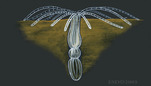
The starlet sea anemone has a bulbous basal end and a contracting column (usually less than two cm but no more than six cm) in order to burrow into the mud. At the top of the column is an oral disk containing the mouth surrounded by two rings of tentacles - typically 16 but up to 20. Although the general color is a greyish white, recent food consumption may temporarily affect pigmentation.
- Other Physical Features
- ectothermic
- heterothermic
- radial symmetry
-
- Range mass
- 10 to 25 g
- 0.35 to 0.88 oz
Reproduction
The starlet sea anemone is believed to reproduce asexually year-round by dividing into halves, while sexual reproduction occurs during the summer and fall.
- Parental Investment
- no parental involvement
Behavior
By pushing its basal end into the mud and contracting its column, this anemone burrows into fine mud in order to secure itself against water currents.
Also, like all members of the order Actiniaria, the starlet sea anemone is a solitary marine polyp.
Food Habits
This species is remarkably unselective in its food consumption; it eats mainly copepods and midge larvae. The tentacles trap prey, then the cilia beat downward creating a water flow helping pull the food from the oral disk into the gastrovascular cavity for consumption.
Economic Importance for Humans: Positive
none known
Economic Importance for Humans: Negative
none known
Conservation Status
Although populations in North America are relatively stable, they are endangered in England as only four populations survive.
This is extremely vulnerable. Because many individuals congregate into the same localities, pollution, human intervention or habitat destruction can wipe out entire populations.
-
- IUCN Red List
-
Vulnerable
More information
Other Comments
This species is a particularly good indicator of pollution because of its sensitivity to hypoxia (low levels of dissolved oxygen).
Contributors
Heather Mossman (author), University of Michigan-Ann Arbor.
Glossary
- Atlantic Ocean
-
the body of water between Africa, Europe, the southern ocean (above 60 degrees south latitude), and the western hemisphere. It is the second largest ocean in the world after the Pacific Ocean.

- Pacific Ocean
-
body of water between the southern ocean (above 60 degrees south latitude), Australia, Asia, and the western hemisphere. This is the world's largest ocean, covering about 28% of the world's surface.
- coastal
-
the nearshore aquatic habitats near a coast, or shoreline.
- ectothermic
-
animals which must use heat acquired from the environment and behavioral adaptations to regulate body temperature
- heterothermic
-
having a body temperature that fluctuates with that of the immediate environment; having no mechanism or a poorly developed mechanism for regulating internal body temperature.
- native range
-
the area in which the animal is naturally found, the region in which it is endemic.
- radial symmetry
-
a form of body symmetry in which the parts of an animal are arranged concentrically around a central oral/aboral axis and more than one imaginary plane through this axis results in halves that are mirror-images of each other. Examples are cnidarians (Phylum Cnidaria, jellyfish, anemones, and corals).
References
Wells, Susan, Pyle, Robert and Collins, N.Mark. 1983. The IUCN Invertebrate Red Data Book, 43-5.
Pearse and Bachebaum. 1987. Living Invertebrates, 163-8.
Banister and Campbell.1985. The Encyclopedia of Aquatic Life,176-9.
Pearse, Pearce and Bachebaum. 1987. Animals Without Backbones, 130-5.
Marshall, C., A. Jackson. 2004. "Nematostella vectensis: Starlet sea anemone" (On-line). Marine Life Information Network: Biology and Sensitivity Key Information Sub-programme. Accessed November 02, 2004 at http://www.marlin.ac.uk/species/Nematostellavectensis.htm.