Mystromys albicaudatuswhite-tailed mouse
Geographic Range
Mystromys albicaudatus is native to the Ethiopian region. It occurs in southern Swaziland and South Africa. (Mills and Hes, 1997; Nowak, 1999; Smithers, 1983; Stuart and Stuart, 1995)
Habitat
Mystromys albicaudatus inhabits savanna grasslands and semi-desert areas. It lives in burrows and in fissures in the soil. (Kingdon, 1997; Mills and Hes, 1997; Neithammer, 1990; Nowak, 1999; Smithers, 1983)
- Habitat Regions
- temperate
- terrestrial
- Terrestrial Biomes
- savanna or grassland
Physical Description
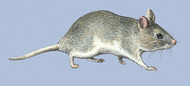
The fur color of M. albicaudatus is buffy-grey with speckles of black. Both the tail and the underside are white. Mystromys albicaudatus has large eyes. It does not have cheek pouches, as many of its relatives do. It has four toes on the forefeet and five on the hind feet. The female has two pairs of nipples, also called inguinal mammae. Mystromys albicaudatus is endothermic and bilaterally symmetric. The approximate length of the head and body is 14 to 18 centimeters for both sexes. The tail is approximately 5 to 8 centimeters. Sexual dimorphism is exhibited in this species in the form of weight difference. The average weight is 96 grams for males, and 78 grams for females. (Kingdon, 1997; Mills and Hes, 1997; Neithammer, 1990; Nowak, 1999; Roberts, 1951; Smithers, 1983; Stuart and Stuart, 1995)
- Other Physical Features
- endothermic
- bilateral symmetry
- Sexual Dimorphism
- male larger
Reproduction
The mating system of M. albicaudatus consists of monogamous pairs. The number of males and females is approximately equal, which is expected in species that are monogamous. Mystromys albicaudatus seems to breed year round. (Hallett and Meester, 1971; Smithers, 1983)
- Mating System
- monogamous
Births occur year round. The gestation period is usually about 37 days. Mystromys albicaudatus can produce many litters per year. Each litter consists of between two and five young, with a mean of 2.9 young per litter. The age of sexual maturity is not known, but the youngest age a female can produce a litter is 146 days. Lactation typically takes 38 days. During the first three weeks of lactation, the young remain continuously attached to the mother’s nipples. When there are five young, the mother periodically detaches one of the offspring so that the remaining one can feed as well. (Hallett and Meester, 1971; Mills and Hes, 1997; Nowak, 1999; Smithers, 1983)
- Key Reproductive Features
- gonochoric/gonochoristic/dioecious (sexes separate)
- sexual
-
- Breeding interval
- Mystromys albicaudatus breeds approximately every 10 weeks.
-
- Breeding season
- Mystromys albicaudatus seems to breed year round.
-
- Range number of offspring
- 2 to 5
-
- Average number of offspring
- 2.9
-
- Average number of offspring
- 3
- AnAge
-
- Average gestation period
- 37 days
-
- Average gestation period
- 38 days
- AnAge
-
- Average weaning age
- 38 days
-
- Range age at sexual or reproductive maturity (female)
- 146 (low) days
Both the male and the female care for the young. The female bears most of the burden though, as she not only lactates, but must drag the young around wherever she goes, as they remain attached almost constantly to her nipples for the first three weeks. The female aids in protection mainly by covering the young. The male is much more aggressive and attacks and bites intruders. In M. albicaudatus, only the female grooms the young. The young are born almost completely hairless. The eyes open on average between 16 and 20 days after birth. The incisors often begin to erupt between 3 and 5 days after birth. It takes about 38 days for the offspring to be fully weaned, though information on when the offspring are fully mature is not provided. (Hallett and Meester, 1971)
- Parental Investment
- altricial
-
pre-hatching/birth
-
provisioning
- female
-
provisioning
-
pre-weaning/fledging
-
provisioning
- female
-
protecting
- male
- female
-
provisioning
-
pre-independence
-
provisioning
- female
-
protecting
- male
- female
-
provisioning
Lifespan/Longevity
The lifespan of M. albicaudatus is not known in the wild, but it is approximately six years in captivity. (Neithammer, 1990)
-
- Average lifespan
Status: captivity - 6 years
- Average lifespan
-
- Average lifespan
Status: captivity - 6.0 years
- Max Planck Institute for Demographic Research
- Average lifespan
-
- Average lifespan
Status: captivity - 6.0 years
- Max Planck Institute for Demographic Research
- Average lifespan
Behavior
Mystromys albicaudatus is nocturnal. It has been reported that it is very active when it rains. It is not described as social; the only reported interactions are between a monogamous pair and its offspring. Mystromys albicaudatus engages in self-grooming, including scratching, face washing and licking. (Hallett and Meester, 1971; Nowak, 1999; Perrin, 1981)
Home Range
The range M. albicaudatus covers is not mentioned. The size of its territory is only the size of its burrow or the crack in the ground it lives in, but no measurements are provided. (Mills and Hes, 1997)
Communication and Perception
There is not much informatin in the literature regarding communication systems in M. albicaudatus. However, it clearly communicates though through vocalizations. When young are separated from their mother shortly after birth, they squeal until they find her. (Hallett and Meester, 1971)
- Communication Channels
- acoustic
Food Habits
Mystromys albicaudatus eats seeds, vegetable material and insects. In the lab, it has been fed and is particularly fond of meat. Also, parents have been seen eating dead offspring on occasion. (Hallett and Meester, 1971; Kingdon, 1997; Mills and Hes, 1997; Nowak, 1999; Stuart and Stuart, 1995)
- Primary Diet
- omnivore
- Animal Foods
- mammals
- insects
- Plant Foods
- seeds, grains, and nuts
Predation
The main predator of M. albicaudatus is the barn owl. Humans also cause population declines by habitat modification. (Mills and Hes, 1997)
-
- Known Predators
-
- barn owls (Tyto alba)
Ecosystem Roles
Mystromys albicaudatus has symbiotic bacteria in its stomach that may be important in carbohydrate fermentation. Also, it eats insects, so it contributes to keeping insect populations in check. Furthermore, it eats seeds, so it is involved in seed dispersal. (Mills and Hes, 1997; Nowak, 1999; Smithers, 1983; Maddock and Perrin, 1981; Mills and Hes, 1997; Nowak, 1999; Smithers, 1983)
- Ecosystem Impact
- disperses seeds
- symbiotic bacteria.
Economic Importance for Humans: Positive
Mystromys albicaudatus has benefited humans through its use in laboratory research. (Laregina, et al., 1978; Little, et al., 1982; McKinney and Hendricks, 1980; Roebuck and Longnecker, 1979; Waggie, et al., 1986)
- Positive Impacts
- research and education
Economic Importance for Humans: Negative
Mystromys albicaudatus is not known to negatively impact the economy.
Conservation Status
Current populations of M. albicaudatus are fragmented and in need of better conservational efforts. Mystromys albicaudatus is listed as endangered in the IUCN Red List. The IUCN indicates that up to 80 percent of its habitat has been lost, and 50 percent of the remaining habitat is expected to be lost in the next ten years if nothing is done. Its status has not been evaluated in the CITES appendices. (Dean, 1978; Downs and Perrin, 1995)
-
- IUCN Red List
-
Endangered
More information
-
- IUCN Red List
-
Endangered
More information
Contributors
Matthew Wund (editor), University of Michigan-Ann Arbor.
Nima Maani (author), University of Michigan-Ann Arbor, Phil Myers (editor, instructor), Museum of Zoology, University of Michigan-Ann Arbor.
Glossary
- Ethiopian
-
living in sub-Saharan Africa (south of 30 degrees north) and Madagascar.

- acoustic
-
uses sound to communicate
- altricial
-
young are born in a relatively underdeveloped state; they are unable to feed or care for themselves or locomote independently for a period of time after birth/hatching. In birds, naked and helpless after hatching.
- bilateral symmetry
-
having body symmetry such that the animal can be divided in one plane into two mirror-image halves. Animals with bilateral symmetry have dorsal and ventral sides, as well as anterior and posterior ends. Synapomorphy of the Bilateria.
- chemical
-
uses smells or other chemicals to communicate
- endothermic
-
animals that use metabolically generated heat to regulate body temperature independently of ambient temperature. Endothermy is a synapomorphy of the Mammalia, although it may have arisen in a (now extinct) synapsid ancestor; the fossil record does not distinguish these possibilities. Convergent in birds.
- monogamous
-
Having one mate at a time.
- motile
-
having the capacity to move from one place to another.
- native range
-
the area in which the animal is naturally found, the region in which it is endemic.
- nocturnal
-
active during the night
- omnivore
-
an animal that mainly eats all kinds of things, including plants and animals
- sexual
-
reproduction that includes combining the genetic contribution of two individuals, a male and a female
- tactile
-
uses touch to communicate
- temperate
-
that region of the Earth between 23.5 degrees North and 60 degrees North (between the Tropic of Cancer and the Arctic Circle) and between 23.5 degrees South and 60 degrees South (between the Tropic of Capricorn and the Antarctic Circle).
- terrestrial
-
Living on the ground.
- tropical savanna and grassland
-
A terrestrial biome. Savannas are grasslands with scattered individual trees that do not form a closed canopy. Extensive savannas are found in parts of subtropical and tropical Africa and South America, and in Australia.
- savanna
-
A grassland with scattered trees or scattered clumps of trees, a type of community intermediate between grassland and forest. See also Tropical savanna and grassland biome.
- temperate grassland
-
A terrestrial biome found in temperate latitudes (>23.5° N or S latitude). Vegetation is made up mostly of grasses, the height and species diversity of which depend largely on the amount of moisture available. Fire and grazing are important in the long-term maintenance of grasslands.
- visual
-
uses sight to communicate
References
Dean, W. 1978. Conservation of the white-tailed rat in South Africa. Biological Conservation, 13/2: 133-140.
Downs, C., M. Perrin. 1995. The thermal biology of the white-tailed rat Mystromys albicaudatus, a cricetine relic in southern temperate African grassland.. Comp. Biochem. Physiol., 110/1: 65-69.
Hallett, A., J. Meester. 1971. Early Postnatal Development of the South African Hamster Mystromys albicaudatus. Zoologica Africana, 6/2: 221-228.
Kingdon, J. 1997. The Kingdon Field Guide to African Mammals. London, England: Academic Press Limited.
Laregina, M., A. Kier, J. Wagner. 1978. A fatal enteric syndrome in Mystromys albicaudatus white-tailed rat following topical antibiotic treatment. Laboratory Animal Science, 28/5: 587-590.
Little, R., K. Parker, J. England, D. Goldstein. 1982. Glycosylated hemoglobin in Mystromys albicaudatus a diabetic animal model. Laboratory Animal Science, 32/1: 44-47.
Maddock, A., M. Perrin. 1981. A microscopical examination of the gastric morphology of the white-tailed rat Mystromys albicaudatus. South African Journal of Zoology, 16/4: 237-247.
McKinney, L., L. Hendricks. 1980. Experimental infection of Mystromys albicaudatus with Leishmania-Brasiliensis Pathology. American Journal of Tropical Medicine & Hygiene, 29/5: 753-760.
Mills, G., L. Hes. 1997. The Complete Book of Southern African Mammals. Cape Town, South Africa: Struik Winchester.
Neithammer, J. 1990. Burrowing Rodents. Pp. 258-259 in Grzimek's Encyclopedia of Mammals, Vol. 3, First Edition. New York: McGraw-Hill Publishing Company.
Nowak, R. 1999. White-tailed Rat. Pp. 1425-1426 in Walker's Mammals of the World, Vol. 3, Sixth Edition. Baltimore and London: The Johns Hopkins University Press.
Perrin, M. 1981. Notes on the activity patterns of 12 species of southern African rodents and a new design of activity monitor. South African Journal of Zoology, 16/4: 248-258.
Roberts, A. 1951. The Mammals of South Africa. New York: Hafner Publishing Company.
Roebuck, B., D. Longnecker. 1979. Response of 2 rodents Mastomys natalensis and Mystromys albicaudatus to the pancreatic carcinogen aza serine. Journal of the National Cancer Institute, 62/5: 1269-1272.
Smithers, R. 1983. The Mammals of the Southern African Subregion. Pretoria, South Africa: University of Pretoria.
Stuart, C., T. Stuart. 1995. Field Guide to the Mammals of Southern Africa. Cape Town, South Africa: Struik Publishers Ltd..
Waggie, K., L. Thornburg, J. Wagner. 1986. Experimentally induced Tyzzer’s disease in the African white-tailed rat Mystromys albicaudatus. Laboratory Animal Science, 36/5: 492-495.