Myotis volanslong-legged myotis
Geographic Range
Myotis volans is found across western North America, from southeastern Alaska to central Mexico. They are most commonly found at elevations from 2000 to 3000 m in coniferous forests. They are occasionally found in riparian or desert habitats, trading tree roosts for abandoned buildings and caves (Warner and Czaplewski 1984). One assessment of pinyon-juniper woodlands in New Mexico found that long-legged myotis make use of these lower elevation woodlands (Chung-MacCoubrey 2005). Another study in the same state found that the species may be more common at these lower elevations when they are migrating (Frey and Yates 1996). (Chung-MacCoubrey, 2005; Frey and Yates, 1996; Warner and Czaplewski, 1984)
Habitat
The most commonly observed roosts are snags, which are favorable due to the dead, peeling bark. The taller these snags are, the more likely Myotis volans will make use of them. Increased height allows for easier access, increased distance from predators, and when surrounded by open canopy, an increased amount of solar exposure, providing energy benefits (Vonhof and Barclay 1996; Ormsbee and McComb 1998). Height isn’t the only factor at play, as vicinity to other potential roosts influences choice, as snags close to other available snags have been shown as favorable for the long-legged myotis. This explains the frequent roost switching observed in Southern British Columbia (Vonhof and Barclay 1996).
In Douglas-Fir forests, snags are most commonly maternity roosts, with buildings and rock crevices used by lactating females as well. Solitary roosts were also found under bridges (Christy and West 1993).
In winter, Myotis volans gather in hibernacula, which are almost exclusively caves. In western Washington found mixed-sex groups of M. volans in six different caves. Nine individuals in this study were recaptured in the same location, indicating some may return to the same cave each year (Senger 1974). (Christy and West, 1993; Ormsbee and McComb, 1998; Senger, 1974; Vonhof and Barclay, 1996)
- Habitat Regions
- temperate
- Other Habitat Features
- caves
-
- Range elevation
- 60 to 3,770 m
- 196.85 to ft
-
- Average elevation
- 2000 to 3000 m
- ft
Physical Description
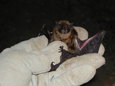
In the field, Myotis volans can be distinguished primarily by a distinctly keeled calcar, as well as short rounded ears and small hind feet. They have fur on the underside of their wing that extends further than other species of Myotis, from the body to the line joining the elbow and knee. In addition, they tend to have a skull with a short rostrum and an abruptly elevated forehead profile (Warner and Czaplewski 1984).
The average measurements of size in millimeters are as follows: total length, 83 to 106 mm; length of tail vertebrae, 41 mm; length of hindfoot, 7 mm; ear length, 11.8 mm; forearm length, 35.2 mm; length of skull, 13.4 to 15 mm; maxillary tooth row, 4.6 to 4.8 mm; zygomatic breadth, 8.2 to 9.0 mm; breadth of braincase, 7 to 7.6 mm (Baker and Phillips 1965).
In terms of sexual dimorphism, females have slightly longer forearms and condylar canines. There are no cases of males being significantly larger than females. The selection for increased size of females could be due to the increased energy demands of pregnancy. Larger size allows for ease of maintaining homeothermy, increased fat storage and a greater array of size for prey selection (Williams and Findley 1979).
The masticatory apparatus found it best suited for a wide gap followed by a forceful closure for capturing insects (Reduker 1983). In terms of teeth, incisors 1 and 3 usually overlap and the incisors are capable of rotation of 150°. These characteristics are specific to M. volans and could serve as important taxonomic characteristics when distinguishing this species from others (Hardy and Arant 2010).
Both the standard and G-banded karyotypes for M. volans are indistinguishable from other species of Myotis (Baker and Patton 1967; Bickham 1979). There are 50 autosomal arms and a diploid number of 44. The X chromosome is medium sized and submetacentric while the Y-chromosome is a small acrocentric (Baker and Patton 1967; Bickham 1979).
The Myotis genome contains five transposable elements, which are mobile DNA sequences present in virtually all organisms and thought to have been inactive in mammals. The piggyBac element of this group is a relatively young transposon, meaning it is likely a recent addition. In contrast, there were multiple copies of the hAT3 element, meaning it is conserved (Frerich and Ammerman 2014). (Baker and Patton, 1967; Baker and Phillips, 1965; Bickham, 1979; Frerich and Ammerman, 2014; Gorresen, et al., 2015; Hardy and Arant, 2010; Reduker, 1983; Warner and Czaplewski, 1984; Williams and Findley, 1979)
- Other Physical Features
- endothermic
- heterothermic
- bilateral symmetry
- Sexual Dimorphism
- female larger
-
- Range mass
- 5 to 10 g
- 0.18 to 0.35 oz
-
- Range length
- 83 to 106 mm
- 3.27 to 4.17 in
-
- Range wingspan
- 242 to 286 mm
- 9.53 to 11.26 in
Reproduction
It is unknown how many mates females or males of this species will have, but mature females will produce one offspring in the breeding season (Davis and Barbour 1970). Like other species of Myotis, they are likely to mate at hibernacula. (Davis and Barbour, 1970)
- Mating System
- polygynandrous (promiscuous)
Spermatogenesis occurs May through August, with peak spermatogenesis occurring in July and spermatogenesis in August. There is a short period of time for primary spermatocyte production that is suspected to be an adaptation for hibernation. Ovulation occurs March through May, followed by parturition from May to early August and lactation coinciding from May until Late August (Druecker 1972).
Overall, reproductive timing for Myotis volans seems to vary greatly, as reports for reproductively active females have shown a wide range of dates depending on the location of capture. In Nevada, pregnant females were caught from June 10th to July 14th (Hall 1946). In South Dakota, pregnant females were caught until June 30th (Jones and Genoways 1967) and in Montana as late as July 9th (Jones et al. 1973). At an even later date of July 4th, pregnant females were caught in Southern California, while the latest date for capture in New Mexico was July 13th (Davis and Barbour 1970). It should be noted that researchers in New Mexico recognized that this was a particularly late parturition period in this region compared with others.
Juveniles typically become volant in August. In Nebraska, pregnant and lactating females were caught from April to August, with the first volant young caught on August 9th (Czaplewski et. al 1979). In Wyoming, pregnant females were caught until Late July, with postpartum females caught July 26, 27, and 29 and August 16 and 17 (Findley 1954). (Czaplewski, et al., 1979; Davis and Barbour, 1970; Dreucker, 1972; Findley, 1954; Hall, 1946; Jones and Genoways, 1967; Jones, et al., 1973)
- Key Reproductive Features
- seasonal breeding
- gonochoric/gonochoristic/dioecious (sexes separate)
- sexual
- viviparous
-
- Breeding interval
- This species breeds once a year.
-
- Breeding season
- May to August
-
- Average number of offspring
- 1
-
- Average number of offspring
- 1
- AnAge
-
- Average age at sexual or reproductive maturity (female)
Sex: female - 152 days
- AnAge
- Average age at sexual or reproductive maturity (female)
The female of this species will care for offspring, but it is not known how long this care lasts until the young can be independent (Dreucker 1972). (Dreucker, 1972)
- Parental Investment
- female parental care
-
pre-hatching/birth
-
provisioning
- female
-
protecting
- female
-
provisioning
-
pre-weaning/fledging
-
provisioning
- female
-
protecting
- female
-
provisioning
-
pre-independence
-
provisioning
- female
-
protecting
- female
-
provisioning
Lifespan/Longevity
Based on recapture data from banded individuals, Myotis volans is known to live at least 21 years (Warner and Czaplewski 1984). (Warner and Czaplewski, 1984)
-
- Average lifespan
Status: wild - 21 years
- Average lifespan
-
- Average lifespan
Sex: male
Status: wild - 2.1 years
- Max Planck Institute for Demographic Research
- Average lifespan
Behavior
Their flight is described as rapid and direct with elaborate maneuvers, usually remaining at treetop level through clumps of trees (Fenton and Bell 1979). They are capable of flying at a speed of 15 to 17 kilometers per hour (Hayward and Davis 1964).
Like other species of Myotis, they emerge at dusk, immediately flocking to pools to drink water (Fenton et al. 1983). Water is likely a significant source of calcium not provided in their diet, as there is higher capture frequency for reproductive females and juveniles at sites with higher water hardness, which correlates to higher dissolved calcium content (Adams et al. 2003). (Adams, et al., 2003; Fenton and Bell, 1979; Fenton, et al., 1983; Hayward and Davis, 1964)
- Key Behaviors
- flies
- nocturnal
- motile
- hibernation
- social
- colonial
Communication and Perception
Echolocation consists of two different types of frequency: frequency modulated (FM) and constant frequency (CF). Myotis volans has a FM echolocation call, with CF component produced during the approach phase of capture. As they approach landing sites, they produce a high-pulse repetition rate. Their CF component can be relatively long, suggesting a greater range of detection than other species. If they are on a collision course with another individual, they will click at each other (Fenton and Bell 1979). The characteristics of their calls suggest they are best adapted for foraging against a mix of unwanted noise, known as background clutter (Pettit and Wilkins 2012).
The sound of their call is similar to Myotis lucifugus (Fenton and Bell 1979), but their calls are usually shorter with a higher max frequency (Saunders and Barclay 1992). Call files from Myotis evotis are essentially indistinguishable from M. volans although calls of the latter tend to be less frequency-modulated (Pettit and Wilkins 2012).
Myotis volans individuals have the capacity to respond behaviorally to subtle changes of light in the ultraviolet spectrum. This ability could be useful for finding food, roosts, communication between individuals, monitoring of predators and entertaining circadian rhythms (Gorresen et al. 2015). (Fenton and Bell, 1979; Gorresen, et al., 2015; Pettit and Wilkins, 2012; Saunders and Barclay, 1992)
- Communication Channels
- acoustic
- Perception Channels
- visual
- tactile
- echolocation
- chemical
Food Habits
Individuals have been observed feeding under canopies of trees (Fenton and Bell 1979), high above the ground in open areas, and along cliff edges (Saunders and Barclay 1992). Foraging activity is substantially greater in riparian areas in comparison with upland areas (Grindal et al. 1999). They tend to fix in on prey from at least 5 and up to 10 meters away (Fenton and Bell 1979). Their capture technique is 37.5% successful when moths are evasive, and 98% successful when moths are not evading attack (Corcoran and Conner 2016).
Myotis volans feed on a wide variety soft-bodied insects including moths (Lepidoptera), flies (Diptera), termites (Isoptera), lace wigs (Neuroptera), wasps (Hymenoptera), bugs (Hemiptera), leafhoppers (Homoptera) and small beetles (Coleoptera) (Black 1974; Jones et. al 1973; Warner 1981; Whitaker et al. 1977,1981). Numerous studies of prey selection have determined a specialization primarily for Lepidoptera (Lacki et al. 2007; Ober and Hayes 2008; Johnson et al. 2007). A study conducted in British Columbia found that principal prey groups are diptera, lepidoptera, neuroptera, and hymenoptera (Kellner and Harestead 2005).
In north-central Idaho, differences in prey consumption related to reproductive status. In lactating females, more lepidoptera and less dipterans were consumed, while pregnant females consumed more coleopterans. In comparison to males, pregnant females consumed more trichopterans (Johnson et al. 2007).
The mean digestive efficiency of M. volans is between 75 and 78%. However, small moths around 20 mg are digested with an efficiency under 75% and it is likely that actual digestive efficiencies in the field are under 70%. Most natural prey are smaller and typically consumed whole, so the efficiency is expected to be lower than these values (Barclay et al. 2011). (Barclay, et al., 2011; Black, 1974; Corcoran and Conner, 2016; Fenton and Bell, 1979; Grindal, et al., 1999; Jones, et al., 1973; Kellner and Harestad, 2005; Lacki, et al., 2007; Ober and Hayes, 2008; Saunders and Barclay, 1992; Warner, 1981; Whitaker, et al., 1981; Whitaker, et al., 1977)
- Primary Diet
- carnivore
- Animal Foods
- insects
Predation
Little is known about the predators or anti-predator adaptations of Myotis volans.
Ecosystem Roles
A variety of ectoparasites have been found on Myotis volans, including the bat bug Cimex piloselis (Hansen, 1964); the flea Myodopsyllus gentilis (Andersen and Jones 1971; Jones et al. 1973); the mites Ichoronyssus britannicus (Furman 1950), Pteracarus chalinolobus (Jameson and Chow 1952), Cryptonyssus desultorius, Macronyssus crosbi, macronyssid n. Sp., Spinturnix americanus, S. bakeri, S. globosus, Notoedres, Acanthophthirius gracilis (Whitaker et al. 1983), and Spinturnix (Jones et al. 1973; Ritzi et al. 2001); the chigger Leptotrombidium myotis (Andersen and Jones 1971; Jones and Genoways 1967; Whitaker et al. 1983); and the nycteribiidae flies Basilia forcipata (Hansen 1964; Jones et al. 1973) and Basilia forcipata (Fox and Stabler 1953).
Maseria vespertilionis was recorded from a M. volans in Oregon. This nematode is found in the subcutaneous tissues near the plantar surface of the rear feet, producing significant lesions in this area (Rausch and Rausch 1983). Carios kelleyi, a species of tick, has been found on M. volans in Southern Alberta and North Central Montana (Lausen 2005).
In British Columbia the gastrointestinal parasites Plagiorchis vespertilionis, P. naviculum, Rictularia lucifugus, Allintoshius nycticeius were found in M. volans (Webster and Casey 1973). In southern Wyoming, one individual passed oocysts from Eimeria californiensis, a parasite capable of causing disease of the intestinal tract known as coccidiosis (Seville and Gruver 2004). Twenty species of bats collected from California, New Mexico, Oregon, South Carolina, Utah, and Baja California Note (Mexico), including Myotis volans showed 7% of the 404 were infected with species of Eimeria (Duszynski et al. 1999). (Andersen and Jones, 1971; Duszynksi, et al., 1999; Fox and Stabler, 1953; Furman, 1950; Hansen, 1964; Jameson and Chow, 1952; Jones and Genoways, 1967; Jones, et al., 1973; Lausen, 2005; Rausch and Rausch, 1983; Ritzi, et al., 2001; Seville and Gruver, 2004; Webster and Casey, 1973; Whitaker, et al., 1983)
- Cimex pilosellus
- Myodopsyllus gentillis
- Ichoronyssus britannicus
- Pteracarus chalinolobus
- Cryptonyssus desultorius
- Macronyssus crosbi
- Macronyssid
- Spinturnix americanus
- Spinturnix bakeri
- Spinturnix globosus
- Notoedres
- Acanthopthirius gracilis
- Leptotrombidium myotis
- Basilia forcipata
- Masseria vespertilionis
- Carios kelleyi
- Plagiorchis vespertilionis
- Plagiorchis naviculum
- Rictularia lucifigus
- Allintoshius nycticeius
- Eimeria californiensis
Economic Importance for Humans: Positive
Bats provide billions of dollars every year in the pest control services they provide for agricultural sectors (Magnino 2021). (Magnino, 2021)
- Positive Impacts
- controls pest population
Economic Importance for Humans: Negative
Some bat species are vectors for disease, such as rabies, but there are no reported instances related to human contact for this species. Rabies-neutralizing antibodies have been found in individuals of this species, suggesting common exposure to the virus (Bowen et al. 2013). (Bowen, et al., 2013)
Conservation Status
Variation in temperature has an effect on capture rates for Myotis volans, with more captures in years with cooler temperatures in June in Colorado. When mean temperatures in June increased by 1.8℃ over a six year period, there were zero captures for five of those years. This indicates a response to climate warming for this species in the Rocky Mountains of Colorado. It is possible that loss of spring down-slope migrations is an adaptation to mitigate these climate warming effects (Adams 2018). It is also possible that this is a result of sampling stochasticity.
Over a 20 year period, there is a long-term trend of reduced proportions of adult female bats in the Front Range of Colorado. Hotter and drier conditions appear to correlate with increased male births. Cooler, wetter conditions are optimal for maintaining ideal sex ratios. If climate continually warms in the region, reproductive activity will undergo significant decline, tending towards a male-biased sex ratio (Adams and Hayes 2018).
White-Nose Syndrome is a disease caused by the fungal pathogen Pseudogymnoascus destructans. This fungus grows in cold temperatures and affects bats while they are in hibernation. Their bodies are in a reduced metabolic state, known as torpor at this time. The infections stresses the metabolic system and often results in mortality (Magnino 2021). This disease has not yet negatively impacted this species as far as we know, but could be a threat in the future (Adams, 2018; Adams and Hayes, 2018; Magnino, 2021)
-
- IUCN Red List
-
Least Concern
More information
-
- IUCN Red List
-
Least Concern
More information
-
- US Federal List
- No special status
-
- CITES
- No special status
-
- State of Michigan List
- No special status
Other Comments
There is a significant amount that unknown about this species, so a push for more research is needed.
Contributors
Faith Cunningham (author), Colorado State University, Tanya Dewey (editor), University of Michigan-Ann Arbor.
Glossary
- Nearctic
-
living in the Nearctic biogeographic province, the northern part of the New World. This includes Greenland, the Canadian Arctic islands, and all of the North American as far south as the highlands of central Mexico.

- acoustic
-
uses sound to communicate
- bilateral symmetry
-
having body symmetry such that the animal can be divided in one plane into two mirror-image halves. Animals with bilateral symmetry have dorsal and ventral sides, as well as anterior and posterior ends. Synapomorphy of the Bilateria.
- carnivore
-
an animal that mainly eats meat
- chaparral
-
Found in coastal areas between 30 and 40 degrees latitude, in areas with a Mediterranean climate. Vegetation is dominated by stands of dense, spiny shrubs with tough (hard or waxy) evergreen leaves. May be maintained by periodic fire. In South America it includes the scrub ecotone between forest and paramo.
- chemical
-
uses smells or other chemicals to communicate
- colonial
-
used loosely to describe any group of organisms living together or in close proximity to each other - for example nesting shorebirds that live in large colonies. More specifically refers to a group of organisms in which members act as specialized subunits (a continuous, modular society) - as in clonal organisms.
- echolocation
-
The process by which an animal locates itself with respect to other animals and objects by emitting sound waves and sensing the pattern of the reflected sound waves.
- endothermic
-
animals that use metabolically generated heat to regulate body temperature independently of ambient temperature. Endothermy is a synapomorphy of the Mammalia, although it may have arisen in a (now extinct) synapsid ancestor; the fossil record does not distinguish these possibilities. Convergent in birds.
- female parental care
-
parental care is carried out by females
- forest
-
forest biomes are dominated by trees, otherwise forest biomes can vary widely in amount of precipitation and seasonality.
- heterothermic
-
having a body temperature that fluctuates with that of the immediate environment; having no mechanism or a poorly developed mechanism for regulating internal body temperature.
- hibernation
-
the state that some animals enter during winter in which normal physiological processes are significantly reduced, thus lowering the animal's energy requirements. The act or condition of passing winter in a torpid or resting state, typically involving the abandonment of homoiothermy in mammals.
- insectivore
-
An animal that eats mainly insects or spiders.
- motile
-
having the capacity to move from one place to another.
- mountains
-
This terrestrial biome includes summits of high mountains, either without vegetation or covered by low, tundra-like vegetation.
- native range
-
the area in which the animal is naturally found, the region in which it is endemic.
- nocturnal
-
active during the night
- polygynandrous
-
the kind of polygamy in which a female pairs with several males, each of which also pairs with several different females.
- seasonal breeding
-
breeding is confined to a particular season
- sexual
-
reproduction that includes combining the genetic contribution of two individuals, a male and a female
- social
-
associates with others of its species; forms social groups.
- tactile
-
uses touch to communicate
- temperate
-
that region of the Earth between 23.5 degrees North and 60 degrees North (between the Tropic of Cancer and the Arctic Circle) and between 23.5 degrees South and 60 degrees South (between the Tropic of Capricorn and the Antarctic Circle).
- visual
-
uses sight to communicate
- viviparous
-
reproduction in which fertilization and development take place within the female body and the developing embryo derives nourishment from the female.
References
Adams, R. 2018. Dark side of climate change: Species-specific responses and first indications of disruption in spring altitudinal migration in myotis bats. Journal of Zoology, 304(4): 268-275.
Adams, R., R. Hayes. 2018. Assemblage-level analysis of sex-ratios in Coloradan bats in relation to climate variables: A model for future expectations.. Global Ecology and Conservation, 14.
Adams, R., S. Pedersen, K. Thibault, J. Jadin, B. Petru. 2003. Calcium as a limiting resource to insectivorous bats: can water holes provide a supplemental mineral source?. Journal of Zoology, 260: 189-194.
Andersen, K., J. Jones. 1971. Mammals of northwestern South Dakota. University of Kansas Publications, Museum of Natural History, 19: 361-393.
Baker, M., C. Phillips. 1965. Mammals from El Nevado De Colima, Mexico. Journal of Mammalogy, 46(4): 691-693.
Baker, R., J. Patton. 1967. Karyotypes and karyotypic variation of North American vespertilionid bats. Journal of Mammalogy, 48: 270-286.
Barclay, R., M. Dolan, A. Dyck. 2011. The digestive efficiency of insectivorous bats. Canadian Journal of Zoology, 69(7): 1853-1856.
Bickham, J. 1979. Banded karyotypes of 11 species of American bats (genus Myotis). Cytologia, 44: 789-797.
Black, H. 1974. A north temperate bat community: structure and prey populations. Journal of Mammalogy, 55: 138-157.
Bowen, R., T. O'Shea, V. Shankar, M. Neubaum, D. Neubaum, C. Rupprecht. 2013. Prevalence of neutralizing antibodies to rabies virus in serum of seven species of insectivorous bats from Colorado and New Mexico, United States. Journal of Wildlife Diseases, 49(2): 367-374.
Christy, R., S. West. 1993. Biology of bats in Douglas-fir forests. U.S. Dept. of Agriculture, Forest Service, Pacific Northwest Research Station..
Chung-MacCoubrey, A. 2005. Use of pinyon-juniper woodlands by bats in New Mexico. Forest Ecology and Management, 204(2): 209-220.
Corcoran, A., W. Conner. 2016. How moths escape bats: predicting outcomes of predator–prey interactions. Journal of Experimental Biology, 219(17): 2704-2715.
Czaplewski, N., J. Farney, J. Jones, J. Dreucker. 1979. Synopsis of bats of Nebraska. Occasional Papers Museum, Texas Tech University, 61: 1-24.
Davis, W., R. Barbour. 1970. Life History Data on Some Southwestern Myotis. The Southwestern Naturalist, 15(2): 261-263.
Dreucker, J. 1972. Aspects Of Reproduction In Myotis Volans, Lasionycteris Noctivagans, And Lasiurus Cinereus. ProQuest Dissertations & Theses Global..
Duszynksi, D., D. Scott, J. Aragon, A. Leach, T. Perry. 1999. Six New Eimeria Species from Vespertilionid Bats of North America.. Journal of Parasitology, 85(3): 496-503.
Fenton, B., G. Bell. 1979. Echolocation and feeding behaviour in four species of Myotis (Chiroptera). Canadian Journal of Zoology (Revue Canadienne de Zoologie), 57(6): 1271-1277.
Fenton, M., H. Merriam, G. Holroyd. 1983. Bats of Kootenay, Glacier, and Mount Revelstoke national parks in Canada: identification by echolocation calls, distribution, and biology. Canadian Journal of Zoology, 61(11): 2503-2508.
Findley, J. 1954. Reproduction in Two Species of Myotis in Jackson Hole, Wyoming. Journal of Mammalogy, 35(3): 434.
Fox, R., R. Stabler. 1953. Basilia calverti n. Sp. (Diptera: Nycteribiidae) from the interior long-legged bat. Journal of Parasitology, 39: 22-27.
Frerich, K., L. Ammerman. 2014. Investigation of hAT and piggyBac transposons in mouse-eared bats (Genus: Myotis). BIOS, 85(1): 67-72.
Frey, J., T. Yates. 1996. Mammalian diversity in New Mexico. New Mexico Journal of Science, 36: 4-37.
Furman, D. 1950. New mites (Acarina: Liponyssinae) from North American bats. Journal of Parasitology, 36: 479-484.
Gorresen, P., P. Cryan, D. Dalton, S. Wolf, F. Bonaccorso. 2015. Ultraviolet Vision May be Widespread in Bats. Acta Chiropterologica, 17(1): 972-977.
Grindal, S., J. Morissette, R. Brigham. 1999. Concentration of bat activity in riparian habitats over an elevational gradient. Canadian Journal of Zoology, 77(6): 972-977.
Hall, E. 1946. Mammals of Nevada. University of California Berkeley Press: 710.
Hansen, C. 1964. Ectoparasites of mammals from Oregon. Great Basin Naturalist, 24: 75-81.
Hardy, L., T. Arant. 2010. Rotation of Incisors in the Bat Genera Myotis, Epesticus, and Nycticeius. Southeastern Naturalist, 9(1): 63-72.
Hayward, B., R. Davis. 1964. Flight Speeds in Western Bats. Journal of Mammalogy, 45(2): 236-242.
Jameson, E., C. Chow. 1952. Pteracurus, a new genus of myobiid mites (Acarina: Myobiidae) from bats (Mammalia: Chiroptera). Journal of Parasitology, 38: 218-221.
Jones, J., H. Genoways. 1967. Annotated checklist of bats from South Dakota. Transactions of the Kansas Academy of Science, 70: 184-196.
Jones, J., R. Lampe, C. Spernath, T. Kunz. 1973. Notes on the distribution and natural history of bats in southeastern Montana.. Occasional Papers Museum, Texas Tech University, 15: 1-12.
Kellner, A., A. Harestad. 2005. Diets of bats in coastal rainforests on Vancouver Island, British Columbia. Northwestern Naturalist, 86(2): 45-48.
Lacki, M., J. Johnson, L. Dodd, M. Baker. 2007. Prey Consumption of Insectivorous Bats in Coniferous Forests of North-Central Idaho. Northwest Science, 81(3): 199-205.
Lausen, C. 2005. First Record of Hosts for Tick Carios kelleyi (Acari: Ixodida: Argasidae) in Canada and Montana. Journal of Medical Entomology, 42(3): 497-501.
Magnino, M. 2021. White-Nose Syndrome: A Novel Dermatomycosis of Biologic Interest and Epidemiologic Consequence. Clinics in Dermatology, 39(2): 299-303.
Ober, H., J. Hayes. 2008. Prey Selection by Bats in Forests of Western Oregon.. Journal of Mammalogy, 89(5): 1191-1200.
Ormsbee, P., W. McComb. 1998. Selection of Day Roosts by Female Long-Legged Myotis in the Central Oregon Cascade Range. The Journal of Wildlife Management, 62(2): 596-603.
Pettit, T., K. Wilkins. 2012. Canopy and edge activity of bats in a quaking aspen (Populus tremuloides) forest. Canadian Journal of Zoology, 90(7): 798-807.
Rausch, R., V. Rausch. 1983.
Masseria Vespertilionis n.g., n.sp. (dorylaimina : muspiceidae), a Nematode from Nearctic Bats (Vespertilionidae). Ann. Parasitol. Hum. Comp., 58(4): 361-376.
Reduker, D. 1983. Functional Analysis of the Masticatory Apparatus in Two Species of Myotis. Journal of Mammalogy, 64(2): 277-286.
Ritzi, C., L. Ammerman, M. Dixon, J. Richerson. 2001. Bat Ectoparasites from the Trans-Pecos Region of Texas, Including Notes from Big Bend National Park. Journal of Medical Entomology, 38(3): 400-404.
Saunders, M., R. Barclay. 1992. Ecomorphology of Insectivorous Bats: A Test of Predictions Using Two Morphologically Similar Species. Ecology, 73: 1335-1345.
Senger, C. 1974. Winter Records of Myotid Bats in Western Washington. The Murrelet, 55(1): 13-14.
Seville, R., J. Gruver. 2004. Species of Eimeria (Apicomlexa: Eimeriidae) from bats (Chiroptera: Vespertilionidae) in central Wyoming. Journal of Parasitology, 90(2): 348-351.
Vonhof, M., R. Barclay. 1996. Roost-site selection and roosting ecology of forest-dwelling bats of British Columbia. Canadian Journal of Zoology (Revue Canadienne de Zoologie), 74: 1797-1805.
Warner, R. 1981. A temperate, montane bat community: foraging behavior and morphological correlates. UnpubIished M.S. thesis, Northern Arizona University, Flagstaff: 118.
Warner, R., N. Czaplewski. 1984. Mytois volans. Mammalian Species, 224: 1-4.
Webster, W., G. Casey. 1973. Studies on the parasites of Chiroptera. III. Helminths from various bat species collected in British Columbia. Canadian Journal of Zoology, 51(6): 633-636.
Whitaker, J., C. Maser, S. Cross. 1981. Food habits of eastern Oregon bats, based on stomach and scat analysis. Northwest Science, 55: 281-292.
Whitaker, J., C. Maser, L. Keller. 1977. Food habits of bats of western Oregon. Northwest Science, 51: 46-55.
Whitaker, J., C. Yunker, C. Maser. 1983. Acarine ectoparasites (mites) of bats of Oregon.. Northwest Science, 57: 97-106.
Williams, D., J. Findley. 1979. Sexual Size Dimorphism in Vespertilionid Bats. The American Midland Naturalist, 102(1): 113-126.