Myotis septentrionalisnorthern long-eared myotis



Geographic Range
Myotis septentrionalis is widely but sparsely distributed across forested regions of the eastern United States. It ranges across southern Canada and up to Newfoundland. It extends down into Florida, through the south central states and through the Dakotas, into eastern British Columbia. In the Columbia Basin M. septentrionalis inhabits several different regions including Cranbrook, Invermere, Golden and Revelstoke forest districts (Trouessart, 1999). It has also been found scattered throughout eastern, central and northern British Columbia including the Peace River, Revelstoke and Liard River areas (Bat Conservation International, 2001). (Bat Conservation International, Inc, 2001; Trouessart, 1999)
Habitat
Northern bats are associated with boreal forests. In British Columbia they are found in the wet forests of the interior cedar-hemlock biogeoclimatic zone. In areas of North America and Canada these bats choose maternity roosts in buildings, under loose bark, and in the cavities of trees. Caves and underground mines are their choice sites for hibernating. (Trouessart, 1999)
- Habitat Regions
- temperate
- Terrestrial Biomes
- forest
Physical Description
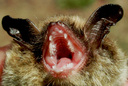
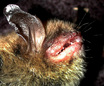
Myotis septentrionalis is a medium sized bat best recognized by its long rounded ears, which extend beyond the tip of the nose when laid forward. It has a comparatively longer tail and larger wing area than Myotis species of similar size; these structural adaptations are associated with its gleaning foraging strategy (Altenbach et. al., 2001).
The total body length of northern bats is 78 mm. The tail measures 26 mm, the foot measures 9 mm, the ears measure 17 to 19 mm, and the forearm measures 35 mm. Northern bats have a wingspan ranging between 23 and 26 cm. These bats weigh 6 to 9 grams. The females of this species are generally larger and heavier than the males (Altenbach et. al., 2001).
The pelage is a dull yellow/brown, with a pale gray ventral side, and dull, brown shoulder spotting (Trouessart, 1999). Myotis septentrionalis has a long, narrow, sharp-pointed tragus, and the calcar lacks a keel (Texas Technical University, 1997). Its skull is narrow with a relatively long rostrum. Its dental formula is that of M. californicus: I 2/3, C 1/1, Pm 3/3, M 3/3 X 2 = 38. (Altenbach, J. S. and Harvey, M. J., 2001; Texas Technical University, 1997; Trouessart, 1999)
- Other Physical Features
- endothermic
- bilateral symmetry
- Sexual Dimorphism
- female larger
-
- Range mass
- 6 to 9 g
- 0.21 to 0.32 oz
-
- Average length
- 78 mm
- 3.07 in
-
- Range wingspan
- 23 to 26 cm
- 9.06 to 10.24 in
Reproduction
During copulation, a male northern bat mounts a female from behind, occasionally grasping the female's neck with his teeth (Barclay et. al., 2000). Northern bats are promiscuous. (Caceres and Barclay, May 12, 2000)
- Mating System
- polygynandrous (promiscuous)
Mating occurs in autumn when groups of a few hundred are formed and pairs copulate before going into hibernation (Trouessart, 1999).
The females store sperm in their uteri during hibernation; ovulation will not occur until they emerge in the spring. Gestation lasts 50 to 60 days, after which a single young is born. In British Columbia limited breeding information suggests that young are born in late June or early July. (Trouessart, 1999)
- Key Reproductive Features
- iteroparous
- seasonal breeding
- gonochoric/gonochoristic/dioecious (sexes separate)
- sexual
- viviparous
- sperm-storing
- delayed fertilization
-
- Breeding season
- These bats breed in autumn.
-
- Range number of offspring
- 1 to 1
-
- Range gestation period
- 50 to 60 days
-
- Average weaning age
- 30 days
Northern bats are born helpless and completely dependent on their mothers. Female northern bats nurse their young for about a month. Males do not help care for the young.
- Parental Investment
- altricial
-
pre-fertilization
-
protecting
- female
-
protecting
-
pre-hatching/birth
-
provisioning
- female
-
protecting
- female
-
provisioning
-
pre-weaning/fledging
-
provisioning
- female
-
protecting
- female
-
provisioning
Lifespan/Longevity
Individuals have been known to live up to 18.5 years. (Bogan, M. A. and Valdez, E. W., December 14, 2000)
-
- Typical lifespan
Status: wild - 18.5 (high) years
- Typical lifespan
-
- Average lifespan
Status: wild - 18.5 years
- Average lifespan
Behavior
During the summer northern bats are commonly found in higher densities around the northern areas of their range, as they are especially reliant upon the richly forested habitats in the north around this time (Altringham, 1996).
Occasionally, these bats may be found roosting with other bat species, although they are much less social than other members of the genus Myotis. The sexes roost separately; however, reproductive females may form small maternity colonies of less than 60 individuals (Altringham, 1996).
In late summer or early autumn the bats gather and move to the places where they will hibernate, traveling up to 56 kilometers from their summer habitat. They generally hibernate alone although they sometimes form very small groups. During hibernation these bats prefer moist, still, narrow crevices where temperatures may be as low as 1.6 degrees Celsius. Hibernation may last for 8 to 9 months in the northern latitudes; length of hibernation varies among the various latitudes and environments. The same hibernacula are often inhabited more than once although not necessarily in sequential seasons. (Altringham, John D., 1996; Caceres and Barclay, May 12, 2000)
Communication and Perception
Nothern bats use passive listening and echolocation to locate insects resting on leaves, tree trunks, or on buildings. (Bogan, M. A. and Valdez, E. W., December 14, 2000)
- Perception Channels
- tactile
- acoustic
- echolocation
- chemical
Food Habits
Myotis septentrionalis emerges shortly after sunset to hunt. Hunting occurs over small ponds, forest clearings and forest edges at a height of 1 to 3 meters. Hunting is coupled with periodic rests (night roosting), followed by a second peak of hunting just before dawn (Trouessart, 1999).
In general, these bats consume a variety of smaller night-flying insects, but they may sometimes glean sitting prey as well.
Foods eaten include: caddisflies, moths, beetles, flies and leafhoppers. (Bogan, M. A. and Valdez, E. W., December 14, 2000; Trouessart, 1999)
- Primary Diet
- carnivore
- Animal Foods
- insects
Predation
No predators are known.
Ecosystem Roles
Northern bats play an important role in their ecosystem by eating large quantities of insects.
Economic Importance for Humans: Positive
Due to its insectivorous feeding style, M. septentrionalis helps control populations of potentionally harmful insects. (Altringham, John D., 1996)
- Positive Impacts
- controls pest population
Economic Importance for Humans: Negative
As is the case with most bats, many humans consider northern bats to be pests. Bats often work their way into the attics of houses and may carry a threat of rabies, although this threat is often exaggerated. (Altringham, John D., 1996)
- Negative Impacts
- household pest
Conservation Status
Timber harvesting may interfere with these bats' ability to utilize trees for nursery colonies and day roosts. It also may prove detrimental to their foraging habits in forested areas (Thomas, 1993). Use of chemical and biological insecticides is another source of concern affecting their food supply. A less vital, yet very real threat to M. septentrionalis is the disturbance they face in the caves (where recreational "caving" is popular) or mines (which are often closed after being abandoned) where they hibernate. A solution to the problem of disturbance at hibernacula is to put up gates that permit the bats to pass while excluding humans. (Thomas, Donald W., 1993)
Temperate North American bats are now threatened by a fungal disease called “white-nose syndrome.” This disease has devastated eastern North American bat populations at hibernation sites since 2007. The fungus, Geomyces destructans, grows best in cold, humid conditions that are typical of many bat hibernacula. The fungus grows on, and in some cases invades, the bodies of hibernating bats and seems to result in disturbance from hibernation, causing a debilitating loss of important metabolic resources and mass deaths. Mortality rates at some hibernation sites have been as high as 90%. (Cryan, 2010; National Park Service, Wildlife Health Center, 2010)
-
- IUCN Red List
-
Least Concern
More information
-
- IUCN Red List
-
Least Concern
More information
-
- US Migratory Bird Act
- No special status
-
- US Federal List
- No special status
-
- CITES
- No special status
-
- State of Michigan List
- No special status
Other Comments
Myotis septentrionalis was formerly classified as a member of the species keeni (Barclay et. al., 2000).
Myotis is a derivative of the Greek word for "mouse-eared" (Barclay et. al., 2000).
Septentrionalis comes from the Latin word for "northern". (Caceres and Barclay, May 12, 2000)
Contributors
Allison Poor (editor), University of Michigan-Ann Arbor.
Jessica Ollendorff (author), University of Michigan-Ann Arbor, Ondrej Podlaha (editor), University of Michigan-Ann Arbor.
Glossary
- Nearctic
-
living in the Nearctic biogeographic province, the northern part of the New World. This includes Greenland, the Canadian Arctic islands, and all of the North American as far south as the highlands of central Mexico.

- acoustic
-
uses sound to communicate
- altricial
-
young are born in a relatively underdeveloped state; they are unable to feed or care for themselves or locomote independently for a period of time after birth/hatching. In birds, naked and helpless after hatching.
- bilateral symmetry
-
having body symmetry such that the animal can be divided in one plane into two mirror-image halves. Animals with bilateral symmetry have dorsal and ventral sides, as well as anterior and posterior ends. Synapomorphy of the Bilateria.
- carnivore
-
an animal that mainly eats meat
- chemical
-
uses smells or other chemicals to communicate
- delayed fertilization
-
a substantial delay (longer than the minimum time required for sperm to travel to the egg) takes place between copulation and fertilization, used to describe female sperm storage.
- echolocation
-
The process by which an animal locates itself with respect to other animals and objects by emitting sound waves and sensing the pattern of the reflected sound waves.
- endothermic
-
animals that use metabolically generated heat to regulate body temperature independently of ambient temperature. Endothermy is a synapomorphy of the Mammalia, although it may have arisen in a (now extinct) synapsid ancestor; the fossil record does not distinguish these possibilities. Convergent in birds.
- forest
-
forest biomes are dominated by trees, otherwise forest biomes can vary widely in amount of precipitation and seasonality.
- hibernation
-
the state that some animals enter during winter in which normal physiological processes are significantly reduced, thus lowering the animal's energy requirements. The act or condition of passing winter in a torpid or resting state, typically involving the abandonment of homoiothermy in mammals.
- insectivore
-
An animal that eats mainly insects or spiders.
- iteroparous
-
offspring are produced in more than one group (litters, clutches, etc.) and across multiple seasons (or other periods hospitable to reproduction). Iteroparous animals must, by definition, survive over multiple seasons (or periodic condition changes).
- migratory
-
makes seasonal movements between breeding and wintering grounds
- motile
-
having the capacity to move from one place to another.
- native range
-
the area in which the animal is naturally found, the region in which it is endemic.
- nocturnal
-
active during the night
- polygynandrous
-
the kind of polygamy in which a female pairs with several males, each of which also pairs with several different females.
- seasonal breeding
-
breeding is confined to a particular season
- sexual
-
reproduction that includes combining the genetic contribution of two individuals, a male and a female
- social
-
associates with others of its species; forms social groups.
- solitary
-
lives alone
- sperm-storing
-
mature spermatozoa are stored by females following copulation. Male sperm storage also occurs, as sperm are retained in the male epididymes (in mammals) for a period that can, in some cases, extend over several weeks or more, but here we use the term to refer only to sperm storage by females.
- tactile
-
uses touch to communicate
- temperate
-
that region of the Earth between 23.5 degrees North and 60 degrees North (between the Tropic of Cancer and the Arctic Circle) and between 23.5 degrees South and 60 degrees South (between the Tropic of Capricorn and the Antarctic Circle).
- viviparous
-
reproduction in which fertilization and development take place within the female body and the developing embryo derives nourishment from the female.
References
Altenbach, J. S., B., Harvey, M. J.. 2001. "Myotis Septentrionalis (Northern Long Eared Bat)" (On-line). Accessed 10/06/01 at http://talpa.unm.edu/batcall/accounts/accountsbase/myse.html.
Altringham, John D., 1996. Bats Biology and Behaviour. New York: Oxford University Press.
Bat Conservation International, Inc, 2001. "Bat Species: U.S. Bats: Myotis Septentrionalis" (On-line). Accessed 10/06/2001 at http://batcon.org/discover/species/mysept.html.
Bogan, M. A., N., Valdez, E. W.. December 14, 2000. "Texas Parks & Wildlife: Nature" (On-line). Accessed 10/06/01 at http://www.tpwd.state.tx.us/nature/wild/mammals/bats/species/north_,myotis/htm.
Caceres, C., R. Barclay. May 12, 2000. Myotis septentrionalis. Mammalian Species, No. 634: pp. 1-4.
Cryan, P. 2010. "White-nose syndrome threatens the survival of hibernating bats in North America" (On-line). U.S. Geological Survey, Fort Collins Science Center. Accessed September 16, 2010 at http://www.fort.usgs.gov/WNS/.
National Park Service, Wildlife Health Center, 2010. "White-nose syndrome" (On-line). National Park Service, Wildlife Health. Accessed September 16, 2010 at http://www.nature.nps.gov/biology/wildlifehealth/White_Nose_Syndrome.cfm.
Ruff, Sue., W. 1999. The Smithsonian Book of North American Mammals. Washington and London: Smithsonian Institution Press.
Texas Technical University, 1997. "The Mammals of Texas - Online Edition: Northern Myotis" (On-line). Accessed 10/05/01 at http://www.nsrl.ttu.edu/tmot1/myotsept.htm.
Thomas, Donald W., 1993. "Bats, Mines, and Politics. BATS. Vol 11, No 2: 10-11" (On-line). Accessed 10/06/01 at http://www.batcon.org/batsmag/v11n2-3.html.
Trouessart, 1999. "Living Landscapes: Endangered Species and Spaces" (On-line). Accessed 10/05/2001 at http://www.livinglandscapes.org/endangered/Mammals/northern1.htm.