Mustela altaicamountain weasel

Geographic Range
Mustela altaica is found in mountains of Asia, from Russian Central Asia to Korea to northern India.
Six subspecies have been described, each with a specific, more restricted range. (Novikov, 1962; Stroganov, 1969)
- Biogeographic Regions
- palearctic
Habitat
The mountain weasel lives chiefly in mountains at elevations up to 3,500 m or more. It may be found in mixed taiga, highland steppes, or above timberline among heaps of stones However, observations suggest this species may be able to live in a larger range of habitats (sand dunes, among reeds, etc). It may live near human habitations and nests in rock crevices, among tree roots, or in burrow of rodents. (Novikov, 1962)
- Habitat Regions
- temperate
- terrestrial
- Terrestrial Biomes
- tundra
- taiga
- desert or dune
- forest
- mountains
- Other Habitat Features
- agricultural
-
- Range elevation
- 3500 (high) m
- 11482.94 (high) ft
Physical Description
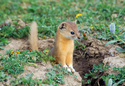
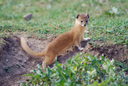
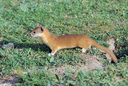
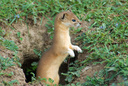
M. altaica generally resembles M. sibiricus but is smaller, with shorter fur, and a less luxuriant tail.
Males exhibit head and body length of 22 to 29 cm, with the tail adding 11 to 15 cm. Males can weigh from 217 to 350 g. Females measure 22 to 25 cm, with tails of 9 to 12 cm. They weigh from 122 to 220 g.
This species undergoes spring and autumn molts. The winter coat is dark yellowish to ruddy brown on the back, with pale yellow to creamy white on throat and belly. The upper head between the muzzle and ears is usually darker gray-brown. The tail may be more rufous than the back. the summer fur is gray to gray-brown with some light yellow. The lips of these weasles are white, and the chin has grayish-brown to whitish vibrissae.
Subspecies of M. altaica can be differentiated by fur color, which is generally a darker or lighter version of the colors described here. (Nowak, 1999; Stroganov, 1969)
- Other Physical Features
- endothermic
- bilateral symmetry
- Sexual Dimorphism
- male larger
-
- Range mass
- 122 to 350 g
- 4.30 to 12.33 oz
-
- Range length
- 217 to 287 mm
- 8.54 to 11.30 in
Reproduction
Although the mating system of M. altaica has not been described, other species of the genus are typically polygynous. Males are known to compete for access to females, and some of their fights can be severe. Based upon the large size dimorphism in M. altaica, it is reasonable to assume that the same mating system prevails. (Nowak, 1999)
- Mating System
- polygynous
According to observations in Kazakhstan, mating occurs in February or March. Young are seen at the beginning of May. Gestation lasts 30-49 days. The variablility reported for the length of gestation may be due to delayed implantation of fertilized eggs--a feature common in other members of the genus. Litters are 1-8 young. Lactation lasts 2 months, following which young begin to lead independent lives, but remain together with litter mates until fall.
Although the timing of reproductive maturity in this species has not been reported, it is likely that like other members of the genus, young are able to breed in the following season, when they are just under a year of age. (Novikov, 1962; Nowak, 1999)
- Key Reproductive Features
- iteroparous
- seasonal breeding
- gonochoric/gonochoristic/dioecious (sexes separate)
- sexual
- fertilization
- viviparous
- delayed implantation
-
- Breeding interval
- These animals breed once annually.
-
- Breeding season
- Breeding in Kazakhstan occurs in February or March.
-
- Range number of offspring
- 1 to 8
-
- Range gestation period
- 30 to 49 days
-
- Average weaning age
- 2 months
-
- Average time to independence
- 2 months
Mustelids are born helpless, with eyes closed and fur not well developed. These altricial young are carred for in a burrow by the mother.
In M. altaica, the mother provides sole parental care. She nurses the young for approximately two months, at which time the young become independent. (Novikov, 1962; Nowak, 1999)
- Parental Investment
- altricial
-
pre-hatching/birth
-
provisioning
- female
-
protecting
- female
-
provisioning
-
pre-weaning/fledging
-
provisioning
- female
-
protecting
- female
-
provisioning
Lifespan/Longevity
Longevity hs not been reported for this species, but for similarly sized members of the genus Mustela, there is very little variation in longevity. These animals live between 7 and 10 years. It is reasonable to assume a simlilar lifespan for M. altaica. (Nowak, 1999)
Behavior
Mountain weasels are chiefly nocturnal, but occasionally hunt during the day. They are very quick and agile, able to swim and climb as well as run. When faced with danger, these animals may make loud chirring sounds and eject a strong-smelling secretion from their anal glands.
Infomration on the sociality of this species is not available, but most members of the genus are relatively solitary, except for mating and for the continued assoication of littermates until the end of their first summer. (Novikov, 1962)
Home Range
The home range size for these animals is not known.
Communication and Perception
Communication has not been described for this species. However, as mustelids go, communication typically involves a variety of forms. Vocalizations are made when animals are threatened. Tactile communication occurs between rival males, between mates, and between a mother and her offspring. Chemical communication occurs in all of the stinky mustelids. There is probably also some visual communication, as these animals do have fairly good vision.
Food Habits
Voles and pikas form a major portion of the mountain weasel's carnivorious diet. These animals may also capture muskrats, ground squirrels, young rabbits, small birds, lizards (during summer months), and to a lesser extent frogs, fish, and insects. M. altaica has also been observed to eat juniper berries in some regions. Observations in capativity suggest daily requirements of flesh are 45-54 g (3-4 domestic mice) in an adult male, though it may kill considerably more in the wild. When rodents abound, these animals are thought to eat only the blood and brain. (Novikov, 1962)
- Primary Diet
-
carnivore
- eats terrestrial vertebrates
- sanguivore
- insectivore
- Animal Foods
- birds
- mammals
- amphibians
- reptiles
- eggs
- blood
- insects
- terrestrial non-insect arthropods
Predation
Predators for these animals have not been reported. Mustelids in general are very fierce, and might not be a good choice of prey for terrestrial mammalian predators, which could expect these weasles to put up a good fight. Primary predators are probably avian, such as owls and hawks.
Ecosystem Roles
As a predatory species, M. altaica probably plays an important role in regulating the populations of small mammals, such as mice and voles.
Economic Importance for Humans: Positive
Mountain weasles are considered beneficial in agricultural areas because they exterminate rodents which can be agricultural pests. Some trade of fur occurs, but pelts have low trade value and thus are of not much commercial importance. The fur is usually dyed. (Novikov, 1962; Nowak, 1999)
- Positive Impacts
- controls pest population
Economic Importance for Humans: Negative
This species may occasionally attack domestic fowl when found near human habitation. (Novikov, 1962)
- Negative Impacts
- crop pest
Conservation Status
With several known subspecies, and a very broad range, these animals are not currently a conservation concern.
-
- IUCN Red List
-
Near Threatened
More information
-
- IUCN Red List
-
Near Threatened
More information
-
- US Federal List
- No special status
-
- CITES
- No special status
Other Comments
Some populations of the mountain weasel are subject to extreme fluctuations, apparently depending on food conditions. Mass mortality may occur due to unknown diseases and fires. (Stroganov, 1969)
Contributors
Nancy Shefferly (editor), Animal Diversity Web.
Ellen Sherrill (author), Humboldt State University, Brian Arbogast (editor), Humboldt State University.
Glossary
- Palearctic
-
living in the northern part of the Old World. In otherwords, Europe and Asia and northern Africa.

- acoustic
-
uses sound to communicate
- agricultural
-
living in landscapes dominated by human agriculture.
- altricial
-
young are born in a relatively underdeveloped state; they are unable to feed or care for themselves or locomote independently for a period of time after birth/hatching. In birds, naked and helpless after hatching.
- bilateral symmetry
-
having body symmetry such that the animal can be divided in one plane into two mirror-image halves. Animals with bilateral symmetry have dorsal and ventral sides, as well as anterior and posterior ends. Synapomorphy of the Bilateria.
- carnivore
-
an animal that mainly eats meat
- chemical
-
uses smells or other chemicals to communicate
- crepuscular
-
active at dawn and dusk
- delayed implantation
-
in mammals, a condition in which a fertilized egg reaches the uterus but delays its implantation in the uterine lining, sometimes for several months.
- desert or dunes
-
in deserts low (less than 30 cm per year) and unpredictable rainfall results in landscapes dominated by plants and animals adapted to aridity. Vegetation is typically sparse, though spectacular blooms may occur following rain. Deserts can be cold or warm and daily temperates typically fluctuate. In dune areas vegetation is also sparse and conditions are dry. This is because sand does not hold water well so little is available to plants. In dunes near seas and oceans this is compounded by the influence of salt in the air and soil. Salt limits the ability of plants to take up water through their roots.
- endothermic
-
animals that use metabolically generated heat to regulate body temperature independently of ambient temperature. Endothermy is a synapomorphy of the Mammalia, although it may have arisen in a (now extinct) synapsid ancestor; the fossil record does not distinguish these possibilities. Convergent in birds.
- fertilization
-
union of egg and spermatozoan
- forest
-
forest biomes are dominated by trees, otherwise forest biomes can vary widely in amount of precipitation and seasonality.
- insectivore
-
An animal that eats mainly insects or spiders.
- internal fertilization
-
fertilization takes place within the female's body
- iteroparous
-
offspring are produced in more than one group (litters, clutches, etc.) and across multiple seasons (or other periods hospitable to reproduction). Iteroparous animals must, by definition, survive over multiple seasons (or periodic condition changes).
- motile
-
having the capacity to move from one place to another.
- mountains
-
This terrestrial biome includes summits of high mountains, either without vegetation or covered by low, tundra-like vegetation.
- native range
-
the area in which the animal is naturally found, the region in which it is endemic.
- nocturnal
-
active during the night
- polygynous
-
having more than one female as a mate at one time
- sanguivore
-
an animal that mainly eats blood
- seasonal breeding
-
breeding is confined to a particular season
- sedentary
-
remains in the same area
- sexual
-
reproduction that includes combining the genetic contribution of two individuals, a male and a female
- social
-
associates with others of its species; forms social groups.
- solitary
-
lives alone
- tactile
-
uses touch to communicate
- taiga
-
Coniferous or boreal forest, located in a band across northern North America, Europe, and Asia. This terrestrial biome also occurs at high elevations. Long, cold winters and short, wet summers. Few species of trees are present; these are primarily conifers that grow in dense stands with little undergrowth. Some deciduous trees also may be present.
- temperate
-
that region of the Earth between 23.5 degrees North and 60 degrees North (between the Tropic of Cancer and the Arctic Circle) and between 23.5 degrees South and 60 degrees South (between the Tropic of Capricorn and the Antarctic Circle).
- terrestrial
-
Living on the ground.
- tundra
-
A terrestrial biome with low, shrubby or mat-like vegetation found at extremely high latitudes or elevations, near the limit of plant growth. Soils usually subject to permafrost. Plant diversity is typically low and the growing season is short.
- visual
-
uses sight to communicate
- viviparous
-
reproduction in which fertilization and development take place within the female body and the developing embryo derives nourishment from the female.
References
Macdonald,, D. 1984. Encyclopedia of Mammals. New York, New York, USA: Facts On File, Inc.
Novikov, G. 1962. Carnivorous Mammals of the Fauna of the USSR. Jerusalem, Israel: IPST Press.
Nowak, R. 1999. Walker's Mammals of the World. Baltimore, Maryland, USA: Johns Hopkins University Press.
Stroganov, S. 1969. Carnivorous Mammals of Siberia. Jerusalem, Israel: IPST Press.