Muntiacus muntjakIndian muntjac
Geographic Range
Muntiacus muntjak can be found in southern and southeastern Asia, from Pakistan east through India and Nepal, across southeast Asia and southern China.
Habitat
Muntjac habitat includes rain forests, areas of dense vegetation, hilly country, and monsoon forests. They like to be close to a water source.
- Terrestrial Biomes
- savanna or grassland
- forest
- rainforest
- scrub forest
Physical Description
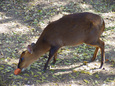
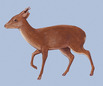
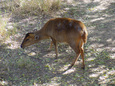
Muntiacus muntjak, also known as the Indian muntjac, have small antlers present in males which are relatively short with long burrs. The females have tufts of hair and small bony knobs that are in the location of the antlers in males. They have a short coat of hair. The coat can be thick and dense for those living in cooler climates, or thin and less dense for those living in warmer areas. The color of the coat is golden tan on the dorsal side, white on the ventral side, and the limbs and face are dark brown. The ears have very little hair. These deer also posses tusklike upper canines measuring about 1 inch long in males. Their body length ranges from 89-135 cm. Their shoulder height and the length of their tail ranges from 40-65 cm and 13-23 cm respectively. The males tend to be larger than the females.
- Other Physical Features
- endothermic
- homoiothermic
- bilateral symmetry
- Sexual Dimorphism
- male larger
-
- Range mass
- 14 to 35 kg
- 30.84 to 77.09 lb
-
- Range length
- 89 to 135 cm
- 35.04 to 53.15 in
Reproduction
In the first year of life, the female muntjac reaches sexual maturity. They are polyestrous with the estrous cycle lasting 14-21 days and the estrus lasting about 2 days. Breeding is not restricted to a specific time of the year. They usually bear just one young at a time. The gestation period is around 180 days and the weight at birth is between 550 and 650 g.
- Key Reproductive Features
- gonochoric/gonochoristic/dioecious (sexes separate)
- sexual
Lifespan/Longevity
-
- Average lifespan
Status: captivity - 17.6 years
- Max Planck Institute for Demographic Research
- Average lifespan
-
- Average lifespan
Status: captivity - 17.0 years
- Max Planck Institute for Demographic Research
- Average lifespan
Behavior
The common name of this Muntjac is the barking deer. When they sense the presence of a predator, they emit sounds that sound like a dog barking. They may bark for more than an hour to make a predator show itself or leave the area. The muntjac may bark more frequently when its ability to see its surroundings is reduced as a result of the evironment. The adult male and female muntjacs are solitary. During the rut their home ranges overlap for a short period. The young leaves the mothers territory when it is just about six months old, after which it must fight for its own territory. Sometimes the adult muntjac allows another indiviual in its territory. However, the other animal must be a male without complete antlers. These males are not aggressive nor are they ready to mate. They also display both diurnal and nocturnal activity.
Communication and Perception
Food Habits
Muntjacs are omnivorous, feeding on herbs, fruit, birds' eggs, small animals, sprouts, seeds, and grasses. They use their canines to bite and their forelegs to deliver strong blows in order to catch small warm-blooded animals.
Economic Importance for Humans: Positive
Hunters of pheasants in India can rely on the barking noises made by the muntjac as a warning signal of an approaching predator. This could be a leopard or tiger which in turn can pose a threat to the hunters themselves. The muntjac itself can be hunted for its meat and skins.
Economic Importance for Humans: Negative
In some areas, where the population is large, they destroy a large number of trees by tearing off the bark. This in turn can lead to a loss of food sources as well as a loss of wood that can be used to provide shelter.
Conservation Status
A study done in 1987 showed that there are 140,000-150,000 Muntiacus muntjak in China. They have been introduced in Texas, the Andaman Islands, and on Lombok. Muntjaks also thrive very well in zoos. The IUCN rates the species Lower Risk, Least Concern.
-
- IUCN Red List
-
Least Concern
More information
-
- IUCN Red List
-
Least Concern
More information
-
- US Federal List
- No special status
-
- CITES
- No special status
Other Comments
The Indian muntjac falls into the subgroup of the deer family that have plesiometacarpals. In this group the only the upper parts of the second and fifth digit metacarpals are present in the foreleg. Some of their predators include pythons, jackals, tigers, leopards, and crocodiles.
Contributors
Adria Jackson (author), University of Michigan-Ann Arbor, Phil Myers (editor), Museum of Zoology, University of Michigan-Ann Arbor.
Glossary
- bilateral symmetry
-
having body symmetry such that the animal can be divided in one plane into two mirror-image halves. Animals with bilateral symmetry have dorsal and ventral sides, as well as anterior and posterior ends. Synapomorphy of the Bilateria.
- chemical
-
uses smells or other chemicals to communicate
- endothermic
-
animals that use metabolically generated heat to regulate body temperature independently of ambient temperature. Endothermy is a synapomorphy of the Mammalia, although it may have arisen in a (now extinct) synapsid ancestor; the fossil record does not distinguish these possibilities. Convergent in birds.
- forest
-
forest biomes are dominated by trees, otherwise forest biomes can vary widely in amount of precipitation and seasonality.
- motile
-
having the capacity to move from one place to another.
- native range
-
the area in which the animal is naturally found, the region in which it is endemic.
- oriental
-
found in the oriental region of the world. In other words, India and southeast Asia.

- rainforest
-
rainforests, both temperate and tropical, are dominated by trees often forming a closed canopy with little light reaching the ground. Epiphytes and climbing plants are also abundant. Precipitation is typically not limiting, but may be somewhat seasonal.
- scrub forest
-
scrub forests develop in areas that experience dry seasons.
- sexual
-
reproduction that includes combining the genetic contribution of two individuals, a male and a female
- solitary
-
lives alone
- tactile
-
uses touch to communicate
- tropical savanna and grassland
-
A terrestrial biome. Savannas are grasslands with scattered individual trees that do not form a closed canopy. Extensive savannas are found in parts of subtropical and tropical Africa and South America, and in Australia.
- savanna
-
A grassland with scattered trees or scattered clumps of trees, a type of community intermediate between grassland and forest. See also Tropical savanna and grassland biome.
- temperate grassland
-
A terrestrial biome found in temperate latitudes (>23.5° N or S latitude). Vegetation is made up mostly of grasses, the height and species diversity of which depend largely on the amount of moisture available. Fire and grazing are important in the long-term maintenance of grasslands.
References
Grzimek, D., D. Badrian, D. Herre, R. Hess, M. Jones. 1990. Grzimek's Enclopedia of Mammals (vol.5). New York, St. Louis, San Francisco: McGraw-Hill Publishing Company.
Walker, E., R. Nowak. 1999. Walker's Mammals of the World. Baltimore and London: The Johns Hopkins University Press.